Buddhism, also known as Buddhadharma and Dharmavinaya (transl. "doctrines and disciplines"), is an Indian religion and philosophy based on teachings attributed to the Buddha, a śramaṇa (wandering ascetic) and religious teacher who lived in the 6th or 5th century BCE. It is the world's fourth-largest religion, with an estimated 320 million to 540 million followers, representing approximately 4.1%–6.7% of the global population. It originated in the eastern Gangetic plain as a śramaṇa movement in the 5th century BCE, and gradually spread throughout much of Asia via the Silk Road. Buddhism has since played a significant role in Asian culture and spirituality, eventually spreading to the West in the 19th century.
According to tradition, the Buddha taught a path of cultivation that leads to awakening and liberation from dukkha (often translated as 'suffering'; 'unsatisfactoriness') by attaining nirvana, the 'blowing out' (extinguishing) of the passions. He regarded this path as a Middle Way between extreme asceticism and sensory indulgence, and also between the extremes of eternalism and nihilism. Teaching that dukkha arises alongside attachment or clinging, the Buddha advised meditation practices and ethical precepts rooted in non-harming. Widely observed teachings include the Four Noble Truths, the Noble Eightfold Path, and the doctrines of dependent origination, karma, and the three marks of existence. Other commonly observed elements include the Triple Gem, the taking of monastic vows, and the cultivation of perfections (pāramitā).
The Buddhist canon is vast, with philosophical traditions and textual collections in different languages (such as Sanskrit, Pali, Tibetan, and Chinese). Buddhist schools vary in their interpretation of the paths to liberation (mārga, "path") as well as the relative importance assigned to various Buddhist texts, and their specific teachings and practices. Two major extant branches of Buddhism are generally recognised by scholars: Theravāda (lit. 'School of the Elders') and Mahāyāna (lit. 'Great Vehicle'). The Theravada tradition emphasises the attainment of nirvāṇa (lit. 'extinguishing') as a means of transcending the individual self and ending the cycle of death and rebirth (saṃsāra), while the Mahayana tradition emphasises the Bodhisattva ideal, in which one works for the liberation of all sentient beings. Additionally, Vajrayāna (lit. 'Indestructible Vehicle'), a body of teachings incorporating esoteric tantric techniques, may be viewed as a separate branch or as a tradition within Mahāyāna.
The Mahāyāna branch, which includes the traditions of Tiantai, Chan, Pure Land, Zen, Nichiren and Tendai, is the largest branch of Buddhism, being predominantly practised in Nepal, Bhutan, China, Malaysia, Vietnam, Taiwan, Korea, and Japan. The second-largest branch, Theravada, is followed mainly in Myanmar, Thailand, Laos, Cambodia, and Sri Lanka. Tibetan Buddhism, a form of Vajrayāna, is practised in the Himalayan states as well as in Mongolia and Russian Kalmykia and Tuva. Japanese Shingon also preserves the Vajrayana tradition as transmitted to China. Historically, until the early 2nd millennium, Buddhism was widely practised in the Indian subcontinent before declining there; it also had a foothold to some extent elsewhere in Asia, namely Afghanistan, Turkmenistan, Uzbekistan, and Tajikistan.
Summary from Wikipedia (CC BY-SA 4.0)
01Etymology
The terms Buddhadharma and Bauddhadharma come from Sanskrit: बुद्ध धर्म and बौद्ध धर्म respectively ("doctrine of the Enlightened One" and "doctrine of Buddhists"). The term Dharmavinaya comes from Sanskrit: धर्मविनय, literally meaning "doctrines [and] disciplines".
The Buddha ("the Awakened One") was a Śramaṇa who lived in South Asia c. 6th or 5th century BCE. Followers of Buddhism, called Buddhists in English, referred to themselves as Sakyan-s or Sakyabhiksu in ancient India. Buddhist scholar Donald S. Lopez asserts they also used the term Bauddha, although the scholar Richard Cohen asserts that that term was used only by outsiders to describe Buddhists.
02The Buddha

Details of the Buddha's life are mentioned in many Early Buddhist Texts, but these accounts are inconsistent. His social background and life details are difficult to substantiate, and the precise dates are uncertain, although the 5th century BCE seems to be the best estimate.
Early texts have the Buddha's family name as "Gautama" (Pali: Gotama), while some texts present Siddhartha as his surname. He was born in Lumbini, (present-day Nepal) and grew up in Kapilavastu, a town in the Ganges Plain, near the modern Nepal–India border, and he spent his life in what is now modern Bihar and Uttar Pradesh. Some hagiographic legends state that his father was a king named Suddhodana and his mother was Queen Maya. Scholars such as Richard Gombrich consider this claim dubious because a combination of evidence suggests he was born in the Shakya community, which was governed by a small oligarchy or republic-like council where there were no ranks but where seniority mattered instead. Some stories about the Buddha, his life, his teachings, and claims about the society he grew up in may have been invented and interpolated at a later time into the Buddhist texts.
Various aspects of the Buddha's background are contested in modern scholarship. For instance, Buddhist texts assert that the Buddha described himself as a kshatriya (warrior class), but Gombrich writes that little is known about his father and there is no proof that his father even knew the term kshatriya. (Mahavira, whose teachings helped establish Jainism, is also claimed by his early followers to have been a kshatriya.)
According to early texts such as the Pali Ariyapariyesanā-sutta ("The discourse on the noble quest", MN 26) and its Chinese parallel at MĀ 204, Gautama was moved by the suffering (dukkha) of life and death, and its endless repetition due to rebirth. He therefore set out on a quest to find liberation from suffering (also known as "nirvana"). Early texts and biographies state that Gautama first studied under two meditation teachers, Āḷāra Kālāma (Sanskrit: Arada Kalama) and Uddaka Ramaputta (Sanskrit: Udraka Ramaputra), learning meditation and philosophy, particularly the meditative attainment of "the sphere of nothingness" from the former and "the sphere of neither perception nor non-perception" from the latter.
Finding these teachings insufficient to attain his goal, he turned to the practice of severe asceticism, which included a strict fasting regime and various forms of breath control. This too did not lead to his goal, and he then turned to the meditative practice of dhyana. He sat in meditation under a Ficus religiosa tree now called the Bodhi Tree – in the town of Bodh Gaya and attained "Awakening" (Bodhi).
According to various early texts, such as the Mahāsaccaka-sutta, and the Samaññaphala Sutta, upon awakening the Buddha gained insight into the workings of karma and his former lives, as well as achieving the ending of the mental defilements (asavas), the ending of suffering, and the end of rebirth in saṃsāra. This event also confirmed for him the Middle Way as the correct path of spiritual practice to end suffering. As an awakened Buddha, he attracted followers and founded a Sangha (monastic order). He spent the rest of his life teaching the Dharma he had discovered, and then died, achieving "final nirvana", at the age of 80 in Kushinagar, India.
The Buddha's teachings were propagated by his followers. In the last centuries of the 1st millennium BCE, these teachings developed into various Buddhist schools of thought, each with its own collection of texts containing different interpretations and of the Buddha's authentic teachings. Over time, these evolved into many traditions, of which the more well-known and widespread in the modern era are Theravada, Mahayana and Vajrayana Buddhism.
03Worldview

The term "Buddhism" is an occidental neologism, commonly (and "rather roughly" according to Donald S. Lopez Jr.) used as a translation for the Dharma of the Buddha, fójiào in Chinese, bukkyō in Japanese, nang pa sangs rgyas pa'i chos in Tibetan, buddhadharma in Sanskrit, buddhaśāsana in Pali.
The Four Noble Truths, or the truths of the Noble Ones, express the basic orientation of Buddhism: everything is impermanent, yet we crave and cling to impermanent states and things, which is dukkha, "incapable of satisfying" and painful. This keeps us caught in saṃsāra, metaphysically interpreted as the endless cycle of repeated rebirth, dukkha and dying again, also interpreted as a psychological cycle of repetitious rebirth of the ego.
But there is a way to liberation from this endless cycle to the state of nirvana, namely following the Noble Eightfold Path.
The truth of dukkha is the basic insight that life in this mundane world, with its clinging and craving to impermanent states and things is dukkha, and unsatisfactory. Dukkha can be translated as "incapable of satisfying", "the unsatisfactory nature and the general insecurity of all conditioned phenomena"; or "painful". Dukkha is most commonly translated as "suffering", but this is inaccurate, since it refers not to episodic suffering, but to the intrinsically unsatisfactory nature of temporary states and things, including pleasant but temporary experiences. We expect happiness from states and things which are impermanent, and therefore cannot attain real happiness.
The Four Noble Truths are:
dukkha ("not being at ease", "suffering", "pain") is an innate characteristic of the perpetual cycle (samsara, lit. 'wandering') of grasping at things, ideas and habits
samudaya (origin, arising, combination; "cause"): dukkha is caused by, or arises with, taṇhā ("craving," "desire" or "attachment," literally "thirst")
nirodha (cessation, ending, confinement): dukkha can be ended or contained by the confinement or letting go of taṇhā
marga (path, "way leading to the ending of pain") is the path leading to the confinement of taṇhā and dukkha, classically the Noble Eightfold Path but also summarised in other paths to liberation
Buddhism teaches that the idea that anything is permanent or that there is self in any being is ignorance or misperception (avijjā), and that this is the primary source of clinging and dukkha.
Ignorance is countered by insight (paññā); most schools of Buddhism, therefore, teach three marks of existence, which fundamentally characterise all phenomena:
Anicca: impermanence
Dukkha: unsatisfactoriness
Anattā: non-self; living things have no permanent immanent soul or essence
Some schools describe four characteristics or "four seals of the Dharma", adding to the above
Nirvana is peaceful/peace (śānta/śānti)
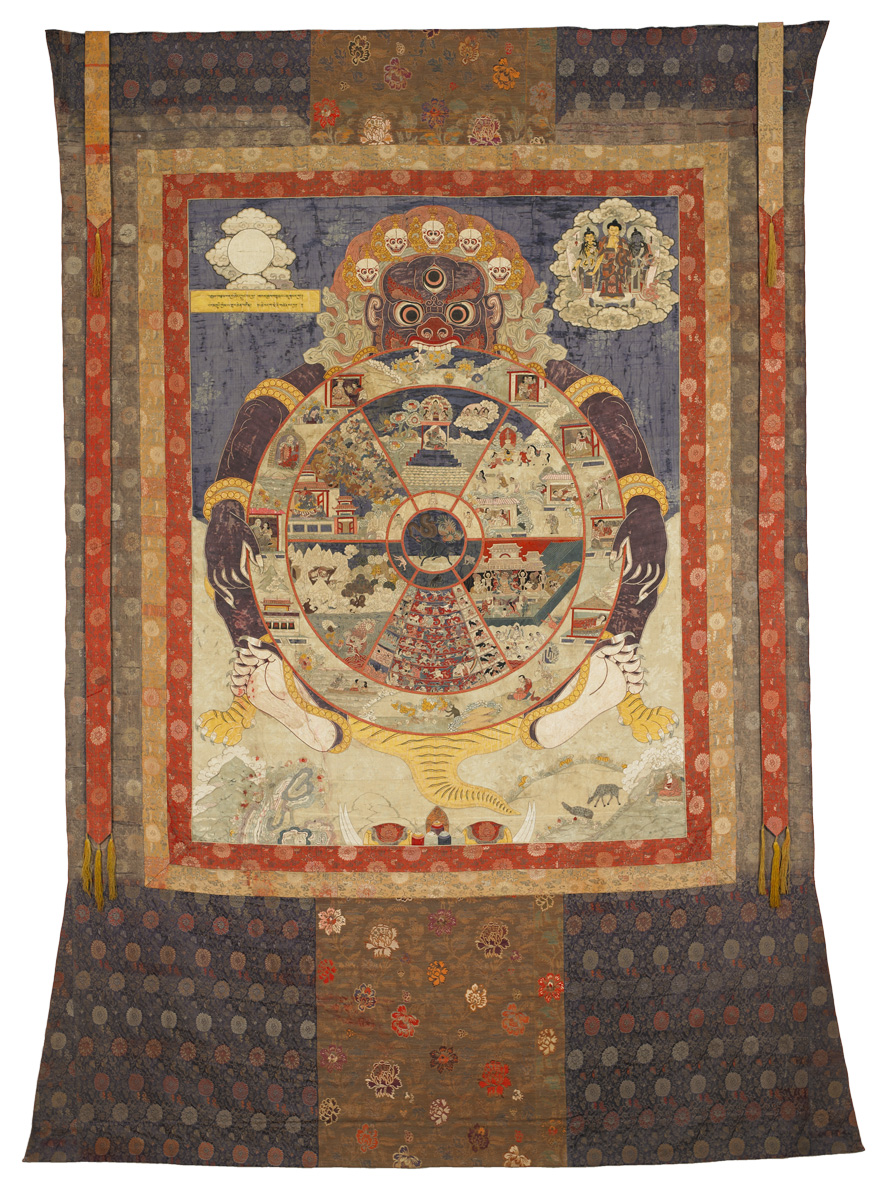
Saṃsāra means "wandering" or "world", with the connotation of cyclic, circuitous change. It refers to the theory of rebirth and "cyclicality of all life, matter, existence", a fundamental assumption of Buddhism, as with all major Indian religions. Samsara in Buddhism is considered to be dukkha, unsatisfactory and painful, perpetuated by desire and avidya (ignorance), and the resulting karma. Liberation from this cycle of existence, nirvana, has been the foundation and the most important historical justification of Buddhism.
Buddhist texts assert that rebirth can occur in six realms of existence, namely three good realms (heavenly, demi-god, human) and three evil realms (animal, hungry ghosts, hellish). Samsara ends if a person attains nirvana, the "blowing out" of the afflictions through insight into impermanence and "non-self".
Rebirth refers to a process whereby beings go through a succession of lifetimes as one of many possible forms of sentient life, each running from conception to death. In Buddhist thought, this rebirth does not involve a soul or any fixed substance. This is because the Buddhist doctrine of anattā (Sanskrit: anātman, no-self doctrine) rejects the concepts of a permanent self or an unchanging, eternal soul found in other religions.
The Buddhist traditions have traditionally disagreed on what it is in a person that is reborn, as well as how quickly the rebirth occurs after death. Some Buddhist traditions assert that "no self" doctrine means that there is no enduring self, but there is avacya (inexpressible) personality (pudgala) which migrates from one life to another. The majority of Buddhist traditions, in contrast, assert that vijñāna (a person's consciousness) though evolving, exists as a continuum and is the mechanistic basis of what undergoes the rebirth process. The quality of one's rebirth depends on the merit or demerit gained by one's karma (i.e., actions), as well as that accrued on one's behalf by a family member. Buddhism also developed a complex cosmology to explain the various realms or planes of rebirth.
In Buddhism, karma (from Sanskrit: "action, work") drives saṃsāra—the endless cycle of suffering and rebirth for each being. Good, skilful deeds (Pāli: kusala) and bad, unskilful deeds (Pāli: akusala) produce "seeds" in the unconscious receptacle (ālaya) that mature later either in this life or in a subsequent rebirth. The existence of karma is a core belief in Buddhism, as with all major Indian religions, and it implies neither fatalism nor that everything that happens to a person is caused by karma. (Diseases and suffering induced by the disruptive actions of other people are examples of non-karma suffering.)
A central aspect of Buddhist theory of karma is that intent (cetanā) matters and is essential to bring about a consequence or phala "fruit" or vipāka "result". The emphasis on intent in Buddhism marks a difference from the karmic theory of Jainism, where karma accumulates with or without intent. The emphasis on intent is also found in Hinduism, and Buddhism may have influenced karma theories of Hinduism.
In Buddhism, good or bad karma accumulates even if there is no physical action, and just having ill or good thoughts creates karmic seeds; thus, actions of body, speech or mind all lead to karmic seeds. In the Buddhist traditions, life aspects affected by the law of karma in past and current births of a being include the form of rebirth, realm of rebirth, social class, character and major circumstances of a lifetime. According to the theory, it operates like the laws of physics, without external intervention, on every being in all six realms of existence including human beings and gods.
A notable aspect of the karma theory in modern Buddhism is merit transfer. A person accumulates merit not only through intentions and ethical living, but also is able to gain merit from others by exchanging goods and services, such as through dāna (charity to monks or nuns). The theory also states a person can transfer one's own good karma to living family members and ancestors.
This Buddhist idea may have roots in the quid-pro-quo exchange beliefs of the Hindu Vedic rituals. The "karma merit transfer" concept has been controversial, not accepted in later Jainism and Hinduism traditions, unlike Buddhism where it was adopted in ancient times and remains a common practice. According to Bruce Reichenbach, the "merit transfer" idea was generally absent in early Buddhism and may have emerged with the rise of Mahayana Buddhism; he adds that while major Hindu schools such as Yoga, Advaita Vedanta and others do not believe in merit transfer, some bhakti Hindu traditions later adopted the idea just like Buddhism.
The cessation of the kleshas and the attainment of nirvana (nibbāna), with which the cycle of rebirth ends, has been the primary and the soteriological goal of the Buddhist path for monastic life since the time of the Buddha. The term "path" is usually taken to mean the Noble Eightfold Path, but other versions of "the path" can also be found in the Nikayas. In some passages in the Pali Canon, a distinction is being made between right knowledge or insight (sammā-ñāṇa), and right liberation or release (sammā-vimutti), as the means to attain cessation and liberation.
Nirvana literally means "blowing out, quenching, becoming extinguished". In early Buddhist texts, it is the state of restraint and self-control that leads to the "blowing out" and the ending of the cycles of sufferings associated with rebirths and redeaths. Many later Buddhist texts describe nirvana as identical with anatta with complete "emptiness, nothingness". In some texts, the state is described with greater detail, such as passing through the gate of emptiness (sunyata)—realising that there is no soul or self in any living being, then passing through the gate of signlessness (animitta)—realising that nirvana cannot be perceived, and finally passing through the gate of wishlessness (apranihita)—realising that nirvana is the state of not even wishing for nirvana.
The nirvana state has been described in Buddhist texts partly in a manner similar to other Indian religions, as the state of complete liberation, enlightenment, highest happiness, bliss, fearlessness, freedom, permanence, non-dependent origination, unfathomable, and indescribable. It has also been described in part differently, as a state of spiritual release marked by "emptiness" and realisation of non-self.
While Buddhism considers the liberation from saṃsāra as the ultimate spiritual goal, in traditional practice, the primary focus of a vast majority of lay Buddhists has been to seek and accumulate merit through good deeds, donations to monks and various Buddhist rituals in order to gain better rebirths rather than nirvana.
Pratityasamutpada, also called "dependent arising, or dependent origination", is the Buddhist theory to explain the nature and relations of being, becoming, existence and ultimate reality. Buddhism asserts that there is nothing independent, except the state of nirvana. All physical and mental states depend on and arise from other pre-existing states, and in turn from them arise other dependent states while they cease.
The 'dependent arisings' have a causal conditioning, and thus Pratityasamutpada is the Buddhist belief that causality is the basis of ontology, not a creator God nor the ontological Vedic concept called universal Self (Brahman) nor any other 'transcendent creative principle'. However, Buddhist thought does not understand causality in terms of Newtonian mechanics; rather it understands it as conditioned arising. In Buddhism, dependent arising refers to conditions created by a plurality of causes that necessarily co-originate a phenomenon within and across lifetimes, such as karma in one life creating conditions that lead to rebirth in one of the realms of existence for another lifetime.
Buddhism applies the theory of dependent arising to explain origination of endless cycles of dukkha and rebirth, through Twelve Nidānas or "twelve links". It states that because Avidyā (ignorance) exists, Saṃskāras (karmic formations) exist; because Saṃskāras exist therefore Vijñāna (consciousness) exists; and in a similar manner it links Nāmarūpa (the sentient body), Ṣaḍāyatana (our six senses), Sparśa (sensory stimulation), Vedanā (feeling), Taṇhā (craving), Upādāna (grasping), Bhava (becoming), Jāti (birth), and Jarāmaraṇa (old age, death, sorrow, and pain). By breaking the circuitous links of the Twelve Nidanas, Buddhism asserts that liberation from these endless cycles of rebirth and dukkha can be attained.
A related doctrine in Buddhism is that of anattā (Pali) or anātman (Sanskrit). It is the view that there is no unchanging, permanent self, soul or essence in phenomena. The Buddha and Buddhist philosophers who follow him such as Vasubandhu and Buddhaghosa, generally argue for this view by analysing the person through the schema of the five aggregates, and then attempting to show that none of these five components of personality can be permanent or absolute.
04Paths to liberation

The Bodhipakkhiyādhammā are seven lists of qualities or factors that promote spiritual awakening (bodhi). Each list is a short summary of the Buddhist path, and the seven lists substantially overlap. The best-known list in the West is the Noble Eightfold Path, but a wide variety of paths and models of progress have been used and described in the different Buddhist traditions. However, they generally share basic practices such as sila (ethics), samadhi (meditation, dhyana) and prajña (wisdom), which are known as the three trainings. An important additional practice is a kind and compassionate attitude toward every living being and the world. Devotion is also important in some Buddhist traditions, and in the Tibetan traditions visualisations of deities and mandalas are important. The value of textual study is regarded differently in the various Buddhist traditions. It is central to Theravada and highly important to Tibetan Buddhism, while the Zen tradition takes an ambiguous stance.
An important guiding principle of Buddhist practice is the Middle Way (madhyamapratipad). It was a part of Buddha's first sermon, where he presented the Noble Eightfold Path that was a 'middle way' between the extremes of asceticism and hedonistic sense pleasures. In Buddhism, states Harvey, the doctrine of "dependent arising" (conditioned arising, pratītyasamutpāda) to explain rebirth is viewed as the 'middle way' between the doctrines that a being has a "permanent soul" involved in rebirth (eternalism) and "death is final and there is no rebirth" (annihilationism).
A common presentation style of the path (mārga) to liberation in the Early Buddhist Texts is the "graduated talk", in which the Buddha lays out a step-by-step training.
In the early texts, numerous different sequences of the gradual path can be found. One of the most important and widely used presentations among the various Buddhist schools is The Noble Eightfold Path, or "Eightfold Path of the Noble Ones" (Skt. 'āryāṣṭāṅgamārga'). This can be found in various discourses, most famously in the Dhammacakkappavattana Sutta (The discourse on the turning of the Dharma wheel).
Other suttas such as the Tevijja Sutta, and the Cula-Hatthipadopama-sutta give a different outline of the path, though with many similar elements such as ethics and meditation.
According to Rupert Gethin, the path to awakening is also frequently summarised by another a short formula: "abandoning the hindrances, practice of the four establishings of mindfulness, and development of the awakening factors".
The Eightfold Path consists of a set of eight interconnected factors or conditions, that when developed together, lead to the cessation of dukkha. These eight factors are: Right View (or Right Understanding), Right Intention (or Right Thought), Right Speech, Right Action, Right Livelihood, Right Effort, Right Mindfulness, and Right Concentration.
This Eightfold Path is the fourth of the Four Noble Truths and asserts the path to the cessation of dukkha (suffering, pain, unsatisfactoriness). The path teaches that the way of the enlightened ones stopped their craving, clinging and karmic accumulations, and thus ended their endless cycles of rebirth and suffering.
The Noble Eightfold Path is grouped into three basic divisions, as follows:
05Common practices
In various suttas which present the graduated path taught by the Buddha, such as the Samaññaphala Sutta and the Cula-Hatthipadopama Sutta, the first step on the path is hearing the Buddha teach the Dharma. This then said to lead to the acquiring of confidence or faith in the Buddha's teachings.
Mahayana Buddhist teachers such as Yin Shun also state that hearing the Dharma and study of the Buddhist discourses is necessary "if one wants to learn and practice the Buddha Dharma." Likewise, in Indo-Tibetan Buddhism, the "Stages of the Path" (Lamrim) texts generally place the activity of listening to the Buddhist teachings as an important early practice.
Traditionally, the first step in most Buddhist schools requires taking of the "Three Refuges", also called the Three Jewels (Sanskrit: triratna, Pali: tiratana) as the foundation of one's religious practice. This practice may have been influenced by the Brahmanical motif of the triple refuge, found in the Rigveda 9.97.47, Rigveda 6.46.9 and Chandogya Upanishad 2.22.3–4. Tibetan Buddhism sometimes adds a fourth refuge, in the lama. The three refuges are believed by Buddhists to be protective and a form of reverence.
The ancient formula which is repeated for taking refuge affirms that "I go to the Buddha as refuge, I go to the Dhamma as refuge, I go to the Sangha as refuge." Reciting the three refuges, according to Harvey, is considered not as a place to hide, rather a thought that "purifies, uplifts and strengthens the heart".
Most forms of Buddhism consider saddhā (Sanskrit: śraddhā, 'trustful confidence' or 'faith'), as a key quality on the path that prepares one for meditative insights. Furthermore, the related quality of devotion (Sanskrit: bhakti; Pali: bhatti) is an important part of the path of most Buddhists, since it supports wholesome qualities like faith and peace of mind. Buddhist devotional and liturgical practices encompass a wide range of forms oriented toward honoring the Buddha, cultivating wholesome mental states, and structuring communal religious life. Buddhist devotional practices include Buddhist liturgy, ritual worship (pūjā), pilgrimage, prostrations, along with Buddhist music and chanting.
As in Hinduism, pūjās typically involves offerings of flowers, incense, lamps, food, or water on a Buddhist altar along with certain recitations and physical acts like bowing. Such rites are understood to generate merit, cultivate wholesome states of mind (such as a state of refuge) and support contemplation. In formal temple settings, worship often follows complex liturgies, including the taking of refuge, precepts and vows, whereas more informal contexts may integrate simpler forms of homage and recitation. Buddhist devotional practices are usually focused on some object, image or location that is seen as holy or spiritually influential. Examples of objects of devotion (known as honzon in Japanese) include paintings or statues of Buddhas and bodhisattvas, stupas, sacred texts, and bodhi trees.
Chanting practices constitute a major component of Buddhist devotion common to all Buddhist traditions going back to ancient India where chanting aided in the memorisation of orally transmitted teachings. A common practice is to chant or recite Buddhist sutras. Other chants are shorter formulas, mantras or dharanis. Among the most popular chants in Buddhism are those associated with recollection of the Buddha and refuge. In East Asian Buddhism this includes the widely popular nianfo formula which is devoted to Amitābha Buddha and is central to Pure Land Buddhism. In Himalayan Buddhism, the Mani mantra is a similarly popular chant among lay and ordained Buddhists alike. A common method of chanting is to use rosaries called malas to count repetitions. Buddhist chanting can thus be a group or private devotional practice which leads to tranquility, faith, accumulation of merit (which can then be transferred on behalf of others), and memorization of the teachings. In Mahayana traditions, especially in the Pure Land schools, chanting practice can also be seen as a way to stimulate or receive the blessings and spiritual power (also known as other-power) of the Buddhas and bodhisattvas.
Śīla (Sanskrit) or sīla (Pāli) is the concept of "moral virtues", that is the second group and an integral part of the Noble Eightfold Path. It generally consists of right speech, right action and right livelihood.
One of the most basic forms of ethics in Buddhism is the taking of "precepts". This includes the Five Precepts for laypeople, Eight or Ten Precepts for monastic life, as well as rules of Dhamma (Vinaya or Patimokkha) adopted by a monastery.
Other important elements of Buddhist ethics include giving or charity (dāna), Mettā (Good-Will), Heedfulness (Appamada), 'self-respect' (Hri) and 'regard for consequences' (Apatrapya).
Buddhist scriptures explain the five precepts (Pali: pañcasīla; Sanskrit: pañcaśīla) as the minimal standard of Buddhist morality. It is the most important system of morality in Buddhism, together with the monastic rules.
The five precepts are seen as a basic training applicable to all Buddhists. They are:
"I undertake the training-precept (sikkha-padam) to abstain from onslaught on breathing beings." This includes ordering or causing someone else to kill. The Pali suttas also say one should not "approve of others killing" and that one should be "scrupulous, compassionate, trembling for the welfare of all living beings".
"I undertake the training-precept to abstain from taking what is not given." According to Harvey, this also covers fraud, cheating, forgery as well as "falsely denying that one is in debt to someone".
"I undertake the training-precept to abstain from misconduct concerning sense-pleasures." This generally refers to adultery, as well as rape and incest. It also applies to sex with those who are legally under the protection of a guardian. It is also interpreted in different ways in the varying Buddhist cultures.
"I undertake the training-precept to abstain from false speech." According to Harvey this includes "any form of lying, deception or exaggeration...even non-verbal deception by gesture or other indication...or misleading statements." The precept is often also seen as including other forms of wrong speech such as "divisive speech, harsh, abusive, angry words, and even idle chatter".
"I undertake the training-precept to abstain from alcoholic drink or drugs that are an opportunity for heedlessness." According to Harvey, intoxication is seen as a way to mask rather than face the sufferings of life. It is seen as damaging to one's mental clarity, mindfulness and ability to keep the other four precepts.
Undertaking and upholding the five precepts is based on the principle of non-harming (Pāli and Sanskrit: ahiṃsa). The Pali Canon recommends one to compare oneself with others, and on the basis of that, not to hurt others. Compassion and a belief in karmic retribution form the foundation of the precepts. Undertaking the five precepts is part of regular lay devotional practice, both at home and at the local temple. However, the extent to which people keep them differs per region and time. They are sometimes referred to as the śrāvakayāna precepts in the Mahāyāna tradition, contrasting them with the bodhisattva precepts.
Vinaya is the specific code of conduct for a sangha of monks or nuns. It includes the Patimokkha, a set of 227 offences including 75 rules of decorum for monks, along with penalties for transgression, in the Theravadin tradition. The precise content of the Vinaya Pitaka (scriptures on the Vinaya) differs in different schools and tradition, and different monasteries set their own standards on its implementation. The list of pattimokkha is recited every fortnight in a ritual gathering of all monks. Buddhist text with vinaya rules for monasteries have been traced in all Buddhist traditions, with the oldest surviving being the ancient Chinese translations.
Monastic communities in the Buddhist tradition cut normal social ties to family and community and live as "islands unto themselves". Within a monastic fraternity, a sangha has its own rules. A monk abides by these institutionalised rules, and living life as the vinaya prescribes it is not merely a means, but very nearly the end in itself. Transgressions by a monk on Sangha vinaya rules invites enforcement, which can include temporary or permanent expulsion.
Another important practice taught by the Buddha is the restraint of the senses (indriyasamvara). In the various graduated paths, this is usually presented as a practice which is taught prior to formal sitting meditation, and which supports meditation by weakening sense desires that are a hindrance to meditation. According to Anālayo, sense restraint is when one "guards the sense doors in order to prevent sense impressions from leading to desires and discontent". This is not an avoidance of sense impression, but a kind of mindful attention towards the sense impressions which does not dwell on their main features or signs (nimitta). This is said to prevent harmful influences from entering the mind. This practice is said to give rise to an inner peace and happiness which forms a basis for concentration and insight.
A related Buddhist virtue and practice is renunciation, or the intent for desirelessness (nekkhamma). Generally, renunciation is the giving up of actions and desires that are seen as unwholesome on the path, such as lust for sensuality and worldly things. Renunciation can be cultivated in different ways. The practice of giving for example, is one form of cultivating renunciation. Another one is the giving up of lay life and becoming a monastic (bhiksu or bhiksuni). Practising celibacy (whether for life as a monk, or temporarily) is also a form of renunciation. Many Jataka stories focus on how the Buddha practised renunciation in past lives.
One way of cultivating renunciation taught by the Buddha is the contemplation (anupassana) of the "dangers" (or "negative consequences") of sensual pleasure (kāmānaṃ ādīnava). As part of the graduated discourse, this contemplation is taught after the practice of giving and morality.
Another related practice to renunciation and sense restraint taught by the Buddha is "restraint in eating" or moderation with food, which for monks generally means not eating after noon. Devout laypersons also follow this rule during special days of religious observance (uposatha).
The training of the faculty called "mindfulness" (Pali: sati, Sanskrit: smṛti, literally meaning "recollection, remembering") is central in Buddhism. According to Analayo, mindfulness is a full awareness of the present moment which enhances and strengthens memory. The Indian Buddhist philosopher Asanga defined mindfulness thus: "It is non-forgetting by the mind with regard to the object experienced. Its function is non-distraction." According to Rupert Gethin, sati is also "an awareness of things in relation to things, and hence an awareness of their relative value".
There are different practices and exercises for training mindfulness in the early discourses, such as the four Satipaṭṭhānas (Sanskrit: smṛtyupasthāna, "establishments of mindfulness") and Ānāpānasati (Sanskrit: ānāpānasmṛti, "mindfulness of breathing").
A closely related mental faculty, which is often mentioned side by side with mindfulness, is sampajañña ("clear comprehension"). This faculty is the ability to comprehend what one is doing and is happening in the mind, and whether it is being influenced by unwholesome states or wholesome ones.
A wide range of meditation practices has developed in the Buddhist traditions, but "meditation" primarily refers to the attainment of samādhi and the practice of dhyāna (Pali: jhāna). Samādhi is a calm, undistracted, unified and concentrated state of awareness. It is defined by Asanga as "one-pointedness of mind on the object to be investigated.
06Texts

Buddhism, like all Indian religions, was initially an oral tradition in ancient times. The Buddha's words, the early doctrines, concepts, and their traditional interpretations were orally transmitted from one generation to the next. The earliest oral texts were transmitted in Middle Indo-Aryan languages called Prakrits, such as Pali, through the use of communal recitation and other mnemonic techniques. The first Buddhist canonical texts were likely written down in Sri Lanka, about 400 years after the Buddha died. The texts were part of the Tripitakas, and many versions appeared thereafter claiming to be the words of the Buddha. Scholarly Buddhist commentary texts, with named authors, appeared in India, around the 2nd century CE. These texts were written in Pali or Sanskrit, sometimes regional languages, as palm-leaf manuscripts, birch bark, painted scrolls, carved into temple walls, and later on paper.
Unlike what the Bible is to Christianity and the Quran is to Islam, but like all major ancient Indian religions, there is no consensus among the different Buddhist traditions as to what constitutes the scriptures or a common canon in Buddhism. The general belief among Buddhists is that the canonical corpus is vast. This corpus includes the ancient Sutras organised into Nikayas or Agamas, itself the part of three basket of texts called the Tripitakas. Each Buddhist tradition has its own collection of texts, much of which is translation of ancient Pali and Sanskrit Buddhist texts of India. The Chinese Buddhist canon, for example, includes 2184 texts in 55 volumes, while the Tibetan canon comprises 1108 texts – all claimed to have been spoken by the Buddha – and another 3461 texts composed by Indian scholars revered in the Tibetan tradition. The Buddhist textual history is vast; over 40,000 manuscripts – mostly Buddhist, some non-Buddhist – were discovered in 1900 in the Dunhuang Chinese cave alone.
The Early Buddhist Texts refers to the literature which is considered by modern scholars to be the earliest Buddhist material. The first four Pali Nikayas, and the corresponding Chinese Āgamas are generally considered to be among the earliest material. Apart from these, there are also fragmentary collections of EBT materials in other languages such as Sanskrit, Khotanese, Tibetan and Gāndhārī. The modern study of early Buddhism often relies on comparative scholarship using these various early Buddhist sources to identify parallel texts and common doctrinal content. One feature of these early texts are literary structures which reflect oral transmission, such as widespread repetition.
After the development of the different early Buddhist schools, these schools began to develop their own textual collections, which were termed Tripiṭakas (Triple Baskets).
Many early Tripiṭakas, like the Pāli Tipitaka, were divided into three sections: Vinaya Pitaka (focuses on monastic rule), Sutta Pitaka (Buddhist discourses) and Abhidhamma Pitaka, which contain expositions and commentaries on the doctrine. The Pāli Tipitaka (also known as the Pali Canon) of the Theravada School constitutes the only complete collection of Buddhist texts in an Indic language which has survived until today. However, many Sutras, Vinayas and Abhidharma works from other schools survive in Chinese translation, as part of the Chinese Buddhist Canon. According to some sources, some early schools of Buddhism had five or seven pitakas.
The Mahāyāna sūtras are a very broad genre of Buddhist scriptures that the Mahāyāna Buddhist tradition holds are original teachings of the Buddha. Modern historians generally hold that the first of these texts were composed probably around the 1st century BCE or 1st century CE. In Mahāyāna, these texts are generally given greater authority than the early Āgamas and Abhidharma literature, which are called "Śrāvakayāna" or "Hinayana" to distinguish them from Mahāyāna sūtras. Mahāyāna traditions mainly see these different classes of texts as being designed for different types of persons, with different levels of spiritual understanding. The Mahāyāna sūtras are mainly seen as being for those of "greater" capacity. Mahāyāna also has a very large literature of philosophical and exegetical texts. These are often called śāstra (treatises) or vrittis (commentaries). Some of this literature was also written in verse form (karikās), the most famous of which is the Mūlamadhyamika-karikā (Root Verses on the Middle Way) by Nagarjuna, the foundational text of the Madhyamika school.
During the Gupta Empire, a new class of Buddhist sacred literature began to develop, which are called the Tantras. By the 8th century, the tantric tradition was very influential in India and beyond. Besides drawing on a Mahāyāna Buddhist framework, these texts also borrowed deities and material from other Indian religious traditions, such as the Śaiva and Pancharatra traditions, local god/goddess cults, and local spirit worship (such as yaksha or nāga spirits).
Some features of these texts include the widespread use of mantras, meditation on the subtle body, worship of fierce deities, and antinomian and transgressive practices such as ingesting alcohol and performing sexual rituals.
Article sections from Wikipedia (CC BY-SA 4.0). Excerpted for readability.