Christianity is an Abrahamic monotheistic religion based on the Bible and the teachings of Jesus. The Gospels state that Jesus is the Son of God and rose from the dead after his crucifixion, whose coming as the messiah (Christ) was prophesied in the Old Testament and chronicled in the New Testament. It is the world's largest and most widespread religion with over 2.3 billion followers, comprising around 28.8% of the world population. Its adherents, known as Christians, are estimated to make up a majority of the population in 120 countries and territories.
Christianity remains culturally diverse in its Western and Eastern branches, and doctrinally diverse concerning justification and the nature of salvation, ecclesiology, ordination, and Christology. Most Christian denominations, however, generally hold in common the belief that Jesus is God the Son—the Logos incarnated—who ministered, suffered, and died on a cross, but rose from the dead for the salvation of humankind; this message is called the gospel, meaning the "good news". The four canonical gospels of Matthew, Mark, Luke and John describe the life of Jesus and teachings as preserved in the early Christian tradition, with the Old Testament as the gospels' respected background.
Christianity began in the 1st century, after the death of Jesus, as a Judaic sect with Hellenistic influence in the Roman province of Judaea. The disciples of Jesus spread their faith around the Eastern Mediterranean area, despite significant persecution. The inclusion of Gentiles led Christianity to slowly separate from Judaism in the 2nd century. Emperor Constantine I decriminalized Christianity in the Roman Empire in 313 with the Edict of Milan. In 325, Constantine convened the Council of Nicaea, where the Nicene Creed was adopted, and where Early Christianity was consolidated into what would become the state religion by around 380. The Church of the East and Oriental Orthodoxy both split over differences in Christology during the 5th century, while the Eastern Orthodox Church and the Catholic Church separated in the East–West Schism in 1054. Protestantism split into numerous denominations from the Catholic Church during the Reformation era (16th century). Following the Age of Discovery (15th–17th century), Christianity expanded globally via missionary work, evangelism, immigration, and trade. Christianity played a prominent role in the development of Western civilization, particularly in Europe from late antiquity and the Middle Ages.
The three main branches of Christianity are Catholicism (1.3 billion people), Protestantism (800 million), and Eastern Orthodoxy (300 million), while other prominent branches include Oriental Orthodoxy (60 million) and Restorationism (35 million). Smaller church communities number in the thousands. In Christianity, efforts toward unity (ecumenism) are underway. In the West, Christianity remains the dominant religion even with a decline in adherence, with about 70% of that population identifying as Christian. Christianity is growing in Africa and Asia, the world's most populous continents. Many Christians are still persecuted in some regions of the world, particularly where they are a minority, such as in the Middle East, North Africa, East Asia, and South Asia.
Summary from Wikipedia (CC BY-SA 4.0)
01Etymology
Early Jewish Christians referred to themselves as being of 'The Way' (Koine Greek: τῆς ὁδοῦ, romanized: tês hodoû), an expression possibly coming from Isaiah 40:3, "prepare the way of the Lord". According to Acts 11:26, the term "Christian" (Χρῑστῐᾱνός, Khrīstiānós), meaning "followers of Christ" and referring to Jesus' disciples, was first used in the city of Antioch by the non-Jewish inhabitants there. The earliest recorded use of the term "Christianity/Christianism" (Χρῑστῐᾱνισμός, Khrīstiānismós) was by Ignatius of Antioch around 100 AD. The name Jesus comes from Ancient Greek: Ἰησοῦς (Iēsous), probably from Hebrew/Aramaic: יֵשׁוּעַ (Yēšūaʿ).
02History

Christianity originated as a Jewish movement in Judaea during the 1st century AD, within the context of late Second Temple Judaism. The earliest followers of Jesus were Jews who understood his life, death and expected return through familiar Jewish apocalyptic and messianic frameworks. They remained embedded in Jewish religious life and did not initially conceive of themselves as departing from Israel or founding a new faith. Following their conviction that Jesus had been raised from the dead, they established a community in Jerusalem that awaited Jesus's return and eschatological renewal, seeking to spread this message throughout Israel and the Jewish diaspora. Early Jewish Christianity maintained a high Christology alongside monotheism. This early community was led by the three Pillars of the Church, namely James the Just, Peter, and John. What eventually became of this earliest Christ-following community remains unclear; they were possibly displaced, relocated, or killed when the Romans destroyed Jerusalem in 70 AD.
Meanwhile, as the message about Jesus spread beyond Judea and Galilee into the broader Greco-Roman world, it increasingly attracted Gentile adherents, especially among "God-fearers": non-Jews who were attracted to Judaism and participated in synagogal worship without fully converting. This created a challenge for the movement's Jewish religious outlook, which insisted on close observance of the Jewish commandments. Against this backdrop, Paul the Apostle, a Jew of the Pharisaic school who had initially persecuted the Jesus movement, became one of its most influential missionaries following his conversion, focusing on spreading the message to non-Jews in the Eastern Mediterranean. Paul argued that Gentiles could participate in the promises of Israel through exclusive devotion to the God of Israel, faith in Christ, baptism, and participation in his death and resurrection, without full adherence to the Torah, including circumcision. This had a formative effect on the emerging Christian identity as separate from Judaism. Over time, such developments contributed to the gradual differentiation between the Jesus movement and other Jewish communities, a process that resulted in the emergence of Christianity as a separate religion.
This formative period was followed by the early bishops, whom Christians consider the successors of Christ's apostles. From the year 150, Christian teachers began to produce theological and apologetic works aimed at defending the faith. These authors are known as the Church Fathers, and the study of them is called patristics. Notable early Fathers include Ignatius of Antioch, Polycarp, Justin Martyr, Irenaeus, Tertullian, Clement of Alexandria and Origen.
During this period, there was no unified Christian movement but rather multiple competing sects, which held radically different beliefs. Christian authors began using the Greek term hairesis, meaning "school of thought", to describe rival communities, which gave rise to the concept of heresy. In the second and third centuries, figures like Justin Martyr, Irenaeus, Tertullian, and Clement of Alexandria, often retrospectively referred to as "proto-orthodox", insisting that there was one original apostolic teaching and that all rivals had deviated from it. Meanwhile, Valentinus, an Alexandrian teacher, developed a Gnostic theology in which Christ brought saving knowledge (gnosis) that enabled believers to be redeemed from the material world. Marcion, from Sinope, drew a distinction between high, purely good god, father of Christ, and the lower, merely "just" god of Israel, who demanded sacrifice and procreation. Marcion is also known to have assembled a collection of Christian texts, including his own gospel, and in doing so created one of the earliest known Christian scriptural canons. Justin Martyr, from Neapolis, disagreed with both, arguing the God of the Jewish scriptures was Christ himself before his incarnation. A gradual splitting off of Gentile Christianity left Jewish Christians continuing to follow the Law of Moses, including practices such as circumcision. By the fifth century, they and the Jewish–Christian gospels would be largely suppressed by the dominant sects in both Judaism and Christianity.
Christianity occupied an unstable position within the Roman world. In antiquity, what moderns call "religion" was closely associated with ancestral traditions and embedded within other aspects of ethnic identity. It is possible that Gentile Christians, having rejected their native gods, were perceived by their pagan neighbors as disrupting the relationship between the divine and the community, on which civic welfare depended. Early examples of persecution of Christians include the Acts of the Apostles, which portrays Saint Stephen as being killed by a mob in Jerusalem, while Paul writes that he himself had persecuted Christians prior to his vision of Christ. Additionally, Tacitus wrote that Emperor Nero blamed Christians for the Great Fire of Rome in 64 AD. In the following centuries, Church Fathers recorded accusations that Christians were responsible for droughts, famines, and plagues. Nevertheless, before the mid-3rd century, persecutions were often reactive, sporadic and local. This changed in 249, when the emperor Decius, who ruled the empire following a long period of instability, ordered all residents of the empire (except Jews) to perform a sacrifice to the Roman gods. Jews had long been excused on the basis of ancestral custom in ways that Christians, lacking any such established tradition, were not. The Diocletianic Persecution beginning in 303 was particularly severe; Christians were accused of attracting demons that disrupted traditional cult practices and threatened public order, and were subjected to confiscations, destruction of buildings, expulsions, imprisonment, and demands for sacrifice. The situation changed under Constantine (r. 306–337), who granted imperial support to Christianity, though under his rule and that of his successors, forms deemed heretical were suppressed.
Christianity spread to Aramaic-speaking peoples along the Mediterranean coast and also to the inland parts of the Roman Empire and beyond that into the Parthian Empire and the later Sasanian Empire, including Mesopotamia, which was dominated at different times and to varying extents by these empires. The presence of Christianity in Africa began in the middle of the 1st century in Egypt and by the end of the 2nd century in the region around Carthage. Mark the Evangelist is claimed to have started the Church of Alexandria in about 43 AD; various later churches claim this as their own legacy, including the Coptic Orthodox Church. Important Africans who influenced the early development of Christianity include Tertullian, Clement of Alexandria, Origen of Alexandria, Cyprian, Athanasius, and Augustine of Hippo.
King Tiridates III made Christianity the state religion in Armenia in the early 4th century, making Armenia the first officially Christian state. It was not an entirely new religion in Armenia, having penetrated into the country from at least the third century, but it may have been present even earlier.
Constantine I was exposed to Christianity in his youth, and throughout his life his support for the religion grew, culminating in baptism on his deathbed. During his reign, state-sanctioned persecution of Christians was ended with the Edict of Toleration in 311 and the Edict of Milan in 313. At that point, Christianity was still a minority belief, comprising perhaps only 5% of the Roman population. Influenced by his adviser Mardonius, Constantine's nephew Julian unsuccessfully tried to suppress Christianity. On 27 February 380, Theodosius I, Gratian, and Valentinian II issued the Edict of Thessalonica establishing Nicene Christianity as the State church of the Roman Empire. As soon as it became connected to the state, Christianity grew wealthy; the Church solicited donations from the rich and could now own land.
Constantine was also instrumental in the convocation of the First Council of Nicaea in 325, which sought to address Arianism and formulated the Nicene Creed, which is still used by in Catholicism, Eastern Orthodoxy, Lutheranism, Anglicanism, and many other Protestant churches. Nicaea was the first of a series of ecumenical councils, which formally defined critical elements of the theology of the Church, notably concerning Christology. The Church of the East did not accept the third and following ecumenical councils and is still separate today by its successors (Assyrian Church of the East).
In terms of prosperity and cultural life, the Byzantine Empire was one of the peaks in Christian history and Christian civilization, and Constantinople remained the leading city of the Christian world in size, wealth, and culture. There was a renewed interest in classical Greek philosophy, as well as an increase in literary output in vernacular Greek. Byzantine art and literature held a preeminent place in Europe, and the cultural impact of Byzantine art on the West during this period was enormous and of long-lasting significance. The later rise of Islam in North Africa reduced the size and numbers of Christian congregations, leaving in large numbers only the Coptic Church in Egypt, the Ethiopian Orthodox Tewahedo Church in the Horn of Africa and the Nubian Church in the Sudan (Nobatia, Makuria and Alodia).
With the decline and fall of the Roman Empire in the West, the papacy became a political player, first visible in Pope Leo's diplomatic dealings with Huns and Vandals. The church also entered into a long period of missionary activity and expansion among the various tribes. While Arianists instituted the death penalty for practicing pagans (see the Massacre of Verden, for example), Catholicism also spread among the Hungarians, the Germanic, the Celtic, the Baltic and some Slavic peoples.
Around 500, Christianity was thoroughly integrated into Byzantine and Kingdom of Italy culture and Benedict of Nursia set out his Monastic Rule, establishing a system of regulations for the foundation and running of monasteries. Monasticism became a powerful force throughout Europe, and gave rise to many early centers of learning, most famously in Ireland, Scotland, and Gaul, contributing to the Carolingian Renaissance of the 9th century.
In the 7th century, Muslims conquered Syria (including Jerusalem), North Africa, and Spain, converting some of the Christian population to Islam, including some of the Christian populations in pre-Islamic Arabia, and placing the rest under a separate legal status. Part of the Muslims' success was due to the exhaustion of the Byzantine Empire in its decades long conflict with Persia. Beginning in the 8th century, with the rise of Carolingian leaders, the Papacy sought greater political support in the Frankish Kingdom.
The Middle Ages brought about major changes within the church. Pope Gregory the Great dramatically reformed the ecclesiastical structure and administration. In the early 8th century, iconoclasm became a divisive issue, when it was sponsored by the Byzantine emperors. The Second Ecumenical Council of Nicaea (787) finally pronounced in favor of icons. In the early 10th century, Western Christian monasticism was further rejuvenated through the leadership of the great Benedictine monastery of Cluny.
In the West, from the 11th century onward, some older cathedral schools became universities (see, for example, University of Oxford, University of Paris and University of Bologna). Previously, higher education had been the domain of Christian cathedral schools or monastic schools (Scholae monasticae), led by monks and nuns. Evidence of such schools dates back to the 6th century AD. These new universities expanded the curriculum to include academic programs for clerics, lawyers, civil servants, and physicians.
03Beliefs

While Christians worldwide share basic convictions, there are differences of interpretations and opinions of the Bible and sacred traditions on which Christianity is based. Christianity encompasses various movements of Christian theology, the main ones being conservative fundamentalist or moderate, liberal and progressive.
Concise doctrinal statements or confessions of religious beliefs are known as creeds. They began as baptismal formulae and were later expanded during the Christological controversies of the 4th and 5th centuries to become statements of faith. "Jesus is Lord" is the earliest creed of Christianity and continues to be used, as with the World Council of Churches.
The Apostles' Creed is the most widely accepted statement of the articles of Christian faith. It is used by a number of Christian denominations for both liturgical and catechetical purposes, most visibly by liturgical churches of Western Christian tradition, including the Latin Church of the Catholic Church, Lutheranism, Anglicanism, and Western Rite Orthodoxy. It is also used by Presbyterians, Methodists, and Congregationalists.
This particular creed was developed between the 2nd and 9th centuries. Its central doctrines are those of the Trinity and God the Creator. Each of the doctrines found in this creed can be traced to statements current in the apostolic period. The creed was apparently used as a summary of Christian doctrine for baptismal candidates in the churches of Rome. Its points include:
Belief in God the Father, Jesus Christ as the Son of God, and the Holy Spirit
The death, descent into hell, resurrection and ascension of Christ
The holiness of the Church and the communion of saints
Christ's second coming, the Day of Judgement and salvation of the faithful
The Nicene Creed was formulated, largely in response to Arianism, at the Councils of Nicaea and Constantinople in 325 and 381 respectively, and ratified as the universal creed of Christendom by the First Council of Ephesus in 431.
The Chalcedonian Definition, or Creed of Chalcedon, developed at the Council of Chalcedon in 451, though rejected by the Oriental Orthodox, taught Christ "to be acknowledged in two natures, inconfusedly, unchangeably, indivisibly, inseparably": one divine and one human, and that both natures, while perfect in themselves, are nevertheless also perfectly united into one person.
The Athanasian Creed, received in the Western Church as having the same status as the Nicene and Chalcedonian, says: "We worship one God in Trinity, and Trinity in Unity; neither confounding the Persons nor dividing the Substance".
Most Christians (Catholic, Eastern Orthodox, Oriental Orthodox, and Protestant alike) accept the use of creeds and subscribe to at least one of the creeds mentioned above.
Certain Evangelical Protestants, though not all of them, reject creeds as definitive statements of faith, even while agreeing with some or all of the substance of the creeds. Also rejecting creeds are groups with roots in the Restoration Movement, such as the Christian Church (Disciples of Christ), the Evangelical Christian Church in Canada, and the Churches of Christ.
The central tenet of Christianity is the belief in Jesus as the Son of God and the Messiah (Christ). Christians believe that Jesus, as the Messiah, was anointed by God as savior of humanity and hold that Jesus' coming was the fulfillment of messianic prophecies of the Old Testament. The Christian concept of messiah differs significantly from the contemporary Jewish concept. The core Christian belief is that through belief in and acceptance of the death and resurrection of Jesus, sinful humans can be reconciled to God, and thereby are offered salvation and the promise of eternal life.
While there have been many theological disputes over the nature of Jesus over the earliest centuries of Christian history, generally, Christians believe that Jesus is God incarnate and "true God and true man" (or both fully divine and fully human). Jesus, having become fully human, suffered the pains and temptations of a mortal man, but did not sin. As fully God, he rose to life again. According to the New Testament, he rose from the dead, ascended to heaven, is seated at the right hand of the Father, and will ultimately return to fulfill the rest of the Messianic prophecy, including the resurrection of the dead, the Last Judgment, and the final establishment of the Kingdom of God.
According to the canonical gospels of Matthew and Luke, Jesus was conceived by the Holy Spirit and born from the Virgin Mary. Little of Jesus' childhood is recorded in the canonical gospels, although infancy gospels were popular in antiquity. In comparison, his adulthood, especially the week before his death, is well documented in the gospels contained within the New Testament, because that part of his life is believed to be most important. The biblical accounts of Jesus' ministry include: his baptism, miracles, preaching, teaching, and deeds.
Christians consider the resurrection of Jesus to be the cornerstone of their faith (see 1 Corinthians 15). Among Christian beliefs, the death and resurrection of Jesus are two core events on which much of Christian doctrine and theology is based. According to the New Testament, Jesus was crucified, died a physical death, was buried within a tomb, and rose from the dead three days later.
The New Testament mentions several post-resurrection appearances of Jesus on different occasions to his twelve apostles and disciples, including "more than five hundred brethren at once", before Jesus' ascension to heaven. Jesus' death and resurrection are commemorated by Christians in all worship services, with special emphasis during Holy Week, which includes Good Friday and Easter Sunday.
The death and resurrection of Jesus are usually considered the most important events in Christian theology, partly because they demonstrate that Jesus has power over life and death and therefore has the authority and power to give people eternal life.
Christian churches accept and teach the New Testament account of the resurrection of Jesus with very few exceptions. Some modern scholars use the belief of Jesus' followers in the resurrection as a point of departure for establishing the continuity of the historical Jesus and the proclamation of the early church. Some liberal Christians do not accept a literal bodily resurrection, seeing the story as richly symbolic and spiritually nourishing myth. Arguments over death and resurrection claims occur at many religious debates and interfaith dialogues. Paul the Apostle, an early Christian convert and missionary, wrote, "If Christ was not raised, then all our preaching is useless, and your trust in God is useless".
Paul the Apostle, like Jews and Roman pagans of his time, believed that sacrifice can bring about new kinship ties, purity, and eternal life. For Paul, the necessary sacrifice was the death of Jesus: Gentiles who are "Christ's" are, like Israel, descendants of Abraham and "heirs according to the promise" The God who raised Jesus from the dead would also give new life to the "mortal bodies" of Gentile Christians, who had become with Israel, the "children of God", and were therefore no longer "in the flesh".
Modern Christian churches tend to be much more concerned with how humanity can be saved from a universal condition of sin and death than the question of how both Jews and Gentiles can be in God's family. According to Eastern Orthodox theology, based upon their understanding of the atonement as put forward by Irenaeus' recapitulation theory, Jesus' death is a ransom. This restores the relation with God, who is loving and reaches out to humanity, and offers the possibility of theosis c.q. divinization, becoming the kind of humans God wants humanity to be. The Catholic church also holds to a form of ransom theory but also teaches that Jesus' death satisfies the debt to the Father incurred by the sins of humanity. The Catholic Church further affirms that salvation does not occur without faithfulness on the part of Christians; converts must live in accordance with principles of love and ordinarily must be baptized. In Protestant theology, Jesus' death is regarded as a substitutionary penalty carried by Jesus, for the debt that has to be paid by humankind when it broke God's moral law.
Christians differ in their views on the extent to which individuals' salvation is pre-ordained by God. Reformed theology places distinctive emphasis on grace by teaching that individuals are completely incapable of self-redemption, but that sanctifying grace is irresistible. In contrast Catholics, Orthodox Christians, and Arminian Protestants believe that the exercise of free will is necessary to have faith in Jesus.
Trinity refers to the teaching that the one God comprises three distinct, eternally co-existing persons: the Father, the Son (incarnate in Jesus Christ) and the Holy Spirit. Together, these three persons are sometimes called the Godhead, although there is no single term in use in Scripture to denote the unified Godhead. In the words of the Athanasian Creed, an early statement of Christian belief, "the Father is God, the Son is God, and the Holy Spirit is God, and yet there are not three Gods but one God". They are distinct from another: the Father has no source, the Son is begotten of the Father, and the Spirit proceeds from the Father. Though distinct, the three persons cannot be divided from one another in being or in operation. While some Christians also believe that God appeared as the Father in the Old Testament, it is agreed that he appeared as the Son in the New Testament and will still continue to manifest as the Holy Spirit in the present. But still, God still existed as three persons in each of these times. However, traditionally there is a belief that it was the Son who appeared in the Old Testament because, for example, when the Trinity is depicted in art, the Son typically has the distinctive appearance, a cruciform halo identifying Christ, and in depictions of the Garden of Eden, this looks forward to an Incarnation yet to occur. In some Early Christian sarcophagi, the Logos is distinguished with a beard, "which allows him to appear ancient, even pre-existent".
The Trinity is an essential doctrine of mainstream Christianity. From earlier than the times of the Nicene Creed (325) Christianity advocated the triune mystery-nature of God as a normative profession of faith. According to Roger E. Olson and Christopher Hall, through prayer, meditation, study and practice, the Christian community concluded "that God must exist as both a unity and trinity", codifying this in ecumenical council at the end of the 4th century.
According to this doctrine, God is not divided in the sense that each person has a third of the whole; rather, each person is considered to be fully God (see Perichoresis). The distinction lies in their relations, the Father being unbegotten; the Son being begotten of the Father; and the Holy Spirit proceeding from the Father and (in Western Christian theology) from the Son. Regardless of this apparent difference, the three "persons" are each eternal and omnipotent. Other Christian religions including Unitarian Universalism, Jehovah's Witnesses, and Mormonism, do not share those views on the Trinity.
The Greek word trias is first seen in this sense in the works of Theophilus of Antioch; his text reads: "of the Trinity, of God, and of His Word, and of His Wisdom". The term may have been in use before this time; its Latin equivalent, trinitas, appears afterwards with an explicit reference to the Father, the Son, and the Holy Spirit, in Tertullian. In the following century, the word was in general use. It is found in many passages of Origen.
Trinitarianism denotes Christians who believe in the concept of the Trinity. Almost all Christian denominations and churches hold Trinitarian beliefs.
04Practices

Depending on the specific denomination of Christianity, practices may include baptism, the Eucharist (Holy Communion or the Lord's Supper), prayer (including the Lord's Prayer), confession, confirmation, burial rites, marriage rites and the religious education of children. Most denominations have ordained clergy who lead regular communal worship services.
Christian rites, rituals, and ceremonies are not celebrated in one single sacred language. Many ritualistic Christian churches make a distinction between sacred language, liturgical language and vernacular language. The three important languages in the early Christian era were: Latin, Greek and Syriac.
Services of worship typically follow a pattern or form known as liturgy. Justin Martyr described 2nd-century Christian liturgy in his First Apology (c. 150) to Emperor Antoninus Pius, and his description remains relevant to the basic structure of Christian liturgical worship:
And Sundays, all who live in cities or in the country gather together to one place, and the memoirs of the apostles or the writings of the prophets are read, as long as time permits; then, when the reader has ceased, the president verbally instructs, and exhorts to the imitation of these good things. Then we all rise together and pray, and, as we before said, when our prayer is ended, bread and wine and water are brought, and the president in like manner offers prayers and thanksgivings, according to his ability, and the people assent, saying Amen; and there is a distribution to each, and a participation of that over which thanks have been given, and to those who are absent a portion is sent by the deacons. And they who are well to do, and willing, give what each thinks fit; and what is collected is deposited with the president, who succours the orphans and widows and those who, through sickness or any other cause, are in want, and those who are in bonds and the strangers sojourning among us, and in a word takes care of all who are in need.
Thus, as Justin described, Christians assemble for communal worship typically on Sunday, the Lord's Day, though other liturgical practices often occur outside this setting. Scripture readings are drawn from the Old and New Testaments, but especially the gospels. Instruction is given based on these readings, in the form of a sermon or homily. There are a variety of congregational prayers, including thanksgiving, confession, and intercession, which occur throughout the service and take a variety of forms including recited, responsive, silent, or sung. Psalms, hymns, worship songs, and other church music may be sung. Services can be varied for special events like significant feast days.
Nearly all forms of worship incorporate the Eucharist, which consists of bread and wine (or a substitute). It is reenacted in accordance with Jesus' instruction at the Last Supper that his followers do in remembrance of him as when he gave his disciples bread, saying, "This is my body", and gave them wine saying, "This is my blood". In the early church, Christians and those yet to complete initiation would separate for the Eucharistic part of the service. Some denominations such as Confessional Lutheran churches continue to practice 'closed communion'. They offer communion to those who are already united in that denomination or sometimes individual church. Catholics further restrict participation to their members who are not in a state of mortal sin. Many other churches, such as the Anglican Communion and the Methodist Churches (such as the Free Methodist Church and United Methodist Church), practice 'open communion' since they view communion as a means to unity, rather than an end, and invite all believing Christians to participate.
In Christian belief and practice, a sacrament is a rite, instituted by Christ, that confers grace, constituting a sacred mystery. The term is derived from the Latin word sacramentum, which was used to translate the Greek word for mystery. Views concerning both which rites are sacramental, and what it means for an act to be a sacrament, vary among Christian denominations and traditions.
The most conventional functional definition of a sacrament is that it is an outward sign, instituted by Christ, that conveys an inward, spiritual grace through Christ. The two most widely accepted sacraments are Baptism and the Eucharist; however, the majority of Christians also recognize five additional sacraments: Confirmation (Chrismation in the Eastern tradition), Holy Orders (or ordination), Penance (or Confession), Anointing of the Sick, and Matrimony (see Christian views on marriage).
Taken together, these are the Seven Sacraments as recognized by churches in the High Church tradition—notably Catholic, Eastern Orthodox, Oriental Orthodox, Independent Catholic, Old Catholic, some Lutherans and Anglicans. Most other denominations and traditions typically affirm only Baptism and Eucharist as sacraments, while some Protestant groups, such as the Quakers, reject sacramental theology. Certain denominations of Christianity, such as Anabaptists, use the term "ordinances" to refer to rites instituted by Jesus for Christians to observe. Seven ordinances have been taught in many Conservative Mennonite Anabaptist churches, which include "baptism, communion, footwashing, marriage, anointing with oil, the holy kiss, and the prayer covering".
In addition to this, the Church of the East has two additional sacraments in place of the traditional sacraments of Matrimony and the Anointing of the Sick. These include Holy Leaven (Melka) and the sign of the cross. The Schwarzenau Brethren Anabaptist churches, such as the Dunkard Brethren Church, observe the agape feast (lovefeast), a rite also observed by Moravian Church and Methodist Churches.
Catholics, Eastern Christians, Lutherans, Anglicans and other traditional Protestant communities frame worship around the liturgical year. The liturgical cycle divides the year into a series of seasons, each with their theological emphases, and modes of prayer, which can be signified by different ways of decorating churches, colors of paraments and vestments for clergy, scriptural readings, themes for preaching and even different traditions and practices often observed personally or in the home.
Western Christian liturgical calendars are based on the cycle of the Roman Rite of the Catholic Church, and Eastern Christians use analogous calendars based on the cycle of their respective rites. Calendars set aside holy days, such as solemnities which commemorate an event in the life of Jesus, Mary, or the saints, and periods of fasting, such as Lent and other pious events such as memoria, or lesser festivals commemorating saints. Christian groups that do not follow a liturgical tradition often retain certain celebrations, such as Christmas, Easter, and Pentecost: these are the celebrations of Christ's birth, resurrection, and the descent of the Holy Spirit upon the Church, respectively. A few denominations such as Quaker Christians make no use of a liturgical calendar.
Most Christian denominations have not generally practiced aniconism, the avoidance or prohibition of devotional images, even if early Jewish Christians, invoking the Decalogue's prohibition of idolatry, avoided figures in their symbols.
The cross, today one of the most widely recognized symbols, was used by Christians from the earliest times. Tertullian, in his book De Corona, tells how it was already a tradition for Christians to trace the sign of the cross on their foreheads. Although the cross was known to the early Christians, the crucifix did not appear in use until the 5th century.
Among the earliest Christian symbols, that of the fish or Ichthys seems to have ranked first in importance, as seen on monumental sources such as tombs from the first decades of the 2nd century. Its popularity seemingly arose from the Greek word ichthys (fish) forming an acrostic for the Greek phrase Iesous Christos Theou Yios Soter (Ἰησοῦς Χριστός, Θεοῦ Υἱός, Σωτήρ), (Jesus Christ, Son of God, Savior), a concise summary of Christian faith.
Other major Christian symbols include the chi-rho monogram, the dove and olive branch (symbolic of the Holy Spirit), the sacrificial lamb (representing Christ's sacrifice), the vine (symbolizing the connection of the Christian with Christ) and many others. These all derive from passages of the New Testament.
Baptism is the ritual act, with the use of water, by which a person is admitted to membership of the Church. Beliefs on baptism vary among denominations. Differences occur firstly on whether the act has any spiritual significance. Some, such as the Catholic and Eastern Orthodox churches, as well as Lutherans and Anglicans, hold to the doctrine of baptismal regeneration, which affirms that baptism creates or strengthens a person's faith, and is intimately linked to salvation. Baptists and Plymouth Brethren view baptism as a purely symbolic act, an external public declaration of the inward change which has taken place in the person, but not as spiritually efficacious. Secondly, there are differences of opinion on the methodology (or mode) of the act. These modes are: by immersion; if immersion is total, by submersion; by affusion (pouring); and by aspersion (sprinkling). Those who hold the first view may also adhere to the tradition of infant baptism; the Orthodox Churches all practice infant baptism and always baptize by total immersion repeated three times in the name of the Father, the Son, and the Holy Spirit. The Lutheran Church and the Catholic Church also practice infant baptism, usually by affusion, and using the Trinitarian formula. Anabaptist Christians practice believer's baptism, in which an adult chooses to receive the ordinance after making a decision to follow Jesus. Anabaptist denominations such as the Mennonites, Amish and Hutterites use pouring as the mode to administer believer's baptism, whereas Anabaptists of the Schwarzenau Brethren and River Brethren traditions baptize by immersion.
In the Gospel of Saint Matthew, Jesus taught the Lord's Prayer, which has been seen as a model for Christian prayer. The injunction for Christians to pray the Lord's prayer thrice daily was given in the Didache and came to be recited by Christians at 9 am, 12 pm, and 3 pm.
In the second century Apostolic Tradition, Hippolytus instructed Christians to pray at seven fixed prayer times: "on rising, at the lighting of the evening lamp, at bedtime, at midnight" and "the third, sixth and ninth hours of the day, being hours associated with Christ's Passion". Prayer positions, including kneeling, standing, and prostrations have been used for these seven fixed prayer times since the days of the early Church. Breviaries such as the Shehimo and Agpeya are used by Oriental Orthodox Christians to pray these canonical hours while facing in the eastward direction of prayer.
The Apostolic Tradition directed that the sign of the cross be used by Christians during the minor exorcism of baptism, during ablutions before praying at fixed prayer times, and in times of temptation.
Intercessory prayer is prayer offered for the benefit of other people. There are many intercessory prayers recorded in the Bible, including prayers of the Apostle Peter on behalf of sick persons and by prophets of the Old Testament in favor of other people. In the Epistle of James, no distinction is made between the intercessory prayer offered by ordinary believers and the prominent Old Testament prophet Elijah. The effectiveness of prayer in Christianity derives from the power of God rather than the status of the one praying.
The ancient church, in both Eastern and Western Christianity, developed a tradition of asking for the intercession of (deceased) saints, and this remains the practice of most Eastern Orthodox, Oriental Orthodox, Catholic, and some Lutheran and Anglican churches.
05Scriptures
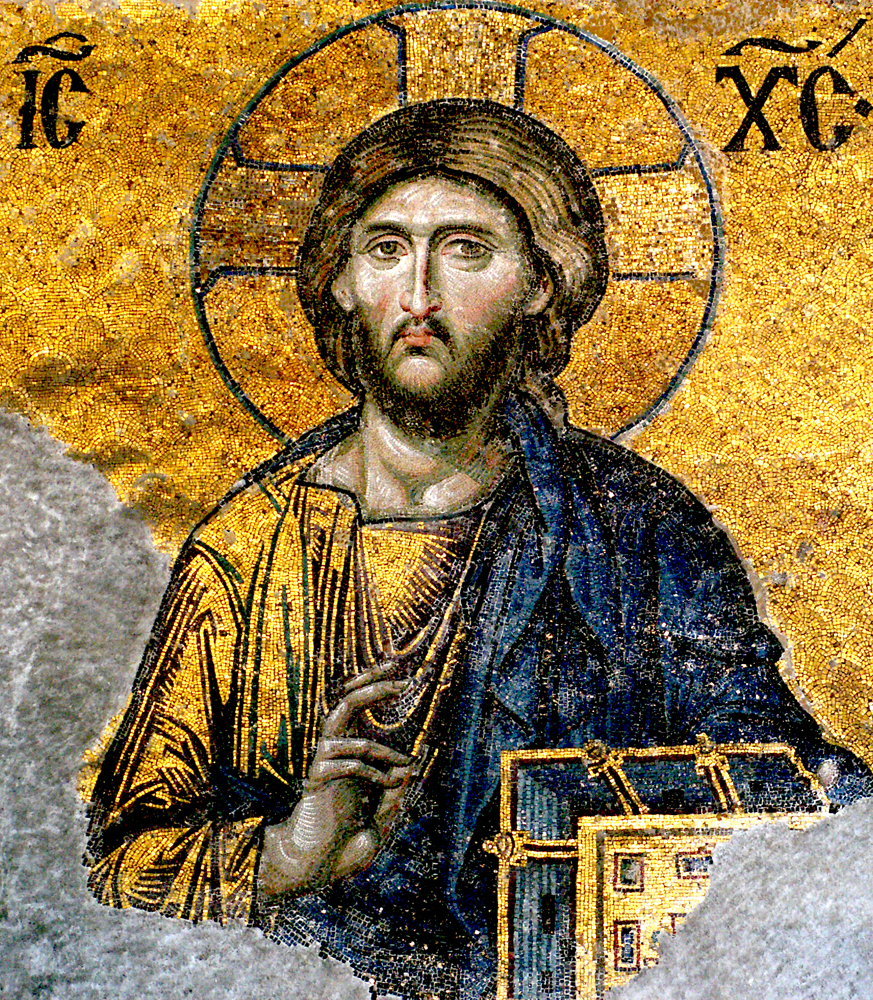
Christianity, like other religions, has adherents whose beliefs and biblical interpretations vary. Christianity regards the biblical canon, the Old Testament and the New Testament, as the inspired word of God. The traditional view of inspiration is that God worked through human authors so that what they produced was what God wished to communicate. The Greek word referring to inspiration in 2 Timothy 3:16 is theopneustos, which literally means "God-breathed".
Some believe that divine inspiration makes present Bibles inerrant, while others claim inerrancy for the Bible in its original manuscripts, although none of those are extant. Another closely related view is biblical infallibility or limited inerrancy, which affirms that the Bible is free of error as a guide to salvation, but may include errors on matters such as history, geography, or science.
The canon of the Old Testament accepted by Protestant churches, which is only the Tanakh (the canon of the Hebrew Bible), is shorter than that accepted by the Orthodox and Catholic churches which also include the deuterocanonical books which appear in the Septuagint, the Orthodox canon being slightly larger than the Catholic; Protestants regard the latter as apocryphal, important historical documents which help to inform the understanding of words, grammar, and syntax used in the historical period of their conception. Some versions of the Bible include a separate Apocrypha section between the Old Testament and the New Testament. The New Testament, originally written in Koine Greek, contains 27 books which are agreed upon by all major churches.
Some denominations have additional canonical holy scriptures beyond the Bible, including the standard works of the Latter Day Saints movement and Divine Principle in the Unification Church.
In antiquity, two schools of exegesis developed in Alexandria and Antioch. The Alexandrian interpretation, exemplified by Origen, tended to read Scripture allegorically, while the Antiochene interpretation adhered to the literal sense, holding that other meanings (called theoria) could only be accepted if based on the literal meaning.
Catholic theology distinguishes two senses of scripture: the literal and the spiritual.
The literal sense of understanding scripture is the meaning conveyed by the words of Scripture. The spiritual sense is further subdivided into:
The allegorical sense, which includes typology. An example would be the parting of the Red Sea being understood as a "type" (sign) of baptism.
The moral sense, which understands the scripture to contain some ethical teaching.
The anagogical sense, which applies to eschatology, eternity and the consummation of the world.
Regarding exegesis, following the rules of sound interpretation, Catholic theology holds:
The injunction that all other senses of sacred scripture are based on the literal
That the historicity of the Gospels must be absolutely and constantly held
That scripture must be read within the "living Tradition of the whole Church" and
That "the task of interpretation has been entrusted to the bishops in communion with the successor of Peter, the Bishop of Rome".
Many Protestant Christians, such as Lutherans and the Reformed, believe in the doctrine of sola scriptura—that the Bible is a self-sufficient revelation, the final authority on all Christian doctrine, and revealed all truth necessary for salvation; other Protestant Christians, such as Methodists and Anglicans, affirm the doctrine of prima scriptura which teaches that Scripture is the primary source for Christian doctrine, but that "tradition, experience, and reason" can nurture the Christian religion as long as they are in harmony with the Bible. Protestants characteristically believe that ordinary believers may reach an adequate understanding of Scripture because Scripture itself is clear in its meaning (or "perspicuous"). Martin Luther believed that without God's help, Scripture would be "enveloped in darkness". He advocated for "one definite and simple understanding of Scripture". John Calvin wrote, "all who refuse not to follow the Holy Spirit as their guide, find in the Scripture a clear light". Related to this is "efficacy", that Scripture is able to lead people to faith; and "sufficiency", that the Scriptures contain everything that one needs to know to obtain salvation and to live a Christian life.
Protestants stress the meaning conveyed by the words of Scripture, the historical-grammatical method. The historical-grammatical method or grammatico-historical method is an effort in Biblical hermeneutics to find the intended original meaning in the text. This original intended meaning of the text is drawn out through examination of the passage in light of the grammatical and syntactical aspects, the historical background, the literary genre, as well as theological (canonical) considerations. The historical-grammatical method distinguishes between the one original meaning and the significance of the text. The significance of the text includes the ensuing use of the text or application. The original passage is seen as having only a single meaning or sense. As Milton S. Terry said: "A fundamental principle in grammatico-historical exposition is that the words and sentences can have but one significance in one and the same connection. The moment we neglect this principle we drift out upon a sea of uncertainty and conjecture". Technically speaking, the grammatical-historical method of interpretation is distinct from the determination of the passage's significance in light of that interpretation. Taken together, both define the term (Biblical) hermeneutics.
Some Protestant interpreters make use of typology.
06Demographics

With around 2.3 billion adherents according to a 2020 estimation by Pew Research Center, split into three main branches of Catholic, Protestant, and Eastern Orthodox, Christianity is the world's largest religion. High birth rates and conversions in the global South were cited as the reasons for the Christian population growth. For the last hundred years, the Christian share has stood at around 33% of the world population. This masks a major shift in the demographics of Christianity; large increases in the developing world have been accompanied by substantial declines in the developed world, mainly in Western Europe and North America. Based on the 2020 population estimate, Christians comprise 28.8% of the world's population. 46.8% of the Christian population is concentrated in 10 countries: United States (over 210 million), Brazil (over 160 million), Mexico (over 110 million), Philippines and Russia (each one over 100 million), Nigeria and Congo (each one over 90 million), Ethiopia (over 70 million), South Africa (over 50 million) and Italy (over 40 million).
Based on a 2015 Pew Research Center study, within the next four decades, Christianity will remain the largest religion; and by 2050, the Christian population is expected to exceed 3 billion. According to some scholars, Christianity ranks at first place in net gains through religious conversion. As a percentage of Christians, the Catholic Church and Orthodoxy (both Eastern and Oriental) are declining in some parts of the world (though Catholicism is growing in Asia, in Africa, vibrant in Eastern Europe, etc.), while Protestants and other Christians are on the rise in the developing world. The so-called popular Protestantism is one of the fastest growing religious categories in the world. Nevertheless, Catholicism will also continue to grow to 1.63 billion by 2050, according to Todd Johnson of the Center for the Study of Global Christianity. Africa alone, by 2015, will be home to 230 million African Catholics. According to Pew Research Center, Africa is expected to be home to 1.1 billion African Christians by 2050.
In 2010, 87% of the world's Christian population lived in countries where Christians are in the majority, while 13% of the world's Christian population lived in countries where Christians are in the minority. Christianity is the predominant religion in Europe, the Americas, Oceania, and Sub-Saharan Africa. There are also large Christian communities in other parts of the world, such as Central Asia, the Middle East and North Africa, East Asia, Southeast Asia, and the Indian subcontinent. In Asia, it is the dominant religion in Armenia, Cyprus, Georgia, East Timor, and the Philippines. However, it is declining in some areas including the northern and western United States, some areas in Oceania (Australia and New Zealand), northern Europe (including Great Britain, Scandinavia and other places), France, Germany, Canada, and some parts of Asia (especially the Middle East, due to the Christian emigration, and Macau).
The total Christian population is not decreasing in Brazil and the southern United States, however, the percentage of the population identifying as Christian is in decline. Since the fall of communism, the proportion of Christians has been largely stable in Central Europe, except in the Czech Republic. On the other hand, Christianity is growing rapidly in both numbers and percentages in Eastern Europe, China, other Asian countries, Sub-Saharan Africa, Latin America, North Africa (Maghreb), Gulf Cooperation Council countries, Muslim world, and Oceania.
Despite a decline in adherence in the West, Christianity remains the dominant religion in the region, with about 70% of that population identifying as Christian. Christianity remains the largest religion in Western Europe, where 71% of Western Europeans identified themselves as Christian in 2018. A 2011 Pew Research Center survey found that 76% of Europeans, 73% in Oceania and about 86% in the Americas (90% in Latin America and 77% in North America) identified themselves as Christians. By 2020, 120 countries and territories in the world had Christian majorities.
There are many charismatic movements that have become well established over large parts of the world, especially Africa, Latin America, and Asia. Since 1900, primarily due to conversion, Protestantism has spread rapidly in Africa, Asia, Oceania, and Latin America. From 1960 to 2000, the global growth of the number of reported Evangelical Protestants grew three times the world's population rate, and twice that of Islam. According to the historian Geoffrey Blainey from the University of Melbourne, since the 1960s there has been a substantial increase in the number of conversions from Islam to Christianity, mostly to the Evangelical and Pentecostal forms. Significant numbers of Muslim converts to Christianity can be found in Afghanistan, Azerbaijan, Central Asia (including Kazakhstan, Kyrgyzstan, and other countries), Indonesia, Malaysia, the Middle East (including Iran, Saudi Arabia, Turkey, and other countries), North Africa (including Algeria, Morocco, and Tunisia), Sub-Saharan Africa, and the Western World (including Albania, Belgium, France, Germany, Kosovo, the Netherlands, Russia, Scandinavia, United Kingdom, the United States, and other western countries). It is also reported that Christianity is popular among people of different backgrounds in Africa and Asia; according to a report by the Singapore Management University, more people in Southeast Asia are converting to Christianity, many of them young and having a university degree. According to scholar Juliette Koning and Heidi Dahles of Vrije Universiteit Amsterdam there is a "rapid expansion" of Christianity in Singapore, China, Hong Kong, Taiwan, Indonesia, Malaysia, and South Korea. According to scholar Terence Chong from the Institute of Southeast Asian Studies, since the 1980s Christianity is expanding in China, Singapore, Indonesia, Japan, Malaysia, Taiwan, South Korea, and Vietnam.
In most countries in the developed world, church attendance among people who continue to identify themselves as Christians has been falling over the last few decades. Some sources view this as part of a drift away from traditional membership institutions, while others link it to signs of a decline in belief in the importance of religion in general. Europe's Christian population, though in decline, still constitutes the largest geographical component of the religion. According to data from the 2012 European Social Survey, around a third of European Christians say they attend services once a month or more. Conversely, according to the World Values Survey, about more than two-thirds of Latin American Christians, and about 90% of African Christians (in Ghana, Nigeria, Rwanda, South Africa and Zimbabwe) said they attended church regularly. According to a 2018 study by the Pew Research Center, Christians in Africa and Latin America and the United States have high levels of commitment to their faith.
Christianity, in one form or another, is the sole state religion of the following nations: Argentina (Catholic), Costa Rica (Catholic), the Kingdom of Denmark (Lutheran), England (Anglican), Greece (Greek Orthodox), Iceland (Lutheran), Liechtenstein (Catholic), Malta (Catholic), Monaco (Catholic), Norway (Lutheran), Samoa, Tonga (Methodist), Tuvalu (Reformed), and Vatican City (Catholic).
There are numerous other countries, such as Cyprus, which although do not have an established church, still give official recognition and support to a specific Christian denomination.
Article sections from Wikipedia (CC BY-SA 4.0). Excerpted for readability.