On 26 December 1991, the Soviet Union was formally dissolved and ceased to exist as a sovereign state and subject of international law. It also brought an end to the Soviet Union's federal government and to Soviet leader Mikhail Gorbachev's efforts to reform the Soviet political and economic system in an attempt to stop a period of political and economic stagnation.
The collapse of the Soviet Union in 1991 resulted from several factors: chronic economic stagnation, the unsustainable financial burden of the arms race with the United States and foreign conflicts, intense ethnic nationalism and separatism within its union republics, and the destabilizing effects of Gorbachev's reforms (particularly glasnost and perestroika).
The process began with growing unrest in the country's union republics developing into an incessant political and legislative conflict between them and the central government. Until its final years, the Soviet Union was made up of 15 union republics that served as the homelands of different ethnic groups. Estonia was the first union republic to declare state sovereignty on 16 November 1988. Lithuania was the first republic to declare independence, in March 1990.
During the failed 1991 August coup, communist hardliners attempted to overthrow Gorbachev and reverse his reforms. However, the turmoil caused the central government in Moscow to lose influence, ultimately leading many republics to declare independence in the following days and months. On 8 December 1991, the leaders of its three founding republics—the Russian SFSR, the Byelorussian SSR, and the Ukrainian SSR—signed the Belovezha Accords and declared that the Soviet Union no longer existed. Eight more republics joined the declaration shortly thereafter. The Belovezha Accords also established the Commonwealth of Independent States (CIS) to replace the Soviet Union as a community. Kazakhstan was the last republic to declare independence, on 16 December. All post-Soviet states, with the exception of Georgia and the Baltic states, joined the CIS on 21 December by signing the Alma-Ata Protocol. Russia, as by far the largest and most populous republic, became the Soviet Union's recognized successor state.
On 25 December 1991, Gorbachev resigned and transferred his presidential powers—including control of the nuclear launch codes—to Russian president Boris Yeltsin. That evening, the Soviet flag was lowered from the Moscow Kremlin for the last time and replaced with the Russian tricolor. The following day, the Soviet of the Republics, the upper chamber of the Supreme Soviet of the Soviet Union, formally dissolved the Soviet Union by adopting Declaration No. 142-N. The dissolution marked the culmination of the Revolutions of 1989 and the end of the Cold War.
In the aftermath of the Cold War, several of the post-Soviet states have retained close links with Russia and formed multilateral organizations such as the CIS and the Collective Security Treaty Organization (CSTO). A few, notably the Baltic states, moved out of the Russian sphere of influence and towards the West.
Summary from Wikipedia (CC BY-SA 4.0)
01Background

Mikhail Gorbachev was elected General Secretary by the Politburo on 11 March 1985, just over four hours after his predecessor Konstantin Chernenko died at the age of 73. Gorbachev, aged 54, was the youngest member of the Politburo. His initial goal as general secretary was to revive the stagnating Soviet economy, and he realized that doing so would require reforming underlying political and social structures. The reforms began with personnel changes of senior Brezhnev-era officials who would impede political and economic change. On 23 April 1985, Gorbachev brought two protégés, Yegor Ligachev and Nikolai Ryzhkov, into the Politburo as full members. He kept the "power" ministries favorable by promoting KGB Chief Viktor Chebrikov from candidate to full member and appointing Minister of Defence Marshal Sergei Sokolov as a Politburo candidate.
The freedom of speech brought by Gorbachev's reforms allowed nationalist movements and ethnic disputes within the Soviet Union to be expressed and grow into dominant political movements. It also led indirectly to the revolutions of 1989 in which Soviet-imposed socialist regimes of the Warsaw Pact were toppled peacefully (with the notable exception of Romania), which in turn increased pressure on Gorbachev to introduce greater democracy and autonomy for the Soviet Union's constituent republics. Under Gorbachev's leadership, the Communist Party of the Soviet Union (CPSU) in 1989 introduced limited competitive elections to a new central legislature, the Congress of People's Deputies (although the ban on other political parties was not lifted until 1990).
On 1 July 1985, Gorbachev sidelined his main rival by removing Grigory Romanov from the Politburo and brought Boris Yeltsin into the Central Committee Secretariat. On 23 December 1985, Gorbachev appointed Yeltsin First Secretary of the Moscow Communist Party, replacing Viktor Grishin.
Gorbachev continued to press for greater liberalization. On 23 December 1986 Andrei Sakharov, the most prominent Soviet dissident, returned to Moscow shortly after receiving a personal telephone call from Gorbachev telling him that after almost seven years his internal exile for defying the authorities was over.
At the 28–30 January Central Committee plenum, Gorbachev suggested a new policy of demokratizatsiya, or "democratization", throughout Soviet society. He proposed that future Communist Party elections should offer a choice between multiple candidates, elected by secret ballot. However, the party delegates at the Plenum watered down Gorbachev's proposal, and democratic choice within the Communist Party was never significantly implemented.
Gorbachev also radically expanded the scope of glasnost, and stated that no subject was off limits for open discussion in the media. On 7 February, dozens of political prisoners were freed in the first group release since the Khrushchev thaw in the mid-1950s.
On 10 September, Boris Yeltsin wrote a letter of resignation to Gorbachev. At the 27 October plenary meeting of the Central Committee, Yeltsin, frustrated that Gorbachev had not addressed any of the issues outlined in his resignation letter, criticized the slow pace of reform, and servility to the general secretary. In his reply, Gorbachev accused Yeltsin of "political immaturity" and "absolute irresponsibility".
Nevertheless, news of Yeltsin's insubordination and "secret speech" spread, and soon samizdat versions began to circulate. That marked the beginning of Yeltsin's rebranding as a rebel and rise in popularity as an anti-establishment figure. The following four years of political struggle between Yeltsin and Gorbachev played a large role in the dissolution of the Soviet Union. On 11 November, Yeltsin was fired from the post of First Secretary of the Moscow City Committee of the Communist Party of the Soviet Union.
In the years leading up to the dissolution, various protests and resistance movements occurred or took hold throughout the Soviet Union, which were variously suppressed or tolerated.
In the Baltics, several protest groups were established against Soviet rule, such as Helsinki-86, the Popular Front of Latvia, Sąjūdis (Lithuania), and the Popular Front of Estonia. Helsinki-86 was the first openly anti-Communist organization in the Soviet Union, and the first openly organized opposition to the Soviet regime, setting an example for other ethnic minorities' pro-independence movements.
On 26 December 1986, 300 Latvian youths gathered in Riga's Cathedral Square and marched down Lenin Avenue toward the Freedom Monument, shouting, "Soviet Russia out! Free Latvia!" Security forces confronted the marchers, and several police vehicles were overturned.
The Jeltoqsan ('December') of 1986 were riots in Alma-Ata, Kazakhstan, sparked by Gorbachev's dismissal of Dinmukhamed Kunaev, the First Secretary of the Communist Party of Kazakhstan and an ethnic Kazakh, who was replaced with Gennady Kolbin, an outsider from the Russian SFSR. Demonstrations started in the morning of 17 December 1986, with 200 to 300 students in front of the Central Committee building on Brezhnev Square. On the next day, 18 December, protests turned into civil unrest as clashes between troops, volunteers, militia units, and Kazakh students turned into a wide-scale confrontation. The clashes could only be controlled on the third day.
On 6 May 1987, Pamyat, a Russian nationalist group, held an unsanctioned demonstration in Moscow. The authorities did not break up the demonstration and even kept traffic out of the demonstrators' way while they marched to an impromptu meeting with Boris Yeltsin.
On 14 June 1987, about 5,000 people gathered again at Freedom Monument in Riga, and laid flowers to commemorate the anniversary of Stalin's mass deportation of Latvians in 1941. The authorities did not crack down on demonstrators, which encouraged more and larger demonstrations throughout the Baltic States. On 18 November 1987, hundreds of police and civilian militiamen cordoned off the central square to prevent any demonstration at Freedom Monument, but thousands lined the streets of Riga in silent protest regardless.
On 25 July 1987, 300 Crimean Tatars staged a noisy demonstration near the Kremlin Wall for several hours, calling for the right to return to their homeland, from which they were deported in 1944; police and soldiers looked on.
On 23 August 1987, the 48th anniversary of the secret protocols of the 1939 Molotov Pact, thousands of demonstrators marked the occasion in the three Baltic capitals to sing independence songs and attend speeches commemorating Stalin's victims. The gatherings were sharply denounced in the official press and closely watched by the police but were not interrupted.
On 17 October 1987, a protest held in Armenia SSR was underway. The following day 1,000 Armenians participated in another demonstration calling for Armenian national rights in Karabakh, and the proposed unification of both Nakhchivan and Nagorno-Karabakh to Armenia. The police tried to physically prevent the march and after a few incidents, dispersed the demonstrators.
02Timeline
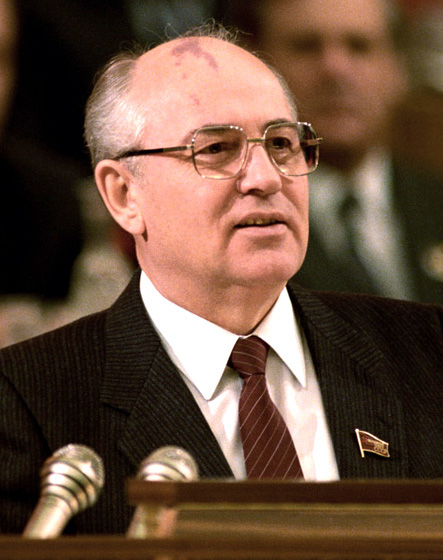
In 1988, Gorbachev started to lose control of two regions of the Soviet Union, as the Baltic republics were now leaning towards independence, and the Caucasus descended into violence and civil war.
On 1 July 1988, the fourth and last day of a bruising 19th Party Conference, Gorbachev won the backing of the tired delegates for his last-minute proposal to create a new supreme legislative body called the Congress of People's Deputies. Frustrated by the old guard's resistance, Gorbachev embarked on a set of constitutional changes to attempt separation of party and state, thereby isolating his Party opponents. Detailed proposals for the new Congress of People's Deputies were published on 2 October 1988, and to enable the creation of the new legislature. The Supreme Soviet, during its 29 November – 1 December 1988, session, implemented amendments to the 1977 Soviet Constitution, enacted a law on electoral reform, and set the date of the election for 26 March 1989.
On 29 November 1988, the Soviet Union ceased jamming all foreign radio stations, allowing Soviet citizens – for the first time since a brief period in the 1960s – to have unrestricted access to news sources beyond Communist Party control.
In 1986 and 1987, Latvia had been in the vanguard of the Baltic states in pressing for reform. In 1988, Estonia took over the lead role with the foundation of the Soviet Union's first popular front and starting to influence state policy.
The Popular Front of Estonia was founded in April 1988. On 16 June 1988, Gorbachev replaced Karl Vaino, the "old guard" leader of the Communist Party of Estonia, with the comparatively liberal Vaino Väljas. In late June 1988, Väljas bowed to pressure from the Estonian Popular Front and legalized the flying of the old blue-black-white flag of Estonia, and agreed to a new state language law that made Estonian the official language of the Republic.
On 2 October, the Popular Front formally launched its political platform at a two-day congress. Väljas attended, gambling that the Front could help Estonia become a model of economic and political revival, while moderating separatist and other radical tendencies. On 16 November 1988, the Supreme Soviet of the Estonian SSR adopted a declaration of national sovereignty under which Estonian laws would take precedence over those of the Soviet Union. Estonia's parliament also laid claim to the republic's natural resources including land, inland waters, forests, mineral deposits, and to the means of industrial production, agriculture, construction, state banks, transportation, and municipal services within the territory of Estonia's borders. At the same time the Estonian Citizens' Committees started registration of citizens of the Republic of Estonia to carry out the elections of the Congress of Estonia.
The Popular Front of Latvia was founded in June 1988. On 4 October, Gorbachev replaced Boris Pugo, the "old guard" leader of the Communist Party of Latvia, with the more liberal Jānis Vagris. In October 1988 Vagris bowed to pressure from the Latvian Popular Front and legalized flying the former carmine red-and-white flag of independent Latvia, and on 6 October he passed a law making Latvian the country's official language.
The Popular Front of Lithuania, called Sąjūdis ("Movement"), was founded in May 1988. On 19 October 1988, Gorbachev replaced Ringaudas Songaila, the "old guard" leader of the Communist Party of Lithuania – who had been in office for nearly a year – with the relatively liberal Algirdas Brazauskas. In October 1988, Brazauskas bowed to pressure from Sąjūdis members, and legalized the flying of the historic yellow-green-red flag of independent Lithuania, and in November 1988 he passed a law making Lithuanian the country's official language; also, the former national anthem, "Tautiška giesmė", was later reinstated. Following a violent protest action in the capital on 28 October, many of Songalia's remaining holdovers within the CPL either resigned or retired in protest of the police brutality of that day.
On 20 February 1988, after a week of growing demonstrations in Stepanakert, capital of the Nagorno-Karabakh Autonomous Oblast (the ethnically Armenian-majority area within the Azerbaijan Soviet Socialist Republic), the Regional Soviet voted to secede and join with the Soviet Socialist Republic of Armenia. This local vote in a small, remote part of the Soviet Union made headlines around the world; it was an unprecedented defiance of republican and national authorities. On 22 February 1988, in what became known as the "Askeran clash", thousands of Azerbaijanis marched towards Nagorno-Karabakh, demanding information about rumors of an Azerbaijani having been killed in Stepanakert. They were informed by officials that no such incident had occurred; however, dissatisfied with what they were told, they began marching toward Nagorno-Karabakh, killing (or injuring?) 50. Karabakh authorities mobilised over a thousand police to stop the march, with the resulting clashes leaving two Azerbaijanis dead. These deaths, announced on state radio, led to the Sumgait pogrom. Between 26 February and 1 March, the city of Sumgait (Azerbaijan) saw violent anti-Armenian rioting during which at least 32 people were killed. The authorities totally lost control and occupied the city with paratroopers and tanks; nearly all of the 14,000 Armenian residents of Sumgait fled.
Gorbachev refused to make any changes to the status of Nagorno-Karabakh, which remained part of Azerbaijan. He instead sacked the Communist Party Leaders in both Republics in response – on 21 May 1988, Kamran Baghirov was replaced by Abdurrahman Vazirov as First Secretary of the Azerbaijan Communist Party. From 23 July to September 1988, a group of Azerbaijani intellectuals began working for a new organization called the Popular Front of Azerbaijan, loosely based on the Estonian Popular Front. On 17 September, when gun battles broke out between the Armenians and Azerbaijanis near Stepanakert, two soldiers were killed and more than two dozen injured. This led to almost tit-for-tat ethnic polarization in Nagorno-Karabakh's two main towns: the Azerbaijani minority was expelled from Stepanakert, and the Armenian minority was expelled from Shusha. On 17 November 1988, in response to the exodus of tens of thousands of Azerbaijanis from Armenia, a series of mass demonstrations began in Baku's Lenin Square, lasting 18 days and attracting half a million demonstrators in support of their compatriots in that region. On 5 December 1988, the Soviet police and civilian militiamen moved in, cleared the square by force, and imposed a curfew that lasted ten months.
The rebellion of fellow Armenians in Nagorno-Karabakh had an immediate effect in Armenia itself. Daily demonstrations, which began in the Armenian capital Yerevan on 18 February, initially attracted few people, but each day the Nagorno-Karabakh issue became increasingly prominent and the numbers swelled. On 20 February, a 30,000-strong crowd demonstrated in the Theater Square, by 22 February, there were 100,000, the next day 300,000, and a transport strike was declared, by 25 February, there were close to a million demonstrators – more than a quarter of Armenia's population. This was the first of the large, peaceful public demonstrations that would become a feature of communism's overthrow in Prague, Berlin, and, ultimately, Moscow. Leading Armenian intellectuals and nationalists, including the future first president of independent Armenia Levon Ter-Petrosyan, formed the eleven-member Karabakh Committee to lead and organize the new movement.
Also on 21 May, Gorbachev replaced Karen Demirchyan with Suren Harutyunyan as First Secretary of the Communist Party of Armenia. However, Harutyunyan quickly changed course and on 28 May, allowed Armenians to unfurl the red-blue-orange First Armenian Republic flag for the first time in almost 70 years to mark the 1918 declaration of the First Republic. On 15 June 1988, the Armenian Supreme Soviet adopted a resolution formally approving the idea of Nagorno-Karabakh's unification as part of the republic. Armenia, formerly one of the most loyal republics, had suddenly turned into the leading rebel republic. On 5 July 1988, when a contingent of troops was sent in to remove demonstrators by force from Yerevan's Zvartnots International Airport, shots were fired and one student protester was killed. In September, further large demonstrations in Yerevan led to the deployment of armored vehicles. In the autumn of 1988 almost all of the 200,000 Azerbaijani minority in Armenia was expelled by Armenian nationalists, with over 100 killed in the process. That, after the Sumgait pogrom earlier that year, which had been carried out by Azerbaijanis to ethnic Armenians and led to the expulsion of Armenians from Azerbaijan, was for many Armenians considered an act of revenge for the killings at Sumgait. On 25 November 1988, a military commandant took control of Yerevan as the Soviet government moved to prevent further ethnic violence.
On 7 December 1988, the Spitak earthquake struck, killing an estimated 25,000 to 50,000 people. When Gorbachev rushed back from a visit to the United States, he was so angered with being confronted by protesters calling for Nagorno-Karabakh to be made part of the Armenian Republic during a natural disaster that on 11 December 1988, he ordered that the entire Karabakh Committee be arrested.
In Tbilisi, the capital of Soviet Georgia, many demonstrators camped out in front of the republic's legislature in November 1988 calling for Georgia's independence and in support of Estonia's declaration of sovereignty.
Beginning in February 1988, the Democratic Movement of Moldova, later the Popular Front of Moldova, organized public meetings, demonstrations, and song festivals, which gradually grew in size and intensity. In the streets, the center of public manifestations was the Stephen the Great Monument in Chișinău, and the adjacent park harboring Aleea Clasicilor (The "Alley of Classics [of Literature]"). The transition from "movement" (an informal association) to "front" (a formal association) was seen as a natural "upgrade" once a movement gained momentum with the public, and the Soviet authorities no longer dared to crack down on it.
On 26 April 1988, about 500 people participated in a march organized by the Ukrainian Cultural Club on Kiev's Khreshchatyk Street to mark the second anniversary of the Chernobyl nuclear disaster, carrying placards with slogans like "Openness and Democracy to the End". Between May and June 1988, Ukrainian Catholics in western Ukraine celebrated the Millennium of Christianity in Kievan Rus' in secret by holding services in the forests of Buniv, Kalush, Hoshi, and Zarvanytsia. On 5 June 1988, as the official celebrations of the Millennium were held in Moscow, the Ukrainian Cultural Club hosted its own observances in Kiev at the monument to Vladimir the Great, the grand prince of Kievan Rus'.
On 16 June 1988, 6,000 to 8,000 people gathered in Lviv to hear speakers declare no confidence in the local list of delegates to the 19th Communist Party conference, to begin on 29 June. On 21 June, a rally in Lviv attracted 50,000 people who had heard about a revised delegate list. Authorities attempted to disperse the rally in front of Druzhba Stadium. On 7 July, 10,000 to 20,000 people witnessed the launch of the Democratic Front to Promote Perestroika. On 17 July, a group of 10,000 gathered in the village Zarvanytsia for Millennium services celebrated by Ukrainian Greek-Catholic Bishop Pavlo Vasylyk. The militia tried to disperse attendees, but it turned out to be the largest gathering of Ukrainian Catholics since Stalin outlawed the Church in 1946. On 4 August, which came to be known as "Bloody Thursday", local authorities violently suppressed a demonstration organized by the Democratic Front to Promote Perestroika.
03Consequences

In the decades following the end of the Cold War, only five or six of the post-Soviet states are on a path to joining the wealthy capitalist states of the West, and most are falling behind, some to such an extent that over 50 years will be needed before they catch up to how they were before the dissolution of the Soviet Union. As of 2011, the experience of former Soviet republics is largely negative, with most states having suffered extreme Gross Domestic Product (GDP) loss, developmental stagnation, low happiness, and population decline.
GDP decline in post-Soviet nations was substantial and averaged roughly 51%. From 1990 to 2000, GDP decline numbered:
63% in Armenia
60% in Azerbaijan
35% in Belarus
35% in Estonia
78% in Georgia
41% in Kazakhstan
50% in Kyrgyzstan
51% in Latvia
44% in Lithuania
63% in Moldova
40% in Russia
50% in Tajikistan
48% in Turkmenistan
59% in Ukraine
Russia experienced the largest drop in life expectancy during peacetime in recorded history after the fall of the USSR. Poverty skyrocketed after the fall of the USSR by the end of the '90s the number of people living below the international poverty went from 3% in 1987–88 to 20% or around 88 million people. Only 4% of the region lived on $4 a day or less but by 1994 this number skyrocketed to 32%. Crime, alcohol use, drug use and suicides all skyrocketed after the fall of the Eastern Bloc.
In a 2001 study by the economist Steven Rosefielde, he calculated that there were 3.4 million premature deaths in Russia from 1990 to 1998, which he partly blames on the "shock therapy" that came with the Washington Consensus. A 2017 study estimates 7 million premature deaths occurred overall as a result of shock therapy. A 2026 Lancet preprint estimates 15.9 million deaths in former Soviet States through to 2019 occurred due to its dissolution, accounting for demographic shift and hampered development.
Sex trafficking also exploded in post-Soviet States due to governmental dysfunction, worsened material conditions, and political instability. A 2010 review found at least 500,000 Russian women had been sex trafficked post-dissolution, with an average of 20,000–60,000 women trafficked annually in Russia since Soviet collapse.
As the Soviet Union began to collapse, social disintegration and political instability fueled a surge in ethnic conflict. Social and economic disparities, along with ethnic friction, created an upsurge in nationalism and discrimination between groups. In particular, disputes over territorial boundaries have been the source of conflict between states experiencing political transition and upheaval. Territorial conflicts often involve disputes related to reunion of ethnic groups, shifting former USSR boundaries, and pre-USSR land claims. Minority groups consistently contribute to territorial fights, regularly opposing election outcomes to seek autonomy.
Additionally, legacies from the Soviet and pre-Soviet eras, along with the suddenness of the actual sociopolitical change, have resulted in conflict throughout the region.
The only wars that have broken out between former Soviet Republics are the Russo-Georgian War, the Russo–Ukrainian War, the Nagorno-Karabakh conflict, and the Second Nagorno-Karabakh war. In 2021, there was a three day border conflict between Kyrgyzstan and Tajikistan.
After decades of hardship following the Sino-Soviet split, the People's Republic of China entered a gradual rapprochement with the Soviet Union in 1989 when Gorbachev visited the country. Afterwards, the border treaty was demarcated in 1991, and they signed the Treaty of Good-Neighborliness and Friendly Cooperation in 2001, which was renewed in June 2021 for five more years. Both countries are members of the Shanghai Cooperation Organisation which was founded in 1996.
On the eve of a 2013 state visit to Moscow by Chinese leader Xi Jinping, Russian president Vladimir Putin remarked that the two nations were forging a special relationship. The two countries have enjoyed close relations militarily, economically, and politically, while supporting each other on various global issues. Commentators have debated whether the bilateral strategic partnership constitutes an alliance. Russia and China officially declared their relations 'Not allies, but better than allies'. The relations between the two countries are currently being put to the test after Russia invading Ukraine. Unlike in the Soviet era, Putin ruled Russia as increasingly China's "junior partner".
The "Special Period", officially known as the "Special Period in the Time of Peace" was an extended period of economic crisis in Cuba that began in 1991 It was defined primarily by extreme reductions of rationed foods at state-subsidized prices, the severe shortages of hydrocarbon energy resources in the form of gasoline, diesel, and other petroleum derivatives that occurred upon the implosion of economic agreements between the petroleum-rich Soviet Union and Cuba, and the shrinking of an economy reliant upon Soviet imports.
During its existence, the Soviet Union provided Cuba with large amounts of oil, food, and machinery. In the years following the collapse of the Soviet Union, Cuba's gross domestic product shrunk 35%, imports and exports both fell over 80%, and many domestic industries shrank considerably. In a speculated attempt to re-join the IMF and the World Bank, executive director Jacques de Groote and another IMF official were invited to Havana in late 1993. After assessing the economic situation in the country they concluded that from 1989 to 1993, Cuba's economic decline was more grave than that experienced by any other socialist Eastern European country.
In 1993 a series of economic reforms began to go into effect, initially enacted to offset the economic imbalances which was a result of the dissolution of the Soviet Union in 1991. The main aspect of these reforms was to legalize the then illegal U.S. Dollar and regulate its usage in the island's economy.
When the Soviet Union dissolved, it ended all aid and trade concessions such as cheap oil to North Korea. Without Soviet aid, the flow of imports to the North Korean agricultural sector ended, and the government proved to be too inflexible to respond. Energy imports fell by 75%. The economy went into a downward spiral, with imports and exports falling in tandem. Flooded coal mines required electricity to operate pumps, and the shortage of coal worsened the shortage of electricity. Agriculture reliant on electrically powered irrigation systems, artificial fertilizers and pesticides was hit particularly hard by the economic collapse.
Between 1989 and 2006, about 1.6 million Soviet Jews and their non-Jewish spouses and their relatives, as defined by the Law of Return, emigrated from the former Soviet Union. About 979,000, or 61%, migrated to Israel.
The end of Soviet war in Afghanistan would lead into a civil war mainly between the Soviet backed Republic of Afghanistan headed by Najibullah and the Mujahadeen alliance known as the Afghan Interim Government in Exile. By January 1992, with the loss of his biggest supporter, Najibullah's regime had become internationally isolated. The cut-off of Soviet aid led to food and fuel shortages within the capital.
The breakup of the Soviet Union resulted in Najibullah deciding to consolidate his power over the non-Pashtuns in the north who were mistrusted and considered less loyal to the ruling Homeland Party regime. This came after complaints to Najibullah from his fellow Pashtun Kochis of harassment from an ethnic Tajik general, Abdul Momin. Momin had developed secret ties with the Tajik mujahideen warlord Ahmad Shah Massoud and was passing on secret information to Massoud which led to Najibullah ordering the sacking of Momin which was carried out by Juma Achak, an Achakzai Pashtun who served as Commander of the Northern Zone and was known to hold Pashtun chauvinist views. General Momin was replaced with General Rasul, an ethnic Pashtun Khalqist known for his brutal reputation as commander of Pul-e Charkhi garrison. This move stoked up ethnic tensions between the Pashtun rulers in Kabul and the non-Pashtuns in the north of the country who opposed Najibullah's attempts to restore Pashtun domination over the north of the country. These tensions would lead to the defection of General Abdul Rashid Dostum, an ethnic Uzbek, who began secret negotiations with Tajik rebel leader Massoud, resulting in the formation of Harakat-e Shamal (the Movement of the North). The alliance would topple Najibullah's regime in April 1992.
Following the overthrow of Najibullah a multi-sided civil war would break out, only for the Taliban which was founded in 1994 to rise in 1996. Because of this, U.S. policies in the war are also thought to have contributed to a "blowback" of unintended consequences against American interests, which led to the United States entering into its own war in Afghanistan following the September 11 attacks in 2001, only to end with the US' withdrawal in 2021 and the Taliban regaining control of Afghanistan.
The breakup of the Soviet Union saw a massive impact in the sporting world. Before its dissolution, the Soviet football team had just qualified for Euro 1992, but its place was instead taken by the CIS national football team. After the tournament, the former Soviet Republics competed as separate independent nations, with FIFA allocating the Soviet team's record to Russia.
Before the start of the 1992 Winter Olympics in Albertville and the Summer Olympics in Barcelona, the Olympic Committee of the Soviet Union formally existed until 12 March 1992, when it disbanded but it was succeeded by the Russian Olympic Committee. However, 12 of the 15 former Soviet Republics competed together as the Unified Team and marched under the Olympic flag in Barcelona, where they finished first in the medal rankings. Separately, Lithuania, Latvia, and Estonia also competed as independent nations in the 1992 Games. The Unified Team also competed in Albertville earlier in the year (represented by six of the twelve ex-republics) and finished second in the medal ranking at those Games. Afterwards, the individual NOCs of the non-Baltic former republics were established. Some NOCs made their debuts at the 1994 Winter Olympic Games in Lillehammer, and others did so at the 1996 Summer Olympic Games in Atlanta.
Members of the Unified Team at the 1992 Summer Olympics in Barcelona consisted of Armenia, Azerbaijan, Belarus, Georgia, Kazakhstan, Kyrgyzstan, Moldova, Russia, Tajikistan, Turkmenistan, Ukraine, and Uzbekistan. At those Summer Games, the Unified Team secured 45 gold medals, 38 silver medals, and 29 bronze medals; four medals more than second-place United States, and 30 more than third-place Germany. In addition to great team success, the Unified Team also saw great personal success. Vitaly Scherbo of Belarus secured six gold medals for the team in gymnastics and also became the most decorated athlete of the Summer Games. Gymnastics, athletics, wrestling, and swimming were the strongest sports for the team, as the four combined earned 28 gold medals and 64 medals in total.
Only six of the countries competed earlier at the 1992 Winter Olympics in Albertville: Armenia, Belarus, Kazakhstan, Russia, Ukraine, and Uzbekistan. The Unified team placed second, three fewer medals than Germany. However, much like the Summer Games, the Unified team had the most decorated medalist in the Winter Games as well, with Lyubov Yegorova of Russia, a cross-country skier winning five total medals.
The Soviet Union's calling code of +7 is still used by Russia and Kazakhstan. Between 1993 and 1997, many newly independent republics implemented their own numbering plans such as Belarus (+375) and Ukraine (+380).
04Chronology of declarations
Union republics are shown in bold, and autonomous units that became states with limited recognition are shown in italics. Entities peacefully reincorporated into a post-Soviet republic are not listed.
05Legacy

In 2013, the American Gallup analytics company found that a majority of citizens in four former Soviet countries regretted the dissolution of the Soviet Union: Armenia, Kyrgyzstan, Russia and Ukraine. In Armenia, 12% of respondents in 2013 said the Soviet collapse did good, while 66% said it did harm. In Kyrgyzstan, 16% of respondents in 2013 said the Soviet collapse did good, while 61% said it did harm. Ever since the Soviet collapse, annual polling by the Levada Center has shown that over 50 percent of Russia's population regretted its collapse. Consistently, 57% of citizens of Russia regretted the collapse of the Soviet Union in a poll in 2014 (while 30 percent said otherwise), and in 2018 a Levada Center poll showed that 66% of Russians lamented the fall of the Soviet Union. In 2005, Russian president Vladimir Putin called the dissolution of the USSR as "the greatest geopolitical catastrophe of the 20th century".
In a similar poll held in February 2005, 50% of respondents in Ukraine stated they regretted the disintegration of the Soviet Union. In 2013, according to Gallup, 56% of Ukrainians said that the dissolution of the Soviet Union did more harm than good, with only 23% saying it did more good than harm. However, a similar poll conducted in 2016 by a Ukrainian group showed only 35% Ukrainians regretting the Soviet collapse and 50% not regretting it.
The breakdown of economic ties that followed the Soviet collapse led to a severe economic crisis and catastrophic fall in the standard of living in post-Soviet states and the former Eastern Bloc, which was even worse than the Great Depression. An estimated seventeen million premature deaths took place in the former USSR after it collapsed, with around four million in Russia alone. Poverty, sex trafficking, and economic inequality surged between 1988 and 1989 and between 1993 and 1995, with the Gini ratio increasing by an average of 9 points for all former socialist countries. Even before the 1998 Russian financial crisis, the Russian GDP was half of what it had been in the early 1990s. By 1999, around 191 million people in post-Soviet states and former Eastern Bloc countries were living on less than $5.50 a day. It has been posited by several scholars that the dissolution of the Soviet Union and the end of communism as a global force in the post-Cold War era allowed neoliberal capitalism to become the dominant global system, which has resulted in rising economic inequality.
In the Kitchen Debate of 1959, Nikita Khrushchev claimed that then US Vice-president Richard Nixon's grandchildren would live "under communism", and Nixon claimed that Khrushchev's grandchildren would live "under freedom". In a 1992 interview, Nixon commented that during the debate, he was sure Khrushchev's claim was wrong, but Nixon was not sure that his own assertion was correct. Nixon said that events had proved that he was indeed right because Khrushchev's grandchildren now lived "in freedom" in reference to the recent end of the Soviet Union. Khrushchev's son Sergei Khrushchev became a naturalized American citizen, although his children remained in Moscow; whereas Nixon's grandchildren including Christopher Nixon Cox and Jennie Eisenhower live as their parents did in the United States.
In a letter dated 24 December 1991, Boris Yeltsin, the Russian president, informed the United Nations Secretary-General that the membership of the Soviet Union in the Security Council and all other UN organs would be continued by the Russian Federation with the support of the 11 member countries of the Commonwealth of Independent States.
However, the Byelorussian Soviet Socialist Republic and the Ukrainian Soviet Socialist Republic had already joined the UN as original members on 24 October 1945, together with the Soviet Union. After declaring independence, the Ukrainian Soviet Socialist Republic changed its name to Ukraine on 24 August 1991, and on 19 September 1991, the Byelorussian Soviet Socialist Republic informed the UN that it had changed its name to the Republic of Belarus.
All of the twelve other independent states that were established from the former Soviet republics were admitted to the UN:
17 September 1991: Estonia, Latvia, and Lithuania
2 March 1992: Armenia, Azerbaijan, Kazakhstan, Kyrgyzstan, Moldova, Tajikistan, Turkmenistan, and Uzbekistan
31 July 1992: Georgia
06Historiographic explanations
The end of the Soviet Union caught many people by surprise. After the marginalisation of the notion of the withering of the state but before 1991, many thought that Soviet Union collapse was impossible or unlikely.
Historiography on the Soviet collapse can be roughly classified in two groups: intentionalist accounts and structuralist accounts.
Intentionalist accounts contend that Soviet collapse was not inevitable and resulted from the policies and decisions of specific individuals, usually Gorbachev and Yeltsin. One characteristic example of intentionalist writing is the historian Archie Brown's The Gorbachev Factor, which argues Gorbachev was the main force in Soviet politics at least from 1985 to 1988 and even later and that he largely spearheaded the political reforms and developments, as opposed to being led by events. That was especially true of the policies of perestroika and glasnost, market initiatives, and foreign policy stance, as the political scientist George Breslauer has seconded by labelling Gorbachev a "man of the events". In a slightly different vein, David Kotz and Fred Weir have contended that Soviet elites were responsible for spurring on both nationalism and capitalism from which they could personally benefit, which is demonstrated also by their continued presence in the higher economic and political echelons of post-Soviet republics.
In contrast, structuralist accounts take a more deterministic view in which Soviet dissolution was an outcome of deeply rooted structural issues, which planted a time bomb. For example, Edward Walker has argued that minority nationalities were denied power at the Union level, confronted by a culturally destabilizing form of economic modernization, and subjected to a certain amount of Russification, but they were at the same time strengthened by several policies pursued by the Soviet government (indigenization of leadership, support for local languages, etc.). Over time, they created conscious nations. Furthermore, the basic legitimating myth of the Soviet federative system (that it was a voluntary and mutual union of allied peoples) eased the task of secession and independence. On 25 January 2016, Russian president Vladimir Putin supported that view by calling Lenin's support of the right of secession for the Soviet republics a "delayed-action bomb".
An opinion piece by Gorbachev in The Japan Times in April 2006 stated: "The nuclear meltdown at Chernobyl 20 years ago this month, even more than my launch of perestroika, was perhaps the real cause of the collapse of the Soviet Union."
It also had a profound impact on the policy-making circles of the Chinese Communist Party (CCP), in particular on CCP general secretary Xi Jinping, who states:
Why did the Soviet Union disintegrate? Why did the Communist Party of the Soviet Union fall from power? An important reason was that the struggle in the field of ideology was extremely intense, completely negating the history of the Soviet Union, negating the history of the Communist Party of the Soviet Union, negating Lenin, negating Stalin, creating historical nihilism and confused thinking. Party organs at all levels had lost their functions, the military was no longer under Party leadership. In the end, the Communist Party of the Soviet Union, a great party, was scattered, the Soviet Union, a great socialist country, disintegrated. This is a cautionary tale!
According to political scientists Steven Levitsky and Lucan Way in their book In Revolution and Dictatorship: The Violent Origins of Durable Authoritarianism (2022), the cohesion of the Communist Party of the Soviet Union (CPSU) leadership had declined by the 1980s. Most party leaders were born after the Soviet Union's origins during the Russian Civil War, and memories of the Eastern Front during World War II were fading.
Article sections from Wikipedia (CC BY-SA 4.0). Excerpted for readability.