The French Revolution was a period of political and societal change in France that began with the Estates General of 1789 and ended with the Coup of 18 Brumaire on 9 November 1799. Many of the revolution's ideas are considered fundamental principles of liberal democracy, and its values remain central to modern French political discourse. It was caused by a combination of social, political, and economic factors which the existing regime proved unable to manage.
Financial crisis and widespread social distress led to the convocation of the Estates General in May 1789, its first meeting since 1614. The representatives of the Third Estate broke away and re-constituted themselves as a National Assembly in June. The Storming of the Bastille in Paris on 14 July led to a series of radical measures by the Assembly, including the abolition of feudalism, state control over the Catholic Church in France, and issuing the Declaration of the Rights of Man and of the Citizen.
The next three years were dominated by a struggle for political control. King Louis XVI's attempted flight to Varennes in June 1791 further discredited the monarchy, and military defeats after the outbreak of the French Revolutionary Wars in April 1792 led to the insurrection of 10 August 1792. As a result, the monarchy was replaced by the French First Republic in September, followed by the execution of Louis XVI himself in January 1793.
After another revolt in June 1793, the constitution was suspended, and political power passed from the National Convention to the Committee of Public Safety, dominated by radical Jacobins led by Maximilien Robespierre. About 16,000 people were sentenced by the Revolutionary Tribunal and executed in the Reign of Terror, which ended in July 1794 with the Thermidorian Reaction. Weakened by external threats and internal opposition, the Committee of Public Safety was replaced in November 1795 by the Directory. Its instability ended in 1799 with the coup of 18 Brumaire and the establishment of the Consulate, with Napoleon Bonaparte as First Consul.
Summary from Wikipedia (CC BY-SA 4.0)
01Causes
The Revolution resulted from multiple long-term and short-term factors, culminating in a social, economic, financial and political crisis in the late 1780s. Combined with resistance to reform by the ruling elite and indecisive policy by Louis XVI and his ministers, the result was a crisis the state was unable to manage.
Between 1715 and 1789, the French population grew from 21 to 28 million, 20% of whom lived in towns or cities, Paris alone having over 600,000 inhabitants. This was accompanied by a tripling in the size of the middle class, which comprised almost 10% of the population by 1789. Despite increases in overall prosperity, its benefits were largely restricted to the rentier and mercantile classes, while the living standards fell for wage labourers and peasant farmers who rented their land. Economic recession from 1785, combined with bad harvests in 1787 and 1788, led to high unemployment and food prices, causing a financial and political crisis.
While the state also experienced a debt crisis, the level of debt itself was not high compared with Britain's. A significant problem was that tax rates varied widely from one region to another, were often different from the official amounts, and were collected inconsistently. The complexity and lack of accountability caused resentment among all taxpayers. Attempts to simplify the system were blocked by the regional Parlements which approved financial policy. The resulting impasse led to the calling of the Estates General of 1789, which became radicalised by the struggle for control of public finances.
Louis XVI was willing to consider reforms, but he often backed down when faced with opposition from conservative elements within the nobility. Enlightenment critiques of social institutions were widely discussed among the educated French elite. At the same time, the American Revolution and the European revolts of the 1780s inspired public debate on issues such as patriotism, liberty, equality, and democracy. These shaped the response of the educated public to the crisis, while scandals such as the Affair of the Diamond Necklace fuelled widespread anger at the court, nobility, and church officials.
02Crisis of the Ancien Régime

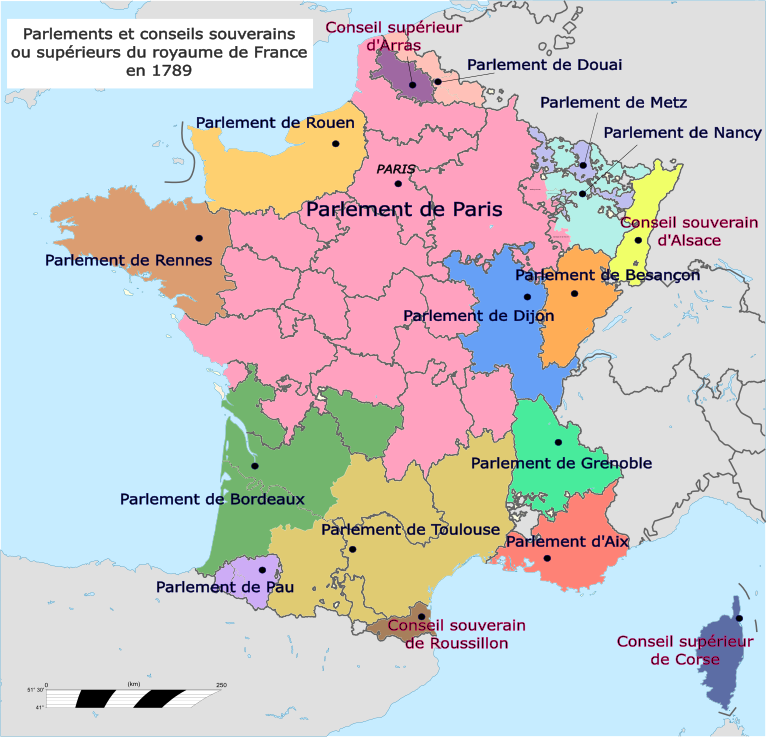
France faced a series of budgetary crises during the 18th century as revenues failed to keep pace with expenditure. Despite solid economic growth, the use of tax farmers meant this was not reflected in a proportional growth in state tax income. As the nobility and Church benefited from a variety of exemptions, the tax burden fell mainly on the lower classes. Reform was difficult because new tax laws had to be registered with regional judicial bodies or parlements that were able to block them. The king could impose laws by decree, but this risked open conflict with the parlements, the nobility, and those subject to new taxes.
France primarily used loans to fund the 1778 to 1783 Anglo-French War. Even after it ended, the monarchy continued to borrow heavily, and by 1788, half of state revenue went on servicing its debt. In 1786, the French finance minister, Calonne, proposed reforms including a universal land tax, the abolition of grain controls and internal tariffs, and new provincial assemblies appointed by the king. The new taxes were rejected, first by a hand-picked Assembly of Notables dominated by the nobility, then by the parlements when submitted by Calonne's successor Brienne. The notables and parlements argued that the proposed taxes could only be approved by an Estates-General, a representative body that last met in 1614.
The conflict between the Crown and the parlements became a national political crisis. Both sides issued a series of public statements, the government arguing that it was combating privilege, and the parlement defending the ancient rights of the nation. Public opinion was firmly on the side of the parlements, and riots broke out in several towns. Brienne's attempts to raise new loans failed, and on 8 August 1788, he announced that the king would summon an Estates-General to convene the following May. Brienne resigned and was replaced by Jacques Necker.
In September 1788, the Parlement of Paris ruled that the Estates-General should convene in the same form as in 1614, meaning that the three estates – the clergy, nobility, and commoners (known as the Third Estate) – would meet and vote separately, with votes counted by estate rather than by head. As a result, the clergy and nobility could combine to outvote the Third Estate, despite representing less than 5% of the population. With the relaxation of censorship and laws against political clubs, a group of liberal nobles and middle class activists known as the Society of Thirty launched a campaign for the doubling of Third Estate representation and individual voting. The public debate sparked an average of 25 new political pamphlets published each week from 25 September 1788.
One of the most influential was written by Abbé Sieyès. Titled What Is the Third Estate?, it denounced the privilege of the clergy and nobility, and argued the Third Estate represented the nation and should sit alone as a National Assembly. Activists such as Jean Joseph Mounier, Antoine Barnave and Maximilien Robespierre organised regional meetings, petitions and literature in support of these demands. In December, the king agreed to double the representation of the Third Estate, but left the question of counting votes for the Estates-General to decide.
The Catholic Church in France was wealthy, owning nearly 10% of all land, as well as receiving annual tithes. However, three-quarters of the 303 clergy elected were parish priests, many of whom earned less than unskilled labourers and had more in common with their poor parishioners than with the bishops of the first estate.
The Second Estate elected 322 deputies, representing about 400,000 men and women, who owned about 25% of the land and collected seigneurial dues and rents from their tenants. Most delegates were town-dwelling members of the noblesse d'épée, or traditional aristocracy. Courtiers and representatives of the noblesse de robe (those who derived rank from judicial or administrative posts) were underrepresented.
Of the 610 deputies of the Third Estate, about two-thirds held legal qualifications and almost half were venal office holders. Less than 100 were in trade or industry, and none were peasants or artisans. To assist delegates, each region completed a list of grievances, known as Cahiers de doléances. Tax inequality and seigneurial dues (feudal payments owed to landowners) headed the grievances in the cahiers de doleances for the estate.
On 5 May 1789, the Estates-General convened at Versailles, with Necker reiterating that each estate should decide separately how and when it would meet and vote in common with the other estates. On the following day, each estate was to separately verify the credentials of their representatives. The Third Estate, however, voted to invite the other estates to join them in verifying all the representatives of the Estates-General in common, and to agree that votes should be counted by head. Negotiations continued until 12 June when the Third Estate unilaterally began verifying its own members. On 17th, the Third Estate declared itself to be the National Assembly of France and that all existing taxes were illegal.
By 19 June, they had been joined by more than 100 members of the clergy. Shaken by this challenge to his authority, the king agreed to a reform package he would present personally to the Estates-General. The Salle des États was closed to prepare for the joint session, but the members of the Estates-General were not informed in advance. Finding their meeting place closed the next day, they took the so-called Tennis Court Oath, undertaking not to disperse until a constitution had been agreed.
At the royal session, Louis XVI announced a series of reforms and stated no new taxes or loans would be implemented without the consent of the Estates-General. However, he then undermined this by re-stating his original demand for all three to sit and vote separately. The Third Estate refused to leave the hall and reiterated their oath not to disperse until a constitution had been agreed. Over the next days more members of the clergy joined the National Assembly. On 27 June, faced with popular demonstrations and mutinies in his French Guards, Louis XVI commanded the members of the first and second estates to join the third in the National Assembly.
03Constitutional monarchy (July 1789 – September 1792)

Even the limited reforms the king had announced went too far for Marie Antoinette and Louis' younger brother the Comte d'Artois. On their advice, Louis dismissed Necker again as chief minister on 11 July. On 12 July, the Assembly went into a non-stop session following rumours that the king was planning to use the Swiss Guards to force it to close. The news brought crowds of protestors into the streets, and soldiers of the elite Gardes Françaises refused to disperse them.
On 14 July many of these soldiers joined a crowd attacking the Bastille, a royal fortress with large stores of arms and ammunition. Its governor, Bernard-René de Launay, surrendered after several hours of fighting that cost the lives of 83 attackers. Launay was taken to the Hôtel de Ville, where he was killed and his head placed on a pike and paraded around the city. Although rumoured to hold many prisoners, the Bastille held only seven: four forgers, a lunatic, a failed assassin, and a deviant nobleman. Nevertheless, it was a potent symbol of the Ancien Régime and it was demolished in the following weeks. Bastille Day has become the French national holiday.
Alarmed by the prospect of losing control of the capital, Louis appointed the Marquis de Lafayette commander of the National Guard, with Jean-Sylvain Bailly as head of a new administrative structure known as the Commune. On 17 July, Louis visited Paris accompanied by 100 deputies, where he was greeted by Bailly and accepted a tricolore cockade to loud cheers. However, it was clear power had shifted from his court; he was welcomed as 'Louis XVI, father of the French and king of a free people.'
The short-lived unity enforced on the Assembly by a common threat quickly dissipated. Deputies argued over constitutional forms, while civil authority rapidly deteriorated. On 22 July, former Finance Minister Joseph Foullon and his son were lynched by a Parisian mob, and neither Bailly nor Lafayette could prevent it. In rural areas, wild rumours and paranoia resulted in the formation of militia and an agrarian insurrection known as the Great Fear. The breakdown of law and order and frequent attacks on aristocratic property led much of the nobility to flee abroad. These émigrés funded reactionary forces within France and urged foreign monarchs to back a counter-revolution.
In response, the Assembly published the August Decrees which abolished feudalism. Over 25% of French farmland was subject to feudal dues, providing the nobility with most of their income; these were now cancelled, along with church tithes. While their former tenants were supposed to pay them compensation, collecting it proved impossible, and the obligation was annulled in 1793. Other decrees included equality before the law, opening public office to all, freedom of worship, and cancellation of special privileges held by provinces and towns.
With the suspension of the 13 regional parlements in November, the key institutional pillars of the old regime had all been abolished in less than four months. From its early stages, the Revolution therefore displayed signs of its radical nature; what remained unclear was the constitutional mechanism for turning intentions into practical applications.
On 9 July, the National Assembly declared itself the National Constituent Assembly and appointed a committee to draft a constitution and statement of rights. Twenty drafts were submitted, which were used by a sub-committee to create a Declaration of the Rights of Man and of the Citizen, with Mirabeau being the most prominent member. The declaration was approved by the Assembly and published on 26 August as a statement of principle.
The Assembly now concentrated on the constitution. Mounier and his monarchist supporters advocated a bicameral system, with an upper house appointed by the king, who would also have the right to appoint ministers and veto legislation. On 10 September, the majority of the Assembly, led by Sieyès and Talleyrand, voted in favour of a single body, and the following day approved a "suspensive veto" for the king, meaning Louis could delay implementation of a law but not block it indefinitely. In October, the Assembly voted to restrict political rights, including voting rights, to "active citizens", defined as French males over the age of 25 who paid direct taxes equal to three days' labour. The remainder were designated "passive citizens", restricted to "civil rights", a distinction opposed by a significant minority, including the Jacobin clubs. By mid-1790, the main elements of a constitutional monarchy were in place, although the constitution was not accepted by Louis until 1791.
Food shortages and the worsening economy caused frustration at the lack of progress and led to popular unrest in Paris. This came to a head in late September 1789, when the Flanders Regiment arrived in Versailles to reinforce the royal bodyguard and were welcomed with a formal banquet as was common practice. The radical press described this as a 'gluttonous orgy' and claimed the tricolour cockade had been abused, while the Assembly viewed their arrival as an attempt to intimidate them.
On 5 October, crowds of women assembled outside the Hôtel de Ville, agitating against high food prices and shortages. These protests quickly turned political, and after seizing weapons stored at the Hôtel de Ville, some 7,000 of them marched on Versailles, where they entered the Assembly to present their demands. They were followed to Versailles by 15,000 members of the National Guard under Lafayette, who was virtually "a prisoner of his own troops".
When the National Guard arrived later that evening, Lafayette persuaded Louis that the safety of his family required their relocation to Paris. Next morning, some of the protestors broke into the royal apartments, searching for Marie Antoinette, who had escaped. They ransacked the palace, killing several guards. Order was eventually restored, and the royal family and Assembly left for Paris, escorted by the National Guard. Louis had announced his acceptance of the August Decrees and the declaration, and his official title changed from 'King of France' to 'King of the French'.
Historian John McManners argues "in eighteenth-century France, throne and altar were commonly spoken of as in close alliance; their simultaneous collapse ... would one day provide the final proof of their interdependence." One suggestion is that after a century of persecution, some French Protestants actively supported an anti-Catholic regime, a resentment fuelled by Enlightenment thinkers such as Voltaire. Jean-Jacques Rousseau, considered a philosophical founder of the revolution, wrote it was "manifestly contrary to the law of nature ... that a handful of people should gorge themselves with superfluities, while the hungry multitude goes in want of necessities."
The Revolution caused a massive shift of power from the Catholic Church to the state; although the extent of religious belief has been questioned, elimination of tolerance for religious minorities meant by 1789 being French also meant being Catholic. The church was the largest individual landowner in France, controlling nearly 10% of all estates and levied tithes, effectively a 10% tax on income, collected from peasant farmers in the form of crops. In return, it provided a minimal level of social support.
The August Decrees abolished tithes, and on 2 November the Assembly confiscated all church property, the value of which was used to back a new paper currency known as assignats. In return, the state assumed responsibilities such as paying the clergy and caring for the poor, the sick and the orphaned. On 13 February 1790, religious orders and monasteries were dissolved, while monks and nuns were encouraged to return to private life.
The Civil Constitution of the Clergy of 12 July 1790 made them employees of the state, established rates of pay, and developed a system for electing priests and bishops. Pope Pius VI and many French Catholics objected to this since it denied the authority of the Pope over the French church. In October, 30 bishops wrote a declaration denouncing the law, further fuelling opposition. When clergy were required to swear loyalty to the Civil Constitution in November, it split the church between the 24% who complied and the majority who refused. This stiffened popular resistance against state interference, especially in traditionally Catholic areas such as Normandy, Brittany and the Vendée, where only a few priests took the oath and the civilian population turned against the revolution. The result was state-led persecution of "refractory clergy", many of whom were forced into exile, deported, or executed.
The period from October 1789 to spring 1791 is usually seen as one of relative tranquility, when some of the most important legislative reforms were enacted. However, conflict over the source of legitimate authority was more apparent in the provinces, where officers of the Ancien Régime had been swept away but not yet replaced by new structures. This was less obvious in Paris, since the National Guard made it the best policed city in Europe, but disorder in the provinces inevitably affected members of the Assembly.
Centrists led by Sieyès, Lafayette, Mirabeau and Bailly created a majority by forging consensus with monarchiens like Mounier, and independents including Adrien Duport, Barnave and Alexandre Lameth. At one end of the political spectrum, reactionaries like Cazalès and Maury denounced the Revolution in all its forms, with radicals like Maximilien Robespierre at the other. He and Jean-Paul Marat opposed the criteria for "active citizens", gaining them substantial support among the Parisian proletariat, many of whom had been disenfranchised by the measure.
On 14 July 1790, celebrations were held throughout France commemorating the fall of the Bastille, with participants swearing an oath of fidelity to "the nation, the law and the king." The Fête de la Fédération in Paris was attended by the royal family, with Talleyrand performing a mass. Despite this show of unity, the Assembly was increasingly divided, while external players like the Paris Commune and National Guard competed for power. One of the most significant was the Jacobin club; originally a forum for general debate, by August 1790 it had over 150 members, split into different factions.
The Assembly continued to develop new institutions; in September 1790, the regional Parlements were abolished and their legal functions replaced by a new independent judiciary, with jury trials for criminal cases. However, moderate deputies were uneasy at popular demands for universal suffrage, labour unions and cheap bread, and over the winter of 1790 and 1791, they passed a series of measures intended to disarm popular radicalism. These included exclusion of poorer citizens from the National Guard, limits on use of petitions and posters, and the June 1791 Le Chapelier Law suppressing trade guilds and any form of worker organization.
The traditional force for preserving law and order was the army, which was increasingly divided between officers, who largely came from the nobility, and ordinary soldiers. In August 1790, the loyalist General Bouillé suppressed a serious mutiny at Nancy; although congratulated by the Assembly, he was criticised by Jacobin radicals for the severity of his actions. Growing disorder meant many professional officers either left or became émigrés, further destabilising the institution.
Held in the Tuileries Palace under virtual house arrest, Louis XVI was urged by his brother and wife to re-assert his independence by taking refuge with Bouillé, who was based at Montmédy with 10,000 soldiers considered loyal to the Crown. The royal family left the palace in disguise on the night of 20 June 1791; late the next day, Louis was recognised as he passed through Varennes, arrested and taken back to Paris.
04First Republic (1792–1795)

In late August, elections were held for the National Convention. Restrictions on the franchise meant the number of votes cast fell to 3.3 million, versus 4 million in 1791, while intimidation was widespread. The Brissotins split between moderate Girondins led by Brissot, and radical Montagnards, headed by Robespierre, Georges Danton, and Jean-Paul Marat. While loyalties constantly shifted, voting patterns suggest roughly 160 of the 749 deputies can generally be categorised as Girondists, with another 200 Montagnards. The remainder were part of a centrist faction known as La Plaine, headed by Bertrand Barère, Pierre Joseph Cambon, and Lazare Carnot.
In the September Massacres, between 1,100 and 1,600 prisoners held in Parisian jails were summarily executed, the vast majority being common criminals. A response to the capture of Longwy and Verdun by Prussia, the perpetrators were largely National Guard members and fédérés on their way to the front. While responsibility is still disputed, even moderates expressed sympathy for the action, which soon spread to the provinces. One suggestion is that the killings stemmed from concern over growing lawlessness, rather than political ideology.
On 20 September, the French defeated the Prussians at the Battle of Valmy, in what was the first major victory by the army of France during the Revolutionary Wars. Emboldened by this, on 22 September the Convention replaced the monarchy with the French First Republic and introduced a new calendar, with 1792 becoming "Year One". The next few months were taken up with the trial of Citoyen Louis Capet, formerly Louis XVI. While evenly divided on the question of his guilt, members of the convention were increasingly influenced by radicals based within the Jacobin clubs and Paris Commune. The Brunswick Manifesto made it easy to portray Louis as a threat to the Revolution, especially when extracts from his personal correspondence showed him conspiring with Royalist exiles.
On 17 January 1793, Louis was sentenced to death for "conspiracy against public liberty and general safety". 361 deputies were in favour, 288 against, while another 72 voted to execute him, subject to delaying conditions. The sentence was carried out on 21 January on the Place de la Révolution, now the Place de la Concorde. Conservatives across Europe called for the destruction of revolutionary France, and in February the Convention responded by declaring war on Britain and the Dutch Republic. Together with Austria and Prussia, these two countries were later joined by Spain, Portugal, Naples, and Tuscany in the War of the First Coalition.
The Girondins hoped war would unite the people behind the government and provide an excuse for rising prices and food shortages. Instead, they found themselves the target of popular anger and in what proved a disastrous strategic move, many left Paris for the provinces. The first conscription measure or levée en masse on 24 February sparked riots in the capital and other regional centres. Already unsettled by changes imposed on the church, in March the traditionally conservative and royalist Vendée rose in revolt. On the 18th, General Charles François Dumouriez was defeated at Neerwinden and defected to the Austrians. Uprisings followed in Bordeaux, Lyon, Toulon, Marseille, and Caen. The Republic seemed on the verge of collapse.
The crisis led to the creation on 6 April 1793 of the Committee of Public Safety, an executive committee accountable to the convention. The Girondins made a fatal political error by indicting Marat before the Revolutionary Tribunal for allegedly directing the September massacres; he was quickly acquitted, further isolating the Girondins from the sans-culottes. When Jacques Hébert called for a popular revolt against the "henchmen of Louis Capet" on 24 May, he was arrested by the Commission of Twelve, a Girondin-dominated tribunal set up to expose 'plots'. In response to protests by the Commune, the Commission warned "if by your incessant rebellions something befalls the representatives of the nation, Paris will be obliterated".
Growing discontent allowed the clubs to mobilize against the Girondins. Backed by the Commune and elements of the National Guard, on 31 May they attempted to seize power in a coup. Although the coup failed, on 2 June the convention was surrounded by a crowd of up to 80,000, demanding cheap bread, unemployment pay and political reforms, including restriction of the vote to the sans-culottes, and the right to remove deputies at will. Ten members of the commission and another twenty-nine members of the Girondin faction were arrested, and on 10 June, the Montagnards took over the Committee of Public Safety.
Meanwhile, a committee led by Robespierre's close ally Louis Antoine de Saint-Just was tasked with preparing a new constitution. Completed in only eight days, it was ratified by the convention on 24 June and contained radical reforms, including universal male suffrage. However, normal legal processes were suspended following the assassination of Marat on 13 July by the Girondist Charlotte Corday, which the Committee of Public Safety used as an excuse to take control. The 1793 Constitution was suspended indefinitely in October.
Key areas of focus for the new government included creating a new state ideology, economic regulation, and winning the war. They were helped by divisions among their internal opponents; while areas like the Vendée and Brittany wanted to restore the monarchy, most supported the Republic but opposed the regime in Paris. On 17 August, the Convention voted a second levée en masse; despite initial problems in equipping and supplying such large numbers, by mid-October Republican forces had re-taken Lyon, Marseille and Bordeaux, while defeating Coalition armies at Hondschoote and Wattignies. The new class of military leaders included a young colonel named Napoleon Bonaparte, who was appointed commander of artillery at the siege of Toulon thanks to his friendship with Augustin Robespierre. His success in that role resulted in promotion to the Army of Italy in April 1794, and the beginning of his rise to military and political power.
Although intended to bolster revolutionary fervour, the Reign of Terror rapidly degenerated into the settlement of personal grievances. At the end of July, the Convention set price controls on a wide range of goods, with the death penalty for hoarders. On 9 September, 'revolutionary groups' were established to enforce these controls, while the Law of Suspects on 17 September approved the arrest of suspected "enemies of freedom". This initiated what has become known as the "Terror". From September 1793 to July 1794, around 300,000 were arrested, with some 16,600 people executed on charges of counter-revolutionary activity, while another 40,000 may have been summarily executed, or died awaiting trial.
Price controls made farmers reluctant to sell their produce in Parisian markets, and by early September the city was suffering acute food shortages. At the same time, the war increased public debt, which the Assembly tried to finance by selling confiscated property. However, few would buy assets that might be repossessed by their former owners, a concern that could only be alleviated by military victory. This meant the financial position worsened as threats to the Republic increased, while printing assignats to deal with the deficit further increased inflation.
On 10 October, the Convention recognised the Committee of Public Safety as the supreme Revolutionary Government and suspended the constitution until peace was achieved. In mid-October, Marie Antoinette was convicted of a long list of crimes and guillotined; two weeks later, the Girondist leaders arrested in June were also executed, along with Philippe Égalité. The "Terror" was not confined to Paris, with over 2,000 killed in Lyons after its recapture.
At Cholet on 17 October, the Republican army won a decisive victory over the Vendée rebels, and the survivors escaped into Brittany. A defeat at Le Mans on 23 December ended the rebellion as a major threat, although the insurgency continued until 1796. The extent of the repression that followed has been debated by French historians since the mid-19th century. Between November 1793 and February 1794, over 4,000 were drowned in the Loire at Nantes under the supervision of Jean-Baptiste Carrier. Historian Reynald Secher claims that as many as 117,000 died between 1793 and 1796. Although those numbers have been challenged, François Furet concludes it "not only revealed massacre and destruction on an unprecedented scale, but a zeal so violent that it has bestowed as its legacy much of the region's identity."
At the height of the Terror, not even its supporters were immune from suspicion, leading to divisions within the Montagnard faction between radical Hébertists and moderates led by Danton. Robespierre saw their dispute as de-stabilising the regime, and, as a deist, objected to the anti-religious policies advocated by the atheist Hébert, who was arrested and executed on 24 March with 19 of his colleagues. To retain the loyalty of the remaining Hébertists, Danton was arrested and executed on 5 April with Camille Desmoulins, after a show trial that arguably did more damage to Robespierre than any other act in this period.
The Law of 22 Prairial (10 June) denied "enemies of the people" the right to defend themselves. Those arrested in the provinces were sent to Paris for judgment; from March to July, executions in Paris increased from 5 to 26 per day. Many Jacobins ridiculed the festival of the Cult of the Supreme Being on 8 June, a lavish and expensive ceremony led by Robespierre, who was also accused of circulating claims he was a second Messiah. Relaxation of price controls and rampant inflation caused increasing unrest among the sans-culottes, but the improved military situation reduced fears the Republic was in danger. Fearing their own survival depended on Robespierre's removal, on 29 June three members of the Committee of Public Safety openly accused him of being a dictator. Robespierre responded by refusing to attend Committee meetings, allowing his opponents to build a coalition against him. In a speech made to the convention on 26 July, he claimed certain members were conspiring against the Republic, an almost certain death sentence if confirmed. When he refused to provide names, the session broke up in confusion. That evening he repeated these claims at the Jacobins club, where it was greeted with demands for execution of the 'traitors'. Fearing the consequences if they did not act first, his opponents attacked Robespierre and his allies in the Convention next day. When Robespierre attempted to speak, his voice failed, one deputy crying "The blood of Danton chokes him!"
After the Convention authorised his arrest, he and his supporters took refuge in the Hotel de Ville, which was defended by elements of the National Guard. Other units loyal to the Convention stormed the building that evening and detained Robespierre, who severely injured himself attempting suicide. He was executed on 28 July with 19 colleagues, including Saint-Just and Georges Couthon, followed by 83 members of the Commune. The Law of 22 Prairial was repealed, any surviving Girondists reinstated as deputies, and the Jacobin Club was closed and banned.
There are various interpretations of the Terror and the violence with which it was conducted. Furet argues that the intense ideological commitment of the revolutionaries and their utopian goals required the extermination of any opposition. A middle position suggests violence was not inevitable but the product of a series of complex internal events, exacerbated by war.
The bloodshed did not end with the death of Robespierre; southern France saw a wave of revenge killings, directed against alleged Jacobins, Republican officials and Protestants.
05French Directory (1795–1799)
Jacobin sympathisers viewed the French Directory as a betrayal of the Revolution, while Bonapartists later justified Napoleon's coup by emphasizing its corruption. The regime also faced internal unrest, a weak economy, and an expensive war, while the Council of 500 could block legislation at will. Since the directors had no power to call new elections, the only way to break a deadlock was rule by decree or use force. As a result, the directory was characterised by "chronic violence, ambivalent forms of justice, and repeated recourse to heavy-handed repression."
Retention of the Conventionnels ensured the Thermidorians held a majority in the legislature and three of the five directors, but they were increasingly challenged by the right. On 5 October, Convention troops led by Napoleon put down a royalist rising in Paris; when the first legislative elections were held two weeks later, over 100 of the 150 new deputies were royalists of some sort. The power of the Parisian sans-culottes had been broken by the suppression of the May 1795 revolt; relieved of pressure from below, the Jacobin clubs became supporters of the directory, largely to prevent restoration of the monarchy.
Removal of price controls and a collapse in the value of the assignat led to inflation and soaring food prices. By April 1796, over 500,000 Parisians were unemployed, resulting in the May insurrection known as the Conspiracy of the Equals. Led by the revolutionary François-Noël Babeuf, their demands included immediate implementation of the 1793 Constitution, and a more equitable distribution of wealth. Despite support from sections of the military, the revolt was easily crushed, while Babeuf and other leaders were executed. Nevertheless, by 1799 the economy had been stabilised, and important reforms made allowing steady expansion of French industry. Many of these remained in place for much of the 19th century.
Prior to 1797, three of the five directors were firmly Republican; Barras, Révellière-Lépeaux and Jean-François Rewbell, as were around 40% of the legislature. The same percentage were broadly centrist or unaffiliated, along with two directors, Étienne-François Letourneur and Lazare Carnot. Although only 20% were committed Royalists, many centrists supported the restoration of the exiled Louis XVIII in the belief this would bring peace. The elections of May 1797 resulted in significant gains for the right, with Royalists Jean-Charles Pichegru elected president of the Council of 500, and Barthélemy appointed a director.
With Royalists apparently on the verge of power, Republicans attempted a pre-emptive coup on 4 September. Using troops from Napoleon's Army of Italy under Pierre Augereau, the Council of 500 was forced to approve the arrest of Barthélemy, Pichegru and Carnot. The elections were annulled, 63 leading Royalists deported to French Guiana, and laws were passed against émigrés, Royalists and ultra-Jacobins. The removal of his conservative opponents opened the way for direct conflict between Barras and those on the left.
Fighting continued despite general war weariness, and the 1798 elections resulted in a resurgence in Jacobin strength. Napoleon's invasion of Egypt in July 1798 confirmed European fears of French expansionism, and the War of the Second Coalition began in November. Without a majority in the legislature, the directors relied on the army to enforce decrees and extract revenue from conquered territories. Generals like Napoleon and Barthélemy Catherine Joubert became central to the political process, while both the army and directory became notorious for their corruption.
It has been suggested the directory collapsed because by 1799, many 'preferred the uncertainties of authoritarian rule to the continuing ambiguities of parliamentary politics'. The architect of its end was Sieyès, who when asked what he had done during the Terror allegedly answered "I survived". Nominated to the directory, his first action was to remove Barras, with the help of allies including Talleyrand, and Napoleon's brother Lucien, president of the Council of 500. On 9 November 1799, the coup of 18 Brumaire replaced the five directors with the French Consulate, which consisted of three members, Napoleon, Sieyès, and Roger Ducos. Most historians consider this the end point of the French Revolution.
06Role of ideology
The role of ideology in the Revolution is controversial with Jonathan Israel stating that the "radical Enlightenment" was the primary driving force of the Revolution. Cobban, however, argues "[t]he actions of the revolutionaries were most often prescribed by the need to find practical solutions to immediate problems, using the resources at hand, not by pre-conceived theories."
The identification of ideologies is complicated by the profusion of revolutionary clubs, factions and publications, absence of formal political parties, and individual flexibility in the face of changing circumstances. In addition, although the Declaration of the Rights of Man was a fundamental document for all revolutionary factions, its interpretation varied widely.
While all revolutionaries professed their devotion to liberty in principle, "It appeared to mean whatever those in power wanted." For example, the liberties specified in the Rights of Man were limited by law when they might "cause harm to others, or be abused". Prior to 1792, Jacobins and others frequently opposed press restrictions on the grounds these violated a basic right. However, the radical National Convention passed laws in September 1793 and July 1794 imposing the death penalty for offences such as "disparaging the National Convention", and "misleading public opinion."
While revolutionaries also endorsed the principle of equality, few advocated equality of wealth since property was also viewed as a right. The National Assembly opposed equal political rights for women, while the abolition of slavery in the colonies was delayed until February 1794 because it conflicted with the property rights of slave owners, and many feared it would disrupt trade. Political equality for male citizens was another divisive issue, with the 1791 constitution limiting the right to vote and stand for office to males over 25 who met a property qualification, so-called "active citizens". This restriction was opposed by many activists, including Robespierre, the Jacobins, and Cordeliers.
The principle that sovereignty resided in the nation was a key concept of the Revolution. However, Israel argues this obscures ideological differences over whether the will of the nation was best expressed through representative assemblies and constitutions, or direct action by revolutionary crowds, and popular assemblies such as the sections of the Paris commune. Many considered constitutional monarchy as incompatible with the principle of popular sovereignty, but prior to 1792, there was a strong bloc with an ideological commitment to such a system, based on the writings of Thomas Hobbes, John Locke, Montesquieu, and Voltaire.
Israel argues the nationalization of church property and the establishment of the Constitutional Church reflected an ideological commitment to secularism, and a determination to undermine a bastion of old regime privilege. While Cobban agrees the Constitutional Church was motivated by ideology, he sees its origins in the anti-clericalism of Voltaire and other Enlightenment figures.
Jacobins were hostile to formal political parties and factions which they saw as a threat to national unity and the general will, with "political virtue" and "love of country" key elements of their ideology. They viewed the ideal revolutionary as selfless, sincere, free of political ambition, and devoted to the nation. The disputes leading to the departure first of the Feuillants, then later the Girondists, were conducted in terms of the relative political virtue and patriotism of the disputants. In December 1793, all members of the Jacobin clubs were subject to a "purifying scrutiny", to determine whether they were "men of virtue".
Article sections from Wikipedia (CC BY-SA 4.0). Excerpted for readability.