The Great Depression was a severe global economic downturn from 1929 to 1939. The period was marked by high rates of unemployment and poverty, drastic reductions in industrial production and international trade, and widespread bank and business failures around the world. The economic contagion began in 1929 in the United States, the largest economy in the world, with the devastating Wall Street crash of 1929 often considered the beginning of the Depression. Among the countries with the most unemployed were the U.S., the United Kingdom, and Germany.
The Depression was preceded by a period of industrial growth and social development known as the "Roaring Twenties". Much of the profit generated by the boom was invested in speculation, such as in the stock market, contributing to growing wealth inequality. Banks were subject to minimal regulation, resulting in loose lending and widespread debt. By 1929, declining spending had led to reductions in manufacturing output and rising unemployment. Share values continued to rise until the October 1929 crash, after which the slide continued until July 1932, accompanied by a loss of confidence in the financial system. By 1933, the U.S. unemployment rate had risen to 25%, about one-third of farmers had lost their land, and 9,000 of its 25,000 banks had gone out of business. President Herbert Hoover was unwilling to intervene heavily in the economy, and in 1930 he signed the Smoot–Hawley Tariff Act, which inadvertently worsened the Depression. In the 1932 presidential election, Hoover was defeated by Franklin D. Roosevelt, who from 1933 pursued a set of expansive New Deal programs in order to provide relief and create jobs. In Germany, which depended heavily on U.S. loans, the crisis caused unemployment to rise to nearly 30% and fueled political extremism, paving the way for Adolf Hitler's Nazi Party to rise to power in 1933.
Between 1929 and 1932, worldwide gross domestic product (GDP) fell by an estimated 15%; in the U.S., the Depression resulted in a 30% contraction in GDP. Recovery varied greatly around the world. Some economies, such as the U.S., Germany, and Japan, started to recover by the mid-1930s; others, such as France, did not return to pre-shock growth rates until later in the decade. The Depression had devastating economic effects on both wealthy and poor countries: all experienced drops in personal income, prices (deflation), tax revenues, and profits. International trade fell by more than 50%, and unemployment in some countries rose as high as 33%. Cities around the world, especially those dependent on heavy industry, were heavily affected. Construction virtually halted in many countries, and farming communities and rural areas suffered as crop prices fell by up to 60%. Faced with plummeting demand and few job alternatives, areas dependent on primary sector industries suffered the most. The outbreak of World War II in 1939 ended the Depression, as it stimulated factory production, providing jobs for women as militaries absorbed large numbers of young, unemployed men.
The precise causes for the Great Depression are disputed. One set of historians, for example, focuses on non-monetary economic causes. Among these, some regard the Wall Street crash itself as the main cause; others consider that the crash was a mere symptom of more general economic trends of the time, which had already been underway in the late 1920s. A contrasting set of views, which rose to prominence in the later part of the 20th century, ascribes a more prominent role to failures of monetary policy. According to those authors, while general economic trends can explain the emergence of the downturn, they fail to account for its severity and longevity; they argue that these were caused by the lack of an adequate response to the crises of liquidity that followed the initial economic shock of 1929 and the subsequent bank failures accompanied by a general collapse of the financial markets.
Summary from Wikipedia (CC BY-SA 4.0)
01Overview
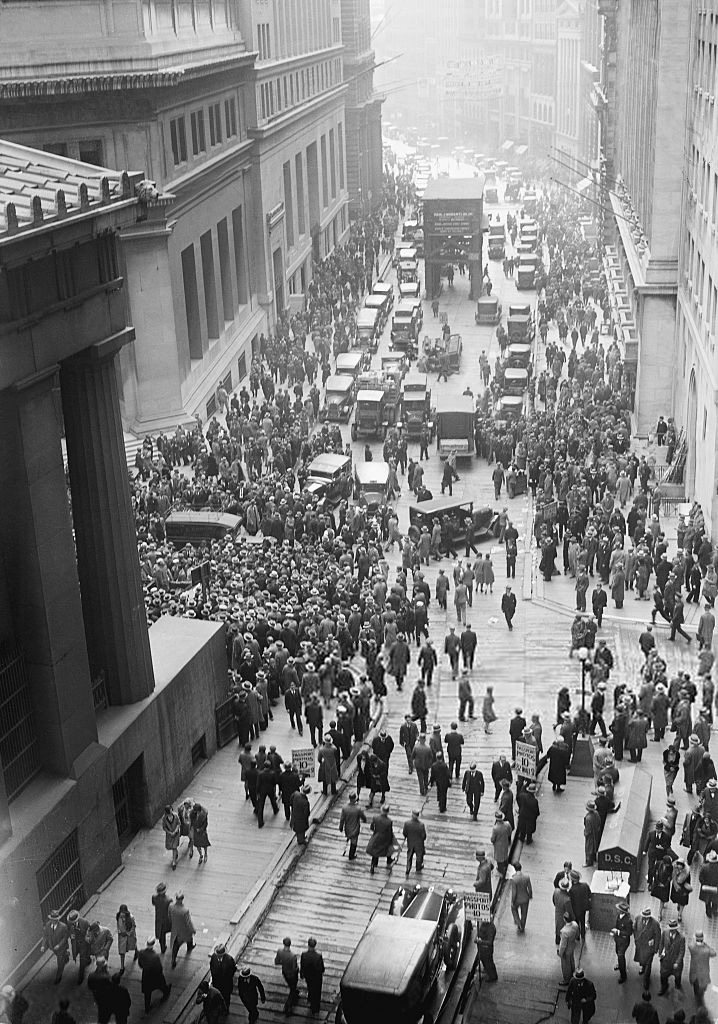
After the Wall Street crash of 1929, when the Dow Jones Industrial Average dropped from 381 to 198 over the course of two months, optimism persisted for some time. The stock market rose in early 1930, with the Dow returning to 294 (pre-depression levels) in April 1930, before steadily declining for years, to a low of 41 in 1932.
At the beginning, governments and businesses spent more in the first half of 1930 than in the corresponding period of the previous year. On the other hand, consumers, many of whom suffered severe losses in the stock market the previous year, cut expenditures by 10%. In addition, beginning in the mid-1930s, a severe drought ravaged the agricultural heartland of the U.S.
Interest rates dropped to low levels by mid-1930, but expected deflation and the continuing reluctance of people to borrow meant that consumer spending and investment remained low. By May 1930, automobile sales had declined to below the levels of 1928. Prices, in general, began to decline, although wages held steady in 1930. Then a deflationary spiral started in 1931. Farmers faced a worse outlook; declining crop prices and a Great Plains drought crippled their economic outlook. At its peak, the Great Depression saw nearly 10% of all Great Plains farms change hands despite federal assistance.
At first, the decline in the U.S. economy was the factor that triggered economic downturns in most other countries due to a decline in trade, capital movement, and global business confidence. Then, internal weaknesses or strengths in each country made conditions worse or better. For example, the U.K. economy, which experienced an economic downturn throughout most of the late 1920s, was less severely impacted by the shock of the depression than the U.S. By contrast, the German economy saw a similar decline in industrial output as that observed in the U.S. Some economic historians attribute the differences in the rates of recovery and relative severity of the economic decline to whether particular countries had been able to effectively devaluate their currencies or not. This is supported by the contrast in how the crisis progressed in, e.g., Britain, Argentina, and Brazil, all of which devalued their currencies early and returned to normal patterns of growth faster than countries that stuck to the gold standard, such as France or Belgium.
Attempts by individual countries to shore up their economies through protectionist policies—such as the 1930 U.S. Smoot–Hawley Tariff Act and retaliatory tariffs in other countries—led to a collapse in global trade, contributing to the depression. By 1933, the economic decline had pushed world trade to one-third of its level compared to four years earlier.
02Course

While the precise causes for the occurrence of the Great Depression are disputed and can be traced to both global and national phenomena, its immediate origins are most conveniently examined in the context of the U.S. economy, from which the initial crisis spread to the rest of the world.
In the aftermath of World War I, the Roaring Twenties brought considerable wealth to the United States and Western Europe. Initially, the year 1929 dawned with good economic prospects: despite a minor crash on 25 March 1929, the market seemed to gradually improve through September. Stock prices began to slump in September and were volatile at the end of the month. A large sell-off of stocks began in mid-October. Finally, on 24 October, Black Thursday, the American stock market crashed 11% at the opening bell. Actions to stabilize the market failed, and on 28 October, Black Monday, the market crashed another 12%. The panic peaked the next day on Black Tuesday, when the market saw another 11% drop.
Thousands of investors were ruined, and billions of dollars had been lost; many stocks could not be sold at any price. The market recovered 12% on Wednesday, but by then significant damage had been done. Though the market entered a period of recovery from 14 November until 17 April 1930, the general situation had been a prolonged slump. From September 1929 to 8 July 1932, the market lost 85% of its value.
Despite the crash, the worst of the crisis did not reverberate around the world until after 1929. The crisis hit panic levels again in December 1930, with a bank run on the Bank of United States, a former privately run bank bearing no relation to the U.S. government (not to be confused with the Federal Reserve). Unable to pay out to all of its creditors, the bank failed.
Among the 608 American banks that closed in November and December 1930, the Bank of United States accounted for a third of the total $550 million deposits lost, and with its closure, bank failures reached a critical mass.
In an initial response to the crisis, the U.S. Congress passed the Smoot–Hawley Tariff Act on 17 June 1930. The act was ostensibly aimed at protecting the American economy from foreign competition by imposing high tariffs on foreign imports. The consensus view among economists and economic historians (including Keynesians, Monetarists, and Austrian economists) is that the passage of the Smoot–Hawley Tariff had, in fact, achieved an opposite effect to what was intended. It exacerbated the Great Depression by preventing economic recovery after domestic production recovered, hampering the volume of trade; still, there is disagreement as to the precise extent of the Act's influence.
In a 1995 survey of American economic historians, two-thirds agreed that the Smoot–Hawley Tariff Act at least worsened the Great Depression. According to the U.S. Senate website, the Smoot–Hawley Tariff Act is among the most catastrophic acts in congressional history.
Many economists have argued that the sharp decline in international trade after 1930 helped to worsen the depression, especially for countries significantly dependent on foreign trade. Most historians and economists blame the act for worsening the depression by seriously reducing international trade and causing retaliatory tariffs in other countries. While foreign trade was a small part of overall economic activity in the U.S. and was concentrated in a few businesses such as farming, it was a much larger factor in many other countries. The average ad valorem (value-based) rate of duties on dutiable imports for 1921–1925 was 25.9%, but under the new tariff it jumped to 50% during 1931–1935. In dollar terms, American exports declined over the next four years from about $5.2 billion in 1929 to $1.7 billion in 1933. Hardest hit were farm commodities such as wheat, cotton, tobacco, and lumber.
Governments around the world took various steps into spending less money on foreign goods, such as "imposing tariffs, import quotas, and exchange controls". These restrictions triggered much tension among countries that had large amounts of bilateral trade, causing major export-import reductions during the depression. Not all governments enforced the same measures of protectionism. Some countries raised tariffs drastically and enforced severe restrictions on foreign exchange transactions, while other countries reduced "trade and exchange restrictions only marginally":
"Countries that remained on the gold standard, keeping currencies fixed, were more likely to restrict foreign trade." These countries "resorted to protectionist policies to strengthen the balance of payments and limit gold losses." They hoped that these restrictions and depletions would hold the economic decline.
Countries that abandoned the gold standard allowed their currencies to depreciate which caused their balance of payments to strengthen. It also freed up monetary policy so that central banks could lower interest rates and act as lenders of last resort. They possessed the best policy instruments to fight the Depression and did not need protectionism.
"The length and depth of a country's economic downturn and the timing and vigor of its recovery are related to how long it remained on the gold standard. Countries abandoning the gold standard relatively early experienced relatively mild recessions and early recoveries. In contrast, countries remaining on the gold standard experienced prolonged slumps."
The gold standard was the primary transmission mechanism of the Great Depression. Even countries that did not face bank failures and a monetary contraction firsthand were forced to join the deflationary policy since higher interest rates in countries that performed a deflationary policy led to a gold outflow in countries with lower interest rates. Under the gold standard's price–specie flow mechanism, countries that lost gold but nevertheless wanted to maintain the gold standard had to permit their money supply to decrease and the domestic price level to decline (deflation).
Some economic studies have indicated that the rigidities of the gold standard not only spread the downturn worldwide but also suspended gold convertibility (devaluing the currency in gold terms) that did the most to make recovery possible.
Every major currency left the gold standard during the Great Depression. The UK was the first to do so. Facing speculative attacks on the pound and depleting gold reserves, in September 1931 the Bank of England ceased exchanging pound notes for gold and the pound was floated on foreign exchange markets. Japan and the Scandinavian countries followed in 1931. Other countries, such as Italy and the United States, remained on the gold standard into 1932 or 1933, while a few countries in the so-called "gold bloc", led by France and including Poland, Belgium, and Switzerland, stayed on the standard until 1935–36.
According to later analysis, the earliness with which a country left the gold standard reliably predicted its economic recovery. For example, The UK and Scandinavia, which left the gold standard in 1931, recovered much earlier than France and Belgium, which remained on gold much longer. Countries such as China, which had a silver standard, almost avoided the depression entirely. The connection between leaving the gold standard as a strong predictor of that country's severity of its depression and the length of time of its recovery has been shown to be consistent for dozens of countries, including developing countries. This partly explains why the experience and length of the depression differed between regions and states around the world.
The financial crisis escalated out of control in mid-1931, starting with the collapse of the Creditanstalt in Vienna in May. This put heavy pressure on Germany, which was already in political turmoil. With the rise in violence of National Socialist ('Nazi') and Communist movements, as well as investor nervousness at harsh government financial policies, investors withdrew their short-term money from Germany as confidence spiraled downward. The Reichsbank lost 150 million marks in the first week of June, 540 million in the second, and 150 million in two days, 19–20 June. Collapse was at hand. U.S. President Herbert Hoover called for a moratorium on payment of war reparations. This angered Paris, which depended on a steady flow of German payments, but it slowed the crisis down, and the moratorium was agreed to in July 1931. An international conference in London later in July produced no agreements, but on 19 August a standstill agreement froze Germany's foreign liabilities for six months. Germany received emergency funding from private banks in New York as well as the Bank of International Settlements and the Bank of England. The funding only slowed the process. Industrial failures began in Germany; a major bank closed in July, and a two-day holiday for all German banks was declared. Business failures were more frequent in July and spread to Romania and Hungary. The crisis continued to get worse in Germany, bringing political upheaval that finally led to the coming to power of Hitler's Nazi regime in January 1933.
The world financial crisis now began to overwhelm Britain; investors around the world started withdrawing their gold from London at the rate of £2.5 million per day. Credits of £25 million each from the Bank of France and the Federal Reserve Bank of New York and an issue of £15 million fiduciary notes slowed, but did not reverse, the British crisis. The financial crisis now caused a major political crisis in Britain in August 1931. With deficits mounting, the bankers demanded a balanced budget; the divided cabinet of Prime Minister Ramsay MacDonald agreed; it proposed to raise taxes, cut spending, and most controversially, cut unemployment benefits by 20%. The attack on welfare was unacceptable to the Labour movement. MacDonald wanted to resign, but King George V insisted he remain and form an all-party coalition "National Government". The Conservative and Liberal parties signed on, along with a small cadre of Labour, but the vast majority of Labour leaders denounced MacDonald as a traitor for leading the new government. Britain went off the gold standard, and suffered relatively less than other major countries in the Great Depression. In the 1931 British election, the Labour Party was virtually destroyed, leaving MacDonald as prime minister for a largely Conservative coalition.
In most countries of the world, recovery from the Great Depression began in 1933. In the U.S., recovery began in early 1933, but the U.S. did not return to 1929 GNP for over a decade and still had an unemployment rate of about 15% in 1940, albeit down from the high of 25% in 1933.
There is no consensus among economists regarding the motive force for the U.S. economic expansion that continued through most of the Roosevelt years (and the 1937 recession that interrupted it). The common view among most economists is that Roosevelt's New Deal policies either caused or accelerated the recovery, although his policies were never aggressive enough to bring the economy completely out of recession. Some economists have also called attention to the positive effects from expectations of reflation and rising nominal interest rates that Roosevelt's words and actions portended. It was the rollback of those same reflationary policies that led to the interruption of a recession beginning in late 1937. One contributing policy that reversed reflation was the Banking Act of 1935, which effectively raised reserve requirements, causing a monetary contraction that helped to thwart the recovery. GDP returned to its upward trend in 1938. A revisionist view among some economists holds that the New Deal prolonged the Great Depression, as they argue that National Industrial Recovery Act of 1933 and the National Labor Relations Act of 1935 restricted competition and established price fixing.
03Causes

During World War I, many countries suspended their gold standard in varying ways. There was high inflation from WWI and in the 1920s in the Weimar Republic, Austria, and throughout Europe. In the late 1920s there was a scramble to deflate prices to get the gold standard's conversion rates back on track to pre-WWI levels by causing deflation and high unemployment through monetary policy. In 1933 FDR signed Executive Order 6102 and in 1934 signed the Gold Reserve Act.
The two classic competing economic theories of the Great Depression are the Keynesian (demand-driven) and the Monetarist explanation. There are also various heterodox theories that downplay or reject the explanations of the Keynesians and monetarists. The consensus among demand-driven theories is that a large-scale loss of confidence led to a sudden reduction in consumption and investment spending. Once panic and deflation set in, many people believed they could avoid further losses by keeping clear of the markets. Holding money became profitable as prices dropped lower and a given amount of money bought ever more goods, exacerbating the drop in demand. Monetarists believe that the Great Depression started as an ordinary recession, but the shrinking of the money supply greatly exacerbated the economic situation, causing a recession to descend into the Great Depression.
Economists and economic historians are almost evenly split as to whether the traditional monetary explanation that monetary forces were the primary cause of the Great Depression is right or the traditional Keynesian explanation that a fall in autonomous spending, particularly investment, is the primary explanation for the onset of the Great Depression. Today there is also significant academic support for the debt deflation theory and the expectations hypothesis that—building on the monetary explanation of Milton Friedman and Anna Schwartz—add non-monetary explanations.
There is a consensus that the Federal Reserve System should have cut short the process of monetary deflation and banking collapse by expanding the money supply and acting as lender of last resort. If they had done this, the economic downturn would have been far less severe and much shorter.
Modern mainstream economists see the reasons in
A money supply reduction (Monetarists) and therefore a banking crisis, reduction of credit, and bankruptcies.
Insufficient demand from the private sector and insufficient fiscal spending (Keynesians).
Passage of the Smoot–Hawley Tariff Act exacerbated what otherwise might have been a more "standard" recession (both Monetarists and Keynesians).
Insufficient spending, the money supply reduction, and debt on margin led to falling prices and further bankruptcies (Irving Fisher's debt deflation).
The monetarist explanation was given by American economists Milton Friedman and Anna J. Schwartz. They argued that the Great Depression was caused by the banking crisis that caused one-third of all banks to vanish, a reduction of bank shareholder wealth, and more importantly, a monetary contraction of 35%, which they called "The Great Contraction". This caused a price drop of 33% (deflation). By not lowering interest rates, by not increasing the monetary base, and by not injecting liquidity into the banking system to prevent it from crumbling, the Federal Reserve passively watched the transformation of a normal recession into the Great Depression. Friedman and Schwartz argued that the downward turn in the economy, starting with the stock market crash, would merely have been an ordinary recession if the Federal Reserve had taken aggressive action. This view was endorsed in 2002 by Federal Reserve Governor Ben Bernanke in a speech honoring Friedman and Schwartz with this statement:
Let me end my talk by abusing slightly my status as an official representative of the Federal Reserve. I would like to say to Milton and Anna: Regarding the Great Depression, you're right. We did it. We're very sorry. But thanks to you, we won't do it again.
The Federal Reserve allowed some large public bank failures—particularly that of the New York-based Bank of United States—which produced panic and widespread runs on local banks, and the Federal Reserve sat idly by while banks collapsed. Friedman and Schwartz argued that, if the Fed had provided emergency lending to these key banks, or simply bought government bonds on the open market to provide liquidity and increase the quantity of money after the key banks fell, all the rest of the banks would not have fallen after the key ones did, and the money supply would not have fallen as far and as fast as it did.
With significantly less money to go around, businesses could not get new loans and could not even get their old loans renewed, forcing many to stop investing. This interpretation blames the Federal Reserve for inaction, especially the New York branch.
One reason why the Federal Reserve did not act to limit the decline of the money supply was the gold standard. At that time, the amount of credit the Federal Reserve could issue was limited by the Federal Reserve Act, which required 40% gold backing of Federal Reserve Notes issued. By the late 1920s, the Federal Reserve had almost hit the limit of allowable credit that could be backed by the gold in its possession. This credit was in the form of Federal Reserve demand notes. A "promise of gold" is not as good as "gold in the hand", particularly when they only had enough gold to cover 40% of the Federal Reserve Notes outstanding. During the bank panics, a portion of those demand notes was redeemed for Federal Reserve gold. Since the Federal Reserve had hit its limit on allowable credit, any reduction in gold in its vaults had to be accompanied by a greater reduction in credit. On 5 April 1933, President Roosevelt signed Executive Order 6102, making the private ownership of gold certificates, coins, and bullion illegal, reducing the pressure on Federal Reserve gold.
British economist John Maynard Keynes argued in The General Theory of Employment, Interest and Money that lower aggregate expenditures in the economy contributed to a massive decline in income and to employment that was well below the average. In such a situation, the economy reached equilibrium at low levels of economic activity and high unemployment.
Keynes's basic idea was simple: to keep people fully employed, governments have to run deficits when the economy is slowing, as the private sector would not invest enough to keep production at the normal level and bring the economy out of recession. Keynesian economists called on governments during times of economic crisis to pick up the slack by increasing government spending or cutting taxes.
As the Depression wore on, Franklin D. Roosevelt tried public works, farm subsidies, and other devices to restart the U.S. economy but never completely gave up trying to balance the budget. According to the Keynesians, this improved the economy, but Roosevelt never spent enough to bring the economy out of recession until the start of World War II.
Irving Fisher argued that the predominant factor leading to the Great Depression was a vicious circle of deflation and growing over-indebtedness. He outlined nine factors interacting with one another under conditions of debt and deflation to create the mechanics of boom to bust. The chain of events proceeded as follows:
Debt liquidation and distress selling
Contraction of the money supply as bank loans are paid off
A fall in the level of asset prices
A still greater fall in the net worth of businesses, precipitating bankruptcies
A fall in profits
A reduction in output, in trade and in employment
Pessimism and loss of confidence
Hoarding of money
A fall in nominal interest rates and a rise in deflation-adjusted interest rates
During the Crash of 1929 preceding the Great Depression, margin requirements were only 10%. Brokerage firms, in other words, would lend $9 for every $1 an investor had deposited. When the market fell, brokers called in these loans, which could not be paid back. Banks began to fail as debtors defaulted on debt and depositors attempted to withdraw their deposits en masse, triggering multiple bank runs. Government guarantees and Federal Reserve banking regulations to prevent such panics were ineffective or not used. Bank failures led to the loss of billions of dollars in assets.
Outstanding debts became heavier because prices and incomes fell by 20–50%, but the debts remained at the same dollar amount. After the panic of 1929 and during the first 10 months of 1930, 744 U.S. banks failed. (In all, 9,000 banks failed during the 1930s.) By April 1933, around $7 billion in deposits had been frozen in failed banks or those left unlicensed after the March Bank Holiday. Bank failures snowballed as desperate bankers called in loans that borrowers did not have time or money to repay. With future profits looking poor, capital investment and construction slowed or completely ceased. In the face of bad loans and worsening future prospects, the surviving banks became even more conservative in their lending. Banks built up their capital reserves and made fewer loans, which intensified deflationary pressures. A vicious cycle developed, and the downward spiral accelerated.
The liquidation of debt could not keep up with the fall of prices that it caused. The mass effect of the stampede to liquidate increased the value of each dollar owed, relative to the value of declining asset holdings. The very effort of individuals to lessen their burden of debt effectively increased it. Paradoxically, the more the debtors paid, the more they owed. This self-aggravating process turned a 1930 recession into a 1933 Great Depression.
Fisher's debt-deflation theory initially lacked mainstream influence because of the counterargument that debt-deflation represented no more than a redistribution from one group (debtors) to another (creditors). Pure redistributions should have no significant macroeconomic effects.
Building on both the monetary hypothesis of Milton Friedman and Anna Schwartz and the debt deflation hypothesis of Irving Fisher, Ben Bernanke developed an alternative way in which the financial crisis affected output. He builds on Fisher's argument that dramatic declines in the price level and nominal incomes lead to increasing real debt burdens, which in turn lead to debtor insolvency and consequently lower aggregate demand; a further price level decline would then result in a debt deflationary spiral. According to Bernanke, a small decline in the price level simply reallocates wealth from debtors to creditors without doing damage to the economy. But when the deflation is severe, falling asset prices along with debtor bankruptcies lead to a decline in the nominal value of assets on bank balance sheets. Banks will react by tightening their credit conditions, which in turn leads to a credit crunch that seriously harms the economy. A credit crunch lowers investment and consumption, which results in declining aggregate demand and additionally contributes to the deflationary spiral.
Since the economic mainstream turned to the new neoclassical synthesis, expectations have been a central element of macroeconomic models. According to Peter Temin, Barry Wigmore, Gauti B. Eggertsson, and Christina Romer, the key to recovery and to ending the Great Depression was brought about by a successful management of public expectations. The thesis is based on the observation that after years of deflation and a very severe recession, important economic indicators turned positive in March 1933 when Franklin D. Roosevelt took office. Consumer prices turned from deflation to a mild inflation, industrial production bottomed out in March 1933, and investment doubled in 1933 with a turnaround in March 1933. There were no monetary forces to explain that turnaround.
04Effects by country

The majority of countries set up relief programs, and most underwent some sort of political upheaval, pushing them to the right. Many of the countries in Europe and Latin America that were democracies saw their democratic governments overthrown by some form of dictatorship or authoritarian rule, most famously in Germany in 1933. The Dominion of Newfoundland abandoned its autonomy within the British Empire, becoming the only region ever to voluntarily relinquish democracy. There, too, were severe impacts across the Middle East and North Africa, including economic decline, which led to social unrest.
The decline in foreign trade hit Argentina hard. The British decision to stop importing Argentine beef led to the signing of the Roca–Runciman Treaty, which preserved a quota in exchange for significant concessions to British exports. By 1935, the economy had recovered to 1929 levels, and the same year, the Central Bank of Argentina was formed. However, the Great Depression was the last time when Argentina was one of the richer countries of the world, as it stopped growing in the decades thereafter and became underdeveloped.
Australia's dependence on agricultural and industrial exports meant it was one of the hardest-hit developed countries. Falling export demand and commodity prices placed massive downward pressures on wages. Unemployment reached a record high of 29% in 1932, with incidents of civil unrest becoming common. After 1932, an increase in wool and meat prices led to a gradual recovery.
Harshly affected by both the global economic downturn and the Dust Bowl, Canadian industrial production had by 1932 fallen to only 58% of its 1929 figure, the second-lowest level in the world after the United States, and well behind countries such as Britain, which fell to only 83% of the 1929 level. Total national income fell to 56% of the 1929 level, again worse than any country apart from the United States. Unemployment reached 27% at the depth of the Depression in 1933.
The League of Nations labeled Chile the country hardest hit by the Great Depression because 80% of government revenue came from exports of copper and nitrates, which were in low demand. Chile initially felt the impact of the Great Depression in 1930, when GDP dropped 14%, mining income declined 27%, and export earnings fell 28%. By 1932, GDP had shrunk to less than half of what it had been in 1929, exacting a terrible toll in unemployment and business failures.
Influenced profoundly by the Great Depression, many government leaders promoted the development of local industry in an effort to insulate the economy from future external shocks. After six years of government austerity measures, which succeeded in reestablishing Chile's creditworthiness, Chileans elected to office during the 1938–58 period a succession of center and left-of-center governments interested in promoting economic growth through government intervention.
Prompted in part by the devastating 1939 Chillán earthquake, the Popular Front government of Pedro Aguirre Cerda created the Production Development Corporation (Corporación de Fomento de la Producción, CORFO) to encourage—with subsidies and direct investments—an ambitious program of import substitution industrialization. Consequently, as in other Latin American countries, protectionism became an entrenched aspect of the Chilean economy.
China was largely unaffected by the Depression, mainly by having stuck to the silver standard. However, the U.S. Silver Purchase Act of 1934 created an intolerable demand on China's silver coins, and so, eventually, the silver standard was officially abandoned in 1935 in favor of the four Chinese national banks' "legal note" issues. China and the British colony of Hong Kong, which followed suit in this regard in September 1935, would be the last to abandon the silver standard. In addition, the Nationalist Government also acted energetically to modernize the legal and penal systems, stabilize prices, amortize debts, reform the banking and currency systems, build railroads and highways, improve public health facilities, legislate against traffic in narcotics, and augment industrial and agricultural production. On 3 November 1935, the government instituted the fiat currency (fapi) reform, immediately stabilizing prices and also raising revenues for the government.
The sharp fall in commodity prices and the steep decline in exports hurt the economies of the European colonies in Africa and Asia. The agricultural sector was especially hard-hit. For example, sisal had recently become a major export crop in Kenya and Tanganyika. During the depression, it suffered severely from low prices and marketing problems that affected all colonial commodities in Africa. Sisal producers established centralized controls for the export of their fibre. There was widespread unemployment and hardship among peasants, labourers, colonial auxiliaries, and artisans. The budgets of colonial governments were cut, which forced the reduction in ongoing infrastructure projects, such as the building and upgrading of roads, ports, and communications. The budget cuts delayed the schedule for creating systems of higher education.
The depression severely hurt the export-based Belgian Congo economy because of the drop in international demand for raw materials and for agricultural products. For example, the price of peanuts fell from 125 to 25 centimes. In some areas, as in the Katanga mining region, employment declined by 70%. In the country as a whole, the wage labour force decreased by 72,000 people, and many men returned to their villages. In Leopoldville, the population decreased by 33% because of this labour migration.
Political protests were not common. However, there was a growing demand that the paternalistic claims be honored by colonial governments to respond vigorously. The theme was that economic reforms were more urgently needed than political reforms. French West Africa launched an extensive program of educational reform, in which "rural schools", designed to modernize agriculture, would stem the flow of underemployed farm workers to cities where unemployment was high. Students were trained in traditional arts, crafts, and farming techniques and were then expected to return to their own villages and towns.
The crisis affected France a bit later than other countries, hitting hard around 1931. While the 1920s saw growth at a strong rate of 4.43% per year, during the 1930s, the rate fell to only 0.63%.
The depression was relatively mild: unemployment levels peaked at less than 5%, and the fall in production was at most 20% below the 1929 output. France also had no major banking crisis.
However, the depression had drastic effects on the local economy and partly explains the February 6, 1934, riots and even more the formation of the Popular Front, led by SFIO socialist leader Léon Blum, which won the elections in 1936. Ultra-nationalist groups also saw increased popularity, though democracy prevailed into World War II.
France's relatively high degree of self-sufficiency meant the damage was considerably less than in neighbouring states like Germany.
The Great Depression hit Germany hard. The impact of the Wall Street crash forced American banks to end the new loans that had been funding the repayments under the Dawes Plan and the Young Plan. The financial crisis escalated out of control in mid-1931, starting with the collapse of the Credit Anstalt in Vienna in May. This put heavy pressure on Germany, which was already in political turmoil with the rise in violence of national socialist and communist movements, as well as with investor nervousness at harsh government financial policies, investors withdrew their short-term money from Germany as confidence spiraled downward. The Reichsbank lost 150 million marks in the first week of June, 540 million in the second, and 150 million in two days, 19–20 June. Collapse was at hand. U.S. President Herbert Hoover called for a moratorium on payment of war reparations. This angered Paris, which depended on a steady flow of German payments, but it slowed the crisis down, and the moratorium was agreed to in July 1931. An international conference in London later in July produced no agreements, but on 19 August, a standstill agreement froze Germany's foreign liabilities for six months. Germany received emergency funding from private banks in New York as well as the Bank of International Settlements and the Bank of England. The funding only slowed the process. Industrial failures began in Germany, a major bank closed in July, and a two-day holiday for all German banks was declared. Business failures became more frequent in July and spread to Romania and Hungary.
In 1932, 90% of German reparation payments were cancelled (in the 1950s, Germany repaid all its missed reparations debts). Widespread unemployment reached 25%, as every sector was hurt. The government did not increase government spending to deal with Germany's growing crisis, as they were afraid that a high-spending policy could lead to a return of the hyperinflation that had affected Germany in 1923. Germany's Weimar Republic was hit hard by the depression, as American loans to help rebuild the German economy now stopped. The unemployment rate reached nearly 30% in 1932.
The German political landscape was dramatically altered, leading to Adolf Hitler's rise to power. The Nazi Party rose from being peripheral to winning 18.3% of the vote in the September 1930 election, and the Communist Party also made gains, while moderate forces, like the Social Democratic Party, the Democratic Party, and the People's Party lost seats. The next two years were marked by increased street violence between Nazis and Communists, while governments under President Paul von Hindenburg increasingly relied on rule by decree, bypassing the Reichstag. Hitler ran for the Presidency in 1932, and while he lost to the incumbent Hindenburg in the election, it marked a point during which both Nazi Party and the Communist parties rose in the years following the crash to altogether possess a Reichstag majority following the general election in July 1932. Although the Nazis lost seats in November 1932 election, they remained the largest party, and Hitler was appointed as Chancellor the following January. The government formation deal was designed to give Hitler's conservative coalition partners many checks on his power, but over the next few months, the Nazis manoeuvred to consolidate a single-party dictatorship.
Hitler followed an economic policy of autarky, creating a network of client states and economic allies in central Europe and Latin America. By cutting wages and taking control of labor unions, plus public works spending, unemployment fell significantly by 1935. Large-scale military spending played a major role in the recovery. The policies had the effect of driving up the cost of food imports and depleting foreign currency reserves, leading to economic impasse by 1936. Nazi Germany faced a choice of either reversing course or pressing ahead with rearmament and autarky. Hitler chose the latter route, which, according to Ian Kershaw, "could only be partially accomplished without territorial expansion" and therefore war.
The reverberations of the Great Depression hit Greece in 1932. The Bank of Greece tried to adopt deflationary policies to stave off the crises that were going on in other countries, but these largely failed. For a brief period, the drachma was pegged to the U.S. dollar, but this move was unsustainable given the country's large trade deficit, and the only long-term effect of this was Greece's foreign exchange reserves being almost totally wiped out in 1932. Remittances from abroad declined sharply, and the value of the drachma began to plummet from 77 drachmas to the dollar in March 1931 to 111 drachmas to the dollar in April 1931.
05Literature
The Great Depression has been the subject of much writing, as authors have sought to evaluate an era that caused both financial and emotional trauma. Perhaps the most noteworthy and famous novel written on the subject is The Grapes of Wrath, published in 1939 and written by John Steinbeck, who was awarded the Pulitzer Prize for the work and in 1962 was awarded the Nobel Prize for literature. The novel focuses on a poor family of sharecroppers who are forced from their home as drought, economic hardship, and changes in the agricultural industry occur during the Great Depression. Steinbeck's Of Mice and Men is another important novella about a journey during the Great Depression. Additionally, Harper Lee's To Kill a Mockingbird is set during the Great Depression. Margaret Atwood's Booker prize-winning The Blind Assassin is likewise set in the Great Depression, centering on a privileged socialite's love affair with a Marxist revolutionary. The era spurred the resurgence of social realism, practiced by many who started their writing careers on relief programs, especially the Federal Writers' Project in the U.S. Nonfiction works from this time also capture important themes. The 1933 memoir Prison Days and Nights by Victor Folke Nelson provides insight into criminal justice ramifications of the Great Depression, especially in regard to patterns of recidivism due to lack of economic opportunity.
Several works for younger audiences are also set during the Great Depression, among them the Kit Kittredge series of American Girl books written by Valerie Tripp and illustrated by Walter Rane, released to tie in with the dolls and playsets sold by the company. The stories, which take place during the early to mid 1930s in Cincinnati, focus on the changes brought by the Depression to the titular character's family and how the Kittredges dealt with it. A theatrical adaptation of the series entitled Kit Kittredge: An American Girl was later released in 2008 to positive reviews. Similarly, Christmas After All, part of the Dear America series of books for older girls, take place in the 1930s Indianapolis; while Kit Kittredge is told in a third-person viewpoint, Christmas After All is in the form of a fictional journal as told by the protagonist Minnie Swift as she recounts her experiences during the era, especially when her family takes in an orphan cousin from Texas.
06Naming
The term "The Great Depression" is most frequently attributed to British economist Lionel Robbins, whose 1934 book The Great Depression is credited with formalizing the phrase, though Hoover is widely credited with popularizing the term, informally referring to the downturn as a depression, with such uses as "Economic depression cannot be cured by legislative action or executive pronouncement" (December 1930, Message to Congress), and "I need not recount to you that the world is passing through a great depression" (1931).
The term "depression" to refer to an economic downturn dates to the 19th century, when it was used by varied Americans and British politicians and economists. The first major American economic crisis, the Panic of 1819, was described by then-president James Monroe as "a depression", and the most recent economic crisis, the Depression of 1920–21, had been referred to as a "depression" by then-president Woodrow Wilson.
Financial crises were traditionally referred to as "panics", most recently the major Panic of 1907, and the minor Panic of 1910–11, though the 1929 crisis was called "The Crash", and the term "panic" has since fallen out of use. At the time of the Great Depression, the term "The Great Depression" was already used to refer to the period 1873–96 (in the United Kingdom), or more narrowly 1873–79 (in the United States), which has retroactively been renamed the Long Depression.
The collapse of the Soviet Union, and the breakdown of economic ties that followed, led to a severe economic crisis and catastrophic fall in the standards of living in the 1990s in post-Soviet states and the former Eastern Bloc, which was even worse than the Great Depression. Even before Russia's financial crisis of 1998, Russia's GDP was half of what it had been in the early 1990s.
Article sections from Wikipedia (CC BY-SA 4.0). Excerpted for readability.