The Unification of Germany (German: Deutsche Einigung, pronounced [ˈdɔʏtʃə ˈʔaɪnɪɡʊŋ] ) was a process of building the first nation-state for Germans with federal features based on the concept of Lesser Germany (one without the Habsburgs' multi-ethnic Austria or its German-speaking part). It commenced on 18 August 1866 with the adoption of the North German Confederation Treaty establishing the North German Confederation, initially a military alliance de facto dominated by the Kingdom of Prussia, which was subsequently deepened through adoption of the North German Constitution.
The process symbolically concluded when the south German states joined the North German Confederation with the ceremonial proclamation of the German Empire (German Reich) having 25 member states and led by the Kingdom of Prussia of Hohenzollerns on 18 January 1871; the event was typically celebrated as the date of the German Empire's foundation, although the legally meaningful events relevant to the completion of unification occurred on 1 January 1871 (accession of South German states and constitutional adoption of the name "German Empire"), 4 May 1871 (entry into force of the permanent Constitution of the German Empire), and 10 May 1871 (Treaty of Frankfurt and recognition of the Empire by the French Third Republic).
Despite the legal, administrative, and political disruption caused by the dissolution of the Holy Roman Empire in 1806, the German-speaking people of the old Empire had a common linguistic, cultural, and legal tradition. European liberalism offered an intellectual basis for unification by challenging dynastic and absolutist models of social and political organization; its German manifestation emphasized the importance of tradition, education, and linguistic unity. Economically, the creation of the Prussian Zollverein (customs union) in 1818, and its subsequent expansion to include other states of the Austrian Empire-led German Confederation, increased economic integration between and within states. Emerging modes of transportation facilitated business and recreational travel, leading to contact and sometimes conflict between and among German-speakers from throughout Central Europe. The model of diplomatic spheres of influence resulting from the Congress of Vienna in 1814–1815 after the Napoleonic Wars endorsed Austrian dominance in Central Europe through Habsburg leadership of the German Confederation, designed to replace the Holy Roman Empire. The negotiators at Vienna underestimated Prussia's growing internal strength and declined to create a second coalition of the German states under Prussia's influence, and so failed to foresee that Prussia (Kingdom of Prussia) would rise to challenge Austria for leadership of the German peoples. This German dualism presented two solutions to the problem of unification: Kleindeutsche Lösung, the small Germany solution (Germany without Austria), or Großdeutsche Lösung, the greater Germany solution (Germany with Austria or its German-speaking part), ultimately settled in favor of the former solution in the Peace of Prague.
Historians debate whether Otto von Bismarck—Minister President of Prussia—had a master plan to expand the North German Confederation of 1866 to include the remaining independent German states into a single entity or simply that he planned to expand the power of the Kingdom of Prussia. They conclude that factors other than the strength of Bismarck's Realpolitik led a collection of early modern polities to reorganize their political, economic, military, and diplomatic relationships in the 19th century. Reaction to Danish and French nationalism prompted expressions of German unity. Military successes—especially those of Prussia—in three regional wars generated enthusiasm and pride that politicians could harness to promote unification. This experience echoed the memory of mutual accomplishment in the Napoleonic Wars, particularly in the War of Liberation of 1813–1814. By establishing a Germany without multi-ethnic Austria (under Austria-Hungary) or its German-speaking part, the political and administrative unification of 1871 avoided, at least temporarily, the problem of dualism.
Despite undergoing in later years several further changes of its name and borders, overhauls of its constitutional system, periods of limited sovereignty and interrupted unity of its territory or government, and despite dissolution of its dominant founding federated state, the polity resulting from the unification process continues today, surviving as the Federal Republic of Germany.
Summary from Wikipedia (CC BY-SA 4.0)
01Early history

Germans emerged in medieval times among the descendants of the Romanized Germanic peoples in the area of modern western Germany, between the Rhine and Elbe rivers, particularly the Franks, Frisians, Saxons, Thuringii, Alemanni, and Baiuvarii. The region was divided into long-lasting divisions, or "Stem duchies", based upon these ethnic designations, under the dominance of the western Franks starting with Clovis I, who established control of the Romanized and Frankish population of Gaul in the 5th century, and began a new process of conquering the peoples east of the Rhine. In subsequent centuries the power of the Franks grew considerably. By the early 9th century AD, large parts of Europe had been united under the rule of the Frankish leader Charlemagne, who expanded the Frankish Empire (Francia) in several directions including east of the Rhine, where he conquered Saxons and Frisians. A confederated realm of German princedoms, along with some adjacent lands, had been in existence for over a thousand years; dating to the Treaty of Verdun i.e. the establishment of East Francia from eastern Frankish Empire in east of the Rhine in 843, especially when the Ottonian dynasty took power to rule East Francia in 919. The realm later in 962 made up the core of the Holy Roman Empire, which at times included more than 1,000 entities and was called the "Holy Roman Empire of the German Nation" from 1512 with the Diet of Cologne (new title was adopted partly because the Empire lost most of its territories in Italy and Burgundy to the south and west by the late 15th century, but also to emphasize the new importance of the German Imperial Estates in ruling the Empire due to the Imperial Reform). The states of the Holy Roman Empire ranged in size from the small and complex territories of the princely Hohenlohe family branches to sizable, well-defined territories such as the Electorate of Bavaria, the Margraviate of Brandenburg or the Kingdom of Bohemia. Their governance varied: they included free imperial cities, also of different sizes, such as the powerful Augsburg and the minuscule Weil der Stadt; ecclesiastical territories, also of varying sizes and influence, such as the wealthy Abbey of Reichenau and the powerful Archbishopric of Cologne; and dynastic states such as Württemberg. Among the German-speaking states, the Holy Roman Empire's administrative and legal mechanisms provided a venue to resolve disputes between peasants and landlords, between jurisdictions, and within jurisdictions. Through the organization of imperial circles (Reichskreise), groups of states consolidated resources and promoted regional and organizational interests, including economic cooperation and military protection.
02Early modern era and Eighteenth century

Since the 15th century, with few exceptions, the Empire's Prince-electors had chosen successive heads of the House of Habsburg from the Duchy of Austria to hold the title of Holy Roman Emperor. Although they initially sought to restore central Imperial power, preserving a weak and fragmented Empire was convenient for France and Sweden, and therefore, their ensuing intervention led to the Peace of Westphalia which effectively precluded any serious attempts to reinforce the imperial central authority and petrified fragmentation and leading to the existence of more than 300 German-speaking political entities, most of them being parts of the Holy Roman Empire, as the Napoleonic Wars dawned. Still though, portions of the extensive Habsburg Monarchy (exclusively its large non-German-speaking territories: Lands of the Crown of Saint Stephen and the Austrian partition of Polish-Lithuanian Commonwealth) or of the Hohenzollern Kingdom of Prussia (both the German-speaking former Duchy of Prussia and the non-German-speaking entire territory of the Prussian partition of Polish-Lithuanian Commonwealth) as well as the German-speaking Swiss cantons were outside of the Imperial borders. This became known as the practice of Kleinstaaterei ("small-statery"). As a further consequence, there was no typical German national identity as late as 1800, mainly due to the highly autonomous or semi-independent nature of the princely states; most inhabitants of the Holy Roman Empire, outside of those ruled by the emperor directly, identified themselves mainly with their prince rather than with the Empire or the nation as a whole. However, by the 19th century, transportation and communication improvements started to bring these regions closer together.
03Dissolution of the Old Empire

Invasion of the Holy Roman Empire by the First French Empire in the War of the Second Coalition (1798–1802) resulted in a massive military defeat for the Empire's and allied forces at the hands of Napoleon Bonaparte. The treaties of Lunéville (1801) and the Mediatization of 1803 secularized the ecclesiastical principalities and abolished most free imperial cities and so these territories along with their inhabitants were absorbed by dynastic states. This transfer particularly expanded the territories of Württemberg and Baden. In 1806, after a successful invasion of Prussia and the defeat of Prussia at the joint battles of Jena-Auerstedt 1806 during the War of the Third Coalition, Napoleon dictated the Treaty of Pressburg which included the formal dissolution of the Holy Roman Empire and the abdication of Emperor Francis II from the nominal reign over it. Napoleon established instead a German client state of France known as the Confederation of the Rhine which, inter alia, provided for the mediatization of over a hundred petty princes and counts and the absorption of their territories, as well as those of hundreds of imperial knights, by the Confederation's member-states. Several states were promoted to kingdoms including the Kingdom of Bavaria, the Kingdom of Saxony or the Kingdom of Hanover. Following the formal secession from the Empire of the majority of its constituent states, the Emperor dissolved the Holy Roman Empire. In his abdication, Francis released all former estates from their duties and obligations to him, and took upon himself solely the title of Emperor of Austria, which had been established since 1804.
04Rise of German nationalism under Napoleon
Under the hegemony of the First French Empire (1804–1814), popular German nationalism thrived in the reorganized German states. Due in part to German-speaking peoples' shared experience, albeit under French rule, various justifications emerged to identify "Germany" as a potential future single state. For the German philosopher Johann Gottlieb Fichte,
The first, original, and truly natural boundaries of states are beyond doubt their internal boundaries. Those who speak the same language are joined to each other by a multitude of invisible bonds by nature herself, long before any human art begins; they understand each other and have the power of continuing to make themselves understood more and more clearly; they belong together and are by nature one and an inseparable whole.
A common language may have been seen to serve as the basis of a nation, but as contemporary historians of 19th-century Germany noted, it took more than linguistic similarity to unify these several hundred polities. The experience of German-speaking Central Europe during the years of French hegemony contributed to a sense of common cause to expel the French invaders and reassert control over their own lands. Napoleon's campaigns in Poland (1806–07) resulting in his decision to re-establish a form of Polish statehood (the Duchy of Warsaw) at the cost of Prussian-conquered Polish territories, as well as his campaigns on the Iberian Peninsula, in western Germany, and his disastrous invasion of Russia in 1812, disillusioned many Germans, princes and peasants alike. Napoleon's Continental System nearly ruined the Central European economy. The invasion of Russia included nearly 125,000 troops from German lands, and the destruction of that army encouraged many Germans, both high- and low-born, to envision a Central Europe free of Napoleon's influence. The creation of student militias such as the Lützow Free Corps exemplified this tendency.
The debacle in Russia loosened the French grip on German princes. In 1813, Napoleon mounted a campaign in the German states to bring them back into the French orbit; the subsequent War of Liberation culminated in the great Battle of Leipzig, also known as the Battle of Nations. In October 1813, more than 500,000 combatants engaged in ferocious fighting over three days, making it the largest European land battle of the 19th century. The engagement resulted in a decisive victory for the Coalition of Austria, Prussia, Russia, Saxony, and Sweden. As a result, the Confederation of the Rhine collapsed and the French period came to an end. Success encouraged the Coalition forces to pursue Napoleon across the Rhine; his army and his government collapsed, and the victorious Coalition incarcerated Napoleon on Elba. During the brief Napoleonic restoration known as the 100 Days of 1815, forces of the Seventh Coalition, including an Anglo-Allied army under the command of the Duke of Wellington and a Prussian army under the command of Gebhard von Blücher, were victorious at Waterloo (18 June 1815). The critical role played by Blücher's troops, especially after having to retreat from the field at Ligny on the 17th, helped to turn the tide of combat against the French. The Prussian cavalry pursued the defeated French on the evening of the 18th of June, sealing the allied victory. From the German perspective, the actions of Blücher's troops at Waterloo, and the combined efforts at Leipzig, offered a rallying point of pride and enthusiasm. This interpretation became a key building block of the Borussian myth expounded by the pro-Prussian nationalist historians later in the 19th century.
05Congress of Vienna and the rise of German dualism

After Napoleon's defeat, the Congress of Vienna established a new European political-diplomatic system based on the balance of power. This system reorganized Europe into spheres of influence, which, in some cases, suppressed the aspirations of the various nationalities, including the Germans and Italians.
Generally, an enlarged Prussia and the 38 other states consolidated from the mediatized territories of 1803 were confederated within the Austrian Empire's sphere of influence. The Congress established a loose German Confederation (1815–1866), headed by Austria, with a "Federal Diet" (called the Bundestag or Bundesversammlung, an assembly of appointed leaders) that met in the city of Frankfurt am Main. Its borders resembled those of its predecessor, the Holy Roman Empire (though there were some deviations e.g. Prussian territory in the Confederation was extended to include the formerly Polish territories of the Lauenburg and Bütow Land and the former Starostwo of Draheim, while the Austrian part was extended to include the formerly Polish territories of the Duchy of Oświęcim and the Duchy of Zator) for the years 1818–1850, meaning that large portions of both Prussia and Austria were left outside the new borders. In recognition of the imperial position traditionally held by the Habsburgs, the emperors of Austria became the titular presidents of this parliament. Despite the term Diet (Assembly or Parliament), this institution should in no way be construed as a broadly, or popularly, elected group of representatives. Many of the states did not have constitutions, and those that did, such as the Duchy of Baden, based suffrage on strict property requirements which effectively limited suffrage to a small portion of the male population.
Problematically, the built-in Austrian dominance failed to take into account Prussia's 18th-century emergence in Imperial politics. This impractical solution did not reflect the new status of Prussia in the overall set-up. Although the Prussian army had been dramatically defeated in the 1806 Battle of Jena-Auerstedt, it had made a spectacular comeback at Waterloo. Consequently, Prussian leaders expected to play a pivotal role in German politics. Ever since the Prince-Elector of Brandenburg had made himself King in Prussia at the beginning of that century, their domains had steadily increased through inheritance and war. Prussia's consolidated strength had become particularly apparent during the Partitions of Poland, the War of the Austrian Succession and the Seven Years' War under Frederick the Great. As Maria Theresa and Joseph tried to restore Habsburg hegemony in the Holy Roman Empire, Frederick countered with the creation of the Fürstenbund (Union of Princes) in 1785. Austrian-Prussian dualism lay firmly rooted in old Imperial politics. Those balance of power manoeuvers were epitomized by the War of the Bavarian Succession, known as the "Potato War" among common folk. Even after the end of the Holy Roman Empire, this competition influenced the growth and development of nationalist movements in the 19th century.
06Prelude
The period of Austrian and Prussian police-states and vast censorship between the Congress of Vienna and the Revolutions of 1848 in Germany later became widely known as the Vormärz ("before March"), referring to March 1848. During this period, European liberalism gained momentum; the agenda included economic, social, and political issues. Most European liberals in the Vormärz sought unification under nationalist principles, promoted the transition to capitalism, and sought the expansion of male suffrage, among other issues. Their "radicalization" depended upon where they stood on the spectrum of male suffrage: the wider the definition of suffrage, the more radical they had the potential to be.
The surge of German nationalism, stimulated by the experience of Germans in the Napoleonic period and initially allied with liberalism, shifted political, social, and cultural relationships within the German states. In this context, one can detect nationalism's roots in the experience of Germans in the Napoleonic period. Furthermore, implicit and sometimes explicit promises made during the German Campaign of 1813 engendered an expectation of popular sovereignty and widespread participation in the political process, promises that largely went unfulfilled once peace had been achieved.
Despite considerable conservative reaction, ideas of unity joined with notions of popular sovereignty in German-speaking lands. The Burschenschaft student organizations and popular demonstrations, such as those held at Wartburg Castle in October 1817, contributed to a growing sense of unity among German speakers of Central Europe.
At the Wartburg Festival in 1817 the first real movements among students were formed – fraternities and student organizations emerged. The colors black, red and gold were symbolic of this. Agitation by student organizations led conservative leaders such as Klemens Wenzel, Prince von Metternich, to fear the rise of nationalist sentiment.
The assassination of German dramatist August von Kotzebue in March 1819 by a radical student seeking unification was followed on 20 September 1819 by the proclamation of the Carlsbad Decrees, which hindered intellectual leadership of the nationalist movement. Metternich was able to harness conservative outrage at the assassination to consolidate legislation that would further limit the press and constrain the rising liberal and nationalist movements. Accordingly, these decrees drove the Burschenschaften underground, restricted the publication of nationalist materials, expanded censorship of the press and private correspondence, and limited academic speech by prohibiting university professors from encouraging nationalist discussion. The decrees were the subject of Johann Joseph von Görres's pamphlet Teutschland [archaic: Deutschland] und die Revolution (Germany and the Revolution) (1820), in which he concluded that it was both impossible and undesirable to repress the free utterance of public opinion by reactionary measures.
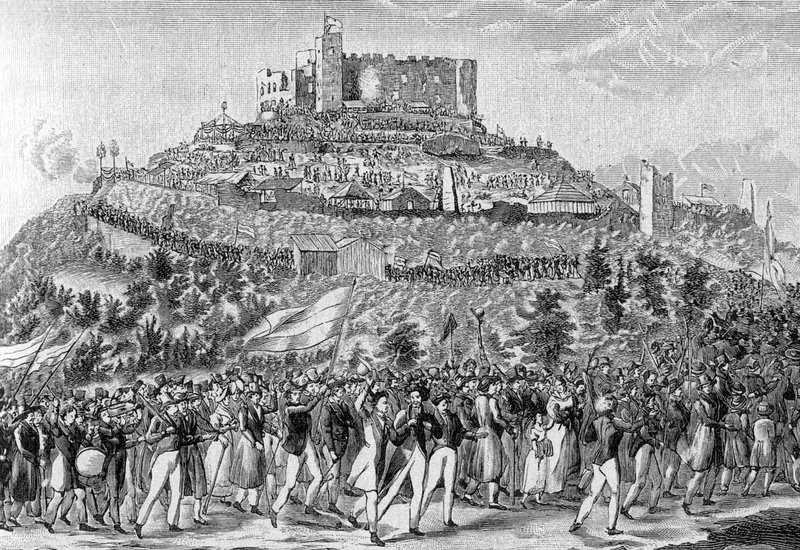
The Hambach Festival (Hambacher Fest) in May 1832 was attended by a crowd of more than 30,000. Promoted as a county fair, its participants celebrating fraternity, liberty, and national unity. Celebrants gathered in the town below and marched to the ruins of Hambach Castle on the heights above the small town of Hambach, in the Palatinate province of Bavaria. Carrying flags, beating drums, and singing, the participants took the better part of the morning and mid-day to arrive at the castle grounds, where they listened to speeches by nationalist orators from across the political spectrum. The overall content of the speeches suggested a fundamental difference between the German nationalism of the 1830s and the French nationalism of the July Revolution: the focus of German nationalism lay in the education of the people; once the populace was educated as to what was needed, it would reach those goals. The Hambach rhetoric emphasized the overall peaceable nature of German nationalism: the point was not to build barricades, a very "French" form of nationalism, but to build emotional bridges between groups. As he had done in 1819, after the Kotzebue assassination, Metternich used the popular demonstration at Hambach to push conservative social policy. The "Six Articles" of 28 June 1832 above all else reaffirmed the principle of monarchical authority. On 5 July, the Frankfurt Diet voted for an additional 10 articles, which reiterated existing rules on censorship, restricted political organizations, and limited other public activity. Furthermore, the member states agreed to send military assistance to any government threatened by unrest. Prince Wrede led half of the Bavarian army to the Palatinate to "subdue" the province. Several hapless Hambach speakers were arrested, tried and imprisoned; one, Karl Heinrich Brüggemann (1810–1887), a law student and representative of the secretive Burschenschaft, was sent to Prussia, where he was first condemned to death, but later pardoned.
Crucially, both the Wartburg rally in 1817 and the Hambach Festival in 1832 had lacked any clear-cut vision for unification. At Hambach, the positions of the many speakers illustrated their disparate agendas. Held together only by the idea of unification, their notions of how to achieve this did not include specific plans but instead rested on the nebulous idea that the Volk (the people), if properly educated, would bring about unification on their own. Grand speeches, flags, exuberant students, and picnic lunches did not translate into a new political, bureaucratic, or administrative apparatus. While many spoke about the need for a constitution, no such document emerged from the key nationalist rallies. In 1848, nationalists sought to remedy that problem.
Several other factors complicated the rise of nationalism in the German states. The man-made factors included political rivalries between members of the German confederation, particularly between the Austrians and the Prussians, and socio-economic competition among the commercial and merchant interests, and the old land-owning and aristocratic interests. Natural factors included widespread drought in the early 1830s, and again in the 1840s, and a food crisis in the 1840s. Further complications emerged as a result of a shift in industrialization and manufacturing; as people sought jobs, they left their villages and small towns to work during the week in cities, returning for a day and a half on weekends.
The economic, social and cultural dislocation of ordinary people, the economic hardship of an economy in transition, and the pressures of meteorological disasters all contributed to growing problems in Central Europe. The failure of most of the governments to deal with the food crisis of the mid-1840s, caused by the potato blight (related to the Great Irish Famine) and several seasons of bad weather, encouraged many to think that the rich and powerful had no interest in their problems. Those in authority were concerned about the growing unrest, political and social agitation among the working classes, and the disaffection of the intelligentsia. No amount of censorship, fines, imprisonment, or banishment, it seemed, could stem the criticism. Furthermore, it was becoming increasingly clear that both Austria and Prussia wanted to be the leaders in any resulting unification; each would inhibit the drive of the other to take the lead in unification.
Formation of the Zollverein, an institution key to unifying the German states economically, helped to create a larger sense of economic unification. Initially conceived by the Prussian Finance Minister Hans, Count von Bülow, as a Prussian customs union in 1818, the Zollverein linked the many Prussian and Hohenzollern territories. Over the ensuing thirty years (and more) other German states joined. The Union helped to reduce protectionist barriers between the German states, especially improving the transport of raw materials and finished goods, making it both easier to move goods across territorial borders and less costly to buy, transport, and sell raw materials. This was particularly important for the emerging industrial centers, most of which were located in the Prussian regions of the Rhineland, the Saar, and the Ruhr valleys. States more distant from the coast joined the Customs Union earlier. Not being a member mattered more for the states of south Germany, since the external tariff of the Customs Union prevented customs-free access to the coast (which gave access to international markets). Thus, by 1836, all states to the south of Prussia had joined the Customs Union, except Austria.
In contrast, the coastal states already had barrier free access to international trade and did not want consumers and producers burdened with the import duties they would pay if they were within the Zollverein customs border. Hanover on the north coast formed its own customs union – the "Tax Union" or Steuerverein – in 1834 with Brunswick and with Oldenburg in 1836. The external tariffs on finished goods and overseas raw materials were below the rates of the Zollverein. Brunswick joined the Zollverein Customs Union in 1842, while Hanover and Oldenburg finally joined in 1854 After the Austro-Prussian war of 1866, Schleswig, Holstein and Lauenburg were annexed by Prussia and thus annexed also to the Customs Union, while the two Mecklenburg states and the city states of Hamburg and Bremen joined later because they were reliant on international trade. The Mecklenburgs joined in 1867, while Bremen and Hamburg joined in 1888.
By the early 19th century, German roads had deteriorated to an appalling extent. Travelers, both foreign and local, complained bitterly about the state of the Heerstraßen, the military roads previously maintained for easy troop movement. As German states ceased to be a military crossroads, however, the roads improved; the length of hard–surfaced roads in Prussia increased from 3,800 kilometers (2,400 mi) in 1816 to 16,600 kilometers (10,300 mi) in 1852, helped in part by the invention of macadam. By 1835, Heinrich von Gagern wrote that roads were the "veins and arteries of the body politic..." and predicted that they would promote freedom, independence and prosperity.As people moved around, they came into contact with others, on trains, at hotels, in restaurants, and for some, at fashionable resorts such as the spa in Baden-Baden. Water transportation also improved. The blockades on the Rhine had been removed by Napoleon's orders, but by the 1820s, steam engines freed riverboats from the cumbersome system of men and animals that towed them upstream. By 1846, 180 steamers plied German rivers and Lake Constance, and a network of canals extended from the Danube, the Weser, and the Elbe rivers.
As important as these improvements were, they could paled in comparison to the impact of the railway. German economist Friedrich List called the railways and the Customs Union "Siamese Twins", emphasizing their important mutually beneficial relationship. He was not alone: the poet August Heinrich Hoffmann von Fallersleben wrote a poem in which he extolled the virtues of the Zollverein, which he began with a list of commodities that had contributed more to German unity than politics or diplomacy. Historians of the German Empire later regarded the railways as the first indicator of a unified state; the patriotic novelist, Wilhelm Raabe, wrote: "The German empire was founded with the construction of the first railway..." Not everyone greeted the iron monster with enthusiasm. The Prussian king Frederick William III saw no advantage in traveling from Berlin to Potsdam a few hours faster, and Metternich refused to ride it at all.
Article sections from Wikipedia (CC BY-SA 4.0). Excerpted for readability.