Augustus (born Gaius Octavius; 23 September 63 BC – 19 August AD 14), also known as Octavian (Latin: Octavianus), was the founder of the Roman Empire and the first Roman emperor from 27 BC until his death in AD 14. The reign of Augustus initiated an imperial cult and an era of imperial peace (the Pax Romana or Pax Augusta) when the Roman world was largely free of armed conflict. The principate, a style of government in which the emperor showed nominal deference to the Senate, was established during his reign and lasted until the Crisis of the Third Century.
Octavian was born into an equestrian branch of the gens Octavia. Octavian's great-uncle, the dictator Julius Caesar, named him as his primary heir in his will, and after Caesar's assassination in 44 BC, Octavian inherited his estate and assumed his name. He fought for the loyalty of Caesar's legions. He was made a senator during a state emergency and seized power by marching on Rome in 43 BC, becoming its youngest elected consul. He, Mark Antony, and Marcus Lepidus formed a triumvirate regime with legally sanctioned powers to outlaw and oppose Caesar's assassins and their allies. Following their victory at the Battle of Philippi in 42 BC, the triumvirate divided the Roman Republic among themselves and ruled as de facto oligarchs. Competing ambitions eventually tore their alliance apart; Octavian had Lepidus exiled in 36 BC for opposing him in Sicily, while Marcus Agrippa, Octavian's naval commander, defeated Antony in Greece at the Battle of Actium in 31 BC. Antony and his wife Cleopatra, the Ptolemaic queen of Egypt, killed themselves during Octavian's invasion of Egypt, which then became Octavian's personal property.
After the demise of the triumvirate, Augustus reached an accord with the remaining Roman elite: he would restore the façade of a free republic, centered around the Senate, the executive magistrates and the legislative assemblies. But his control of the military and half of Rome's provinces meant he maintained autocratic power legitimized by his appointment as commander-in-chief of most Roman armies. To avoid the appearance of monarchy or dictatorship, he eventually refused to stand for reelection to the consulship, but the Senate granted him the powers of the tribunate and censorship and the titles princeps ('first citizen'), augustus ('the revered'), and pater patriae (lit. 'father of the country'), and named the month of August after him. After the death of Lepidus, Augustus also assumed the title of pontifex maximus ('supreme pontiff').
Augustus dramatically enlarged the Empire, annexing Egypt, Dalmatia, Pannonia, Noricum, and Raetia, expanding possessions in Africa, and completing the conquest of Hispania. His expansionism, however, suffered a major setback in Germania. Beyond the frontiers, he secured the empire with a buffer region of client states and negotiated peace treaties with the Parthian Empire and Kingdom of Kush. He reformed the Roman system of taxation and currency, developed networks of roads with an official courier system, established a standing professional army, established the Praetorian Guard as well as official police and fire-fighting services for the city of Rome, and renovated much of the city during his reign. Augustus was a writer and patron of poets such as Virgil, and has been featured in various works of art from ancient to modern times. He died in AD 14 at age 75 from natural causes, and the Senate posthumously deified him. Persistent rumors have claimed his wife Livia poisoned him. He was succeeded as emperor by his stepson and adoptive son Tiberius.
Summary from Wikipedia (CC BY-SA 4.0)
01Name

Augustus ( aw-GUST-əs) was known by many names throughout his life:
Gaius Octavius: ( ok-TAY-vee-əs; Latin: [ˈɡaːiʊs ɔkˈtaːwiʊs]). According to Suetonius, Octavius received the cognomen Thurinus (Latin: [tʰuːˈriːnʊs], 'of Thurii') in his infancy to commemorate his father's victory over followers of Spartacus at Thurii. Marcus Junius Brutus, the assassin of Octavian's adoptive father Julius Caesar, rejected Octavian's claim to testamentary adoption by Caesar by referring to him as Octavius.
Gaius Julius Caesar: After Julius Caesar named Octavius his heir in 44 BC, Octavius took Caesar's nomen and cognomen. Historians often distinguished him from the late Caesar by adding Octavianus (Latin: [ɔktaːwiˈaːnʊs]) after the name, denoting that he was a former member of the gens Octavia. There is no evidence that Augustus did this himself, although some of his contemporaries called him Gaius Octavius, Gaius Julius Caesar Octavianus, or "young Caesar". Historians usually refer to him as Octavian ( ok-TAY-vee-ən) for the period between 44 and 27 BC.
Imperator Caesar: Octavian's early coins and inscriptions all refer to him as Gaius Caesar, but by 38 BC he had replaced Gaius with the victory title imperator ('commander'). His family line continued the use of the name Caesar, a cognomen for one branch of the Julian family, and eventually this formed a standard imperial title.
Imperator Caesar Augustus: In 27 BC the Senate granted him the honorific Augustus (Latin: [au̯ˈɡʊstʊs]) ('the revered'). Historians use this name, or its converse Augustus Caesar, to refer to him from 27 BC until his death in AD 14.
02Early life

Octavian was born as Gaius Octavius in Rome on 23 September 63 BC, at a family property on the Palatine Hill. His father, Gaius Octavius, came from a moderately wealthy equestrian family of the gens Octavia. He ascended the cursus honorum and served as a proconsular governor of Macedonia. His family was from Velitrae, near Rome, where his son spent part of his childhood. The younger Octavius's mother, Atia, was a niece of Julius Caesar.
After Octavius's father died in 59 BC or 58 BC, his mother married Lucius Marcius Philippus, who was elected as consul in 56 BC. When Octavius's grandmother Julia, sister of Julius Caesar, died in 52 or 51 BC, Octavius delivered her funeral oration, his first public appearance. A Greek slave tutor named Sphaerus educated him in reading, writing, arithmetic, and Greek. Octavius later freed Sphaerus and gave him a state funeral in 40 BC. As a teenager, he studied philosophy under Areios of Alexandria and Athenodorus of Tarsus, Latin rhetoric under Marcus Epidius, and Greek rhetoric under Apollodorus of Pergamon.
Julius Caesar had formed an informal alliance with Pompey and Crassus in 60 BC, but by 49 BC it had fallen apart and Pompey and Caesar were fighting a protracted civil war. In 47 BC, after Octavius donned the toga virilis and became an adult citizen, Caesar had him elected as pontiff, replacing the slain Lucius Ahenobarbus. The following year, Octavius presided over the Greek games commemorating the opening of Caesar's Temple of Venus Genetrix. He wished to join Caesar's staff for the African campaign but gave way when his mother Atia protested over his poor health. Caesar allowed Octavius to proceed next to his chariot during his triumph celebrating the campaign and awarded Octavius with military decorations as if he had been present. In 45 BC Octavius traveled to Hispania to join Caesar's Spanish campaign against Pompey the Younger. On 13 September 45 BC Caesar deposited a new will with the Vestal Virgins naming Octavius as his principal heir.
03Rise to power

In 44 BC, Octavius was at Apollonia, Illyria, when Julius Caesar was made Rome's first dictator perpetuo ('dictator in perpetuity') in February, and then assassinated on the Ides of March (15 March). Octavius consulted with Caesar's officers in Macedonia before sailing for Italy to ascertain his political fortunes. Caesar had no living legitimate children under Roman law. His will made Octavius his main heir with the condition that he assume the dead dictator's name. After landing near Brundisium in southern Italy, Octavius received a copy of the will, which bequeathed him three-quarters of Caesar's estate. Against the advice of his stepfather Philippus, Octavius accepted Caesar's will on 8 May 44 BC. He purported that Caesar adopted him as his son and assumed the name Gaius Julius Caesar. His stepfather, Cicero, and other contemporaries referred to him as Octavianus.
Octavian could not rely on his limited funds to make a successful entry into politics. After a warm welcome by Caesar's soldiers at Brundisium, he demanded a portion of the funds allotted by Caesar for his eastern war against the Parthians. This amounted to 700 million sesterces stored at Brundisium, the staging ground in Italy for military operations in the east. Octavian made another bold move when, without official permission, he appropriated the annual tribute from Rome's province of Asia to Italy. He also began to recruit Caesar's veterans and men designated for the Parthian war. On his march to Rome through Italy, Octavian's presence and newly acquired riches won over many, including Caesar's veterans stationed in Campania. By June, he had gathered an army of 3,000 men, paying each a bonus of 500 denarii, which was more than twice a soldier's annual pay.
Arriving in Rome on 6 May 44 BC, Octavian found consul Mark Antony, Caesar's former colleague, in an uneasy truce with Caesar's assassins. A general amnesty on 17 March pardoned the assassins in exchange for recognition of Caesar's legal acts. Soon afterwards, Antony succeeded in driving most of them out of Rome with an inflammatory eulogy at Caesar's funeral, mounting public opinion against the assassins.
Mark Antony amassed political support, but had lost the support of many Romans and Caesarians when he opposed the motion to elevate Caesar to divine status. Octavian challenged him as the leader of the Caesarians. To halt Octavian from dispersing 300 sesterces per capita to the urban plebs in accordance with Caesar's will, Antony refused to give Octavian the money due him as Caesar's heir. He also blocked the curiate assembly from hearing Octavian's attempts to legitimize his supposed adoption by Caesar, to have Caesar formally deified and to reinstate Caesar's golden throne for public view at games staged in April and June. During Caesar's victory games, Octavian distributed some of the funds in Caesar's will and combined this with his own money, enhancing his popularity while damaging Antony's.
During the summer of 44 BC, Octavian won the support of more veterans and also senators who perceived Antony as a threat to the state. Antony had lictors drag Octavian away from a hearing over the reinstatement of private property seized by Caesar in 49 BC. Octavian then claimed Antony threatened his life as retribution for distributing money to the plebs in Caesar's will. Caesar's veterans convinced Antony to publicly reconcile with Octavian in the Temple of Jupiter Optimus Maximus. Thereafter, Antony's bellicose edicts against the assassins Marcus Junius Brutus and Gaius Cassius Longinus alienated him from the moderate Caesarian senators, who feared a renewed civil war. In September, Marcus Tullius Cicero, now a political ally of Octavian, began to give a series of speeches portraying Antony as a threat to the Republic.
With opinion in Rome turning against him and his consulship concluding, Antony illegally passed a law that would assign him the province of Cisalpine Gaul in northern Italy. Octavian meanwhile built up a private army in Italy by recruiting Caesarian veterans, and in early November entered Rome with this private force to challenge Antony. However, they vacated the city shortly afterwards, due to some veterans choosing to quit once it became clear they were involved in a Caesarian squabble rather than a revenge campaign against Caesar's assassins. Nevertheless, on 28 November, Octavian won over two of Antony's legions with the enticing offer of monetary gain. Antony then left Rome for Cisalpine Gaul, which was to be handed to him on 1 January 43 BC. However, the province had earlier been assigned to the assassin Decimus Junius Brutus Albinus, who now refused to yield to Antony. Antony besieged him at Mutina. This provided an opportunity for Octavian, whose private army was at hand.
Cicero defended Octavian against Antony's taunts, and had him inducted as a senator on 1 January 43 BC. Octavian was given the power to vote alongside the former consuls, the privilege to stand for election at an earlier age than usual, and imperium pro praetore which legitimized his command. Octavian accompanied the consuls to relieve the siege of Mutina. He assumed the fasces on 7 January, a date that he would later commemorate as the beginning of his public career. Antony retreated to Transalpine Gaul after his forces were defeated at the battles of Forum Gallorum and Mutina in April. Both consuls were killed, however, leaving Octavian in sole command of their armies. These victories earned him his first acclamation as imperator, a title reserved for victorious commanders.
Largely ignoring Octavian, the Senate heaped many rewards on Decimus Brutus and attempted to give him command of the consular legions. In response, Octavian stayed in the Po Valley and refused to pursue Antony. In July, an embassy of centurions sent by Octavian entered Rome; they demanded the now-vacant consulship for Octavian, with Cicero as co-consul, and the rescission of the decree declaring Antony a public enemy. When this was refused, Octavian marched on Rome, where he encountered no military opposition. On 19 August 43 BC, aged 19, he became consul alongside his relative Quintus Pedius. Pedius passed legislation creating a special tribunal for Caesar's assassins and their alleged associates; Octavian presided over the trial and had them convicted and exiled in absentia. Octavian also induced the curiate assembly to have him adrogated into Caesar's family, legitimizing his claim of testamentary adoption. Meanwhile, Antony formed an alliance with Marcus Aemilius Lepidus, then governor of Gallia Narbonensis. The Senate branded Lepidus, a fellow Caesarian, as a public enemy for joining Antony, but they reversed the pair's outlawing at Pedius's behest while Octavian marched north to fight Decimus Brutus and meet with Antony.
In a meeting near Bononia in October 43 BC, Octavian joined with Antony and Lepidus to form the triumvirate, ostensibly for the stability of the Roman Republic, and on 27 November the lex Titia legitimized their agreement for five years. The triumvirate gave the men consular power, the right to appoint magistrates, and allowed their division among themselves of the provinces not under the control of the liberatores in the east. Octavian had previously been engaged to Servilia, daughter of Servilius Isauricus, but instead became engaged to Claudia, stepdaughter of Antony, to solidify their political union. Octavian also relinquished the consulship to Antony's ally Publius Ventidius.
The triumvirs then set in motion proscriptions, targeting some 300 men as outlaws, divided roughly evenly between senators and equestrians. Thousands more had their properties confiscated. Contemporary Roman historians provide conflicting reports as to which triumvir was most responsible for the proscriptions and killing. However, the sources agree that the proscriptions enabled all three to eliminate political enemies.
The triumvirs initiated the proscriptions partly to raise money to pay the salaries of their troops for the upcoming conflict against Caesar's assassins Marcus Brutus and Gaius Cassius, but the main intention was the removal of wartime rivals. The triumvirs seized the proscripts' property. However much money was raised was insufficient, so the triumvirs introduced a range of new taxes to fund their war. They reinstituted property taxes and created new imposts on slaves, before also demanding property assessments for taxes on rich women that were reduced after a public protest of women in Rome.
On 1 January 42 BC, with Lepidus as consul, the Senate posthumously recognized Julius Caesar as a divinity of the Roman state, divus Iulius. Octavian was able to further his cause by emphasizing that he was divi filius ('son of the divine'). Antony and Octavian then led twenty-eight legions east against Brutus and Cassius, whom they defeated after two battles at Philippi in Macedonia in October 42 BC. Brutus and Cassius both died by suicide. Claiming responsibility for both victories, Antony branded Octavian a coward for handing over his direct military control to Marcus Vipsanius Agrippa. Octavian was bedridden with illness during the first battle, allegedly removing himself from command over the camp per his doctor's advice, but captured Brutus's camp during the second battle.
After Philippi, the triumvirs again divided the provinces. Lepidus was suspected of colluding with Sextus Pompey, the renegade general whom the anti-Caesarian Senate had given command over all Mediterranean coastlines in 43 BC. Cisalpine Gaul was combined with Italia and given to Octavian along with the provinces of Hispania Citerior and Hispania Ulterior that Lepidus had to forfeit. Antony travelled east to Egypt where he allied himself with Cleopatra, a Roman client ruler, former lover of Julius Caesar, and mother of Caesar's son Caesarion. In addition to the eastern provinces, Antony controlled Gallia Comata and took Gallia Narbonensis from Lepidus, who was left with the province of Africa.
Octavian was left to settle tens of thousands of discharged veterans in Italy. Those who fought for the assassins also required settlement for their pacification. With no remaining public land, Octavian chose to confiscate land from citizens, instead of alienating the soldiers who could mount a real threat to the regime in Italy. The settlements affected some eighteen cities, with entire populations fully or partially evicted.
These veteran settlements brought Octavian widespread dissatisfaction. The disaffected rallied to Mark Antony's brother Lucius Antonius, who was supported by a majority in the Senate. Meanwhile, Octavian asked for a divorce from Claudia, Antony's stepdaughter. He returned Claudia to her mother, Fulvia, claiming that their marriage had never been consummated. Fulvia and Lucius Antonius then raised an army in Italy to fight for Antony's rights against Octavian. Lucius even briefly took Rome, forcing Lepidus and his two legions to flee the city. However, the Roman army still depended on the triumvirs for their salaries. Lucius and his allies ended up in a defensive siege at Perusia, where Octavian forced their surrender in February 40 BC. Octavian spared Lucius, while Fulvia fled to Sicyon in Greece and died shortly afterwards. On 15 March, the anniversary of Julius Caesar's assassination, Octavian had 300 Roman senators and equestrians executed for allying with Lucius. Perusia was also sacked, though it is unclear who started the fires. These reprisals sullied Octavian's reputation.
Sextus Pompey affirmed his control of Sicily as part of an agreement with the triumvirate in 40 BC, and gained control of Sardinia and Corsica in 39. Both Antony and Octavian sought an alliance with him. Octavian established a temporary alliance in 40 BC when he married Scribonia, an aunt of Sextus's wife.
04Sole ruler of Rome
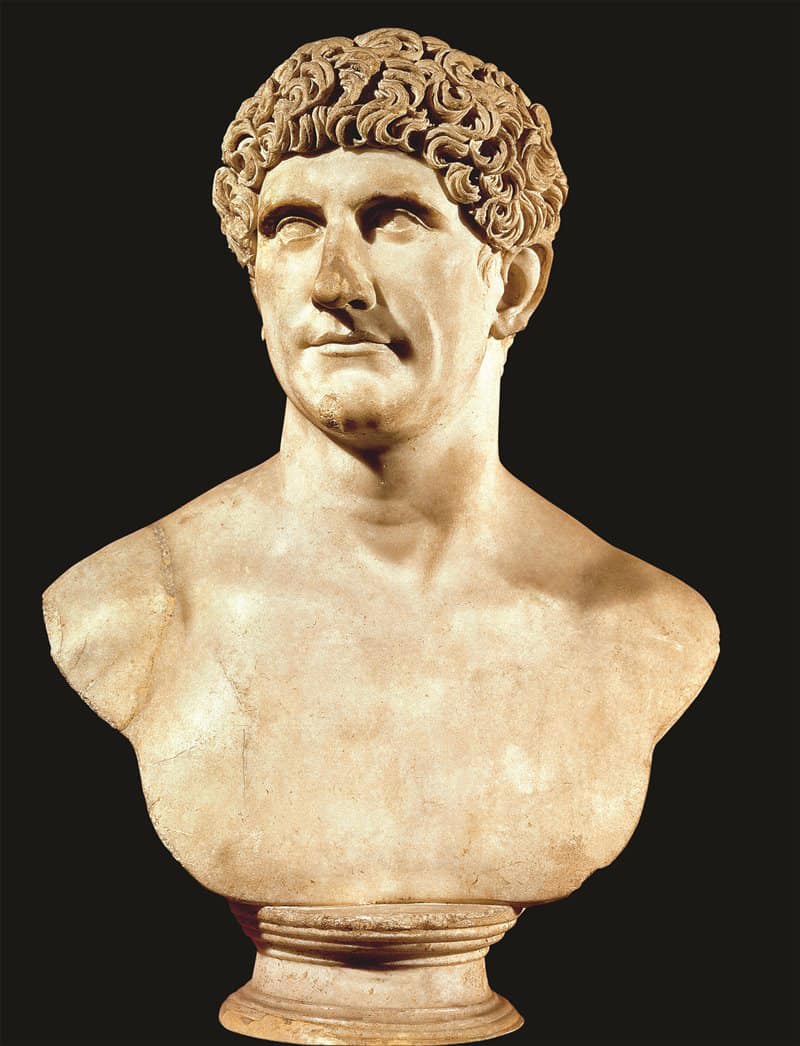
The conquest of Egypt greatly relieved Octavian's debts incurred from the civil wars. He controlled Roman Egypt directly, forbade senators to travel there, and appointed equestrian governor Cornelius Gallus to supervise its administration and enormously lucrative taxation. While in Alexandria in 30 BC, Octavian visited the tomb of Alexander the Great, the conqueror he emulated and imitated in his own artistic portraits. Octavian's conquest of Egypt brought an end to the Hellenistic period; it also cemented the cultural formation of a Greek East and Latin West in the Mediterranean and a cosmopolitan universal monarchy centered on Rome.
Octavian would become the first Roman emperor as Augustus and also the first Roman pharaoh of Egypt, though he did not partake in Egyptian coronation rites or worship of the Apis bull, and he never visited Egypt again after 30 BC. Before returning to Rome, Octavian wintered in 30 BC on the Greek island of Samos. In August the following year, he celebrated three triumphs in Rome for his victories in Illyria, Greece, and Egypt. He and Agrippa were elected as the consuls for 28 BC, and granted the powers of a censor so as to conduct the census.
After defeating Antony and Cleopatra, Octavian could rule the entire Republic under an unofficial principate, with himself as princeps ('leading citizen' or 'first citizen'). He achieved this incrementally by courting the Senate and people of Rome while purporting not to aspire to dictatorship or monarchy. Influential aristocrats were previously called princeps and Octavian would embrace this title as part of his self-representation as restorer of the Republic.
Years of civil war had left Rome in a state of near lawlessness, but republican tradition opposed autocracy. At the same time, Octavian could not give up his authority without risking war. The Senate and people desired a return to stability, traditional legality, civility, and the assurance of free elections—which would be conducted in name at least under Octavian, soon to be princeps Augustus. The gradual fashioning of this regime involved trial by error and experimentation, popular support for legally sanctioned moves, and appointed term limits for offices in perhaps a cautious attempt to avoid the same fate as his adoptive father Julius Caesar.
On 13 January 27 BC, Octavian made a show of returning power to the Senate and relinquishing his provinces and armies. However, he retained the loyalty of serving soldiers and veterans. The careers of many clients and adherents depended on his patronage, as his financial power was unrivaled. Other senators refrained from spending to build and maintain roads in Italy in 20 BC, but Octavian undertook direct responsibility on behalf of the public. The Roman currency issued in 16 BC publicized Octavian's involvement, after he donated vast amounts of money to the aerarium Saturni, the public treasury.
In an agreement known as the first settlement, Octavian was able to continue the appearance of a still-functional constitution through the Senate proposing to him that he once again assume control of the provinces. Feigning reluctance, on 16 January 27 BC he accepted a ten-year responsibility of overseeing provinces that were considered chaotic. The provinces ceded to him constituted much of the Roman world, including Hispania, Gaul, Syria, Cilicia, Cyprus, and Egypt. Moreover, command of these provinces provided him control over the majority of Rome's legions. Octavian–Augustus's power ultimately rested in his control over Rome's military.
However, Octavian–Augustus did not have a monopoly on political and martial power. The Senate still controlled the grain-producing North Africa as well as the militarily strategic Illyria and Macedonia. However, the Senate had control of only five or six legions distributed among three senatorial proconsuls, compared to the twenty legions under Augustus's control, and their control of these regions did not significantly challenge his authority. Divided control between senators and proconsuls had precedent, and Augustus used republican legal frameworks to amass power.
While Augustus acted as consul in Rome, he dispatched senators to the provinces under his command as his representatives to manage provincial affairs. The Senate chose governors to oversee the remaining provinces. Augustus issued instructions and edicts not only to his own legates but also to independent proconsuls governing public provinces that were nominally under senatorial control. Augustus's control of entire provinces followed Republican-era precedents for the limited objective of securing peace and creating stability, with Pompey having been given a similar level of command across the Roman world.
On 16 January 27 BC the Senate gave Octavian the new title of augustus ('revered'). It was a title of religious rather than political authority, and it indicated that Octavian now approached divinity. Future Roman emperors inherited the honorific augustus, and it became their main title. Another titular option, that of Romulus, after the legendary founder of Rome, was associated too strongly with monarchy, an association Octavian sought to avoid. The Senate also confirmed his position as princeps senatus ('leader of the Senate'). Augustus now styled himself as Imperator Caesar divi filius ('Commander Caesar son of the deified one'), boasting his familial link to deified Julius Caesar. The use of imperator signified a permanent link to the Roman tradition of victory. Augustus transformed Caesar, a cognomen for one branch of the Julian family, into a new imperial family line that began with him.
The Senate allowed Augustus to hang the corona civica ('civic crown') above his door and to have laurels drape his doorposts. He renounced flaunting insignia of power such as holding a scepter, wearing a diadem, or wearing the golden crown and purple toga of Julius Caesar. Nonetheless, the Senate awarded him with a golden shield displayed in the meeting hall of the Curia, bearing the inscription virtus, pietas, clementia, iustitia ('valor, piety, clemency, and justice'). By the summer of 27 BC he left Rome and traveled to Gaul. From 26 to 24 BC he governed the Empire from Tarraco in Roman Spain, overseeing military campaigns in the Iberian peninsula until his return to Rome.
By 23 BC, some of the un-republican implications of the first settlement were becoming apparent. Augustus's continuous consulships drew attention to his de facto dominance of politics and halved the opportunities for others to achieve what was still nominally the preeminent position in the Roman state. His desire to have his nephew Marcus Claudius Marcellus eventually assume the principate in his turn also caused problems. To signal reconciliation with pro-republican aristocrats, Augustus appointed the noted republican Calpurnius Piso, who had opposed Julius Caesar and supported the assassins, as co-consul in 23 BC, after his choice Aulus Terentius Varro Murena died unexpectedly.
In the late spring Augustus was severely ill, apparently with a liver disease. Expecting his death, he made arrangements ensuring the continuation of the principate while allaying senators' suspicions of his anti-republicanism. He prepared to hand down his signet ring to his friend and general Agrippa but handed to his co-consul Piso all of his official documents, an account of public finances, and authority over troops in the provinces. Augustus's supposedly favored nephew Marcellus came away empty-handed. This surprised many who expected Augustus to name an heir to his position as an unofficial emperor.
Augustus bestowed only properties and possessions to his designated heirs, as an obvious system of institutionalized imperial inheritance would have provoked resistance and hostility among the republican-minded Romans fearful of monarchy. It appears that Augustus did not view the 19-year-old Marcellus as being ready to inherit his political pre-eminence. By giving his signet ring to Agrippa, however, Augustus signaled to the legions that Agrippa was a potential successor who they should obey, constitutional procedure notwithstanding.
The emperor's illness subsided while under the care of his personal physician Antonius Musa, and soon afterwards on 1 July 23 BC Augustus gave up his consulship. He would serve as consul only twice more, in 5 and 2 BC, both times to introduce his grandsons into public life. Augustus's resignation from the consulship allowed him to exercise wider patronage within the senatorial class while allowing other senators a better chance to become consul. However, Augustus desired to retain his consular imperium throughout the empire, leading to another compromise between him and the Senate known as the second settlement.
After Augustus relinquished the annual consulship, he was no longer in an official position to rule the state. However, his dominant position remained unchanged over his 'imperial' provinces where he was still a proconsul. When he annually held the office of consul, he had the power to intervene with the affairs of the other provincial proconsuls appointed by the Senate throughout the empire, when he deemed necessary.
A second problem later arose showing the need for the second settlement in what became known as the "Marcus Primus affair". In late 24 or early 23 BC, charges were brought against Marcus Primus, former proconsular governor of Macedonia, for waging a war without approval of the Senate on the Odrysian kingdom of Thrace, whose king was a Roman ally. Lucius Licinius Varro Murena defended Primus, arguing that Augustus had ordered Primus to attack the client state. Later, Primus testified that the orders came from the recently deceased Marcellus. Such orders suggested that Augustus intended to have his nephew take his place as princeps and establish a monarchy over Rome, and would have been considered a breach of the Senate's prerogatives under the settlement of 27 BC, since Macedonia was a province under senatorial jurisdiction, not Augustus's imperial authority.
The situation was so serious that Augustus appeared at the trial even though he had not been called as a witness. Under oath, he declared that he gave no such order. Murena disbelieved Augustus's testimony and resented his attempt to subvert the trial by using his auctoritas. He demanded to know why Augustus appeared at the trial; Augustus replied that he came in the public interest. The jurors found Primus guilty, though some voted to acquit, suggesting that some disbelieved Augustus's claims.
The Senate negotiated the second settlement with Augustus partly to allay confusion and formalize his legal authority to intervene in senatorial provinces, granting him a form of general imperium proconsulare ('proconsular power') that applied throughout the empire, not solely to his provinces. Moreover, the Senate augmented Augustus's proconsular imperium into imperium proconsulare maius ('greater proconsular power'). This form of proconsular imperium was applicable throughout the empire and in effect gave Augustus constitutional power superior to all other proconsuls. Augustus stayed in Rome during the renewal process and obtained veterans' support for the renewal of his proconsular imperium maius in 13 BC by providing them with lavish donations.
During the second settlement, Augustus was also granted the power of a tribune (tribunicia potestas) for life, though not the official title of tribune. For some years, Augustus had been awarded tribunicia sacrosanctitas, the immunity given to a tribune of the plebs. Now he decided to assume the full powers of the magistracy, renewed annually, in perpetuity. Legally, it was closed to patricians, a status that Augustus had acquired when adopted by Julius Caesar.
05Death and succession
Augustus's illness in 23 BC accentuated the problem of succession. To ensure stability, he needed to designate an heir. This needed to be done subtly so that it did not trigger fears of monarchy. If someone was to succeed to Augustus's position of power, he would first have to be recognized as meritful.
Some historians argue that Augustus favored his nephew Marcellus, who had married Augustus's daughter Julia, while others argue that he preferred Marcus Agrippa, who was Augustus's second in charge and a respected military commander. After Marcellus died in 23 BC, Augustus remarried his daughter Julia to Agrippa in 21 BC. This union produced five children, three sons and two daughters. In 18 BC, Agrippa was granted a five-year appointment to the eastern provinces with proconsular imperium and also the tribunicia potestas that Augustus possessed. This grant showed Augustus's favor but upset some conservative senators.
Augustus adopted his grandsons Gaius and Lucius, illuminating his intent to make them his heirs. He served as consul in 5 and 2 BC so that he could personally usher them into their political careers. Gaius was consul for AD 1, with Augustus having him wait until he turned 21, while Lucius died before his designated consulship. Augustus also showed favor to his stepsons Tiberius and Drusus, granting them public offices while seeming to favor Drusus. Tiberius married Agrippa's eldest daughter, Vipsania Agrippina, while Drusus married Augustus's niece Antonia. After Agrippa died in 12 BC, Augustus ordered Tiberius to divorce Vipsania for the widowed Julia. Drusus and Antonia's marriage was considered an unbreakable affair, whereas Vipsania was deemed less important. Drusus died in 9 BC.
Tiberius shared in Augustus's tribunician powers from 6 BC but shortly thereafter withdrew into retirement, reportedly wanting no further role in politics. A failing marriage with Julia and envy for her sons Gaius and Lucius could have contributed to Tiberius's departure. Augustus exiled his daughter for adultery in 2 BC, but inducted his grandsons into the college of priests at an early age and introduced them to the army in Gaul.
After the deaths of Lucius in AD 2 and Gaius in AD 4, Augustus recalled Tiberius to Rome in June AD 4 and adopted him, on the condition that Tiberius adopt his nephew Germanicus. This continued the tradition of presenting at least two generations of heirs. In AD 4 Tiberius was also granted the tribunicia potestas and a proconsular post in Germany; for his efforts there and in Illyricum, he eventually triumphed. By AD 13, he had received the imperium maius proconsulare equalling that of Augustus.
The only other possible claimant was Agrippa Postumus, Augustus's youngest grandson. However, Augustus had exiled him to Sorrento in AD 6 and then to Planasia in AD 7. The Senate made Agrippa's banishment permanent, and Augustus officially disowned him for his lack of good character and alleged involvement in a conspiracy. After Tiberius succeeded Augustus, he was most likely the one who had Agrippa killed in exile.
On 19 August AD 14, Augustus died at Nola, where his father had died. Both Tacitus and Cassius Dio claimed Livia poisoned him. Many historians dismiss the alleged poisoning, however, as a fabrication to discredit her son Tiberius. Livia had long been the target of similar (probably false) rumors of poisoning. If poisoning is accepted, it is possible that Livia supplied a poisoned fig to assist death. Augustus's health had declined in the months before his death and he had prepared for a smooth transition in power to Tiberius.
Augustus's famous last words were, "Have I played the part well? Then applaud as I exit" (Acta est fabula, plaudite). An enormous procession of mourners travelled with Augustus's body from Nola to Rome, with all business closed on his funeral. Tiberius and his son Drusus delivered the eulogy while standing atop two rostra. Augustus's body was coffin-bound and cremated on a pyre close to his mausoleum.
On 17 September 27 BC the Senate proclaimed Augustus to have joined the company of the gods and the deified Julius Caesar as a member of the Roman pantheon. People in Rome's eastern provinces had worshipped Octavian as a living deity since his victory at Actium. There was limited worship of him in some western provinces, primarily at the Sanctuary of the Three Gauls in Lugdunum (Lyon, France) and at Ara Ubiorum in Oppidum Ubiorum (Cologne, Germany), but not at Rome where such worship remained taboo. Only his genius (spirit) was allowed worship there.
06Legacy
Augustus created a regime that maintained relative peace and prosperity in the Latin West and Greek East for two centuries, initiating the celebrated Pax Romana (or Pax Augusta), though the Augustan golden age myth may obscure the complicated political challenges faced by Augustus. His regime laid the foundations of a concept of universal monarchy in the Byzantine and Holy Roman Empires down to their dissolutions in 1453 and 1806, respectively. Later Romans viewed his reign favorably, embodied by the Senate's formal wish to every emperor after Trajan that they "be more fortunate than Augustus and better than Trajan". This positive overall image was also helped by his successors copying many of Augustus's policies and forms of self-promotion, which modern research calls imitatio Augusti.
The surname Caesar and the title augustus became permanent titles of Roman rulers for fourteen centuries after Augustus's death, used in Rome and Constantinople following the Empire's division. Caesar formed the root of later regnal titles such as the German kaiser and Russian czar. Emperors preferred his title of civilis princeps for three centuries until they adopted the title domini ('lords'), beginning with Diocletian. His adoptive name Imperator ('victorious general') served as the etymological root of the word 'emperor', though it did not possess this connotation in Augustus's lifetime. The emperors alone held the office of pontifex maximus until the fall of the Western Roman Empire, after which the papacy adopted it.
Augustus composed an account of his achievements, the Res Gestae Divi Augusti, to be inscribed in bronze in front of his mausoleum. Copies of the text were inscribed throughout the empire upon his death. The Latin inscriptions, along with Greek translations, were inscribed on many public edifices, and historian Theodor Mommsen called them the "queen of inscriptions". The Res Gestae is Augustus's only surviving major work, though he is also known to have composed poems entitled "Sicilia", "Epiphanus", and "Ajax", an autobiography of 13 books, a philosophical treatise, and a written rebuttal to Brutus's Eulogy of Cato. Augustus's private letters also reveal facts about his personal life. The poet Martial preserved a sexually crude poem allegedly written by Octavian during the Perusine War, which pokes fun at Mark Antony, his wife Fulvia, and his mistress Glaphyra. Pliny the Elder suggested that Augustus displayed and finished Agrippa's world map publicly exhibited in the Porticus Vipsania. This map would later form the basis of various medieval world maps.
In his Res Gestae, Augustus defined the relative peace established by his reign as a peace "born of victories" (parta victoriis pax) in the civil wars, and Augustan artwork incorporates this theme. This peace ensured Romans and subjugated peoples within their Empire upheld a cohesive social pact: the latter would relinquish their sovereignty and pay taxes in exchange for the preservation of their customs and the protection of Rome. By boasting of his many conquests, the Res Gestae emphasizes the same code of honor found in Republican funerary inscriptions such as those of the Scipios, a key element in elevating the political reputation of Roman families.
Augustus thoroughly transformed the city of Rome, creating a permanent police force, firefighting force, and praefectus ('municipal prefect'). Established in AD 6 and based on previous firefighting services established in 22 and 7 BC, the vigiles was a combined fire brigade and police force divided into cohorts of 500 to 1,000 men each, with seven units assigned to fourteen divided city sectors. A praefectus vigilum ('prefect of the watch') was put in charge of the vigiles, whereas vicomagistri officials had previously been in charge of each district following the fire of 7 BC. Augustus created a standing army, fixed at a size of 28 legions of about 170,000 soldiers, reduced from 60 legions at the end of the civil wars in 30 BC. This was supported by many auxiliary units of 500 non-citizen soldiers each, often recruited from recently conquered areas.
With his finances securing the maintenance of roads throughout Italy, Augustus installed an official system of relay stations overseen by a military officer known as the praefectus vehiculorum. Besides speeding communication in Italy, his extensive road construction allowed Roman armies to march swiftly across the country. In AD 6 Augustus established the aerarium militare, donating 170 million sesterces to the new military treasury that provided for both active and retired soldiers.
One of Augustus's most enduring institutions was the establishment of the Praetorian Guard in 27 BC, commanded by two praetorian prefects (later one) after Augustus created this office in 2 BC. Originally a personal bodyguard unit on the battlefield, the praetorians evolved into an imperial guard as well as an important political force in Rome. They served the emperors into the early 4th century.
Augustus's tax reforms greatly impacted the subsequent success of the Empire, bringing it under direct taxation from Rome. This increased and stabilized Rome's revenues from its territories and regularized the financial relationship between Rome and its provinces, avoiding provincial resentments with arbitrary exaction. An equally important reform was the abolition of tax farming. The publicani, Republican era private tax farmers, were infamous for their depredations and great wealth, so they were replaced by salaried tax collectors.
Under Augustus, the measures of taxation were determined by censuses with fixed quotas for each province. Citizens of Rome and Italy paid indirect taxes, while direct taxes were exacted from the provinces. Indirect taxes included a 4% tax on the price of slaves, a 1% tax on goods sold at auction, and a 5% tax on the inheritance of estates valued at over 100,000 sesterces by persons other than the next of kin. Due to protest from equestrians, the suffect consuls for 9 AD modified and lessened penalties in the Lex Papia Poppaea that affected the inheritance of estates by unmarried or childless individuals, though it continued to generate revenues with properties of the deceased seized by the state.
Augustus's annexation of Egypt allowed him to divert its immense wealth for imperial purposes. Considered Augustus's private property rather than a province, it became part of each succeeding emperor's patrimonium. Instead of a legate or proconsul, Augustus installed a prefect from the equestrian class to administer Egypt and maintain its lucrative seaports. This position became the highest political achievement for any equestrian besides becoming praetorian prefect. Gold and silver found in the Ptolemaic royal treasury was melted down for coins. In his will, Augustus left money to his family but also 43 million sesterces to the Roman people, 1,000 sesterces to every praetorian, 500 sesterces to every soldier in urban cohorts, and 300 sesterces to each soldier.
In 8 BC, the Roman month of Sextilis (or Sextilus) was renamed August (Latin: Augustus) after Augustus. Augustus chose Sextilis as it was the month of his first consulship and of his various victories. In comparison, the month of July (Latin: Iulius) in the Julian calendar was named after Julius Caesar, the only other month in the Roman calendar named after a Roman.
On his deathbed, Augustus boasted that he converted Rome from a city of bricks into one of marble. Marble could be found in Roman buildings before Augustus, but it was not extensively used as a building material until his reign. He left a mark on the monumental topography of the city's center, as well as on the Campus Martius with the Ara Pacis (Altar of Peace) and monumental sundial, whose central gnomon was an obelisk taken from Egypt. The relief sculptures decorating the Ara Pacis visually augment Augustus's triumphs outlined in the Res Gestae. Its reliefs depict praetorians, the Vestals, and the citizenry of Rome.
The Corinthian order of architectural style originating from ancient Greece was the dominant architectural style in the age of Augustus. Suetonius once commented that Rome was unworthy of its status as an imperial capital, yet Augustus and Agrippa set out to dismantle this sentiment. They transformed the appearance of Rome upon the Greek model, incorporating both Classical and Hellenistic elements with many Athenian monuments as direct inspirations.
Augustus had the temples of Caesar, Jupiter Tonans, and Apollo Palatinus erected, as well as the Baths of Agrippa and the Forum of Augustus with its Temple of Mars Ultor. He encouraged the establishment of the Theatre of Balbus and Agrippa's construction of the Pantheon, and funded additional projects in the name of others, often relations (e.g. Portico of Octavia, Theatre of Marcellus). Even his tomb in Rome was built before his death to house members of his family. To celebrate his victory at the Battle of Actium, the Arch of Augustus was built in 29 BC near the entrance of the Temple of Castor and Pollux, and widened in 19 BC to include a triple-arch design. He also completed projects left unfinished by Julius Caesar, such as the Curia Julia, the Forum of Caesar, and the Temple of Venus Genetrix. He rebuilt the Basilica Aemilia by 2 BC (previously burned down in a fire of 35 BC).
Augustus also provided grand spectacles in Rome. The amphitheater constructed by Statilius Taurus from 34 to 29 BC was the first stone amphitheater built in the city, and opened with gladiator games around the time Octavian staged shows of live combat and the first ever killing of a rhino and hippopotamus for entertainment in Rome. Augustus staged lion hunts in the Circus Maximus, temporarily flooded the Circus Flaminius for slaughtering crocodiles, and held gladiatorial bouts in the Saepta Julia. In 2 BC he also staged an elaborate mock naval battle, the naumachia Augusti, by creating an artificial lake on the west bank of the Tiber, its waters fed by a newly built aqueduct, the Aqua Alsietina that stretched for over twenty miles. In a lethal performance, the combatants reenacted the 480 BC Battle of Salamis between the Greek city-states led by Athens and the Persian Achaemenid Empire.
Augustus put Agrippa in charge of Rome's water supply, sanitation, drainage system, public baths, and roads. Agrippa had overseen these works when he served as aedile in 33 BC, and even privately funded them afterwards. In 33 BC he built the Aqua Julia aqueduct, along with new cisterns and water towers. After Agrippa's death in 12 BC, Augustus had to find a solution to maintain Rome's water supply system, and he arranged a system where the Senate designated three of its members as commissioners in charge of the water supply and repair of aqueducts.
During the triumvirate and early reign of Augustus, Agrippa oversaw the construction of new roads for military purposes to the Rhine frontier. Augustus created the senatorial commission of the curatores viarum ('supervisors for roads'), which worked with local officials and contractors to organize regular repairs to roads. Augustus repaired all bridges in Rome except the Milvian and Minucian ones, and paved the Via Flaminia between Rome and Ariminum. In his late reign, he tasked a commission of five senators, the curatores locorum publicorum iudicandorum ('Supervisors of Public Property'), with maintaining public buildings and temples.
Augustus's official residence was the Domus Augusti ('House of Augustus') on the Palatine Hill, though its identification is not certain. According to Suetonius the home was somewhat modest, but if it was the Carettoni house west of the Palatine temple of Apollo, then Augustus's residence would have been substantially larger and more luxurious than literary sources admit.
Article sections from Wikipedia (CC BY-SA 4.0). Excerpted for readability.