Charles V (24 February 1500 – 21 September 1558) was Holy Roman Emperor and Archduke of Austria from 1519 to 1556, King of Spain (as Charles I) from 1516 to 1556, King of Sicily and Naples from 1516 to 1554, and also Lord of the Netherlands and titular Duke of Burgundy (as Charles II) from 1506 to 1555. He was heir to and then head of the rising House of Habsburg. His dominions in Europe included the Holy Roman Empire, extending from Germany to northern Italy with rule over the Austrian hereditary lands and Burgundian Low Countries, and Spain with its possessions of the southern Italian kingdoms of Sicily, Naples, and Sardinia. In the Americas, he oversaw the continuation of Spanish colonisation and a short-lived German colonisation. The personal union of the European and American territories he ruled was the first collection of realms labelled "the empire on which the sun never sets".
Charles was born in Flanders to Habsburg Archduke Philip the Handsome, son of Maximilian I, Holy Roman Emperor and Mary of Burgundy, and Joanna of Castile, third child of Isabella I of Castile and Ferdinand II of Aragon, the Catholic Monarchs of Spain. Heir of his grandparents, Charles inherited his family's dominions at a young age. After his father's death in 1506, he inherited the Habsburg Netherlands in the Low Countries. In 1516, he became King of Spain as co-monarch of Castile and Aragon with his mother. Spain's possessions included the Castilian colonies of the Spanish West Indies and the Spanish Main, as well as Naples, Sicily and Sardinia. At the death of his paternal grandfather Maximilian in 1519, he inherited the Austrian hereditary lands and was elected as Holy Roman Emperor. He adopted the Imperial name of Charles V as his main title, and styled himself as a new Charlemagne.
Charles revitalised the medieval concept of universal monarchy. With no fixed capital, he made 40 journeys through the different entities he ruled and spent a quarter of his reign travelling within his realms. Although his empire came to him peacefully, he spent most of his life waging war, exhausting his revenues and leaving debts in his attempt to defend the integrity of the Holy Roman Empire from the Protestant Reformation, the expansion of the Ottoman Empire, and in wars with France. Charles borrowed money from German and Italian bankers and, to repay them, relied on the wealth of the Low Countries and the flow of silver from New Spain and Peru, brought under his rule following the Spanish conquest of the Aztec and Inca empires, which caused widespread inflation. He supported the Magellan expedition, which resulted in the first circumnavigation of the world.
Crowned King of Germany in Aachen, Charles sided with Pope Leo X and declared Martin Luther an outlaw at the Diet of Worms in 1521. The same year, Francis I of France, surrounded by the Habsburg possessions, started a war in Italy that led to his capture in the Battle of Pavia (1525). In 1527, Rome was sacked by an army of Charles's mutinous soldiers. Charles then defended Vienna from the Ottoman Turks and obtained coronations as King of Italy and Holy Roman Emperor from Pope Clement VII. In 1535, he took possession of Milan and captured Tunis. However, the loss of Buda during the struggle for Hungary and the Algiers expedition in the early 1540s frustrated his anti-Ottoman policies. After years of negotiations, Charles came to an agreement with Pope Paul III for the organisation of the Council of Trent (1545). The refusal of the Lutheran Schmalkaldic League to recognise the council's validity led to a war, won by Charles. However, Henry II of France offered new support to the Lutheran cause and strengthened the Franco-Ottoman alliance with Suleiman the Magnificent.
Ultimately, Charles conceded the Peace of Augsburg and abandoned his multi-national project with abdications in 1556 that divided his hereditary and imperial domains between the Spanish Habsburgs, headed by his son Philip II of Spain, and the Austrian Habsburgs, headed by his brother Ferdinand. In 1557, Charles retired to the Monastery of Yuste in Extremadura and died there a year later.
Summary from Wikipedia (CC BY-SA 4.0)
01Ancestry
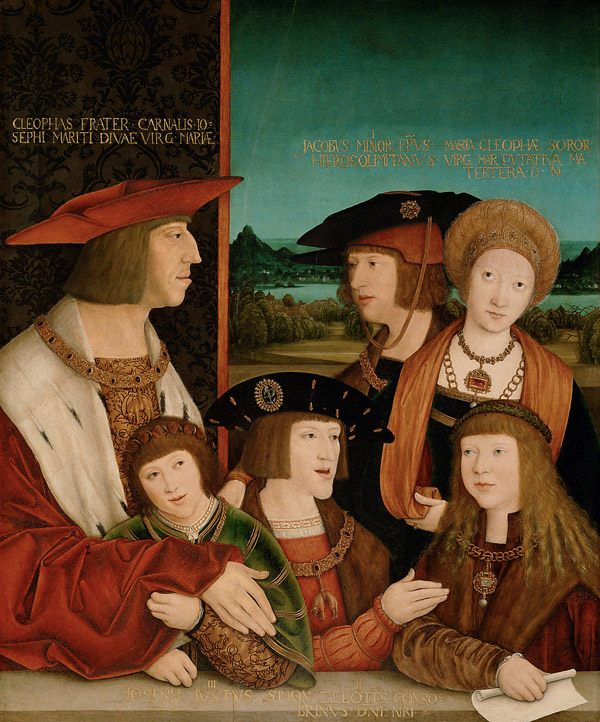
Charles of Austria was born on 24 February 1500 in the Prinsenhof of Ghent, a Flemish city of the Habsburg Netherlands, to Philip the Handsome and Joanna of Trastámara. His father Philip, nicknamed Philip the Handsome, was the firstborn son of Maximilian I, Holy Roman Emperor, Archduke of Austria, and Mary of Burgundy, heiress to the Burgundian Netherlands. Charles's mother Joanna of Castile was a younger daughter of Ferdinand II of Aragon and Isabella I of Castile, the Catholic Monarchs of Spain from the House of Trastámara. The political marriage of Philip and Joanna was first conceived in a letter sent by Maximilian to Ferdinand, part of the establishment of an Austro-Spanish alliance opposed to the Kingdom of France in the context of the Italian Wars.
From the moment he became King of the Romans in 1486, Charles's paternal grandfather Maximilian had carried a very financially risky policy of maximum expansionism, relying mostly on the resources of the Austrian hereditary lands. Even though it is often implied by, among others, Erasmus of Rotterdam, that Charles V and the Habsburgs gained their vast empire through peaceful policies (exemplified by the saying Bella gerant aliī, tū fēlix Austria nūbe / Nam quae Mars aliīs, dat tibi regna Venus or "Let others wage war, but thou, O happy Austria, marry; for those kingdoms which Mars gives to others, Venus gives to thee", reportedly spoken by Mathias Corvinus), Maximilian and his descendants fought wars aplenty. Maximilian fought 27 wars during his four decades of ruling.
His general strategy was to combine his intricate systems of alliance, wars, military threats and offers of marriage to realise his expansionist ambitions. Ultimately, he succeeded in coercing Bohemia, Hungary and Poland into acquiescence in the Habsburgs' expansionist plan.
The fact that the marriages between the Habsburgs and the Trastámaras, originally conceived as a marital alliance against France, would bring the crowns of Castile and Aragon to Maximilian's male line was unexpected.
The marriage contract between Philip and Joanna was signed in 1495, and celebrations were held in 1496. Philip was already Duke of Burgundy given Mary's death in 1482 (although the Duchy of Burgundy itself had been lost to the French crown). He was also heir apparent of Austria as an honorific archduke. Joanna, in contrast, was only third in the Spanish line of succession, preceded by her older brother John, Prince of Asturias and older sister Isabella of Aragon. Both heirs to the crowns of Castile and Aragon, John and Isabella, died in 1498. The Catholic Monarchs desired to keep the Spanish kingdoms in Iberian hands, so they designated their Portuguese grandson Miguel da Paz as heir presumptive of Spain by naming him Prince of Asturias; but he died as a baby in 1500.
02Birth and childhood

Charles's mother went into labour at a ball in February 1500. He was named in honour of Charles the Bold of Burgundy, who had attempted to create a continuous Burgundian State stretching from the North Sea to Savoy. When Charles was born, a poet at the court reported that the people of Ghent "shouted Austria and Burgundy throughout the whole city for three hours" to celebrate his birth.
Given the dynastic situation, the newborn was originally heir apparent only of the Habsburg Netherlands, being given the honorary title Duke of Luxembourg. He was also second in line to the Austrian duchies, becoming known in his early years simply as "Charles of Ghent". He was baptised at the Church of Saint John by the Bishop of Tournai. The Burgundian nobles Charles I de Croÿ and John III of Glymes were his godfathers, and Margaret of York and Margaret of Austria, Duchess of Savoy, respectively, his step-great-grandmother and aunt, his godmothers. Charles's baptism gifts were a sword and a helmet, objects of Burgundian chivalric tradition representing, respectively, the instrument of war and the symbol of peace. The death in July 1500 of the young heir presumptive Miguel de Paz to the Iberian realms of his maternal grandparents meant baby Charles's future inheritance potentially expanded to include Castile, Aragon, and the overseas possessions in the Americas.
In 1501, his parents, Philip and Joanna, left Charles in the care of Philip's step-grandmother, Margaret of York, in Mechelen and went to Spain. The main goal of their Spanish mission was the recognition of Joanna as Princess of Asturias, following Prince Miguel's death a year earlier. They succeeded despite facing some opposition from the Castilian Cortes, which were reluctant to create the premises for Habsburg succession. In 1504, when her mother Isabella died, Joanna became Queen of Castile. Charles only met his father again in 1503 while his mother returned in 1504 (after giving birth to Ferdinand in Spain). The Spanish Ambassador Gutierre Gómez de Fuensalida reported that Philip often visited and they had lots of fun. The couple's unhappy marriage and Joanna's unstable mental state, however, created many difficulties, making it unsafe for the children to stay with the parents.
Philip was recognised as King of Castile in 1506. He died shortly after, an event that was said to drive the mentally unstable Joanna into complete insanity. She was retired in isolation to the Royal Palace of Tordesillas. Charles's grandfather Ferdinand took control of all the Spanish kingdoms, under the pretext of protecting Charles's rights, which in reality he wanted to elude. Ferdinand's new marriage with Germaine de Foix failed to produce a surviving Trastámara heir to the throne, so Charles remained the heir presumptive to the Iberian realms. With his father dead and his mother confined, Charles became Duke of Burgundy and was recognised as Prince of Asturias (heir presumptive of Castile) and honorific Archduke (heir apparent of Austria).
03Inheritances

The Burgundian inheritance included the Habsburg Netherlands, which consisted of a large number of lordships in the Low Countries and covered modern-day Belgium, Netherlands and Luxembourg. It also included the Free County of Burgundy (the region of Franche-Comté) and the County of Charolais, but excluded the Duchy of Burgundy, annexed by France in 1477. At the death of Philip in 1506, Charles was recognised as Lord of the Netherlands and count of Burgundy and Charolais, also becoming the titular Duke of Burgundy, and thus being styled as Duke Charles II of Burgundy.
During his childhood and teen years, Charles lived in Mechelen together with his sisters Mary, Eleanor and Isabella at the court of his aunt Margaret of Austria, Duchess of Savoy. William de Croÿ (later prime minister) and Adrian of Utrecht (later Pope Adrian VI) served as his tutors. The culture and courtly life of the Low Countries played an important part in the development of Charles's beliefs. As a member of the Burgundian Order of the Golden Fleece in his infancy, and later its grandmaster, Charles was educated in the ideals of the medieval knights and the desire for Christian unity to fight the infidel. The Low Countries were very rich during his reign, both economically and culturally. Charles was very attached to his homeland and spent a large part of his life in Brussels and Flemish cities.
The Spanish inheritance, resulting from a dynastic union of the crowns of Castile and Aragon, included Spain and the Castilian possessions in the Americas (the Spanish West Indies and the Province of Tierra Firme) and the Aragonese kingdoms of Naples, Sicily, and Sardinia. Joanna inherited these territories in 1516 while confined, allegedly because she was mentally ill. Charles, therefore, claimed the crowns for himself jure matris, thus becoming co-monarch with Joanna with the title of Charles I of Castile and Aragon or Charles I of Spain.
Castile and Aragon together formed the largest of Charles's personal possessions. They provided a great number of generals and tercios, the formidable Spanish infantry of the time, while Joanna remained confined in Tordesillas until her death. Plus Ultra, the rendition from French into Latin of Charles's personal motto "Plus Oultre" (Further Beyond), later became the national motto of Spain and features on the country's flag as part of the Spanish coat of arms since the 18th century. However, at his accession to the Iberian thrones, Charles was viewed as a foreign prince.
Two rebellions, the Revolt of the Brotherhoods and the Revolt of the Comuneros, contested Charles's rule in the 1520s. Following these revolts, Charles placed Spanish counsellors in a position of power and spent a significant part of his life in Castile, including his final years in a monastery. His son and heir, later Philip II of Spain, was born and raised in Castile. Nonetheless, many Spaniards believed that their resources, largely consisting of flows of silver from the Americas, were being used to sustain Imperial-Habsburg policies that were not in Spain's interest.
Charles inherited the Austrian hereditary lands in 1519, as Charles I of Austria, and obtained the election as Holy Roman Emperor against the candidacy of the French king. Since the Imperial election, he was known as Emperor Charles V even outside of Germany. The dynastic motto of the House of Habsburg used by Charles was A.E.I.O.U. ("Austria Est Imperare Orbi Universo" — "it is Austria's destiny to rule the world"; although its exact meaning remains disputed). Charles staunchly defended Catholicism as Lutheranism spread. Various German princes broke with him on religious grounds, fighting against him. Charles's presence in Germany was often marked by the organization of imperial diets to maintain religious and political unity.
He was frequently in Northern Italy, often taking part in complicated negotiations with the Popes to address the rise of Protestantism. The German Catholics supported the Emperor. Charles had a close relationship with important German families, like the House of Nassau, many of which were represented at his imperial court. Many German princes, noblemen and generals led his military campaigns against France and the Ottomans or accompanied him in his travels, and the bulk of his army was generally composed of German troops, especially the Imperial Landsknechte.
04Reign

In 1506, Charles inherited all of his father's territories in the Low Countries, thus becoming the ruler of the Habsburg Netherlands. His inheritance also included the Free County of Burgundy (region of Franche-Comté) within the Holy Roman Empire, and the County of Charolais in the Kingdom of France. and, most notably, the Low Countries. His territories in the Low Countries mostly lay within the Holy Roman Empire, and partially within the French realm. Thus, Charles's birthplace, the city of Ghent, belonged to the County of Flanders, at that time still being the fief of the French crown. Since he was a minor, his aunt Margaret of Austria acted as regent, as appointed by Emperor Maximilian, until 1515. She soon found herself at war with France over Charles's requirement to pay homage to the French king for Flanders, Artois and Charolais, as his father had done. The outcome was that France relinquished its ancient claim on Flanders and Artois in 1528.
From 1515 to 1523, Charles's government in the Netherlands also had to contend with the rebellion of Frisian peasants (led by Pier Gerlofs Donia and Wijard Jelckama). The rebels were initially successful, but after a series of defeats, the remaining leaders were captured and executed in 1523.
Charles extended the Burgundian territory with the annexation of Tournai, Artois, Utrecht, Groningen, and Guelders. The Seventeen Provinces had been unified by Charles's Burgundian ancestors, but nominally were fiefs of either France or the Holy Roman Empire. Charles eventually won the Guelders Wars and united all provinces under his rule, the last one being the Duchy of Guelders. In 1549, Charles issued a Pragmatic Sanction, declaring the Habsburg Netherlands to be a unified entity of which his family would be the heirs.
The entire region of the Low Countries held an essential place in the Empire. For Charles V, they were his home, the region where he was born and spent his childhood. Because of trade and industry and the wealth of the region's cities, the Habsburg Netherlands also represented a significant income for Charles' treasury.
The Burgundian territories were generally loyal to Charles throughout his reign. The important city of Ghent rebelled in 1539 due to heavy tax payments demanded by Charles. The rebellion did not last long, however, as Charles's military response, with reinforcement from Fernando Álvarez de Toledo, 3rd Duke of Alba, was swift and humiliating to the rebels of Ghent.
In the Castilian Cortes of Valladolid in 1506 and of Madrid in 1510, Charles was sworn as the Prince of Asturias, heir-apparent to his mother Queen Joanna. On the other hand, in 1502, the Aragonese Corts gathered in Zaragoza and pledged an oath to Joanna as heiress-presumptive, but Alonso de Aragón, Archbishop of Zaragoza (an illegitimate son of King Ferdinand), expressed firmly that this oath could not establish jurisprudence, that is to say, modify the right of the succession, except by virtue of a formal agreement between the Corts and the King. So, upon the death of King Ferdinand II of Aragon, on 23 January 1516, Joanna inherited the Crown of Aragon, which consisted of Aragon, Mallorca, Catalonia, Valencia, Naples, Sicily and Sardinia, while Charles became governor general (regent). Nevertheless, the Flemish wished Charles to assume the royal title, and this was supported by Emperor Maximilian I and Pope Leo X. Consequently, after Ferdinand II's funeral on 14 March 1516, Charles I was proclaimed King of Castile and of Aragon jointly with his mother. Finally, the Castilian Regent, Cardinal Jiménez de Cisneros accepted the fait accompli, and the Castilian and Aragonese Cortes paid homage to him as King of Aragon jointly with his mother. Cisneros acceded to Charles's desire to be proclaimed king and imposed his instatement throughout the kingdom. Charles arrived in his new kingdoms in the autumn of 1517. Cisneros came to meet him but fell ill along the way, not without a suspicion of poison, and he died before reaching the King.
Due to the irregularity of Charles assuming the royal title while his mother, the legitimate queen, was alive, the negotiations with the Castilian Cortes in Valladolid (1518) proved difficult. In the end Charles was accepted under the following conditions: he would learn to speak Castilian; he would not appoint foreigners; he was prohibited from taking precious metals from Castile beyond the Quinto Real; and he would respect the rights of his mother, Queen Joanna. The Cortes paid homage to him in Valladolid in February 1518. After this, Charles departed to the Crown of Aragon. He managed to overcome the resistance of the Aragonese Cortes and Catalan Corts, and he was recognized as King of Aragon and Count of Barcelona jointly with his mother, while his mother was kept confined and ruled in name only. The Kingdom of Navarre had been invaded by Ferdinand of Aragon jointly with Castile in 1512, but he pledged a formal oath to respect the kingdom. On Charles's accession to the Spanish thrones, the Parliament of Navarre (Cortes) required him to attend the coronation ceremony (to become Charles IV of Navarre). Still, this demand fell on deaf ears, and the parliament kept piling up grievances.
Charles was accepted as sovereign, even though the Spanish felt uneasy with the Imperial style. Spanish kingdoms varied in their traditions. Castile had become an authoritarian, highly centralised kingdom, where the monarch's own will easily overrode legislative and justice institutions. By contrast, in the Crown of Aragon, and especially in the Pyrenean Kingdom of Navarre, law prevailed, and the monarchy was seen as a contract with the people. This became an inconvenience and a matter of dispute for Charles V and later kings since realm-specific traditions limited their absolute power. With Charles, the government became more absolute, even though, until his mother died in 1555, Charles did not hold absolute power in the country.
Soon, resistance to the Emperor arose because of heavy taxation to support foreign wars in which Castilians had little interest and because Charles tended to select Flemings for high offices in Castile and America, ignoring Castilian candidates. The resistance culminated in the Revolt of the Comuneros, which Charles suppressed. The Comuneros released Joanna and wanted to depose Charles and support Joanna to be the sole monarch instead. While Joanna refused to depose her son, her confinement continued after the revolt to discourage similar events in future. Immediately after crushing the Castilian revolt, Charles was confronted again with the pressing issue of Navarre when King Henry II attempted to reconquer the kingdom. Main military operations lasted until 1524, when Hondarribia surrendered to Charles's forces, but frequent cross-border clashes in the western Pyrenees only stopped in 1528 (Treaties of Madrid and Cambrai).
After these events, Navarre remained a matter of domestic and international litigation still for a century (a French dynastic claim to the throne did not end until the July Revolution in 1830). Charles wanted his son and heir Philip II to marry the heiress of Navarre, Jeanne d'Albret. Jeanne was instead forced to marry William, Duke of Julich-Cleves-Berg, but that childless marriage was annulled after four years. She next married Antoine de Bourbon, and both she and their son Henry of Navarre would oppose Philip II in the French Wars of Religion.
After its integration into Charles's empire, Castile guaranteed effective military units and its American possessions provided the bulk of the empire's financial resources. However, the two conflicting strategies of Charles V, enhancing the possessions of his family and protecting Catholicism against Protestant heretics, diverted resources away from building up the Spanish economy. Elite elements in Spain called for more protection for the commercial networks, which were threatened by the Ottoman Empire and Barbary pirates. Charles instead focused on defeating Protestantism in Germany and the Netherlands, which proved to be a lost cause. Each hastened the economic decline of the Spanish Empire in the next generation. The enormous budget deficit accumulated during Charles's reign, along with the inflation that affected the kingdom, resulted in declaring bankruptcy during the reign of Philip II.
The Crown of Aragon inherited by Charles included the Kingdom of Naples, the Kingdom of Sicily and the Kingdom of Sardinia. Additionally, as Holy Roman Emperor and King of Italy, Charles was the sovereign of several states of northern Italy. The Duchy of Milan, however, was under French control after its victory against Switzerland at the Battle of Marignano in 1515.
Imperial-Papal troops succeeded in re-installing Francesco II Sforza in Milan in 1521, in the context of an alliance between Charles V and Pope Leo X. A Franco-Swiss army was expelled from Lombardy at the Battle of Bicocca in 1522. In 1524, Francis I of France retook the initiative, crossing into Lombardy where Milan, along with several other cities, once again fell to his attack. Pavia alone held out, and on 24 February 1525 (Charles's twenty-fifth birthday), Charles's forces led by Charles de Lannoy captured Francis and crushed his army in the Battle of Pavia.
In 1535, Francesco II Sforza died without heirs, and Charles V annexed the territory as a vacant Imperial state with the help of Massimiliano Stampa, one of the most influential courtiers of the late Duke. Charles successfully held on to all of its Italian territories, though they were invaded again on multiple occasions during the Italian Wars.
In addition, Habsburg trade in the Mediterranean was consistently disrupted by the Ottoman Empire and its vassal Barbary pirates. In 1538, a Holy League consisting of all the Italian states and the Spanish kingdoms was formed to drive the Ottomans back, but it was defeated at the Battle of Preveza. Decisive naval victory eluded Charles; it would not be achieved until after his death, at the Battle of Lepanto in 1571.
After the death of his paternal grandfather, Maximilian, in 1519, Charles inherited the Habsburg monarchy. He was also the natural candidate of the electors to succeed his grandfather as Holy Roman Emperor. He defeated the candidacies of Frederick III of Saxony, Francis I of France, and Henry VIII of England in the 1519 Imperial election. According to some, Charles became emperor due to the fact that, by paying huge bribes to the electors, he was the highest bidder. He won the crown on 28 June 1519. On 23 October 1520, he was crowned in Germany and some ten years later, on 24 February 1530, he was crowned Holy Roman Emperor by Pope Clement VII in Bologna, the last emperor to receive a papal coronation. Others point out that while the electors were paid, this was not the reason for the outcome, or at most played only a small part. The important factor that swayed the final decision was that Frederick refused the offer, and made a speech in support of Charles on the ground that they needed a strong leader against the Ottomans, Charles had the resources and was a prince of German extraction.
Although even at the beginning of his reign, his position was more powerful than that of any of his predecessors, the decentralised structure of the Empire proved resilient, not least because of the Reformation.
05Abdications and death
Between 1554 and 1556, Charles V gradually divided the Habsburg empire between a senior Spanish line and an Austrian branch of the House of Habsburg. His abdications all occurred at the Palace of Coudenberg in Brussels. First, he abdicated the thrones of Sicily and Naples, the latter a Papal fief, and the Imperial Duchy of Milan, in favour of his son Philip II of Spain on 25 July 1554. Philip was secretly invested with Milan already in 1540 and again in 1546, but only in 1554 did the Emperor make it public. Upon the abdications of Naples and Sicily, Philip was invested by Pope Julius III with the Kingdom of Naples on 2 October and with the Kingdom of Sicily on 18 November.
The most famous – and only public – abdication took place a year later, on 25 October 1555, when Charles announced to the States General of the Netherlands (reunited in the great hall where he was emancipated forty years before by Emperor Maximilian) his abdication of those territories in favour of his son Philip as well as his intention to step down from all of his positions and retire to a monastery. During the ceremony, the gout-afflicted Emperor Charles V leaned on the shoulder of his advisor William the Silent and, crying, pronounced his resignation speech:
When I was nineteen [...] I undertook to be a candidate for the Imperial crown, not to increase my possessions but rather to engage myself more vigorously in working for the welfare of Germany and my other realms [...] and in the hopes of thereby bringing peace among the Christian peoples and uniting their fighting forces for the defence of the Catholic faith against the Ottomans. [...] I had almost reached my goal when the attack by the French king and some German princes called me once more to arms. Against my enemies, I accomplished what I could, but success in war lies in the hands of God, who gives victory or takes it away, as He pleases. [...] I must, for my part, confess that I have often misled myself, either from youthful inexperience, from the pride of mature years, or from some other weakness of human nature. I nonetheless declare to you that I never knowingly or willingly acted unjustly. [...] If actions of this kind are nevertheless justly laid to my account, I formally assure you now that I did them unknowingly and against my own intention. I therefore beg those present today, whom I have offended in this respect, together with those who are absent, to forgive me.
He concluded the speech by mentioning his voyages: ten to the Low Countries, nine to Germany, seven to Spain, seven to Italy, four to France, two to England, and two to North Africa. His last public words were, "My life has been one long journey."
With no fanfare, in 1556, he finalised his abdications. On 16 January 1556, he gave Spain and the Spanish Empire in the Americas to Philip. On 27 August 1556, he abdicated as Holy Roman Emperor in favour of his brother Ferdinand, elected King of the Romans in 1531. The succession was recognised by the prince-electors assembled at Frankfurt only in 1558, and by the Pope only in 1559. The Imperial abdication also marked the beginning of Ferdinand's legal and suo jure rule in the Austrian possessions, that he governed in Charles's name since 1521–1522, and were territorially linked with his rule over Hungary and Bohemia since 1526.
According to scholars, Charles decided to abdicate for a variety of reasons: the religious division of Germany sanctioned in 1555; the state of Spanish finances, bankrupted with inflation by the time his reign ended; the revival of Italian Wars with attacks from Henry II of France; the never-ending advance of the Ottomans in the Mediterranean and central Europe; and his declining health, in particular attacks of gout such as the one that forced him to postpone an attempt to recapture the city of Metz where he was later defeated.
In September 1556, Charles left the Low Countries and sailed to Spain, accompanied by his sisters, Mary of Hungary and Eleanor of Austria. He arrived at the Monastery of Yuste of Extremadura in 1557. He continued to correspond widely and kept an interest in the situation of the empire, while suffering from severe gout. He lived alone in a secluded monastery, surrounded by paintings by Titian and with clocks lining every wall, which some historians believe were symbols of his reign and his lack of time. In August 1558, Charles was taken seriously ill, with what was diagnosed in the twenty-first century as malaria.
He died in the early hours of the morning on 21 September 1558, at the age of 58, holding in his hand the cross that his wife Isabella had been holding when she died. Following his death, there were a plethora of commemorations in his empire, including in Mexico and Peru. Some 30,000 masses were arranged for the soul of the Emperor. Some 30,000 gold ducats that he had set aside for the ransom of prisoners, poor virgins, and paupers were distributed. He still owed huge debts from his constant warfare far beyond the funds on hand, which his heirs spent decades paying off.
Charles was originally buried in the chapel of the Monastery of Yuste, but he left a codicil in his last will and testament asking for the establishment of a new religious foundation in which he would be reburied with Isabella. Following his return to Spain in 1559, their son Philip undertook the task of fulfilling his father's wish when he founded the Monastery of San Lorenzo de El Escorial. After the Monastery's Royal Crypt was completed in 1574, the bodies of Charles and Isabella were relocated and re-interred into a small vault directly underneath the altar of the Royal Chapel, in accordance with Charles's wishes to be buried "half-body under the altar and half-body under the priest's feet" side by side with Isabella.
They remained in the Royal Chapel while the famous Basilica of the Monastery and the Royal tombs were still under construction. In 1654, after the Basilica and Royal tombs were finally completed during the reign of their great-grandson Philip IV of Spain, the remains of Charles and Isabella were moved into the Royal Pantheon of Kings, which lies directly under the Basilica. On one side of the Basilica are bronze effigies of Charles and Isabella, with effigies of their daughter Maria of Austria and Charles's sisters Eleanor of Austria and Maria of Hungary behind them. Adjacent to them on the opposite side of the Basilica are effigies of their son Philip with three of his wives and their ill-fated grandson Carlos, Prince of Asturias.
06Administration
Given the vast dominions of the House of Habsburg, Charles was often on the road and needed deputies to govern his realms for the times he was absent from his territories. His first Governor of the Habsburg Netherlands was Margaret of Austria, Duchess of Savoy, succeeded by his sister Mary of Hungary and Emmanuel Philibert, Duke of Savoy. His first Regent of Spain was Adrian of Utrecht (succeeded by Isabella of Portugal and Philip II of Spain). For the regency and governorship of the Austrian hereditary lands, Charles named his brother Ferdinand archduke in the Austrian lands under his authority at the Diet of Worms (1521).
Charles agreed to favour the election of Ferdinand as King of the Romans in Germany, which took place in 1531. By virtue of these agreements, Ferdinand became Holy Roman Emperor and obtained hereditary rights over Austria at the abdication of Charles in 1556. Charles de Lannoy, Carafa and Antonio Folc de Cardona y Enriquez were viceroys of the kingdoms of Naples, Sicily and Sardinia, respectively.
Charles V travelled ten times to the Low Countries, nine to Germany, seven to Spain, seven to Italy, four to France, two to England, and two to North Africa. During all his travels, the Emperor left a documentary trail in almost every place he went, allowing historians to surmise that he spent 10,000 days in the Low Countries, 6,500 days in Spain, 3,000 days in Germany, and 1,000 days in Italy. He spent 195 days in France, 99 in North Africa and 44 days in England. For 260 days, his exact location is unrecorded, all of them being days spent at sea travelling between his dominions. As he put it in his last public speech: "my life has been one long journey".
Charles never travelled to his overseas possessions in the Americas, since a transatlantic crossing to a place not central to his political interests at the time was unthinkable.
The New World was an increasingly important part of the balance of power, but it was completely subordinate to European considerations. The Spanish colonial empire took up relatively little of Charles V's time. Its principal function was to provide resources to support his ambitions on the near side of the Atlantic: again and again, it was bullion from the Indies – a fifth of total revenue – which either funded campaigns against the French, Turks, and German princes directly or provided the security against which the Emperor could borrow the great banking Fugger family in Augsburg. For example, of nearly 2 million escudos' worth of treasury, the largest recipient was Germany, followed by the Low Countries. Charles's travels throughout his reign also show his priority quite clearly: he visited Italy on seven occasions, France on four, and England and Africa on two, and spent six long stays in Spain itself, but he travelled to Flanders and Germany on no fewer than nineteen occasions; he never visited the Americas. His imperial status stemmed from the Imperium Romanum, not the global sweep of his lands. In short, the Holy Roman Empire, not the emerging Spanish empire, provided the Imperial context in which the ambitions of Charles V played out.
He did, however, establish strong administrative structures to rule them, including the European-based Council of the Indies in 1524 and the establishment of the Viceroyalty of New Spain and the Viceroyalty of Peru when the Aztec and Inca civilisations were conquered in his name.
In 1534, Charles accepted a personal audience with Maxixcatzin, a nobleman from Tlaxcala who demanded and received several special privileges for his city and its people. The Tlaxcallans had formed an alliance with Spain and were instrumental in the overthrow of the Aztecs and other conquests in the Americas. Charles' decrees recognised their contributions and promised that Tlaxcala's autonomy would be preserved. His treatment of the Tlaxcallans and other friendly native peoples as important allies rather than conquered subjects ensured strong support from Tlaxcala and other allied native groups for the next three centuries.
Under the organisation and patronage of Maximilian I, Southern Germany had become the leading arms industry region of the 16th century, rivalled only by Northern Italy with the chief centers being Nuremberg, Augsburg, Milan, and Brescia. Charles V continued with the development of mass production and standardization of gun caliber, which greatly affected warfare.
The Helmschmied of Augsburg and the Filippo Negroli of Milan were among the foremost families of armourers of the time. Under Charles V, the Spanish arms industry was significantly expanded, with significant improvements of muskets.
The Landsknechte, originally recruited and organised by Maximilian and Georg von Frundsberg, formed the bulk of Charles V's army. They surpassed the Swiss mercenaries in quality and quantity as the "best and most easily available mercenaries in Europe". They were considered best fighting troops in the first half of the 16th century for their brutal and ruthless efficiency, with a French saying going "a Landsknecht thrown out of heaven couldn't get in hell because he would frighten the devil".
Terrence McIntosh notes that Charles V, like his grandfather, "relied heavily on German military manpower, fearsome landsknechts, as well as redoubtable Swiss-German mercenaries. Maximilian invaded northern Italy in 1496, 1508, and repeatedly between 1509 and 1516. Soon after the Imperial election in 1519, Charles V was waging war there. His overwhelmingly German troops won the Battle of Pavia and captured the French king in 1525; two years later, they sacked the city of Rome, murdering between six and twelve thousand residents and pillaging for eight months."
His expansionist and aggressive policy, in combination with the brutal behaviours of the Landsknechte, which incidentally happened right at the formation of the early modern German nation, left an indelible mark on his neighbours' impression of the German polity, despite the fact that, in the long term, it was in general not belligerent.
Charles V also favoured German heavy cavalry, although costly. Many cavalrymen and noblemen fighting for Charles V were of Burgundian extraction, often part of the Order of the Golden Fleece. Italian condottieri were also recruited.
In Spain, inheriting the reform work of Gonzalo Fernández de Córdoba, in 1536, Charles reorganised his infantry and created the first units of the tercios. Later they became "the most formidable fighting force of the sixteenth century". The original tercios were exclusively Spanish and this situation remained until Philip II organized the Italian tercios in 1584.
Charles's main sources of revenue were from Castile, Naples and the Low Countries, which yielded in total an annual amount of around 2.8 million Spanish ducats in the 1520s and about 4.8 million Spanish ducats in the 1540s. Ferdinand I's annual revenue totalled between 1.7 million and 1.9 million Venetian ducats (2.15–2.5 million florin or Rhine gulden). Their chief enemy, the Ottomans, had a more streamlined and profitable system, yielding 10 million gold ducats in 1527–1528 and did not suffer from a deficit.
He often had to depend on loans from bankers. He borrowed 28 million ducats in total during his reign, of which 5.5 million ducats came from the Fuggers and 4.2 million from the Welsers of Augsburg. Other creditors were from Genoa, Antwerp and Spain.
The Habsburg expansion and consolidation of rule was accompanied by the remarkable development of communication, diplomatic and espionage systems. In 1495, Emperor Maximilian and Franz von Taxis (from the Thurn und Taxis family) developed the Niederländische Postkurs, a postal system that connected the Low Countries with Innsbruck. The system quickly converged with the European trade system and an emerging market for news, spurring a pan-Europe communication revolution.
The system was developed further by Philip the Handsome, who negotiated new standards for the systems with the Taxis, and unified communication between Germany, the Netherlands, France and Spain by adding stations in Granada, Toledo, Blois, Paris and Lyon in 1505.
After his father's death, Charles, as Duke of Burgundy, continued to develop the system. Behringer notes that, "Whereas the status of private mail remains unclear in the treaty of 1506, it is obvious from the contract of 1516 that the Taxis company had the right to carry mail and keep the profit as long as it guaranteed the delivery of court mail at clearly defined speeds, regulated by time sheets to be filled in by the post riders on the way to their destination. In return, imperial privileges guaranteed exemption from local taxes, local jurisdiction, and military service. 21 The terminology of the early modern communications system and the legal status of its participants were invented at these negotiations." He confirmed Jannetto's son Giovanni Battista de Tassis as Postmaster General (chief et maistre general de noz postes par tous noz royaumes, pays, et seigneuries) in 1520. By Charles V's time, "the Holy Roman Empire had become the centre of the European communication universe."
Charles V inherited efficient multinational diplomatic networks from both the Trastámara and Habsburg-Burgundian dynasties. Following the example of the papal curia, in the late fifteenth century, both dynasties began to employ permanent envoys, earlier than other secular powers. The Habsburg network developed in parallel to their postal system. Charles V combined the Spanish and the Imperial systems into one.
His opponents, chiefly France, found a counterweight, though, by the alliance with the Ottoman Empire, which Francis I admitted to be the only force that could prevent the Habsburgs from transforming European states into a Europe-wide empire. Charles V's military might frightened other European rulers, while he was able to make the pope a reluctant agent, like his grandfather Ferdinand had done; no lasting alliance could be achieved. After the Battle of Pavia, the European rulers united to prevent harsh terms from being placed upon France.
In the 1530s, in the context of the conflict between the Habsburg Empire and its greatest opponent, the Ottomans, an espionage network was built by Charles and Don Alfonso Granai Castriota, the marquis of Atripalda, who conducted its operations. Naples became the main rearguard of the system. Gennaro Varriale writes that, "on the eve of the Tunis campaign, Emperor Charles V possessed a network of spies based in the Kingdom of Naples that watched over all the corners of the Ottoman Empire."
Several notable men were recognised with patronage by Charles. Noted Spanish poet Garcilaso de la Vega, a nobleman and ambassador in the Imperial court of Charles, was first appointed contino (imperial guard) of the Emperor in 1520. Alfonso de Valdés, twin brother of the humanist Juan de Valdés and secretary of the Emperor, was a Spanish humanist. Peter Martyr d'Anghiera, an Italian historian at the service of Spain, wrote the first accounts of explorations in Central and South America in a series of letters and reports, grouped in the original Latin publications of 1511 to 1530 into sets of ten chapters called "decades". His Decades are of great value in the history of geography and discovery. His De Orbe Novo (On the New World, 1530) describes the first contacts of Europeans and Native Americans, Native American civilisations in the Caribbean and North America, as well as Mesoamerica, and includes, for example, the first European reference to India rubber.
Martyr was given the post of chronicler (cronista) in the newly formed Council of the Indies (1524), commissioned by Charles V to describe what was occurring in the explorations of the New World. In 1523, Charles gave him the title of Count Palatine, and in 1524 called him once more into the Council of the Indies.
Article sections from Wikipedia (CC BY-SA 4.0). Excerpted for readability.