Mehmed II (Ottoman Turkish: محمد ثانى, romanized: Meḥemmed-i s̱ānī; Turkish: II. Mehmed, pronounced [icinˈdʒi ˈmehmet]; 30 March 1432 – 3 May 1481), commonly known as Mehmed the Conqueror (Ottoman Turkish: ابو الفتح, romanized: Ebū'l-fetḥ, lit. 'the Father of Conquest'; Turkish: Fâtih Sultan Mehmed), was the sultan of the Ottoman Empire twice, from August 1444 to September 1446 and again from February 1451 to May 1481.
During his first reign, he defeated the crusade led by John Hunyadi after Hungarian incursions into his lands violated the Treaties of Edirne and Szeged. Upon his restoration to the throne in 1451, he strengthened the Ottoman Navy and made preparations to attack Constantinople. In 1453, at the age of 21, he conquered Constantinople and effectively brought an end to the Byzantine Empire. After the conquest, Mehmed claimed the title caesar of Rome (Ottoman Turkish: قیصر روم, romanized: qayṣar-i rūm), on the grounds that Constantinople had been the seat and capital of the surviving Eastern Roman Empire since its consecration in 330 AD by Emperor Constantine I. The claim was soon recognized by the Patriarchate of Constantinople, but rejected by most European monarchs.
Mehmed continued his conquests and reunified Anatolia, and campaigned as far west as Bosnia in Southeast Europe. At home, he implemented many political and social reforms. He was a patron of the arts and sciences, and by the end of his reign, Constantinople had been transformed into a thriving imperial capital. He is considered a hero in modern-day Turkey and parts of the wider Muslim world, with Istanbul's Fatih district, Fatih Sultan Mehmet Bridge and Fatih Mosque being named after him.
Summary from Wikipedia (CC BY-SA 4.0)
01Early life and first reign

Mehmed II was born on 30 March 1432, in Edirne, then the capital city of the Ottoman Empire. His father was Sultan Murad II (1404–1451) and his mother Hüma Hatun, a slave of uncertain origin.
When Mehmed II was eleven years old, he was sent to Amasya with his two lalas (advisors) to govern and thus gain experience, per the custom of Ottoman rulers before his time. Sultan Murad II also sent a number of teachers for him to study under. This Islamic education had a great impact in molding Mehmed's mindset and reinforcing his Muslim beliefs. He was influenced in his practice of Islamic epistemology by practitioners of science, particularly by his mentor, Molla Gürâni, and he followed their approach. The influence of Akshamsaddin in Mehmed's life became predominant from a young age, especially in the imperative of fulfilling his Islamic duty to overthrow the Byzantine Empire by conquering Constantinople.
After Murad II made peace with Hungary on 12 June 1444, he abdicated the throne in favour of his 12-year-old son Mehmed II in July/August 1444.
During Mehmed II's first reign, he defeated the crusade led by John Hunyadi after the Hungarian incursions into his country broke the conditions of the truce per the Treaties of Edirne and Szeged in September 1444. Cardinal Julian Cesarini, the representative of the Pope, had convinced the king of Hungary that breaking the truce with Muslims was not a betrayal. At this time, Mehmed II asked his father Murad II to reclaim the throne, but Murad II refused. According to the 17th-century chronicles, Mehmed II wrote, "If you are the sultan, come and lead your armies. If I am the sultan, I hereby order you to come and lead my armies." Then, Murad II led the Ottoman army and won the Battle of Varna on 10 November 1444. Halil Inalcik states that Mehmed II did not ask for his father. Instead, it was Çandarlı Halil Pasha's effort to bring Murad II back to the throne.
In 1446, while Murad II returned to the throne, Mehmed retained the title of sultan but only acted as a governor of Manisa. Following the death of Murad II in 1451, Mehmed II became sultan for the second time. Ibrahim II of Karaman invaded the disputed area and instigated various revolts against Ottoman rule. Mehmed II conducted his first campaign against İbrahim of Karaman; the Byzantines threatened to release Ottoman claimant Orhan.
02Conquests

When Mehmed II ascended the throne again in 1451, he devoted himself to strengthening the Ottoman navy and made preparations for an attack on Constantinople. In the narrow Bosphorus Straits, the fortress Anadoluhisarı had been built by his great-grandfather Bayezid I on the Asian side; Mehmed erected an even stronger fortress called Rumelihisarı on the European side, and thus gained complete control of the strait. Having completed his fortresses, Mehmed proceeded to levy a toll on ships passing within reach of their cannon. A Venetian vessel ignoring signals to stop was sunk with a single shot and all the surviving sailors beheaded, except for the captain, who was impaled and mounted like a human scarecrow as a warning to other sailors on the strait.
Abu Ayyub al-Ansari, the companion and standard bearer of the Islamic prophet Muhammad, had died during the first Siege of Constantinople (674–678). As Mehmed II's army approached Constantinople, Mehmed's sheikh Akshamsaddin discovered the tomb of Abu Ayyub al-Ansari. After the conquest, Mehmed built Eyüp Sultan Mosque at the site to emphasize the importance of the conquest to the Islamic world and highlight his role as ghazi.
In 1453, Mehmed commenced the siege of Constantinople with an army between 80,000 and 200,000 troops, an artillery train of over seventy large field pieces, and a navy of 320 vessels, the bulk of them transports and storeships. The city was surrounded by sea and land; the fleet at the entrance of the Bosphorus stretched from shore to shore in the form of a crescent, to intercept or repel any assistance for Constantinople from the sea. In early April, the Siege of Constantinople began. At first, the city's walls held off the Turks, even though Mehmed's army used the new bombard designed by Orban, a giant cannon similar to the Dardanelles Gun. The harbor of the Golden Horn was blocked by a boom chain and defended by twenty-eight warships.
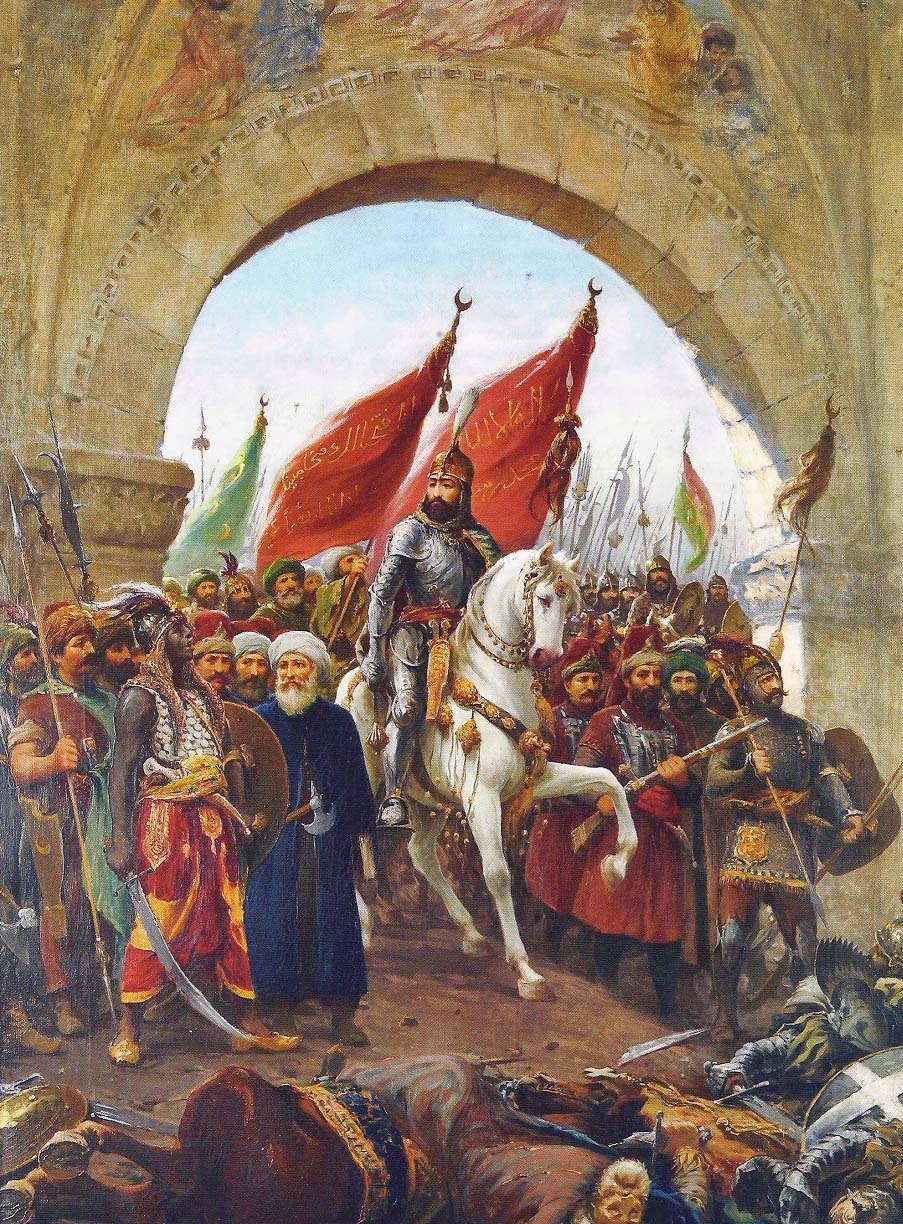
On 22 April, Mehmed transported his lighter warships overland, around the Genoese colony of Galata, and into the Golden Horn's northern shore; eighty galleys were transported from the Bosphorus after paving a route, little over one mile, with wood. Thus, the Byzantines stretched their troops over a longer portion of the walls. About a month later, Constantinople fell, on 29 May, following a fifty-seven-day siege. After this conquest, Mehmed moved the Ottoman capital from Adrianople to Constantinople.
When Sultan Mehmed II stepped into the ruins of the Boukoleon, known to the Ottomans and Persians as the Palace of the Caesars, probably built over a thousand years before by Theodosius II, he uttered the famous lines of Saadi:
Some Muslim scholars claimed that a hadith in Musnad Ahmad referred specifically to Mehmed's conquest of Constantinople, seeing it as the fulfillment of a prophecy and a sign of the approaching apocalypse.
After the conquest of Constantinople, Mehmed claimed the title of caesar of the Roman Empire (Qayser-i Rûm), based on the assertion that Constantinople had been the seat and capital of the Roman Empire since 330 AD and whoever possessed the Imperial capital was the ruler of the empire. The contemporary scholar George of Trebizond supported his claim. The claim was not recognized by the Catholic Church and most of, if not all, Western Europe, but was recognized by the Eastern Orthodox Church. Mehmed had installed Gennadius Scholarius, a staunch antagonist of the West, as the ecumenical patriarch of Constantinople with all the ceremonial elements, ethnarch (or milletbashi) status, and rights of property that made him the second largest landlord in the empire after the sultan himself in 1454, and in turn, Gennadius II recognized Mehmed the Conqueror as the successor to the throne.
Emperor Constantine XI Palaiologos died without producing an heir, and had Constantinople not fallen to the Ottomans, he likely would have been succeeded by the sons of his deceased elder brother. Those children were taken into the palace service of Mehmed after the fall of Constantinople. The oldest boy, renamed Hass Murad, became a personal favorite of Mehmed and served as beylerbey of the Balkans. The younger son, renamed Mesih Pasha, became admiral of the Ottoman fleet and sanjak-bey of the Gallipoli. He eventually served twice as Grand Vizier under Mehmed's son, Bayezid II.
After the fall of Constantinople, Mehmed would also go on to conquer the Despotate of Morea in the Peloponnese in two campaigns in 1458 and 1460 and the Empire of Trebizond in northeastern Anatolia in 1461. The last two vestiges of Byzantine rule were thus absorbed by the Ottoman Empire. The conquest of Constantinople bestowed immense glory and prestige on the country. Kritovoulos reports that 10 years after the conquest of Constantinople, Mehmed II allegedly visited the site of Troy and boasted that he had avenged the Trojans by conquering the Greeks (Byzantines). This story is considered to be fictitious, as there are no Ottoman sources which mention it and there is no further evidence of any Turkish claiming of Troy. Mehmed also allegedly visited the Acropolis, but this, too, is considered apocryphal. These myths were customary in propaganda writing and encomia; Kritovoulos, in particular, used those two stories because he sought to "Hellenize" Mehmed.
Mehmed II's first campaigns after Constantinople were in the direction of Serbia, which had been an Ottoman vassal state intermittently since the Battle of Kosovo in 1389. The Ottoman ruler had a connection with the Serbian Despotate – one of Murad II's wives was Mara Branković – and he used that fact to claim Serbian lands. Đurađ Branković's recently made alliance with the Hungarians, and his irregular payments of tribute, further served as justifications for the invasion. The Ottomans sent an ultimatum demanding the keys to some Serbian castles which formerly belonged to the Ottomans. When Serbia refused these demands, the Ottoman army led by Mehmed set out from Edirne towards Serbia in 1454, sometime after the 18th of April. Mehmed's forces quickly succeeded in capturing Sivricehisar (sometimes identified with the Ostrvica Fortress) and Omolhisar, and repulsed a Serbian cavalry force of 9,000 cavalry sent against them by the despot. Following these actions, the Serbian capital of Smederevo was put under siege by the Ottoman forces. Before the city could be taken, intelligence was received about an approaching Hungarian relief force led by Hunyadi, which caused Mehmed to lift the siege and start marching back to his domains. By August the campaign was effectively over, Mehmed left a part of his force under the command of Firuz Bey in Serbia in anticipation of a possible offensive on Ottoman territories by Hunyadi. This force was defeated by a combined Hungarian-Serbian army led by Hunyadi and Nikola Skobaljić on the 2nd of October near Kruševac, after which Hunyadi went on to raid Ottoman controlled Nish and Pirot before returning back to Belgrade. Roughly a month later, on the 16th of November, the Ottomans avenged their earlier defeat at Kruševac by defeating Skobaljić's army near Tripolje, where the Serbian voivode was captured and executed via impalement. Following this a temporary treaty was signed with the Serbian despot, where Đurađ would formally recognize the recently captured Serbian forts as Ottoman land, send thirty thousand florins to the Porte as yearly tribute and provide troops for Ottoman campaigns. The 1454 campaign had resulted in the capture of fifty thousand prisoners from Serbia, four thousand of whom were settled in various villages near Constantinople. The following year, Mehmed received reports from one of his frontier commanders about Serbian weakness against a possible invasion, the reports in combination with the dissatisfactory results of the 1454 campaign convinced Mehmed to initiate another campaign against Serbia. The Ottoman army marched on the important mining town of Novo Brdo, which Mehmed put under siege. The Serbians couldn't resist the Ottoman army out in the open, thus resorted to fortifying their various settlements and having their peasants flee to either various fortresses or forests. After forty days of siege and intense cannon fire, Novo Brdo surrendered. Following the conquest of the city, Mehmed captured various other Serbian settlements in the surrounding area, after which he started his march back towards Edirne, visiting his ancestor Murad I's grave in Kosovo on the way.
In 1456, Mehmed decided to continue his momentum towards the northwest and capture the city of Belgrade, which had been ceded to the Kingdom of Hungary by the Serbian despot Đurađ Branković in 1427. Significant preparations were made by the Sultan for the conquest of the city, including the casting of 22 large cannons alongside many smaller ones and the establishment of a navy which would sail up the Danube to aid the army during the siege. The exact number of troops Mehmed commanded varies between sources, but the rumours of its size were significant enough to cause panic in Italy. Ottoman troops began arriving at Belgrade on the 13th of June. After the necessary preparations were finished, Ottoman cannons started bombarding the city walls and Ottoman troops started filling the ditches in front of the walls with earth to advance forward. As despair started to set in amongst the defenders, news started arriving of a relief force assembling across the Danube under the command of John Hunyadi. Upon learning of this development, Mehmed held a war council with his commanders to determine the army's next actions. Karaca Pasha recommended that a part of the army should cross the Danube to counter the approaching relief army. This plan was rejected by the council, particularly due to the opposition by the Rumelian Begs. Instead, the decision was made to prioritize capturing the fortress, a move seen as a tactical blunder by modern historians. This allowed Hunyadi to set up camp with his army across the Danube uncontested. Shortly after, the Ottoman navy was defeated in a five hour long battle by the newly arrived Christian Danubian navy. Following this, Hunyadi's troops started entering the city to reinforce the besieged, which increased the morale of the defending forces. Infuriated by the unfolding events, Mehmed ordered a final attack to capture the city on the 21st of July, after continuous cannon fire building up to the day of the attack. Ottoman troops were initially successful in breaching the defences and entering the city, however were eventually repulsed by the defenders. The Christians pressed their advantage by launching a counter attack, which started pushing back the Ottoman forces, managing to advance as far as the Ottoman camp. At this crucial point of the battle, one of the viziers advised Mehmed to abandon the camp for his safety, which he refused to do so on the grounds that it would be a "sign of cowardice". After this, Mehmed personally joined the fighting, accompanied by two of his begs. The Sultan managed to personally kill three enemy soldiers before being injured, forcing him to abandon the battlefield. The news of their Sultan fighting alongside them and the arrival of reinforcements caused a morale boost amongst the Ottoman troops, which allowed them to go on the offensive again and push the Christian forces out of the Ottoman camp. The actions of the Sultan had prevented a complete rout of the Ottoman army, however, the army had been far too weakened to attempt to take the city again, causing the Ottoman war council to decide on ending the siege. The Sultan and his army began a retreat to Edirne during the night, without the Christian forces being able to pursue them. Hunyadi died shortly after the siege, meanwhile Đurađ Branković regained possession of some parts of Serbia.
Shortly before the end of the year 1456, roughly 5 months after the Siege of Belgrade, the 79-year-old Branković died.
03Administration and culture
He gathered Italian artists, humanists and Greek scholars at his court, allowed the Byzantine Church to continue functioning, ordered the patriarch Gennadius to translate Christian doctrine into Turkish, and called Gentile Bellini from Venice to paint his portrait as well as Venetian frescoes that are vanished today. He collected in his palace a library that included works in Greek, Persian, and Latin. Mehmed invited Muslim scientists and astronomers such as Ali Qushji and artists to his court in Constantinople, started a university, and built mosques (for example, the Fatih Mosque), waterways, and Istanbul's Topkapı Palace and the Tiled Kiosk.
Around the grand mosque that he constructed, he erected eight madrasas, which, for nearly a century, kept their rank as the highest teaching institutions of the Islamic sciences in the empire.
Mehmed II allowed his subjects a considerable degree of religious freedom, provided they were obedient to his rule. After his conquest of Bosnia in 1463, he issued the Ahdname of Milodraž to the Bosnian Franciscans, granting them the freedom to move freely within the Empire, offer worship in their churches and monasteries, and practice their religion free from official and unofficial persecution, insult, or disturbance. However, his standing army was recruited from the Devshirme, a group that took Christian subjects at a young age (8–20 yrs): they were converted to Islam, then schooled for administration or the military Janissaries. This was a meritocracy which "produced from among their alumni four out of five Grand Viziers from this time on".
Within Constantinople, Mehmed established a millet, or an autonomous religious community, and appointed the former Patriarch Gennadius Scholarius as religious leader for the Orthodox Christians of the city. His authority extended to all Ottoman Orthodox Christians, and this excluded the Genoese and Venetian settlements in the suburbs, and excluded Muslim and Jewish settlers entirely. This method allowed for an indirect rule of the Christian Byzantines and allowed the occupants to feel relatively autonomous even as Mehmed II began the Turkish remodeling of the city, turning it into the Turkish capital, which it remained until the 1920s.
After conquering Constantinople, when Mehmed II finally entered the city through what is now known as the Topkapi Gate, he immediately rode his horse to the Hagia Sophia, where he ordered the building to be protected. He ordered that an imam meet him there in order to chant the Muslim Creed: "I testify that there is no god but Allah. I testify that Muhammad is the messenger of Allah." The Orthodox cathedral was transformed into a Muslim mosque through a charitable trust, solidifying Islamic rule in Constantinople.
Mehmed's main concern with Constantinople was with rebuilding the city's defenses and repopulation. Building projects were commenced immediately after the conquest, which included the repair of the walls, construction of the citadel, a remarkable hospital with students and medical staff, a large cultural complex, two sets of barracks for the janissaries, a tophane gun foundry outside Galata, and a new palace. To encourage the return of the Greeks and the Genoese who had fled from Galata, the trading quarter of the city, he returned their houses and provided them with guarantees of safety. Mehmed issued orders across his empire that Muslims, Christians, and Jews should resettle in the city, demanding that five thousand households needed to be transferred to Constantinople by September. From all over the Islamic empire, prisoners of war and deported people were sent to the city; these people were called "Sürgün" in Turkish (Greek: σουργούνιδες sourgounides; "immigrants").
Mehmed restored the Ecumenical Orthodox Patriarchate (6 January 1454), appointing the monk Gennadios as the first Orthodox Patriarch. He also appointed a grand rabbi (Hakham Bashi), Moses Capsali, but it is not clear whether the rabbi's authority extended over all the Jews of the empire or only those living in Constantinople. Mehmed was also reputed to have established the Armenian Patriarchate of Constantinople, but this is merely a legend; the Armenian patriarchate was not created until sometime between 1526 and 1543. Older scholarship credited Mehmed with the creation of the millet system, a framework by which non-Muslim religious groups were granted fiscal and legal autonomy through their respective religious institutions. More recent scholarship considers these claims to be exaggerated, although a degree of autonomy was definitely granted to these communities in the 1400s and 1500s. The more centralized form of the millets is now regarded as a product of the late 18th and early 19th centuries.
In addition, he founded, and encouraged his viziers to found, a number of Muslim institutions and commercial installations in the main districts of Constantinople, such as the Rum Mehmed Pasha Mosque built by the Grand Vizier Rum Mehmed Pasha. From these nuclei, the metropolis developed rapidly. According to a survey carried out in 1478, there were then in Constantinople and neighboring Galata 16,324 households, 3,927 shops, and an estimated population of 80,000. The population was about 60% Muslim, 20% Christian, and 10% Jewish.
By the end of his reign, Mehmed's ambitious rebuilding program had changed the city into a thriving imperial capital. According to the contemporary Ottoman historian Neşri, "Sultan Mehmed created all of Istanbul". Fifty years later, Constantinople had again become the largest city in Europe.
Two centuries later, the well-known Ottoman itinerant Evliya Çelebi gave a list of groups introduced into the city with their respective origins. Even today, many quarters of Istanbul, such as Aksaray and Çarşamba, bear the names of the places of origin of their inhabitants. However, many people escaped again from the city, and there were several outbreaks of plague, so that in 1459 Mehmed allowed the deported Greeks to come back to the city. This measure apparently had no great success, since French voyager Pierre Gilles wrote in the middle of the 16th century that the Greek population of Constantinople was unable to name any of the ancient Byzantine churches that had been transformed into mosques or abandoned. This shows that the population substitution had been total.
Mehmed the Conqueror consolidated power by building his imperial court, the divan, with officials who would be solely loyal to him and allow him greater autonomy and authority. Under previous sultans the divan had been filled with members of aristocratic families that sometimes had other interests and loyalties than that of the sultan. Mehmed the Conqueror transitioned the empire away from the Ghazi mentality that emphasizes ancient traditions and ceremonies in governance and moved it towards a centralized bureaucracy largely made of officials of devşirme background. Additionally, Mehmed the Conqueror took the step of converting the religious scholars who were part of the Ottoman madrasas into salaried employees of the Ottoman bureaucracy who were loyal to him. This centralization was possible and formalized through a kanunname, issued during 1477–1481, which for the first time listed the chief officials in the Ottoman government, their roles and responsibilities, salaries, protocol and punishments, as well as how they related to each other and the sultan.
Once Mehmed had created an Ottoman bureaucracy and transformed the empire from a frontier society to a centralized government, he took care to appoint officials who would help him implement his agenda. His first grand vizier was Zaganos Pasha, who was of devşirme background as opposed to an aristocrat, and Zaganos Pasha's successor, Mahmud Pasha Angelović, was also of devşirme background. Mehmed was the first sultan who was able to codify and implement kanunname solely based on his own independent authority. Additionally, Mehmed was able to later implement kanunname that went against previous tradition or precedent. This was monumental in an empire that was so steeped in tradition and could be slow to change or adapt. Having viziers and other officials who were loyal to Mehmed was an essential part of this government because he transferred more power to the viziers than previous sultans had. He delegated significant powers and functions of government to his viziers as part of his new policy of imperial seclusions. A wall was built around the palace as an element of the more closed era, and unlike previous sultans Mehmed was no longer accessible to the public or even lower officials. His viziers directed the military and met foreign ambassadors, two essential parts of governing especially with his numerous military campaigns. One such notable ambassador was Kinsman Karabœcu Pasha (Turkish: "Karaböcü Kuzen Paşa"), who came from a rooted family of spies, which enabled him to play a notable role in Mehmed's campaign of conquering Constantinople.
Aside from his efforts to expand Ottoman dominion throughout the Eastern Mediterranean, Mehmed II also cultivated a large collection of Western art and literature, many of which were produced by Renaissance artists. From a young age, Mehmed had shown interest in Renaissance art and Classical literature and histories, with his school books having caricaturistic illustrations of ancient coins and portraiture sketched in distinctly European styles. Furthermore, he reportedly had two tutors, one trained in Greek and another in Latin, who read him Classical histories, including those of Laertius, Livy, and Herodotus, in the days leading up to the fall of Constantinople.
From early on in his reign, Mehmed invested in the patronage of Italian Renaissance artists. His first documented request in 1461 was a commission from artist Matteo de' Pasti, who resided in the court of the lord of Rimini, Sigismondo Malatesta. This first attempt was unsuccessful, though, as Pasti was arrested in Crete by Venetian authorities accusing him of being an Ottoman spy. Later attempts would prove more fruitful, with some notable artists including Costanzo da Ferrara and Gentile Bellini both being invited to the Ottoman court.
Aside from his patronage of Renaissance artists, Mehmed was also an avid scholar of contemporary and Classical literature and history. This interest culminated in Mehmed's work on building a massive multilingual library that contained over 8000 manuscripts in Persian, Ottoman Turkish, Arabic, Latin, and Greek, among other languages. Of note in this large collection was Mehmed's Greek scriptorium, which included copies of Arrian's Anabasis of Alexander the Great and Homer's Iliad. His interest in Classical works extended in many directions, including the patronage of the Greek writer Kritiboulos of Imbros, who produced the Greek manuscript History of Mehmed the Conqueror, alongside his efforts to salvage and rebind Greek manuscripts acquired after his conquest of Constantinople.
Historians believe that Mehmed's widespread cultural and artistic tastes, especially those aimed towards the West, served various important diplomatic and administrative functions. His patronage of Renaissance artists have been interpreted as a method of diplomacy with other influential Mediterranean states, significantly many Italian states including the Kingdom of Naples and the Republic of Florence. Furthermore, historians speculate that his Greek scriptorium was used to educate Greek chancellery officials in an attempt to reintegrate former Byzantine diplomatic channels with several Italian states that conducted their correspondences in Greek. Importantly, historians also assert that Mehmed's vast collection of art and literature worked towards promoting his imperial authority and legitimacy, especially in his newly conquered lands.
04Family

Mehmed II had at least eight known consorts, at least one of whom was his legal wife.
Mehmed II's eight known consorts are:
Gülbahar Hatun Mother of Gevherhan Hatun and Bayezid II.
Gülşah Hatun. Mother of Şehzade Mustafa.
Sittişah Mukrime Hatun. Also known as Sitti Hatun. She was the daughter of Dulkadiroğlu Süleyman Bey, the sixth ruler of Dulkadir. She was his legal wife, and it is believed that she had no children. Her niece Ayşe Hatun, her brother’s daughter, became a consort of Bayezid II.
Çiçek Hatun. Mother of Şehzade Cem.
Anna Hatun. Daughter of the Greek emperor of Trebizond David II Komnenos and his wife Helena Kantakuzenos. The marriage was initially proposed by her father, but Mehmed refused. However, after the conquest of Trebizond in 1461, Anna entered Mehmed's harem as a "noble tribute" or "noble guest" and stayed there for two years, after which Mehmed married her to Zaganos Pasha.
Helena Hatun (1442–1469). Daughter of the despot of Morea Demetrios Palaiologos. W. Miller, citing Greek sources, writes that Mehmed did not trust Helena and feared that she might poison him. Furthermore, no Ottoman chronicle mentions a marriage between Mehmed II and Helena Palaiologina.
Maria Hatun. Born Maria Gattilusio, she was the widow of Alexander Komnenos Asen, brother of Anna Hatun's father and by him she had a son, Alexios, executed by Mehmed II. She was judicated as the most beautiful woman of her age and entered in the harem after her capture in 1462.
Hatice Hatun. daughter of Zaganos Mehmed Pasha and his first wife, Sitti Nefise Hatun. She entered the harem in 1453 and Mehmed divorced her in 1456
Mehmed II had at least three sons:
Bayezid II (3 December 1447 – 10 June 1512) – son of Gülbahar Hatun. He succeeded his father as the Ottoman Sultan.
Şehzade Mustafa (1450, Manisa – 25 December 1474, Konya) – son of Gülşah Hatun. Governor of Konya until his death. He was the favorite son of his father.
Şehzade Cem (22 December 1459, Constantinople – 25 February 1495; Capua, Kingdom of Naples, Italy) – son of Çiçek Hatun. Governor of Konya after the death of his brother Mustafa, he fought for the throne against his half-brother Bayezid. He died in exile.
Mehmed II had at least three daughters:
Gevherhan Hatun (1446 – Constantinople, 1514) – daughter of Gülbahar Hatun. She was the mother of Sultan Ahmad Beg.
Ayşe Hatun
Kamerhan Hatun. She married her cousin Hasan Bey, son of Candaroğlu Kemaleddin İsmail Bey and Hatice Hatun, full-sister of Mehmed II. They had a daughter, Hanzade Hatun.
His grandfather, Mehmed I, struggled over the throne with his brothers Süleyman, İsa, and Musa during the Ottoman Interregnum. This civil war lasted eight years and weakened the empire due to the casualties it inflicted and the division it sowed in Ottoman society. As a result, Mehmed II formally legalized the practice of fratricide in order to preserve the state and not further place strain on the unity as previous civil wars did. Mehmed II stated, "Of any of my sons that ascends the throne, it is acceptable for him to kill his brothers for the common benefit of the people (nizam-i alem). The majority of the ulama (Muslim scholars) have approved this; let action be taken accordingly". From that time, until the practice declined during the reigns of Ahmed I and Ibrahim, each sultan, upon ascending the throne, ordered the execution of his brothers and all their male descendants.
05Personal life
Mehmed had a strong interest in ancient Greek and medieval Byzantine civilization. His heroes were Achilles and Alexander the Great and he could discuss Christian religion with some authority. He was reputed to be fluent in several languages, including Turkish, Serbian, Arabic, Persian, Greek and Latin.
At times, he assembled the ulama, or learned Muslim teachers, and caused them to discuss theological problems in his presence. During his reign, mathematics, astronomy, and theology reached their highest level among the Ottomans. His social circle included a number of humanists and sages such as Ciriaco de' Pizzicolli of Ancona, Benedetto Dei of Florence and Michael Critobulus of Imbros, who mentions Mehmed as a Philhellene thanks to his interest in Grecian antiquities and relics. It was on his orders that the Parthenon and other Athenian monuments were spared destruction. Besides, Mehmed II himself was a poet writing under the name "Avni" (the helper, the helpful one) and he left a classical diwan poetry collection.
Some sources claim that Mehmed had a passion for his hostage and favourite, Radu the Fair. Young men condemned to death were spared and added to Mehmed's seraglio if he found them attractive, and the Porte went to great lengths to procure young noblemen for him.
06Death and legacy
In 1481 Mehmed marched with the Ottoman army, but upon reaching Maltepe, Istanbul, he became ill. He was just beginning new campaigns to capture Rhodes and southern Italy, however according to some historians his next voyage was planned to overthrow the Mamluk Sultanate of Egypt and to capture Egypt and claim the caliphate. But after some days he died, on 3 May 1481, at the age of forty-nine, and was buried in his türbe near the Fatih Mosque complex. According to the historian Colin Heywood, "there is substantial circumstantial evidence that Mehmed was poisoned, possibly at the behest of his eldest son and successor, Bayezid."
The news of Mehmed's death caused great rejoicing in Europe; church bells were rung, and celebrations held. The news was proclaimed in Venice thus: "La Grande Aquila è morta!" ('The Great Eagle is dead!')
Mehmed II is recognized as the first sultan to codify criminal and constitutional law, long before Suleiman the Magnificent; he thus established the classical image of the autocratic Ottoman sultan. Mehmed's thirty-year rule and numerous wars expanded the Ottoman Empire to include Constantinople, the Turkish kingdoms and territories of Asia Minor, Bosnia, Serbia, and Albania. Mehmed left behind an imposing reputation in both the Islamic and Christian worlds. According to historian Franz Babinger, Mehmed was regarded as a bloodthirsty tyrant by the Christian world and by a part of his subjects.
Istanbul's Fatih Sultan Mehmet Bridge (completed 1988), which crosses the Bosporus Straits, is named after him, and his name and picture appeared on the Turkish 1000 lira note from 1986 to 1992.
Article sections from Wikipedia (CC BY-SA 4.0). Excerpted for readability.