Napoleon Bonaparte (born Napoleone di Buonaparte; 15 August 1769 – 5 May 1821), later known by his regnal name Napoleon I, was Emperor of the French from 18 May 1804 until his first abdication in 1814, with a brief restoration during the Hundred Days in 1815. He rose to prominence as a general during the French Revolution and led a series of military campaigns across Europe and the Middle East during the French Revolutionary and Napoleonic Wars. As a statesman, he implemented numerous legal and administrative reforms in France and Europe.
Born on the island of Corsica to a family of Italian origin, Napoleon moved to mainland France in 1779 and was commissioned as an officer in the French Royal Army in 1785. He supported the French Revolution in 1789 and promoted its cause in Corsica. He rose rapidly through the ranks after winning the siege of Toulon in 1793 and defeating royalist insurgents in Paris on 13 Vendémiaire in 1795. In 1796 he commanded a military campaign against the Austrians and their Italian allies in the War of the First Coalition, scoring decisive victories and becoming a national hero. He led an invasion of Egypt and Syria in 1798, which served as a springboard for his rise to political power. In November 1799 Napoleon engineered the Coup of 18 Brumaire against the French Directory and became First Consul of the Republic. He won the Battle of Marengo in 1800, which secured France's victory in the War of the Second Coalition, and in 1803 he sold the territory of Louisiana to the United States. In December 1804 Napoleon crowned himself Emperor of the French, further consolidating his power.
The breakdown of the Treaty of Amiens led to the War of the Third Coalition by 1805. Napoleon shattered the coalition with a decisive victory at the Battle of Austerlitz, which led to the dissolution of the Holy Roman Empire. In the War of the Fourth Coalition, Napoleon defeated Prussia at the Battle of Jena–Auerstedt in 1806, marched his Grande Armée into Eastern Europe, and defeated the Russians in 1807 at the Battle of Friedland. Seeking to extend his trade embargo against Britain, Napoleon invaded the Iberian Peninsula and installed his brother Joseph as King of Spain in 1808, provoking the Peninsular War. In 1809 the Austrians again challenged France in the War of the Fifth Coalition, during which Napoleon consolidated his dominance over Europe after winning the Battle of Wagram. In the summer of 1812 he launched an invasion of Russia. After forcing the Russians to abandon Moscow following the Battle of Borodino, Napoleon briefly occupied the city before conducting a catastrophic retreat of his army that winter. In 1813 Prussia and Austria joined Russia in the War of the Sixth Coalition, in which Napoleon was decisively defeated at the Battle of Leipzig. The coalition invaded France and captured Paris, forcing Napoleon to abdicate in April 1814. He was exiled to the Mediterranean island of Elba and the Bourbons were restored to power. Ten months later Napoleon escaped from Elba with around a thousand men and marched on Paris, reclaiming control of the country. His opponents responded by forming a Seventh Coalition, which defeated him at the Battle of Waterloo in June 1815. Napoleon was exiled to the remote island of Saint Helena in the South Atlantic, where he died of stomach cancer in 1821, aged 51.
Since his death, Napoleon has maintained a prominent place in historical research and popular culture. He is considered one of the greatest military commanders in history, and Napoleonic tactics are still studied at military schools worldwide. His legacy endures through the legal and administrative reforms he enacted in France and Western Europe, most notably the Napoleonic Code. He established a system of public education, abolished the vestiges of feudalism, emancipated Jews and other religious minorities, abolished the Spanish Inquisition, enacted the principle of equality before the law for an emerging middle class, and centralized state power at the expense of religious authorities. His conquests also acted as a catalyst for political change and the development of nation-states. However, he remains controversial because of his role in wars that devastated Europe, his looting of conquered territories, and his mixed record on civil rights. He abolished the free press, ended directly elected representative government, exiled and imprisoned critics of his regime, reinstated slavery in French colonies, banned the entry of black people and mulattos into France, reduced the civil rights of women and children, reintroduced a hereditary monarchy and nobility, and violently repressed popular uprisings against his rule.
Summary from Wikipedia (CC BY-SA 4.0)
01Early life

Napoleon's family was of Italian origin. His paternal ancestors, the Buonapartes, descended from a minor Tuscan noble family who emigrated to Corsica in the 16th century. His maternal ancestors, the Ramolinos, descended from a noble family from Lombardy. Napoleon's parents, Carlo Maria Buonaparte and Maria Letizia Ramolino, lived in the Maison Bonaparte in Ajaccio, where Napoleon was born on 15 August 1769. He had an elder brother, Joseph, and six younger siblings: Lucien, Elisa, Louis, Pauline, Caroline, and Jérôme. Five more siblings were stillborn or did not survive infancy. Napoleon was baptized as a Catholic under the name Napoleone di Buonaparte. In his youth, his name was also spelled as Nabulione, Nabulio, Napolionne, and Napulione.
Napoleon was born one year after the Republic of Genoa ceded Corsica to France through the Treaty of Versailles. His father supported Pasquale Paoli during the Corsican war of independence against France. After the Corsican defeat at the Battle of Ponte Novu in 1769 and Paoli's exile to Britain, Carlo became friends with the French governor Charles Louis de Marbeuf, who became his patron and a godfather to Napoleon. With Marbeuf's support, Carlo was named Corsican representative to the court of Louis XVI, and Napoleon obtained a royal bursary to a military academy in mainland France.
The dominant influence of Napoleon's childhood was his mother, whose firm discipline restrained a rambunctious child. Later in life, Napoleon said, "The future destiny of the child is always the work of the mother." Napoleon's noble, moderately affluent background afforded him greater opportunities to study than were available to a typical Corsican of the time.
In January 1779, aged 9, Napoleon moved to the French mainland and enrolled at a religious school in Autun to improve his French, his mother tongues being Corsican and Italian. Although he eventually became fluent in French, he spoke it with a Corsican accent, and his French spelling was poor. In May he transferred to the military academy at Brienne-le-Château where he was routinely bullied by his peers for his accent, birthplace, short stature, mannerisms, and poor French. He became reserved and melancholic, applying himself to reading. An examiner observed that Napoleon "has always been distinguished for his application in mathematics. He is fairly well acquainted with history and geography ... This boy would make an excellent sailor".
One story of Napoleon at the school is that he led junior students to victory against senior students in a snowball fight, which allegedly showed his leadership abilities. But the story was told only after Napoleon had become famous. In his later years at Brienne, Napoleon became an outspoken Corsican nationalist and admirer of Paoli.
In September 1784 Napoleon was admitted to the École militaire in Paris where he trained to become an artillery officer. He excelled at mathematics and read widely in geography, history and literature. However, he was poor at French and German. His father's death in February 1785 cut the family income and forced him to complete the two-year course in one year. In September he was examined by the famed scientist Pierre-Simon Laplace and became the first Corsican to graduate from the École militaire.
02Early career
Upon graduating in September 1785, Bonaparte was commissioned a second lieutenant in La Fère artillery regiment. Bonaparte served in Valence and Auxonne until after the outbreak of the French Revolution in 1789 but spent long periods of leave in Corsica, which fed his Corsican nationalism. In September 1789 he returned to Corsica and promoted the French revolutionary cause. Paoli returned to the island in July 1790, but he had no sympathy for Bonaparte, as he deemed his father a traitor for having deserted the cause of Corsican independence.
Bonaparte plunged into a complex three-way struggle among royalists, revolutionaries, and Corsican nationalists. He became a supporter of the Jacobins and joined the pro-French Corsican Republicans who opposed Paoli's policy and his aspirations to secede. He was given command over a battalion of Corsican volunteers and promoted to captain in the regular army in 1792, despite exceeding his leave of absence and a dispute between his volunteers and the French garrison in Ajaccio.
In February 1793 Bonaparte took part in the failed French expedition to Sardinia. Following allegations that Paoli had sabotaged the expedition and that his regime was corrupt and incompetent, the French National Convention outlawed him. In early June, Bonaparte and 400 French troops failed to capture Ajaccio from Corsican volunteers, and the island came under the control of Paoli's supporters. When Bonaparte learned that the Corsican assembly had condemned him and his family, the Buonapartes fled to Toulon on the French mainland.
Bonaparte returned to his regiment in Nice and was made captain of a coastal battery. In July 1793 he published a pamphlet, Le souper de Beaucaire (Supper at Beaucaire), demonstrating his support for the National Convention which was heavily influenced by the Jacobins.
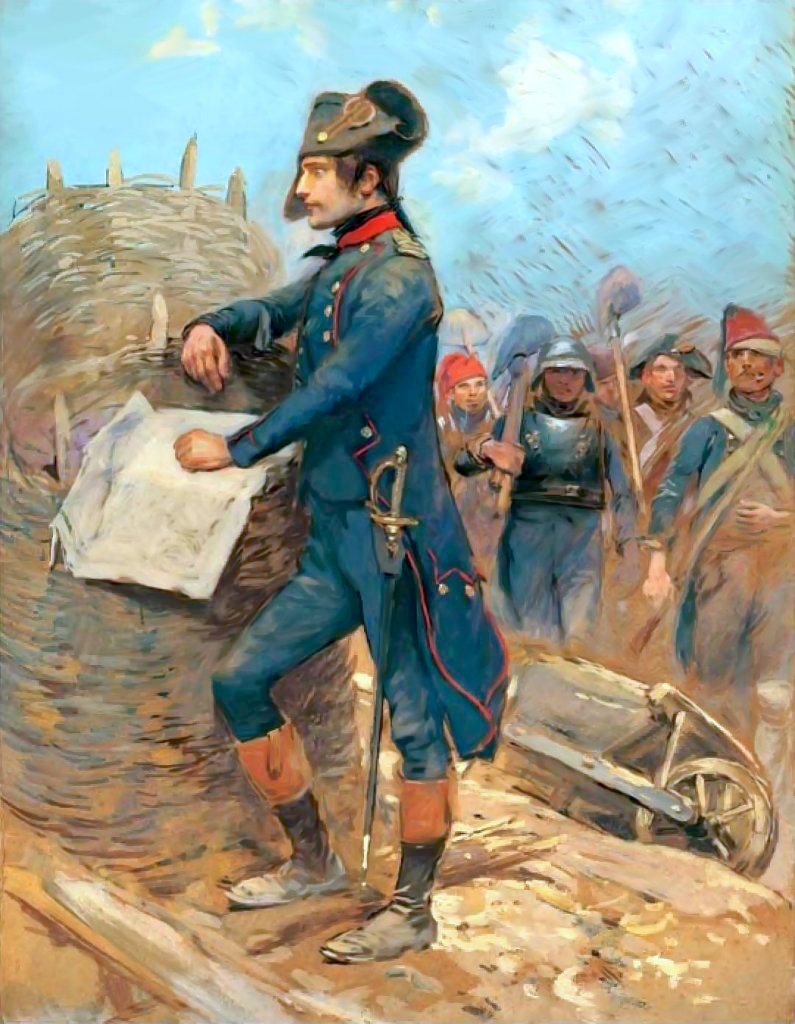
In September, with the help of his fellow Corsican Antoine Christophe Saliceti, Bonaparte was appointed artillery commander of the republican forces sent to recapture the port of Toulon, which was occupied by allied forces. He quickly increased the available artillery and proposed a plan to capture a hill fort where republican guns could dominate the city's harbour and force the allies to evacuate. The successful assault on the position on 16–17 December led to the capture of the city.
Toulon brought Bonaparte to the attention of powerful men including Augustin Robespierre, the younger brother of Maximilien Robespierre, a leading Jacobin. He was promoted to brigadier general and put in charge of defences on the Mediterranean coast. In February 1794 he was made artillery commander of the Army of Italy and devised plans to attack the Kingdom of Sardinia.
The French army carried out Bonaparte's plan in the Second Battle of Saorgio in April 1794 and then advanced to seize Ormea in the mountains. From Ormea it headed west to outflank the Austro-Sardinian positions around Saorge. After this campaign, Augustin Robespierre sent Bonaparte on a mission to the Republic of Genoa to determine the country's intentions towards France.
After the Fall of Maximilien Robespierre in July 1794, Bonaparte's association with leading Jacobins made him politically suspect to the new regime. He was arrested on 9 August but released two weeks later. He was asked to draw up plans to attack Italian positions as part of France's war with Austria, and in March 1795 he took part in an expedition to take back Corsica from the British, but the French were repulsed by the Royal Navy.
From 1794 Bonaparte was in a romantic relationship with Désirée Clary, whose sister Julie Clary had married Bonaparte's elder brother Joseph. In April 1795 Bonaparte was assigned to the Army of the West, which was engaged in the War in the Vendée—a civil war and royalist counter-revolution in the Vendée region. As an infantry command, it was a demotion from artillery general, and he pleaded poor health to avoid the posting. During this period he wrote the romantic novella Clisson et Eugénie, about a soldier and his lover, in a clear parallel to Bonaparte's own relationship with Clary.
In August he obtained a position with the Bureau of Topography, where he worked on military planning. On 15 September he was removed from the list of generals in regular service for refusing to serve in the Vendée campaign. He sought a transfer to Constantinople to offer his services to Sultan Selim III. The request was eventually granted, but he never took up the post.
On 3 October royalists in Paris declared a rebellion against the National Convention. Paul Barras, a leader of the Thermidorian Reaction, knew of Bonaparte's military exploits at Toulon and made him second in command of the forces defending the convention in the Tuileries Palace. Bonaparte had seen the massacre of the king's Swiss Guard during the Insurrection of 10 August 1792 there three years earlier and realized that artillery would be the key to its defence. He ordered a young cavalry officer, Joachim Murat, to seize cannons, and Bonaparte deployed them in key positions. On 5 October 1795—13 Vendémiaire An IV in the French Republican calendar—he fired on the rebels with canister rounds (described by Thomas Carlyle as "the whiff of grapeshot"). About 300 to 1,400 rebels died in the uprising. Bonaparte's role in defeating the rebellion earned him and his family the patronage of the new government, the French Directory. On 26 October he was promoted to commander of the Army of the Interior, and in January 1796, he was appointed head of the Army of Italy.
Within weeks of the Vendémiaire uprising, Bonaparte was romantically involved with Joséphine de Beauharnais, the former mistress of Barras. Josephine had been born in the French colonies in the Lesser Antilles, and her family owned slaves on sugar plantations. The couple married on 9 March 1796 in a civil ceremony. Bonaparte began to habitually style himself "Napoleon Bonaparte" rather than using the Italian form "Napoleone di Buonaparte."
Two days after the marriage, Bonaparte left Paris to take command of the Army of Italy. He went on the offensive, hoping to defeat the Kingdom of Sardinia in Piedmont before their Austrian allies could intervene. In a series of victories during the Montenotte campaign, he knocked the Piedmontese out of the war in two weeks. The French then focused on the Austrians, laying siege to Mantua. The Austrians launched offensives against the French to break the siege, but Bonaparte defeated every relief effort, winning the Battle of Castiglione, the Battle of Bassano, the Battle of Arcole, and the Battle of Rivoli. The French triumph at Rivoli in January 1797 led to the collapse of the Austrian position in Italy. At Rivoli Austria lost 43% of its soldiers dead, wounded or taken prisoner.
The French then invaded the heartlands of the House of Habsburg. French forces in southern Germany had been defeated by Archduke Charles, Duke of Teschen in 1796, but Charles withdrew his forces to protect Vienna after learning of Bonaparte's assault. In their first encounter, Bonaparte pushed Charles back and advanced deep into Austrian territory after winning the Battle of Tarvis in March 1797. Alarmed by the French thrust that reached Leoben, about 100 km from Vienna, the Austrians sued for peace. The preliminary peace of Leoben, signed on 18 April, gave France control of most of northern Italy and the Low Countries and promised to partition the Republic of Venice with Austria. Bonaparte marched on Venice and forced its surrender, ending 1,100 years of Venetian independence. He authorized the French to loot treasures such as the Horses of Saint Mark.
In this Italian campaign, Bonaparte's army captured 150,000 prisoners, 540 cannons, and 170 standards. The French army fought 67 actions and won 18 pitched battles through superior artillery technology and Bonaparte's tactics. Bonaparte extracted an estimated 45 million French pounds from Italy during the campaign, another 12 million pounds in precious metals and jewels, and more than 300 paintings and sculptures.
During the campaign, Bonaparte became increasingly influential in French politics. He founded two newspapers: one for the troops in his army and one for circulation in France. The royalists attacked him for looting Italy and warned that he might become a dictator. Bonaparte sent General Charles-Pierre Augereau to Paris to support a coup d'état that purged royalists from the legislative councils on 4 September—the Coup of 18 Fructidor. This left Barras and his republican allies in control again, but more dependent upon Bonaparte, who finalized peace terms with Austria by the Treaty of Campo Formio. Bonaparte returned to Paris on 5 December 1797 as a hero. He met Charles Maurice de Talleyrand, France's foreign minister, and took command of the Army of England for the planned invasion of Britain.
After two months of planning, Bonaparte decided that France's naval strength was not yet sufficient to confront the Royal Navy. He decided on a military expedition to seize Egypt and thereby undermine Britain's access to its trade interests in India. Bonaparte wished to establish a French presence in the Middle East and join forces with Tipu Sultan, the Sultan of Mysore, an enemy of the British. Bonaparte assured the Directory that "as soon as he had conquered Egypt, he will establish relations with the Indian princes and, together with them, attack the English in their possessions". The Directory agreed in order to secure a trade route to the Indian subcontinent.
In May 1798, Bonaparte was elected a member of the French Academy of Sciences. His Egyptian expedition included a group of 167 scientists, with mathematicians, naturalists, chemists, and geodesists among them. Their discoveries included the Rosetta Stone, and their work was published in the Description de l'Égypte in 1809. En route to Egypt, Bonaparte reached Hospitaller Malta on 9 June 1798, then controlled by the Knights Hospitaller. Grand Master Ferdinand von Hompesch zu Bolheim surrendered after token resistance, and Bonaparte captured an important naval base with the loss of only three men.
Bonaparte and his expedition eluded pursuit by the Royal Navy and landed at Alexandria on 1 July. He fought the Battle of Shubra Khit against the Mamluks, Egypt's ruling military caste. This helped the French practise their defensive tactic for the Battle of the Pyramids on 21 July, about 24 km (15 mi) from the pyramids. Bonaparte's forces of 25,000 roughly equalled those of the Mamluks' Egyptian cavalry. Twenty-nine French and approximately 2,000 Egyptians were killed. The victory boosted the French army's morale.
On 1 August 1798 the British fleet under Sir Horatio Nelson captured or destroyed all but two vessels of the French fleet in the Battle of the Nile, preventing Bonaparte from strengthening the French position in the Mediterranean. His army had succeeded in a temporary increase of French power in Egypt, though it faced repeated uprisings. In early 1799 he moved an army into the Ottoman province of Damascus (Syria and Galilee). Bonaparte led these 13,000 French soldiers in the conquest of the coastal towns of Arish, Gaza, Jaffa, and Haifa. The attack on Jaffa was particularly brutal. Bonaparte discovered that many of the defenders were former prisoners of war, ostensibly on parole, so he ordered the garrison and some 1,500–5,000 prisoners to be executed by bayonet or drowning. Men, women, and children were robbed and murdered for three days.
Bonaparte began with an army of 13,000 men. 1,500 were reported missing, 1,200 died in combat, and thousands perished from disease—mostly bubonic plague. He failed to reduce the fortress of Acre, so he marched his army back to Egypt in May. Bonaparte was alleged to have ordered plague-stricken men to be poisoned with opium to speed the retreat.
03Ruler of France

Unknown to Bonaparte, the Directory had sent him orders to return from Egypt with his army to ward off a possible invasion of France, but these messages never arrived. By the time he reached Paris in October, France's situation had been improved by a series of victories. The republic, however, was bankrupt, and the ineffective Directory was unpopular. Despite the failures in Egypt, Bonaparte returned to a hero's welcome. The Directory discussed Bonaparte's desertion but was too weak to punish him.
Bonaparte formed an alliance with Talleyrand and leading members of the Council of Five Hundred and Directory—Lucien Bonaparte, Emmanuel Joseph Sieyès, Roger Ducos and Joseph Fouché—to overthrow the government. On 9 November 1799 (18 Brumaire according to the revolutionary calendar), the conspirators launched a coup and the following day, backed by grenadiers with fixed bayonets, forced the Council of Five Hundred to dissolve the Directory and appoint Bonaparte, Sieyès and Ducos provisional consuls.
On 13 December, Bonaparte introduced the Constitution of the Year VIII, under which three consuls were appointed for 10 years. Real power lay with Bonaparte as first consul, and his preferred candidates Cambacérès and Charles-François Lebrun were appointed as second and third consuls who only had an advisory role. The constitution also established a Legislative Body and Tribunate which were selected from indirectly elected candidates, and a Senate and Council of State which were effectively nominated by the executive. The constitution was approved by plebiscite on 7 February 1800. The official count was over three million in favour and 1,562 against. Lucien, however, had doubled the count of the "yes" vote to give the false impression that a majority of those eligible to vote had approved the constitution.
Historians have variously described Bonaparte's regime as "dictatorship by plebiscite", "absolutist rule decked out in the spirit of the age", and "soft despotism". Local and regional administration was reformed to concentrate power in the central government, censorship was introduced, and most opposition newspapers were closed down to stifle dissent. Royalist and regional revolts were dealt with by a combination of amnesties for those who lay down their arms and brutal repression of those who continued to resist. Bonaparte also improved state finances by securing loans under a promise to defend private property, raising taxes on tobacco, alcohol and salt, and extracting levies from France's satellite republics.
Bonaparte believed that the best way to secure his regime was by a victorious peace. In May 1800, he led an army across the Swiss Alps into Italy, aiming to surprise the Austrian armies that had reoccupied the peninsula when Bonaparte was still in Egypt. After a difficult crossing over the Alps, the French captured Milan on 2 June. The French confronted an Austrian army under Michael von Melas at the battle of Marengo on 14 June. The Austrians fielded about 30,000 soldiers while Bonaparte commanded 24,000 troops. The Austrians' initial attack surprised the French who were gradually driven back. Late in the afternoon, however, a full division under French General Louis Desaix arrived on the field and reversed the tide of the battle. The Austrian army fled leaving behind 14,000 casualties. The following day, the Austrians signed an armistice and agreed to abandon northern Italy.
When peace negotiations with Austria stalled, Bonaparte reopened hostilities in November. A French army under General Jean Victor Marie Moreau swept through Bavaria and scored an overwhelming victory over the Austrians at the battle of Hohenlinden in December. The Austrians capitulated and signed the Treaty of Lunéville in February 1801. The treaty reaffirmed and expanded earlier French gains at Campo Formio. On 26 January 1802, following the Consulte de Lyon, Napoleon was declared president of the Italian Republic.
Bonaparte's triumph at Marengo increased his popularity and political authority. However, he still faced royalist plots and feared Jacobin influence, especially in the army. Several assassination plots, including the Conspiration des poignards (Dagger plot) in October 1800 and the Plot of the Rue Saint-Nicaise two months later, gave him a pretext to arrest about 100 suspected Jacobins and royalists, some of whom were shot and many others deported to penal colonies.
After a decade of war, France and Britain signed the Treaty of Amiens in March 1802, bringing the Revolutionary Wars to an end. Under the treaty, Britain agreed to withdraw from most of the colonies it had recently captured from France and her allies, and France agreed to evacuate Naples. In April, Bonaparte publicly celebrated the peace and his controversial Concordat of 1801 with Pope Pius VII under which the pope recognized Bonaparte's regime and the regime recognized Catholicism as the majority religion of France. In a further step towards national reconciliation (known as "fusion"), Bonaparte offered an amnesty to most émigrés who wished to return to France.
With Europe at peace and the economy recovering, Bonaparte became increasingly popular, both domestically and abroad. In May 1802, the Council of State recommended a new plebiscite asking the French people to make "Napoleon Bonaparte" consul for life. (It was the first time his first name was officially used by the regime.) About 3.6 million voted "yes" and 8,374 "no." 40–60% of eligible Frenchmen voted, the highest turnout for a plebiscite since the revolution.
France had regained her overseas colonies under Amiens but did not control them all. The French National Convention had voted to abolish slavery in February 1794, but in May 1802 Bonaparte reintroduced it in all the recovered colonies except Saint-Domingue and Guadeloupe which were under the control of rebel generals. A French military expedition under Antoine Richepance regained control of Guadeloupe, and slavery was reintroduced there on 16 July.
Saint-Domingue was the most profitable of the colonies – a major source of sugar, coffee and indigo – but was under the control of the former slave Toussaint Louverture. Bonaparte sent the Saint-Domingue expedition under his brother-in-law General Charles Leclerc to retake the colony, and they landed there in February 1802 with 29,000 men. Although Toussaint was captured and sent to France in July, the expedition ultimately failed due to high rates of disease and a string of defeats against rebel commander Jean-Jacques Dessalines. In May 1803 Bonaparte acknowledged defeat, and the last 8,000 French troops left the island. The former slaves proclaimed the independent republic of Haiti in 1804.
As war with Britain again loomed in 1803, Bonaparte realized that his American colony of Louisiana would be difficult to defend. In need of funds, he agreed to the Louisiana Purchase with the United States, doubling the latter's size. The price was $15 million. The peace with Britain was uneasy. Britain did not evacuate Malta as promised and protested against Bonaparte's annexation of Piedmont and his Act of Mediation (19 February), which established a Swiss Confederation. Neither of these territories were covered by Amiens, but they inflamed tensions significantly, as did Bonaparte's occupation of Holland and apparent ambitions in India. The dispute culminated in a declaration of war by Britain in May 1803. Bonaparte responded by reassembling the invasion camp at Boulogne and ordering the arrest of every British male between 18 and 60 years old in France and its dependencies as a prisoner of war.
In February 1804 Bonaparte's police made a series of arrests in relation to a royalist plot to kidnap or assassinate him that involved the British government, Moreau and an unnamed Bourbon prince. On the advice of his foreign minister, Talleyrand, Napoleon ordered the kidnapping of the Duke of Enghien, violating the sovereignty of Baden. The duke was quickly executed after a secret military trial, even though there was no proof he had been involved in the plot. Enghien's kidnapping and execution infuriated royalists and monarchs throughout Europe and drew a formal protest from Russia.
Following the royalist plot, Bonaparte's supporters convinced him to convert the Consulate into a monarchy. They argued that the presence of an heir would help to secure the regime in case of his death. As well, they believed a monarchy would make Napoleon more acceptable to constitutional monarchists, and put France on the same footing as other European monarchies. On 18 May the senate proclaimed Napoleon Emperor of the French and approved a new constitution. The following day, Napoleon appointed 18 of his leading generals Marshals of the Empire.The hereditary empire was confirmed by a plebiscite in June. The official result showed 3.5 million voted "yes" and 2,569 voted "no". The yes count, however, was falsely inflated by 300,000 to 500,000 votes. The turnout, at 35%, was below the figure for the previous plebiscite. Britain, Russia, Sweden and the Ottoman Empire refused to recognize Napoleon's title. Austria, however, recognized Napoleon as Emperor of the French in return for his recognition of Francis I as Emperor of Austria.
Napoleon's coronation, with the participation of Pope Pius VII, took place at Notre Dame de Paris on 2 December 1804. After having been anointed by the pope, Napoleon crowned himself with a replica of Charlemagne's crown. He then crowned Joséphine, who became the second woman in French history, after Marie de' Medici, to be crowned and anointed. He then swore an oath to defend the territory of the republic; to respect the Concordat, freedom of worship, political and civil liberty and the sale of nationalized lands; to raise no taxes except by law; to maintain the Legion of Honour; and to govern in the interests, wellbeing and the glory of the French people.
On 17 March 1805 Napoleon declared himself King of Italy and crowned himself with the Iron Crown of Lombardy at the Cathedral of Milan. Austria saw this as a provocation because of its own territorial interests in Italy. When Napoleon incorporated Genoa and Liguria into his empire, Austria formally protested against this violation of the Treaty of Lunéville.
By September 1805 Sweden, Russia, Austria, Naples and the Ottoman Empire had joined Britain in a coalition against France. In 1803 and 1804 Napoleon had assembled a force around Boulogne for an invasion of Britain. They never invaded, but the force formed the core of Napoleon's Grande Armée, created in August 1805. At the start, this French army had about 200,000 men organized into seven corps, artillery and cavalry reserves, and the élite Imperial Guard. By August 1805 the Grande Armée had grown to a force of 350,000 men, who were well equipped, well trained, and led by competent officers.
To facilitate the invasion, Napoleon planned to lure the Royal Navy from the English Channel by a diversionary attack on the British West Indies. However, the plan unravelled after the British victory at the Battle of Cape Finisterre in July 1805. French Admiral Pierre-Charles Villeneuve retreated to Cádiz instead of linking up with French naval forces at Brest for an attack on the English Channel. Facing a potential invasion from his continental enemies, Napoleon abandoned his invasion of England and sought to destroy the isolated Austrian armies in southern Germany before their Russian ally could arrive in force. On 25 September, 200,000 French troops began to cross the Rhine on a front of 260 km (160 mi).
Austrian commander Karl Mack von Leiberich had gathered most of the Austrian army at the fortress of Ulm in Swabia. Napoleon's army, however, moved quickly and outflanked the Austrian positions. After some minor engagements that culminated in the Battle of Ulm, Mack surrendered.
04Exile on Saint Helena

Napoleon was held in British custody and transferred to the island of Saint Helena in the Atlantic Ocean, 1,870 km (1,010 nmi) from the west coast of Africa. Napoleon and 27 followers arrived at Jamestown in October 1815 on board HMS Northumberland. The prisoner was guarded by a garrison of 2,100 soldiers while a squadron of 10 ships continuously patrolled the waters to prevent escape. In the following years, there were rumours of escape plots, but no serious attempts were ever made.
Napoleon stayed for two months at a pavilion in Briars before he was moved to Longwood House, a 40-room wooden bungalow. The location and interior of the house were damp, windswept, rat-infested and unhealthy. The Times published articles insinuating the British government was trying to hasten his death. Napoleon often complained of his living conditions in letters to the island's governor Hudson Lowe while his attendants complained of "colds, catarrhs, damp floors and poor provisions".
Napoleon insisted on imperial formality. When he held a dinner party, men were expected to wear military dress and "women [appeared] in evening gowns and gems. It was an explicit denial of the circumstances of his captivity". He formally received visitors, read, and dictated his memoirs and commentaries on military campaigns. He studied English under Emmanuel, comte de Las Cases, for a few months but gave up as he was poor at languages.
Napoleon circulated reports of poor treatment in the hope that public opinion would force the allies to revoke his exile on Saint Helena. Under instructions from the government, Lowe cut Napoleon's expenditure, refused to recognize him as a former emperor, and made his supporters sign a guarantee they would stay with him indefinitely. Accounts of Napoleon's treatment led in March 1817 to a debate in the British Parliament where Henry Vassall-Fox, 3rd Baron Holland, made a call for a public inquiry.
In mid-1817, Napoleon's health worsened. His physician, Barry O'Meara, diagnosed chronic hepatitis and warned Lowe that Napoleon could die from the poor climate and lack of exercise. Lowe thought O'Meara was exaggerating and dismissed him in July 1818. In November 1818, the allies announced that Napoleon would remain a prisoner on Saint Helena for life. When he learnt the news, he became depressed and more isolated, spending longer periods in his rooms, which further undermined his health. Much of his entourage left Saint Helena, including Las Cases in December 1816, General Gaspard Gourgaud in March 1818 and Albine de Montholon—who was possibly Napoleon's lover—in July 1819. In September 1819, two priests and the physician François Carlo Antommarchi joined Napoleon's retinue.
Napoleon's health continued to worsen, and in March 1821 he was confined to bed. In April he wrote two wills declaring that he had been assassinated by the "English oligarchy", that the Bourbons would fall, and that his son would rule France. He left his fortune to 97 legatees and asked to be buried by the Seine. On 3 May he was given the last rites but could not take communion due to his illness. He died on 5 May 1821 at age 51. His last words, variously recorded by those present, were either France, l'armée, tête d'armée, Joséphine ("France, the army, head of the army, Joséphine"), or qui recule...à la tête d'armée ("who retreats... at the head of the army") or "France, my son, the Army."
Antommarchi and the British wrote separate autopsy reports, each concluding that Napoleon had died of internal bleeding caused by stomach cancer, the disease that had killed his father. A later theory, based on high concentrations of arsenic found in samples of Napoleon's hair, held that Napoleon had died of arsenic poisoning. However, subsequent studies also found high concentrations of arsenic in hair samples from Napoleon's childhood and from his son and Joséphine. Arsenic was widely used in medicines and products such as hair creams in the 19th century. A 2021 study by an international team of gastrointestinal pathologists once again concluded that Napoleon died of stomach cancer.
Napoleon was buried with military honours in the Valley of the Geraniums. Napoleon's heart and intestines were removed and sealed inside his coffin. Napoleon's penis was allegedly removed during the autopsy and sold and exhibited. In 1840, the British government gave Louis Philippe I permission to return Napoleon's remains to France. Napoleon's body was exhumed and found to be well preserved as it had been sealed in four coffins (two of metal and two of mahogany) and placed in a masonry tomb. On 15 December 1840, a state funeral was held in Paris with 700,000 to 1,000,000 attendees who lined the route of the funeral procession to the chapel of Les Invalides. The coffin was later placed in the cupola in St Jérôme's Chapel, where it remained until Napoleon's tomb, designed by Louis Visconti, was completed. In 1861, during the reign of Napoleon III, his remains were entombed in a sarcophagus in the crypt under the dome at Les Invalides.
05Religion
Napoleon was baptized in Ajaccio on 21 July 1771 and raised a Roman Catholic. He began to question his faith at age 13 while at Brienne. Biographers have variously described him from that time as a deist, a follower of Jean-Jacques Rousseau's "natural religion" or a believer in destiny. He consistently expressed his belief in a God or creator.
He understood the power of organized religion in social and political affairs and later sought to use it to support his regime. His attitude to religion is often described as utilitarian. In 1800 he stated, "it was by making myself a Catholic that I won the war in the Vendée, by making myself a Moslem that I established myself in Egypt, by making myself an ultramontane that I turned men's hearts towards me in Italy. If I were to govern a nation of Jews I would rebuild the Temple of Solomon."
Napoleon had a civil marriage with Joséphine in 1796 and, at the pope's insistence, a private religious ceremony with her the day before his coronation as emperor in 1804. This marriage was annulled by tribunals under Napoleon's control in January 1810. In April 1810, Napoleon married Austrian princess Marie Louise in a Catholic ceremony. Napoleon was excommunicated by the pope through the bull Quum memoranda in 1809. His will in 1821 stated, "I die in the Apostolical Roman religion, in the bosom of which I was born, more than fifty years since." Napoleon read the Quran in translation and had an interest in Islam and the Orient. He also defended Muhammad ("a great man") against Voltaire's Mahomet.
Seeking national reconciliation between revolutionaries and Catholics, Napoleon and Pope Pius VII agreed to the Concordat of 1801. The agreement recognized the Catholic Church as the majority church of France and in return the Church recognized Napoleon's regime, undercutting much of the ground from royalists. The Concordat confirmed the seizure of Church lands and endowments during the revolution, but reintroduced state salaries for the clergy. The government also controlled the nomination of bishops for investiture by the pope. Bishops and other clergy were required to swear an oath of loyalty to the regime.
When the Concordat was published on 8 April 1802, Napoleon presented another set of laws called the Organic Articles which further increased state control over the French Church. Similar arrangements were made with the Church in territories controlled by Napoleon, especially in Italy and Germany.
Napoleon progressively occupied and annexed the Papal States from 1805. When he annexed Rome in May 1809, the pope excommunicated him the following month. In July, French officials arrested the pope in the Vatican and exiled him to Savona. In 1812 the pontiff was transferred to the Palace of Fontainebleau in France. In January 1813, Napoleon pressured the pope to sign a new "Concordat of Fontainebleau" which was soon repudiated by the pontiff. The pope was not released until 1814.
In February 1795, the National Convention proclaimed religious equality for France's Protestant churches and other religions. In April 1802, Napoleon published laws increasing state control of Calvinist congregations and Lutheran directories, with their pastors to be paid by the state. With Napoleon's military victories, formal religious equality and civil rights for religious minorities spread to the conquered territories and satellite states, although their implementation varied with the local authorities.
Jews in France had been granted full civil rights in September 1791 and religious equality in 1795. The revolutionary and Napoleonic regimes abolished Jewish ghettoes in the territories they conquered. Napoleon wished to assimilate Jews into French society and convened an assembly of Jewish notables in 1806 to that end. In 1807, he summoned a Sanhedrin to adapt the law of Moses to those of the empire. An imperial decree of March 1808 organized Jewish worship into consistories, limited usury and encouraged Jews to adopt a family name, intermarriage, and civil marriage and divorce. Jews, however, were still subject to discrimination in many parts of the empire and satellite states.
06Personality
Pieter Geyl wrote in 1947, "It is impossible that two historians, especially two historians living in different periods, should see any historical personality in the same light." There is no dispute that Napoleon was ambitious, although commentators disagree on whether his ambition was mostly for his own power and glory or for the welfare of France. Historians agree that Napoleon was highly intelligent with an excellent memory and was a superior organizer who could work efficiently for long hours. In battle, he could rapidly dictate a series of complex commands to his subordinates, keeping in mind where major units were expected to be at each future point.
He was an inspiring leader who could obtain the best from his soldiers and subordinates. Arthur Wellesley, 1st Duke of Wellington, said his presence on the battlefield was worth 40,000 soldiers. He could charm people when he needed to but could also publicly humiliate them and was known for his rages when his plans were frustrated. The historian Frank McLynn sees him as a misogynist with a cruel streak which he often inflicted on women, children and animals.
There is debate over whether Napoleon was an outsider who never felt at home in France or with other people. Hippolyte Taine said Napoleon saw others only as instruments and was cut off from feelings of admiration, sympathy or pity. Arthur Lévy replied that Napoleon genuinely loved Joséphine and often showed humanity and compassion to his enemies or those who had let him down. He had the normal middle class virtues and understood the common man.
Historians are divided over whether Napoleon was consistently ruthless when his power was threatened or surprisingly indulgent in some cases. Those arguing for a ruthless personality point to episodes such as his violent suppression of revolts in France and conquered territories, his execution of the Duc d'Enghien and plotters against his rule, and his massacre of Turkish prisoners of war in Syria in 1799. Others point to his mild treatment of disloyal subordinates such as Bernadotte, Talleyrand, and Fouché.
Many historians see Napoleon as pragmatic and a realist, at least in the early years of his rule. He was not driven by ideology and promoted capable men irrespective of their political and social background, as long as they were loyal. As an expert in military matters, he valued technical expertise and listened to the advice of experts in other fields. However, there is a consensus that once he dominated Europe he became more intolerant of other views and surrounded himself with "yes men". Towards the end of his reign he lost his realism and ability to compromise.
Some historians talk of Napoleon's dual nature: a rationalist with a strong romantic streak. He took a team of scholars, artists and engineers with him to Egypt in order to scientifically study the country's culture and history, but at the same time was struck by romantic "orientalism". "I was full of dreams," he stated. "I saw myself founding a religion, marching into Asia, riding an elephant, a turban on my head and in my hand a new Koran that I would have composed to suit my need."
Napoleon was superstitious. He believed in omens, numerology, fate and lucky stars, and always asked of his generals: "is he lucky?" Dwyer states that Napoleon's victories at Austerlitz and Jena in 1805–06 left him even more certain of his destiny and invincibility. "I am of the race that founds empires", he once boasted, deeming himself an heir to the Ancient Romans.
Various psychologists have attempted to explain Napoleon's personality. Alfred Adler cites Napoleon to describe an inferiority complex in which short people adopt over-aggressive behaviour to compensate for lack of height; this inspired the term Napoleon complex. Adler, Erich Fromm and Wilhelm Reich ascribe his nervous energy to sexual dysfunction. Harold T. Parker speculated that rivalry with his older brother and bullying when he moved to France led him to develop an inferiority complex which made him domineering.
Article sections from Wikipedia (CC BY-SA 4.0). Excerpted for readability.