Socrates (; Ancient Greek: Σωκράτης, romanized: Sōkrátēs; c. 470 – 399 BC) was an ancient Greek philosopher from Classical Athens, perhaps the first Western moral philosopher, and a major inspiration on his student Plato, who largely founded the tradition of Western philosophy. An enigmatic figure, Socrates authored no texts and is known mainly through the posthumous accounts of classical writers, particularly his students Plato and Xenophon. These accounts are written as dialogues, in which Socrates and his interlocutors examine a subject in the style of question and answer; they gave rise to the Socratic dialogue literary genre. Contradictory accounts of Socrates make a reconstruction of his philosophy nearly impossible, a situation known as the Socratic problem. Socrates was a polarizing figure in Athenian society. In 399 BC, he was accused of impiety and corrupting the youth. After a trial that lasted a day, he was sentenced to death. As related by Plato, he was put to death by administration of poison after refusing offers from allies to help him escape.
Plato's dialogues are among the most comprehensive accounts of Socrates to survive from antiquity. They demonstrate the Socratic approach to areas of philosophy including epistemology and ethics. The Platonic Socrates lends his name to the concept of the Socratic method, and also to Socratic irony. The Socratic method of questioning, or elenchus, takes shape in dialogue using short questions and answers, epitomized by those Platonic texts in which Socrates and his interlocutors examine various aspects of an issue or an abstract meaning, usually relating to one of the virtues, and find themselves at an impasse, unable to define what they thought they understood. Socrates frequently proclaims his ignorance, saying that he is only sure that he does not know.
Socrates exerted a strong influence on philosophers in later antiquity and has continued to do so in the modern era. He was studied by medieval and Islamic scholars and played an important role in the thought of the Italian Renaissance, particularly within the humanist movement. Interest in him continued unabated, as reflected in the works of Søren Kierkegaard and Friedrich Nietzsche. Depictions of Socrates in art, literature, and popular culture have made him a widely known figure in the Western philosophical tradition.
Summary from Wikipedia (CC BY-SA 4.0)
01Biography

Socrates was born in 470 or 469 BC to Sophroniscus and Phaenarete, a stoneworker and a midwife, respectively, in the Athenian deme of Alopece; therefore, he was an Athenian citizen, having been born to relatively affluent Athenians. He lived close to his father's relatives and inherited, as was customary, part of his father's estate, securing a life reasonably free of financial concerns. His education followed the laws and customs of Athens. He learned the basic skills of reading and writing and, like most wealthy Athenians, received extra lessons in various other fields such as gymnastics, poetry and music. He was married twice (which came first is not clear): his marriage to Xanthippe took place when Socrates was in his fifties, and another marriage was with a daughter of Aristides, an Athenian statesman. He had three sons with Xanthippe. Socrates fulfilled his military service during the Peloponnesian War and distinguished himself in three campaigns, according to Plato.
Another incident that reflects Socrates's respect for the law is the arrest of Leon the Salaminian. As Plato describes in his Apology, Socrates and four others were summoned to the Tholos and told by representatives of the Thirty Tyrants (which began ruling in 404 BC) to arrest Leon for execution. Again Socrates was the sole abstainer, choosing to risk the tyrants' wrath and retribution rather than to participate in what he considered to be a crime.
Socrates attracted great interest from the Athenian public and especially the Athenian youth. He was notoriously ugly, having a flat turned-up nose, bulging eyes and a large belly; his friends joked about his appearance. Socrates was indifferent to material pleasures, including his own appearance and personal comfort. He neglected personal hygiene, bathed rarely, walked barefoot, and owned only one ragged coat. He moderated his eating, drinking, and sex, although he did not practice full abstention. Although Socrates was attracted to youth, he resisted his passion for them because, as Plato describes, he was more interested in educating their souls and did not seek sex from his disciples. Politically, he did not take sides in the rivalry between the democrats and the oligarchs in Athens; he criticized both. The character of Socrates as exhibited in Apology, Crito, Phaedo and Symposium concurs with other sources to an extent that gives confidence in Plato's depiction of Socrates in these works as being representative of the real Socrates.
Socrates died in Athens in 399 BC after a trial for impiety (asebeia) and the corruption of the young. He spent his last day in prison among friends and followers who offered him a route to escape, which he refused. He died the next morning, in accordance with his sentence, after drinking hemlock. According to the Phaedo, his last words were: "Crito, we owe a rooster to Asclepius. Don't forget to pay the debt."
02Trial of Socrates

In 399 BC, Socrates was formally accused of corrupting the minds of the youth of Athens, and for asebeia (impiety), i.e., worshipping false gods and failing to worship the gods of Athens. At the trial, Socrates defended himself unsuccessfully. He was found guilty by a majority vote cast by a jury of hundreds of male Athenian citizens and, according to the custom, proposed his own penalty: that he should be given free food and housing by the state for the services he rendered to the city, or alternatively, that he be fined one mina of silver (according to him, all he had). The jurors declined his offer and ordered the death penalty.
Of all the works written about Socrates' trial, only three survive: Plato's Apology, Xenophon's Apology, and Xenophon's Memorabilia.
Socrates was charged in a politically tense climate. In 404 BC, the Athenians had been crushed by Spartans at the decisive naval Battle of Aegospotami, and subsequently, the Spartans laid siege to Athens. They replaced the democratic government with a new, pro-oligarchic government, named the Thirty Tyrants. Because of their tyrannical measures, some Athenians organized to overthrow the Tyrants—and, indeed, they managed to do so briefly—until a Spartan request for aid from the Thirty arrived and a compromise was sought. When the Spartans left again, however, democrats seized the opportunity to kill the oligarchs and reclaim the government of Athens.
The accusations against Socrates were initiated by a poet, Meletus, who asked for the death penalty in accordance with the charge of asebeia. Other accusers were Anytus and Lycon. After a month or two, in late spring or early summer, the trial started and likely went on for most of one day. There were two main sources for the religion-based accusations. First, Socrates had rejected the anthropomorphism of traditional Greek religion by denying that the gods did bad things like humans do. Second, he seemed to believe in a daimonion—an inner voice with, as his accusers suggested, divine origin.
Plato's Apology starts with Socrates answering the various rumours against him that have given rise to the indictment. First, Socrates defends himself against the rumour that he is an atheist naturalist philosopher, as portrayed in Aristophanes's The Clouds; or a sophist. Against the allegations of corrupting the youth, Socrates answers that he has never corrupted anyone intentionally, since corrupting someone would carry the risk of being corrupted back in return, and that would be illogical, since corruption is undesirable. On the second charge, Socrates asks for clarification. Meletus responds by repeating the accusation that Socrates is an atheist. Socrates notes the contradiction between atheism and worshipping false gods. He then claims that he is "God's gift" to the Athenians, since his activities ultimately benefit Athens; thus, in condemning him to death, Athens itself will be the greatest loser. After that, he says that even though no human can reach wisdom, seeking it is the best thing someone can do, implying money and prestige are not as precious as commonly thought.
Socrates was given the chance to offer alternative punishments for himself after being found guilty. He could have requested permission to flee Athens and live in exile, but he did not do so. According to Xenophon, Socrates made no proposals, while according to Plato he suggested free meals should be provided for him daily in recognition of his worth to Athens or, more in earnest, that a fine should be imposed on him. The jurors favoured the death penalty by making him drink a cup of hemlock (a poisonous liquid). In return, Socrates warned jurors and Athenians that criticism of them by his many disciples was inescapable, unless they became good men. After a delay caused by Athenian religious ceremonies, Socrates spent his last day in prison. His friends visited him and offered him an opportunity to escape, which he declined.
The question of what motivated Athenians to convict Socrates remains controversial among scholars. There are two theories. The first is that Socrates was convicted on religious grounds; the second, that he was accused and convicted for political reasons. Another, more recent, interpretation synthesizes the religious and political theories, arguing that religion and state were not separate in ancient Athens.
The argument for religious persecution is supported by the fact that Plato's and Xenophon's accounts of the trial mostly focus on the charges of impiety. In those accounts, Socrates is portrayed as making no effort to dispute the fact that he did not believe in the Athenian gods. Against this argument stands the fact that many skeptics and atheist philosophers during this time were not prosecuted. According to the argument for political persecution, Socrates was targeted because he was perceived as a threat to democracy. It was true that Socrates did not stand for democracy during the reign of the Thirty Tyrants and that most of his pupils were against the democrats. The case for it being a political persecution is usually challenged by the existence of an amnesty that was granted to Athenian citizens in 403 BC to prevent escalation to civil war after the fall of the Thirty. However, as the text from Socrates's trial and other texts reveal, the accusers could have fuelled their rhetoric using events prior to 403 BC.
03Philosophy
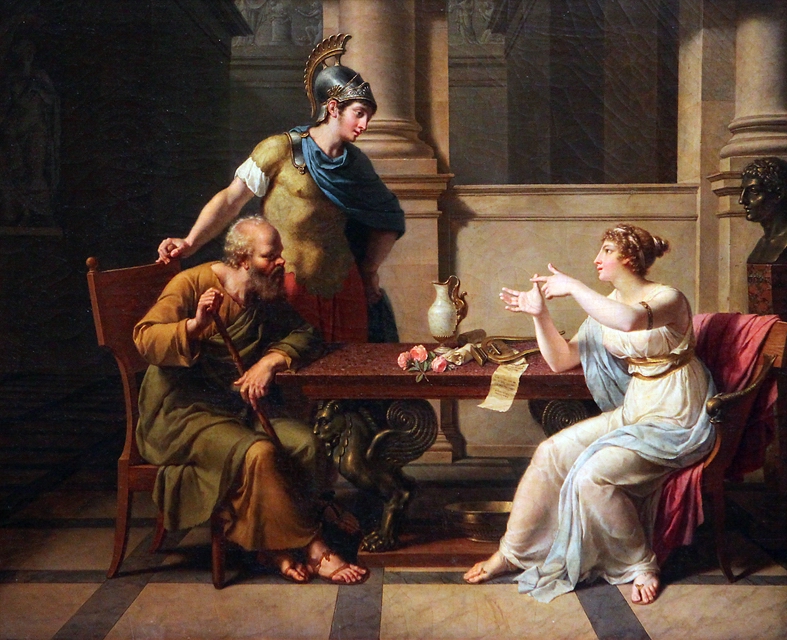
A fundamental characteristic of Plato's Socrates is the Socratic method, or the method of refutation (elenchus). It is most prominent in the early works of Plato, such as Apology, Crito, Gorgias, Republic I, and others. The typical elenchus proceeds as follows. Socrates initiates a discussion about a topic with a supposed expert on the subject, usually in the company of some young men and boys, and by dialogue proves the expert's beliefs and arguments to be contradictory. Socrates initiates the dialogue by asking his interlocutor for a definition of the subject. As he asks more questions, the interlocutor's answers eventually contradict the first definition. The conclusion is that the expert did not really know the definition in the first place. The interlocutor may come up with a different definition. That new definition, in turn, comes under the scrutiny of Socratic questioning. With each round of question and answer, Socrates and his interlocutor hope to approach the truth. More often, they continue to reveal their ignorance. Since the interlocutors' definitions most commonly represent the mainstream opinion on a matter, the discussion places doubt on the common opinion.
Socrates also tests his own opinions through the Socratic method. Thus Socrates does not teach a fixed philosophical doctrine. Rather, he acknowledges his own ignorance while searching for truth with his pupils and interlocutors.
Scholars have questioned the validity and the exact nature of the Socratic method, or indeed if there even was a Socratic method. In 1982, the scholar of ancient philosophy Gregory Vlastos claimed that the Socratic method could not be used to establish the truth or falsehood of a proposition. Rather, Vlastos argued, it was a way to show that an interlocutor's beliefs were inconsistent. There have been two main lines of thought regarding this view, depending on whether it is accepted that Socrates is seeking to prove a claim wrong. According to the first line of thought, known as the constructivist approach, Socrates indeed seeks to refute a claim by this method, and the method helps in reaching affirmative statements. The non-constructivist approach holds that Socrates merely wants to establish the inconsistency between the premises and the conclusion of the initial argument.
Socrates starts his discussions by prioritizing the search for definitions. In most cases, Socrates initiates his discourse with an expert on a subject by seeking a definition—by asking, for example, what virtue, goodness, justice, or courage is. To establish a definition, Socrates first gathers clear examples of a virtue and then seeks to establish what they had in common. According to Guthrie, Socrates lived in an era when sophists had challenged the meaning of various virtues, questioning their substance; Socrates's quest for a definition was an attempt to clear the atmosphere from their radical skepticism.
Some scholars have argued that Socrates does not endorse the priority of definition as a principle, because they have identified cases where he does not do so. Some have argued that this priority of definition comes from Plato rather than Socrates. Philosopher Peter Geach, accepting that Socrates endorses the priority of definition, finds the technique fallacious. Αccording to Geach, one may know a proposition even if one cannot define the terms in which the proposition is stated.
Plato's Socrates often claims that he is aware of his own lack of knowledge, especially when discussing ethical concepts such as arete (i.e., goodness, courage) since he does not know the nature of such concepts. For example, during his trial, with his life at stake, Socrates says: "I thought Evenus a happy man, if he really possesses this art (technē), and teaches for so moderate a fee. Certainly I would pride and preen myself if I knew (epistamai) these things, but I do not know (epistamai) them, gentlemen". In some of Plato's dialogues, Socrates appears to credit himself with some knowledge, and can even seem strongly opinionated for a man who professes his own ignorance.
There are varying explanations of the Socratic inconsistency (other than that Socrates is simply being inconsistent). One explanation is that Socrates is being either ironic or modest for pedagogical purposes: he aims to let his interlocutor to think for himself rather than guide him to a prefixed answer to his philosophical questions. Another explanation is that Socrates holds different interpretations of the meaning of "knowledge". Knowledge, for him, might mean systematic understanding of an ethical subject, on which Socrates firmly rejects any kind of mastery; or might refer to lower-level cognition, which Socrates may accept that he possesses. In any case, there is a consensus that Socrates accepts that acknowledging one's lack of knowledge is the first step towards wisdom.
Socrates is known for disavowing knowledge, a claim encapsulated in the saying "I know that I know nothing". This is often attributed to Socrates on the basis of a statement in Plato's Apology, though the same view is repeatedly found elsewhere in Plato's early writings on Socrates. In other statements, though, he implies or even claims that he does have knowledge. For example, in Plato's Apology Socrates says: "...but that to do injustice and disobey my superior, god or man, this I know to be evil and base..." (Apology, 29b6–7). In his debate with Callicles, he says: "...I know well that if you will agree with me on those things which my soul believes, those things will be the very truth..."
Whether Socrates genuinely thought he lacked knowledge or merely feigned a belief in his own ignorance remains a matter of debate. A common interpretation is that he was indeed feigning modesty. According to Norman Gulley, Socrates did this to entice his interlocutors to speak with him. On the other hand, Terence Irwin claims that Socrates's words should be taken literally.
Gregory Vlastos argues that there is enough evidence to refute both claims. In his view, for Socrates, there are two separate meanings of "knowledge": Knowledge-C and Knowledge-E (C stands for "certain", and E stands for elenchus, i.e. the Socratic method). Knowledge-C is something unquestionable whereas Knowledge-E is the knowledge derived from Socrates's elenchus. Thus, Socrates speaks the truth when he says he knows-C something, and he is also truthful when saying he knows-E, for example, that it is evil for someone to disobey his superiors, as he claims in Apology. Not all scholars have agreed with this semantic dualism. James H. Lesher has argued that Socrates claimed in various dialogues that one word is linked to one meaning (i.e. in Hippias Major, Meno, and Laches). Lesher suggests that although Socrates claimed that he had no knowledge about the nature of virtues, he thought that in some cases, people can know some ethical propositions.
There is a widespread assumption that Socrates was an ironist, mostly based on the depiction of Socrates by Plato and Aristotle. Socrates's irony is so subtle and slightly humorous that it often leaves the reader wondering if Socrates is making an intentional pun. Plato's Euthyphro is filled with Socratic irony. The story begins when Socrates is meeting with Euthyphro, a man who has accused his own father of murder. When Socrates first hears the details of the story, he comments, "It is not, I think, any random person who could do this [prosecute one's father] correctly, but surely one who is already far progressed in wisdom". When Euthyphro boasts about his understanding of divinity, Socrates responds that it is "most important that I become your student". Socrates is commonly seen as ironic when using praise to flatter or when addressing his interlocutors.
Scholars are divided on why Socrates uses irony. According to an opinion advanced since the Hellenistic period, Socratic irony is a playful way to get the audience's attention. Another line of thought holds that Socrates conceals his philosophical message with irony, making it accessible only to those who can separate the parts of his statements which are ironic from those which are not. Gregory Vlastos has identified a more complex pattern of irony in Socrates. In Vlastos's view, Socrates's words have a double meaning, both ironic and not. One example is when he denies having knowledge. Vlastos suggests that Socrates is being ironic when he says he has no knowledge (where "knowledge" means a lower form of cognition); while, according to another sense of "knowledge", Socrates is serious when he says he has no knowledge of ethical matters. This opinion is not shared by many other scholars.
For Socrates, the pursuit of eudaimonia motivates all human action, directly or indirectly. Virtue and knowledge are linked, in Socrates's view, to eudaimonia, but how closely he considered them to be connected is still debated. Some argue that Socrates thought that virtue and eudaimonia are identical. According to another view, virtue serves as a means to eudaimonia (the "identical" and "sufficiency" theses, respectively). Another point of debate is whether, according to Socrates, people desire what is in fact good—or, rather, simply what they perceive as good.
Moral intellectualism refers to the prominent role Socrates gave to knowledge. He believed that all virtue was based on knowledge (hence Socrates is characterized as a virtue intellectualist). He also believed that humans were guided by the cognitive power to comprehend what they desire, while diminishing the role of impulses (a view termed motivational intellectualism). In Plato's Protagoras (345c4–e6), Socrates implies that "no one errs willingly", which has become the hallmark of Socratic virtue intellectualism. In Socratic moral philosophy, priority is given to the intellect as being the way to live a good life; Socrates deemphasizes irrational beliefs or passions. Plato's dialogues that support Socrates's intellectual motivism—as this thesis is named—are mainly the Gorgias (467c–8e, where Socrates discusses the actions of a tyrant that do not benefit him) and Meno (77d–8b, where Socrates explains to Meno his view that no one wants bad things, unless they do not know what is good and bad in the first place). Scholars have been puzzled by Socrates's view that akrasia (acting because of one's irrational passions, contrary to one's knowledge or beliefs) is impossible. Most believe that Socrates left no space for irrational desires, although some claim that Socrates acknowledged the existence of irrational motivations, but denied they play a primary role in decision-making.
Socrates's religious nonconformity challenged the views of his times and his critique reshaped religious discourse for the coming centuries. In Ancient Greece, organized religion was fragmented, celebrated in a number of festivals for specific gods, such as the City Dionysia, or in domestic rituals, and there were no sacred texts. Religion intermingled with the daily life of citizens, who performed their personal religious duties mainly with sacrifices to various gods. Whether Socrates was a practicing man of religion or a 'provocateur atheist' has been a point of debate since ancient times; his trial included impiety accusations, and the controversy has not yet ceased.
Socrates discusses divinity and the soul mostly in Alcibiades, Euthyphro, and Apology. In Alcibiades Socrates links the human soul to divinity, concluding "Then this part of her resembles God, and whoever looks at this, and comes to know all that is divine, will gain thereby the best knowledge of himself." His discussions on religion always fall under the lens of his rationalism. Socrates, in Euthyphro, reaches a conclusion which takes him far from the age's usual practice: he considers sacrifices to the gods to be useless, especially when they are driven by the hope of receiving a reward in return.
04Legacy

Socrates's impact was immense in philosophy after his death. With the exception of the Epicureans and the Pyrrhonists, almost all philosophical currents after Socrates traced their roots to him: Plato's Academy, Aristotle's Lyceum, the Cynics, and the Stoics. Interest in Socrates kept increasing until the third century AD. The various schools differed in response to fundamental questions such as the purpose of life or the nature of arete (virtue), since Socrates had not handed them an answer, and therefore, philosophical schools subsequently diverged greatly in their interpretation of his thought. He was considered to have shifted the focus of philosophy from a study of the natural world, as was the case for pre-Socratic philosophers, to a study of human affairs.
Immediate followers of Socrates were his pupils, Euclid of Megara, Aristippus, and Antisthenes, who drew differing conclusions among themselves and followed independent trajectories. The full doctrines of Socrates's pupils are difficult to reconstruct. Antisthenes had a profound contempt of material goods. According to him, virtue was all that mattered. Diogenes and the Cynics continued this line of thought. On the opposite end, Aristippus endorsed the accumulation of wealth and lived a luxurious life. After leaving Athens and returning to his home city of Cyrene, he founded the Cyrenaic philosophical school which was based on hedonism, and endorsing living an easy life with physical pleasures. His school passed to his grandson, bearing the same name. There is a dialogue in Xenophon's work in which Aristippus claims he wants to live without wishing to rule or be ruled by others. In addition, Aristippus maintained a skeptical stance on epistemology, claiming that we can be certain only of our own feelings. This view resonates with the Socratic understanding of ignorance. Euclid was a contemporary of Socrates. After Socrates's trial and death, he left Athens for the nearby town of Megara, where he founded a school, named the Megarians. His theory was built on the pre-Socratic monism of Parmenides. Euclid continued Socrates's thought, focusing on the nature of virtue.
The Stoics relied heavily on Socrates. They applied the Socratic method as a tool to avoid inconsistencies. Their moral doctrines focused on how to live a smooth life through wisdom and virtue. The Stoics assigned virtue a crucial role in attaining happiness and also prioritized the relation between goodness and ethical excellence, all of which echoed Socratic thought. At the same time, the philosophical current of Platonism claimed Socrates as its predecessor, in ethics and in its theory of knowledge. Arcesilaus, who became the head of the academy about 80 years after its founding by Plato, radically changed the academy's doctrine to what is now known as Academic Skepticism, centered on the Socratic philosophy of ignorance. The Academic Skeptics competed with the Stoics over who was Socrates's true heir with regard to ethics. While the Stoics insisted on knowledge-based ethics, Arcesilaus relied on Socratic ignorance. The Stoics' reply to Arcesilaus was that Socratic ignorance was part of Socratic irony (they themselves disapproved the use of irony), an argument that ultimately became the dominant narrative of Socrates in later antiquity.
While Aristotle considered Socrates an important philosopher, Socrates was not a central figure in Aristotelian thought. One of Aristotle's pupils, Aristoxenus even authored a book detailing Socrates's scandals.
The Epicureans were antagonistic to Socrates. They attacked him for superstition, criticizing his belief in his daimonion and his regard for the oracle at Delphi. They also criticized Socrates for his character and various faults, and focusing mostly on his irony, which was deemed inappropriate for a philosopher and unseemly for a teacher.
The Pyrrhonists were also antagonistic to Socrates, accusing him of being a prater about ethics, who engaged in mock humility, and who sneered at and mocked people.
Socratic thought found its way to the Islamic Middle East alongside that of Aristotle and the Stoics. Plato's works on Socrates, as well as other ancient Greek literature, were translated into Arabic by early Muslim scholars such as Al-Kindi, Jabir ibn Hayyan, and the Muʿtazila. For Muslim scholars, Socrates was hailed and admired for combining his ethics with his lifestyle, perhaps because of the resemblance in this regard with Muhammad's personality. Socratic doctrines were altered to match Islamic faith: according to Muslim scholars, Socrates made arguments for monotheism and for the temporality of this world and rewards in the next life. His influence in the Arabic-speaking world continues to the present day.
In medieval times, little of Socrates's thought survived in the Christian world as a whole; however, works on Socrates from Christian scholars such as Lactantius, Eusebius and Augustine were maintained in the Byzantine Empire, where Socrates was studied under a Christian lens. After the fall of Constantinople, many of the texts were brought back into the world of Roman Christianity, where they were translated into Latin. Overall, ancient Socratic philosophy, like the rest of classical literature before the Renaissance, was addressed with skepticism in the Christian world at first.
During the early Italian Renaissance, two different narratives of Socrates developed. On the one hand, the humanist movement revived interest in classical authors. Leonardo Bruni translated many of Plato's Socratic dialogues, while his pupil Giannozzo Manetti authored a well-circulated book, a Life of Socrates. They both presented a civic version of Socrates, according to which Socrates was a humanist and a supporter of republicanism. Bruni and Manetti were interested in defending secularism as a non-sinful way of life; presenting a view of Socrates that was aligned with Christian morality assisted their cause. In doing so, they had to censor parts of his dialogues, especially those which appeared to promote homosexuality or any possibility of pederasty (with Alcibiades), or which suggested that the Socratic daimon was a god. On the other hand, a different picture of Socrates was presented by Italian Neoplatonists, led by the philosopher and priest Marsilio Ficino. Ficino was impressed by Socrates's un-hierarchical and informal way teaching, which he tried to replicate. Ficino portrayed a holy picture of Socrates, finding parallels with the life of Jesus Christ. For Ficino and his followers, Socratic ignorance signified his acknowledgement that all wisdom is God-given (through the Socratic daimon).
In early modern France, Socrates's image was dominated by features of his private life rather than his philosophical thought, in various novels and satirical plays. Some thinkers used Socrates to highlight and comment upon controversies of their own era, like Théophile de Viau who portrayed a Christianized Socrates accused of atheism, while for Voltaire, the figure of Socrates represented a reason-based theist. Michel de Montaigne wrote extensively on Socrates, linking him to rationalism as a counterweight to contemporary religious fanatics.
In the 18th century, German idealism revived philosophical interest in Socrates, mainly through Hegel's work. For Hegel, Socrates marked a turning point in the history of humankind by the introduction of the principle of free subjectivity or self-determination. While Hegel hails Socrates for his contribution, he nonetheless justifies the Athenian court, for Socrates's insistence upon self-determination would be destructive of the Sittlichkeit (a Hegelian term signifying the way of life as shaped by the institutions and laws of the State). Also, Hegel sees the Socratic use of rationalism as a continuation of Protagoras' focus on human reasoning (as encapsulated in the motto homo mensura: "man is the measure of all things"), but modified: it is our reasoning that can help us reach objective conclusions about reality. Also, Hegel considered Socrates as a predecessor of later ancient skeptic philosophers, even though he never clearly explained why.
Søren Kierkegaard considered Socrates his teacher, and authored his master's thesis on him, The Concept of Irony with Continual Reference to Socrates. There he argues that Socrates is not a moral philosopher but is purely an ironist. He also focused on Socrates's avoidance of writing: for Kierkegaard, this avoidance was a sign of humility, deriving from Socrates's acceptance of his ignorance. Not only did Socrates not write anything down, according to Kierkegaard, but his contemporaries misconstrued and misunderstood him as a philosopher, leaving us with an almost impossible task in comprehending Socratic thought. Only Plato's Apology was close to the real Socrates, in Kierkegaard's view. In his writings, he revisited Socrates quite frequently; in his later work, Kierkegaard found ethical elements in Socratic thought. Socrates was not only a subject of study for Kierkegaard, he was a model as well: Kierkegaard paralleled his task as a philosopher to Socrates. He writes, "The only analogy I have before me is Socrates; my task is a Socratic task, to audit the definition of what it is to be a Christian", with his aim being to bring society closer to the Christian ideal, since he believed that Christianity had become a formality, void of any Christian essence. Kierkegaard denied being a Christian, as Socrates denied possessing any knowledge.
Friedrich Nietzsche resented Socrates's contributions to Western culture. In his first book, The Birth of Tragedy (1872), Nietzsche held Socrates responsible for what he saw as the deterioration of ancient Greek civilization during the 4th century BC and after. For Nietzsche, Socrates turned the scope of philosophy from pre-Socratic naturalism to rationalism and intellectualism. He writes: "I conceive of [the Presocratics] as precursors to a reformation of the Greeks: but not of Socrates"; "with Empedocles and Democritus the Greeks were well on their way towards taking the correct measure of human existence, its unreason, its suffering; they never reached this goal, thanks to Socrates". The effect, Nietzsche proposed, was a perverse situation that had continued down to his day: our culture is a Socratic culture, he believed. In a later publication, The Twilight of the Idols (1887), Nietzsche continued his offensive against Socrates, focusing on the arbitrary linking of reason to virtue and happiness in Socratic thinking. He writes: "I try to understand from what partial and idiosyncratic states the Socratic problem is to be derived: his equation of reason = virtue = happiness. It was with this absurdity of a doctrine of identity that he fascinated: ancient philosophy never again freed itself [from this fascination]". From the late 19th century until the early 20th, the most common explanation of Nietzsche's hostility towards Socrates was his anti-rationalism; he considered Socrates the father of European rationalism. In the mid-20th century, philosopher Walter Kaufmann published an article arguing that Nietzsche admired Socrates. Current mainstream opinion is that Nietzsche was ambivalent towards Socrates.
Hannah Arendt, Leo Strauss and Karl Popper, after experiencing the horrors of World War II, amidst the rise of totalitarian regimes, saw Socrates as an icon of individual conscience. Arendt, in Eichmann in Jerusalem (1963), suggests that Socrates's constant questioning and self-reflection could prevent the banality of evil. Strauss considers Socrates's political thought as paralleling Plato's. He sees an elitist Socrates in Plato's Republic as exemplifying why the polis is not, and could not be, an ideal way of organizing life, since philosophical truths cannot be digested by the masses. Popper takes the opposite view: he argues that Socrates opposes Plato's totalitarian ideas.
Article sections from Wikipedia (CC BY-SA 4.0). Excerpted for readability.