Sun Yat-sen (; 12 November 1866 – 12 March 1925) was a Chinese physician, revolutionary and political philosopher who founded the Republic of China (ROC) and the Kuomintang (KMT). Sun is credited with leading the 1911 Revolution and overthrowing the Qing dynasty. He served as the first president of the Provisional Government of the Republic of China (1912) and as the inaugural premier of the Kuomintang.
Born to a poor peasant family in Guangdong, Sun was educated in Hawaii before graduating from the Hong Kong College of Medicine for Chinese in 1892. In 1894 he submitted a petition to reform the Qing government to Li Hongzhang, which was rejected. Sun subsequently went into exile and led anti-Qing movements overseas, founding the Revive China Society, the Tongmenghui, and the People's News.
Following the 1911 Revolution, Sun proclaimed the establishment of the Republic of China but relinquished the presidency to Beiyang Army leader Yuan Shikai in exchange for securing the Qing court's abdication. After the assassination of Song Jiaoren in 1913, widely attributed to Yuan, Sun led a failed Second Revolution against him, after which Sun fled to Japan. In 1917, Sun established a Constitutional Protection junta in Guangzhou, but before his planned Northern Expedition against the warlords, he was forced to resign due to infighting. Sun assumed the junta leadership in 1921, survived Chen Jiongming's revolt, and collaborated with Soviet Union and the Chinese Communist Party to form the First United Front. In late 1924, he traveled north beyond his base in Guangdong to call for a national assembly and the abolition of unequal treaties, continuing his struggle against the warlords Duan Qirui and Zhang Zuolin. He died in Beijing in 1925.
Sun is revered by both the Republic of China, which designates him "Father of the Nation," and the People's Republic of China, which honors him as the "Forerunner of the Revolution." Sun's flagship ideology, Three Principles of the People, sought to modernize China through nationalism, democracy, and the people's livelihood, within an ethnically harmonious conception of the Chinese nation.
Summary from Wikipedia (CC BY-SA 4.0)
01Names

Sun's genealogical name was Sun Deming (Cantonese: Syūn Dāk-mìhng; 孫德明). As a child, his milk name was Tai Tseung (Cantonese: Dai-jeuhng; 帝象). In school, a teacher gave him the name Sun Wen (Cantonese: Syūn Màhn; 孫文), which was used by Sun for most of his life.
Sun's courtesy name was Zaizhi (Cantonese: Joi-jī; 載之), and his art name was Rixin (Yaht-sān; 日新) before it was changed to Yixian (Yaht-sān; 逸仙) when he attended school in British Hong Kong. The most common English form of his name derives from the Cantonese romanization of his art names, which differ in Mandarin pronunciation but are identical in Cantonese.
Sun Zhongshan (Syūn Jūng-sāan; 孫中山, also romanized Chung Shan), his best known name in the Chinese-speaking world, is derived from his Japanese name Kikori Nakayama (中山樵; Nakayama Kikori), the pseudonym given to him by Tōten Miyazaki when he was in hiding in Japan.
His birthplace, originally known as Xiangshan, was renamed Zhongshan in his honour shortly after his death in 1925.
02Early years
Sun Deming was born on 12 November 1866 to Sun Dacheng and Madame Yang. His birthplace was the village of Cuiheng, Xiangshan County (now Zhongshan City), Canton Province (now Guangdong). He was Hakka and Cantonese. His father owned very little land and worked as a tailor in Macau and as a journeyman and a porter. After finishing primary education and meeting childhood friend Lu Haodong, he moved to Honolulu in the Kingdom of Hawaii, where he lived a comfortable life of modest wealth supported by his elder brother Sun Mei.
Sun began his education at the age of 10, and later attended secondary school in Hawaii. In 1878, after receiving a few years of local schooling, a 13-year-old Sun went to live with his elder brother Sun Mei, who would later make major contributions to overthrowing the Qing dynasty, and who financed Sun's attendance of the ʻIolani School. There, he studied English, British history, mathematics, science, and Christianity. Sun was initially unable to speak English, but quickly acquired it, received a prize for academic achievement from King Kalākaua, and graduated in 1882. He then attended Oahu College (now known as Punahou School) for one semester. Sun Yat-sen learned American history and political ideas extensively during his schooling in Hawaii, particularly admiring figures like Abraham Lincoln and Alexander Hamilton, which profoundly shaped his vision for a democratic China, incorporating concepts of republicanism, self-rule, and economic development inspired by American models. He studied U.S. history and geography, absorbing revolutionary ideals from American schools that influenced his own revolutionary path for China. By 1883, Sun's interest in Christianity had become deeply worrisome for his brother, who, seeing his conversion as inevitable, sent Sun back to China.
Upon returning to China, a 17-year-old Sun met with his childhood friend Lu Haodong at the Beiji Temple (北極殿) in Cuiheng, where villagers engaged in traditional folk healing and worshipped an effigy of the North Star God. Feeling contemptuous of these practices, Sun and Lu incurred the wrath of their fellow villagers by breaking the wooden idol; as a result, Sun's parents felt compelled to dispatch him to Hong Kong. In November 1883, Sun began attending the Diocesan Home and Orphanage on Eastern Street (now the Diocesan Boys' School), and from 15 April 1884 he attended The Government Central School on Gough Street (now Queen's College), until graduating in 1886.
In 1886, Sun studied medicine at the Guangzhou Boji Hospital under the Christian missionary John Glasgow Kerr. According to his book Kidnapped in London, in 1887 Sun heard of the opening of the Hong Kong College of Medicine for Chinese (the forerunner of the University of Hong Kong). He immediately sought to attend, and went on to obtain a license to practice medicine from the institution in 1892; out of a class of twelve students, Sun was one of two who graduated.
03Religious views and Christian baptism

Sun was a Christian. It has been argued, e.g. by D. Treadgold, that Sun was not a real Christian; he just portrayed himself as such for political reasons. The evidence is that Sun did not visit the church often nor often celebrate Christian festivals such as Christmas or Easter.
Sun said in San Francisco, "Our greatest hope is to make the Bible and Christian education, as we have known it, the means of conveying to our countrymen what blessings may be in the way of just laws."
Sun was baptized in Hong Kong on 4 May 1884 by Rev. Charles Robert Hager, an American missionary of the Congregational Church of the United States (American Board of Commissioners for Foreign Missions), to his brother's disdain. The minister would also develop a friendship with Sun. Sun attended To Tsai Church (道濟會堂), founded by the London Missionary Society in 1888, while he studied medicine in Hong Kong College of Medicine for Chinese. Sun pictured a revolution as similar to the salvation mission of the Christian church. His conversion to Christianity was related to his revolutionary ideals and push for advancement.
04Becoming a revolutionary

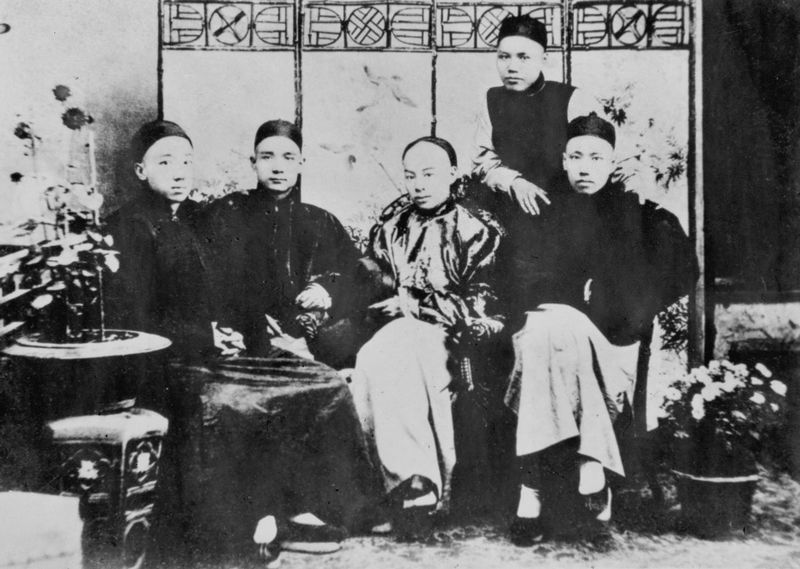
During the Qing-dynasty rebellion around 1888, Sun was in Hong Kong with a group of revolutionary thinkers, nicknamed the Four Bandits, at the Hong Kong College of Medicine for Chinese.
In 1891, Sun met revolutionary friends in Hong Kong including Yeung Ku-wan who was the leader and founder of the Furen Literary Society. The group was spreading the idea of overthrowing the Qing. In 1894, Sun wrote an 8,000-character petition to Qing Viceroy Li Hongzhang presenting his ideas for modernizing China. He traveled to Tianjin to personally present the petition to Li but was not granted an audience. After that experience, Sun turned irrevocably toward revolution. He left China for Hawaii and founded the Revive China Society, which was committed to revolutionizing China's prosperity. It was the first Chinese nationalist revolutionary society. Members were drawn mainly from Chinese expatriates, especially from the lower social classes. The same month in 1894, the Furen Literary Society was merged with the Hong Kong chapter of the Revive China Society. Thereafter, Sun became the secretary of the newly merged Revive China Society, which Yeung Ku-wan headed as president. They disguised their activities in Hong Kong under the running of a business under the name "Kuen Hang Club" (乾亨行). Sun had members swear an oath to "Expel the Tartar barbarians, restore China."
A "Heaven and Earth Society" sect known as Tiandihui had been around for a long time. The group has also been referred to as the "three cooperating organizations", as well as the triads. Sun mainly used the group to leverage his overseas travels to gain further financial and resource support for his revolution.
In 1895, China suffered a serious defeat during the First Sino-Japanese War. There were two types of responses. One group of intellectuals contended that the Manchu Qing government could restore its legitimacy by successfully modernizing. Stressing that overthrowing the Manchu would result in chaos and would lead to China being carved up by imperialists, intellectuals like Kang Youwei and Liang Qichao supported responding with initiatives like the Hundred Days' Reform. In another faction, Sun Yat-sen and others like Zou Rong wanted a revolution to replace the dynastic system with a modern nation-state in the form of a republic. The Hundred Days' reform turned out to be a failure by 1898.
05First uprising and exile
In the second year of the establishment of the Revive China Society, on 26 October 1895, the group planned and launched the First Guangzhou uprising against the Qing in Guangzhou. Yeung Ku-wan directed the uprising starting from Hong Kong. However, plans were leaked out, and more than 70 members, including Lu Haodong, were captured by the Qing government. The uprising was a failure. Sun received financial support mostly from his brother, who sold most of his 12,000 acres of ranch and cattle in Hawaii. Additionally, members of his family and relatives of Sun would take refuge at the home of his brother Sun Mei at Kamaole in Kula, Maui.
While in exile in London in 1896, Sun raised money for his revolutionary party and to support uprisings in China. While the events leading up to it are unclear, Sun Yat-sen was detained at the Chinese Legation in London on 11 October, where the Chinese secret service planned to smuggle him back to China to execute him for his revolutionary actions. He was released after 12 days by the efforts of James Cantlie, The Globe, The Times, and the Foreign Office, which left Sun a hero in the United Kingdom. James Cantlie, Sun's former teacher at the Hong Kong College of Medicine for Chinese, maintained a lifelong friendship with Sun and later wrote an early biography of him Sun wrote a book in 1897 about his detention, Kidnapped in London.
The bronze plaque of Sun is currently mounted on an outside wall of the building of "City Junior School" at 4 Gray's Inn Place.
Sun traveled by way of Canada to Japan to begin his exile there. He arrived in Yokohama on 16 August 1897 and met with the Japanese philosopher Tōten Miyazaki. Most Japanese who actively worked with Sun were motivated by a pan-Asian opposition to Western imperialism. In Japan, Sun also met Mariano Ponce, a diplomat of the First Philippine Republic.
During the Philippine Revolution and the Philippine–American War, Sun helped Ponce procure weapons that had been salvaged from the Imperial Japanese Army and ship the weapons to the Philippines. By helping the Philippine Republic, Sun hoped that the Filipinos would retain their independence so that he could be sheltered in the country in staging another Chinese revolution. However, as the war ended in July 1902, the United States emerged victorious from a bitter three-year war against the Republic. Therefore, Sun did not have the opportunity to ally with the Philippines in his revolution in China.
In 1897, through an introduction by Tōten, Sun Yat-sen met Tōyama Mitsuru of the political organization Genyosha. Through Tōyama, he received financial support for his activities and living expenses in Tokyo from Hiraoka Kotarō. Additionally, his residence, a 2,000-square-meter (22,000 sq ft) mansion in Waseda-Tsurumaki-cho, was arranged by Inukai Tsuyoshi.
In 1899, the Boxer Rebellion occurred. The following year, Sun Yat-sen attempted another uprising in Huizhou, but it ended in failure. In 1902, despite already having a wife in China, he married the Japanese teenage girl Kaoru Otsuki. Furthermore, he kept Asada Haru as a mistress and frequently had her accompany him.
06From failed uprisings to revolution
On 22 October 1900, Sun ordered the launch of the Huizhou Uprising to attack Huizhou and provincial authorities in Guangdong. That came five years after the failed Guangzhou Uprising. This time, Sun appealed to the triads for help. The uprising was another failure. Miyazaki, who participated in the revolt with Sun, wrote an account of the revolutionary effort under the title "33-Year Dream" (三十三年之夢) in 1902.
In 1903, Sun made a secret trip to Bangkok in which he sought funds for his cause in Southeast Asia. His loyal followers published newspapers, providing invaluable support to the dissemination of his revolutionary principles and ideals among Siamese Chinese in Siam (Thailand). In Bangkok, Sun visited Yaowarat Road, in the city's Chinatown. On that street, Sun gave a speech claiming that Overseas Chinese were "the Mother of the Revolution." He also met the local Chinese merchant Seow Houtseng, who sent financial support to him.
Sun's speech on Yaowarat Road was commemorated by the street later being named "Sun Yat Sen Street" or "Soi Sun Yat Sen" (Thai: ซอยซุนยัตเซ็น) in his honour.
According to Lee Yun-ping, chairman of the Chinese historical society, Sun needed a certificate to enter the United States since the Chinese Exclusion Act of 1882 would have otherwise blocked him.
In March 1904, while residing in Kula, Maui, Sun Yat-sen obtained a Certificate of Hawaiian Birth, issued by the Territory of Hawaii, stating that "he was born in the Hawaiian Islands on the 24th day of November, A.D. 1870." He renounced it after it served its purpose to circumvent the Chinese Exclusion Act. Official files of the United States show that Sun had United States nationality, moved to China with his family at age 4, and returned to Hawaii 10 years later.
On 6 April 1904, on his first attempt to enter the United States, Sun Yat-sen landed in San Francisco. He was detained and faced with possible deportation. Sun, represented by the law firm of Ralston & Siddons, based in Washington DC, filed an appeal with the Commissioner-General of Immigration on 26 April 1904. On 28 April 1904, the acting secretary of the Department of Commerce and Labor in a four-page decision contained in the case file, set aside the order of deportation and ordered the Commissioner of Immigration in San Francisco to "permit the said Sun Yat-sen to land." Sun was then freed to embark on his fundraising tour in the United States.
Later in 1911, Sun Yat-sen would visit several Chinese American communities in the United States, including a community in Phoenix, to thank them for their financial support in the revolution.
In 1900, Sun Yat-sen temporarily exiled himself to Japan again. During his stay in Japan, he expressed his thoughts to Inukai Tsuyoshi, saying, "The Meiji Restoration is the first step of the Chinese revolution, and the Chinese revolution is the second step of the Meiji Restoration."
While in Japan, on 25 October 1915, Sun married Soong Ching-ling, the second daughter of Soong Jiashu, who was also a Hakka like him. The arrangement of their marriage was supported by Umeya Shokichi, a Japanese supporter who provided financial aid.
Fusanosuke Kuhara, a prominent figure in Japan's political and business circles, invited Sun to his villa, the Nihonkan, located where the current restaurant "Kochuan" in Shirokane Happo-en stands. Kuhara offered Sun the newly built "Orchid Room" to encourage and support his friend living in a foreign land.
The Orchid Room was equipped with a secret escape route known as "Sun Yat-sen's Escape Passage." This precautionary measure included a hidden door behind the fireplace, which led to an underground tunnel, providing an escape route in case of emergencies.
In 1904, Sun Yat-sen came about with the goal "to expel the Tatar barbarians (specifically, the Manchu), to revive Zhonghua, to establish a Republic, and to distribute land equally among the people" (驅除韃虜, 恢復中華, 創立民國, 平均地權). One of Sun's major legacies was the creation of his political philosophy of the Three Principles of the People. These Principles included the principle of nationalism (minzu, 民族), of democracy (minquan, 民權), and of welfare (minsheng, 民生).
On 20 August 1905, Sun joined forces with revolutionary Chinese students studying in Tokyo to form the unified group Tongmenghui (United League), which sponsored uprisings in China. By 1906 the number of Tongmenghui members reached 963.
Sun's notability and popularity extended beyond the Greater China region, particularly to Nanyang (Southeast Asia), where a large concentration of overseas Chinese resided in Malaya (Malaysia and Singapore). In Singapore, he met the local Chinese merchants Teo Eng Hock (張永福), Tan Chor Nam (陳楚楠) and Lim Nee Soon (林義順), which mark the commencement of direct support from the Nanyang Chinese. The Singapore chapter of the Tongmenghui was established on 6 April 1906, but some records claim the founding date to be end of 1905. The villa used by Sun was known as Wan Qing Yuan. Singapore then was the headquarters of the Tongmenghui.
After founding the Tongmenghui, Sun advocated the establishment of the Chong Shing Yit Pao as the alliance's mouthpiece to promote revolutionary ideas. Later, he initiated the establishment of reading clubs across Singapore and Malaysia to disseminate revolutionary ideas by the lower class through public readings of newspaper stories. The United Chinese Library, founded on 8 August 1910, was one such reading club, first set up at leased property on the second floor of the Wan He Salt Traders in North Boat Quay.
The establishment of United Chinese Library (同德书报社) was encouraged by Sun since 1907. In 1910, the library was rented on the second floor of Wanhe (万和) Salt Godown, in North Boat Quay. In November 1911, the library moved to 51 Armenian Street. Sun missed the ceremony of new address due to delay of ship transportation service.
The registration was approved on 8 August 1911. The library provided over 50,000 books and many of them were destroyed during Japanese occupation of Singapore.
On 1 December 1907, Sun led the Zhennanguan Uprising against the Qing at Friendship Pass, which is the border between Guangxi and Vietnam. The uprising failed after seven days of fighting. In 1907, there were a total of four failed uprisings, including Huanggang uprising, Huizhou seven women lake uprising and Qinzhou uprising. In 1908, two more uprisings failed: the Qin-lian Uprising and Hekou Uprising.
Because of the failures, Sun's leadership was challenged by elements from within the Tongmenghui who wished to remove him as leader. In Tokyo, members from the recently merged Restoration society raised doubts about Sun's credentials. Tao Chengzhang and Zhang Binglin publicly denounced Sun in an open leaflet, "A declaration of Sun Yat-sen's Criminal Acts by the Revolutionaries in Southeast Asia", which was printed and distributed in reformist newspapers like Nanyang Zonghui Bao. The goal was to target Sun as a leader leading a revolt only for profiteering.
The revolutionaries were polarized and split between pro-Sun and anti-Sun camps. Sun publicly fought off comments about how he had something to gain financially from the revolution. However, by 19 July 1910, the Tongmenghui headquarters had to relocate from Singapore to Penang to reduce the anti-Sun activities. It was also in Penang that Sun and his supporters would launch the first Chinese "daily" newspaper, the Kwong Wah Yit Poh, in December 1910.
To sponsor more uprisings, Sun made a personal plea for financial aid at the Penang conference, held on 13 November 1910 in Malaya. The high-powered preparatory meeting of Sun's supporters was subsequently held in Ipoh, Singapore, at the villa of Teh Lay Seng, the chairman of the Tungmenghui, to raise funds for the Huanghuagang uprising, also known as the Yellow Flower Mound Uprising. The Ipoh leaders were Teh Lay Seng, Wong I Ek, Lee Guan Swee, and Lee Hau Cheong. The leaders launched a major drive for donations across the Malay Peninsula and raised HK$187,000.
On 27 April 1911, the revolutionary Huang Xing led the Yellow Flower Mound Uprising against the Qing. The revolt failed and ended in disaster. The bodies of only 72 revolutionaries were identified of the 86 that were found. The revolutionaries are remembered as martyrs.
Despite the failure of this uprising, which was due to a leak, it was successful in triggering off the trend of nation-wide revolts.
On 10 October 1911, the military Wuchang uprising took place and was led again by Huang Xing. The uprising expanded to the Xinhai Revolution, also known as the "Chinese Revolution", to overthrow the last emperor, Puyi. That put Huang in charge of the revolution that ended over 2000 years of imperial rule in China. On 12 October, when Sun learned of the successful rebellion against the Qing emperor from press reports, he returned to China from the United States and was accompanied by his closest foreign advisor, the American "General" Homer Lea, an adventurer whom Sun had met in London when they attempted to arrange British financing for the future Chinese republic. Both sailed for China, arriving there on 21 December 1911.
Article sections from Wikipedia (CC BY-SA 4.0). Excerpted for readability.