The Asante Empire (Asante Twi: Asanteman), also known as the Ashanti Empire, was an Akan state that lasted from 1701 to 1902, in what is now modern-day Ghana. It expanded from the Ashanti Region to include most of Ghana and also parts of Ivory Coast and Togo. Due to the empire's military prowess, wealth, architecture, sophisticated hierarchy, trade networks and culture, the Asante Empire has been extensively studied and has more historic records written by European, primarily British, authors than any other indigenous culture of sub-Saharan Africa.
Starting in the late 17th century, the Asante king Osei Tutu (c. 1695 – 1717) and his adviser Okomfo Anokye established the Asante Kingdom, with the Golden Stool of Asante as a sole unifying symbol. Osei Tutu oversaw a massive Asante territorial expansion, building up the army by introducing new organisation and turning a disciplined royal and paramilitary army into an effective fighting machine. In 1701, the Asante army conquered Denkyira, giving the Asante access to the Gulf of Guinea and the Atlantic Ocean coastal trade with Europeans, notably the Dutch. The economy of the Asante Empire was mainly based on the trade of gold and agricultural exports as well as slave trading, craft work and trade with markets further north.
The Asante Empire fought several wars with neighboring kingdoms and lesser organized groups such as the Fante. The Asante held their own against the British in the first two of the five Anglo-Ashanti Wars, killing British army general Sir Charles MacCarthy and keeping his skull as a gold-rimmed drinking cup in 1824. British forces later burnt and sacked the Asante capital of Kumasi, however, and following the final Asante defeat at the fifth Anglo-Ashanti War, the Asante empire became part of the Gold Coast colony on 1 January 1902. Today, the Asante Kingdom survives as a constitutionally protected, sub-national traditional state in union with the Republic of Ghana. The current king of the Asante kingdom is Otumfuo Osei Tutu II. The Asante kingdom is the home to Lake Bosumtwi, Ghana's only natural lake. The state's current economic revenue is derived mainly from trading in gold bars, cocoa, kola nuts and agriculture.
Summary from Wikipedia (CC BY-SA 4.0)
01Etymology
The name Asante means "because of war". The word derives from the Twi words ɔsa meaning "war" and nti meaning "because of". This name comes from the Asante's origin as a kingdom created to fight the Denkyira kingdom.
The variant name "Ashanti" comes from British reports transcribing "Asante" as the British heard it pronounced, as-hanti. The hyphenation was subsequently dropped and the name Ashanti remained, with various spellings including Ashantee common into the early 20th century.
02History

Akan traditions preserve several types of historical narratives known as adomankomasem (creation stories), atetesem (migration traditions), and abakomsem (histories of political authority). In Asante traditions, Amansie is remembered as the early homeland of the Akan people and means the "Origin of the Nations" or the "Settlement of the Aborigines." The region was associated with the ancestors of the Aduana and Oyoko clans, who are said to have first settled at Asumennya–Santemanso. One tradition recounts how a golden chain descended from the sky carrying a stool and a herald woman, Ankyewea Nyame, the ancestor of the Oyoko lineage, who settled at Asantemanso where other people later emerged from the earth and joined her community. From Amansie, a large portion of the Akan population later migrated to Adanse, where permanent settlements were established and the transition from mobile communities to organized political societies began. Early Akan political organization developed around communities known as aman (states), which were independent political communities governed by ruling lineages. Authority within the communities was symbolized by the akonnwa (stools), which represented the legitimacy of a chief's right to rule. The earliest Akan states in the region between the Pra and Ofin rivers were Adansemanso, Abuakwa Atwumamanso, Asenmanso, Abankeseso, and Asantemanso, collectively known as the Akanman Nnum Piesie ("Five First-Born Akan States").
Excavations in Asantemanso, near present-day Essumeja, revealed continuous occupation from at least the 9th century CE, with traces of earlier habitation possibly dating as far back as 700 BCE. Excavations uncovered iron-smelting furnaces, pottery, and the remains of houses. During the first millennium CE, Asantemanso was one of several towns in the forest-savannah areas, alongside Adansemanso, Bima, Begho, Bono Manso, and Ahwene Koko. They were part of a trade network that connected the forest with the Middle Niger Valley through Wangara merchants.. By the 10th century, Asantemanso had grown into a large town with pottery similar to that found in the Birim Valley.
According to Ray Kea, Asantemanso was a proto-urban polity and a "technology of power" in the forest zone. He wrote that it was the center of abirempon that organized gold production, trade, and political authority in the surrounding area. From the 15th century onward, people from Asantemanso moved north and founded Kumase, Dwaben, Kokofu, Kumawu, and nearby towns. As the new towns grew, Asantemanso declined and was no longer the center of Asanteman.
In Akan oral tradition, Adanse is the place where Odomankoma (God) began the creation of the word. It is also associated with the beginnings of Akan kingship and the abusua (clan) system. Adansemanso, the first capital of Adanse, was continuously occupied from the 9th century CE, with earlier settlement dating to 393 CE. Excavations revealed that the town reached its largest size between the 13th and 15th centuries.
According to Osei Tutu Agyeman Prempeh II, the Adanse were the most powerful and advanced of the early Akan groups and were remembered for establishing the first organized kingship in the region. Many southern Akan regarded the region as their ancestral homeland, as well as the origin of many ruling lineages. The Agona of Denkyira originally lived the area stretching from Asokwa west of Obuase and Akrofuom to the meeting of the Oda and Ofin rivers. The Asona, who later founded Ejisu (Edweso), Offinso, and Akyem Abuakwa, traced their ancestry to Kokobiante. The rulers of Assin Atandasu as well as the Asona of Apemanim, the Afutuakwa of Fosu, and the Aboabo of Assin Nyankomase traced their origins to the Pra–Kusa range. The Bretuo of Mampon and Kwahu, the Oyoko of Abadwum and Edubiase, and the Ekouna of Fomena also regard Adanse as the origin point where later lineages migrated from.
From the 16th century onward, several clans moved north and established new towns and states. The Agona were among the first and founded Tafo. They were followed by the Ekoona, Aduana, and Asene, who established Domaa, Amakom, Awima, Kwabre, Suntreso, Asokore, Kwaaman, Kenyase, Kaase, and other settlements. The states took part in trade between the northwestern savannah and the forest.
References to inland Akan-speaking polities appear in European sources in the early sixteenth century. Duarte Pacheco Pereira, writing between 1505 and 1508, listed the Haccanys among the principal gold-trading groups of in the Gold Coast, alongside the Bremus, Atis, Boroes, and Madinguas. In 1519, the same inland states requested that livestock and other goods be sent to the "King of Assan" in exchange for gold. To secure cooperation from inland traders, Portuguese agents distributed gifts to encourage movement toward coastal markets. One report revealed that 1,550 Martin de Castro sent messengers to Akani, located four days inland from Elmina. Other Portuguese records later referred to envoys and rulers identified as “Kings of Akan,” and by 1548 mentioned internal wars among them. A report of 1572 referred to the kingdom of Asaas and stated that the gold exported from that territory was originally mined at Tafoe (Tafo).
Throughout the sixteenth and seventeenth centuries, the names Accany, Akani, and Arcania appeared in Portuguese, Dutch, and English records. The label referred to inland gold-producing regions north of the coastal states. The region was north of Fante, Agona, and Etsi, west of Kwahu and Akwamu, and south of Bono and Wenchi. It was located in the area between the Ofin, Pra, and Birim river basins. This region was densely populated and associated with gold production and trade. European merchants referred to inland Akan gold traders as Accanists. The traders transported gold and other goods to coastal markets such as Elmina and Kormantine.
Akani merchants supplied a large amount of the gold exported annually by European merchants on the coast. K. Y. Daaku described it as a confederation of Akan polities bound by kinship and trade, centered on Adanse, which he identified as the political and commercial core. J. K. Fynn interpreted it as a centralized kingdom extending across Adanse, south to Assin, east into parts of Akyem, and west toward Denkyira. Ray Kea instead believed it as a trading society organized around merchant groups that controlled inland gold routes.
The breakup of the Akan heartland resulted from succession disputes, competition over trade, and struggles for political control among leading clans. Akyem Abuakwa traditions trace the crisis to the death of Awurade Basa, king of Adansemanso and creator of the Afenakwa sword, a symbol of centralized authority. As wealth became concentrated in Assin and Denkyira, conflicts over tolls, markets, and caravan routes undermined the confederation. The weakening of Adanse’s political unity led to the movement of several Akan people lineages. Some, including the Asona clan, who crossed east of the Pra, while others, among them the ancestors of the Asante, moved north from the Amansie to the Kumasi area. After 1629, the movements intensified with the military campaigns of the Denkyira. Under Werempe-Ampem, Denkyira expanded through military force and control of the gold trade, absorbing many Akan territories and disrupting established trade networks.
By the mid-seventeenth century, the introduction of firearms altered the balance of power in the interior. The Portuguese and Dutch were officially restricted from selling guns, increasing European competition after the 1650s led to greater availability of firearms on the coast. Dutch officials reported growing demand for guns on the Gold Coast by 1658. During this period, Adanse was defeated and Denkyira rose to become the dominant power in the Pra-Ofin basin. After the victory Denkyira became the leading power in the Gold Coast hinterland and extended its authority over neighboring regions.
Members of the Oyoko and Ekoona clans migrated north from Adanse and Amansie to avoid Denkyira’s domination. They settled in new areas where they could control land and trade with less interference. Oti Akenten was credited with leading the movement of the Oyoko clan from Asantemanso to Kokofu to Kwaman. During his leadership, the Oyoko became stronger than the Ekoona headmen who had previously held authority in the area. At the time of the migration, the forest region was already full of well established Akan states like Kaase, Tafo, Amakom and others. The Kwaman area was bordered to the north and north-east by the Guan state of Atara Frinam, and to the north-west by the Bono kingdom. It was located near Tafo, which was an inland trading center on the north–west route. The location allowed the polity to take part in and influence regional trade. The Adanse-Amansie migrants competed for land and control of trade routes which contributed to closer political coordination among them.
The Oyoko settled at Nsuta, Juaben, Kokofu, Bekwai, and Kumasi, creating a group of towns within about thirty miles of present-day Kumasi. The concentration of settlements later formed the territorial nucleus of the Asante Union. From this base, the Oyoko leadership began consolidating surrounding settlements into a loose confederation.
By the late seventeenth century the interior of the Gold Coast was dominated by three major Akan states: Denkyira, Akyem, and Akwamu. Their control of gold production and inland trade routes made them the principal powers of the region. After numerous military campaigns, Denkyira controlled several gold-producing regions like Aowin, Gwira, Wassa, Twifo, Adanse, and Asante, monopolizing the gold resources of the upper Tano, Ankobra, Ofin, and Pra river systems. Rivalry among Denkyira, Akyem, and Akwamu contributed to political instability in the hinterland as the states competed for control of gold production, kola trade, and the inland routes linking the forest states with the coast. The Denkyirahene Boamponsem required the ruler of Kwaman to pay an annual tribute of gold and palm oil and to send a member of the royal family to reside at the Denkyira court. In response, the Kumase ruler Oti Akenten sent his nephew Osei Tutu, who remained for a period at the Denkyira capital accompanied by several attendants, including the future Asante military leader Amankwatia.
After this period Osei Tutu sought refuge at the court of the Akwamuhene Nana Ansa Sasraku I while avoiding Denkyira authority. Akwamu later supported Osei Tutu during the formation of the Asante Union in an effort to counterbalance the Denkyira–Akyem alliance and weaken their influence in the interior. At Akwamu he became associated with Okomfo Anokye, the future cofounder of the Asante Empire. After returning to Kumase, relations with Denkyira deteriorated and tensions intensified between the two states.
Around 1680, leadership of the growing Asante union passed to Nana Obiri Yeboa, who continued the process of political consolidation. His death in battle with the Dormaa led to the rise of Osei Tutu I.At this time, the Asante states were subject to Denkyira. The Denkyirahene Ntim Gyakari demanded heavy tribute. When the Asante refused, war broke out around 1698. According to Asante tradition, the leaders of Nsuta, Mampong, Dwaben, Bekwai, and Kokofu met before the final break with Denkyira. During this period, the Golden Stool (Sika dwa) became the central symbol of unity under Osei Tutu I.
The stool remains sacred and is believed to contain the Sunsum of the Asante people. In 1701, Osei Tutu and Okomfo Anokye led a coalition of Asante states against Denkyira and defeated them at the Battle of Feyiase. The victory ended Denkyira’s control over the Asante states. After the war, the allied rulers recognized Kumasi as the center of the union and Osei Tutu as Asantehene.
After gaining independence from Denkyira in 1701, Asante emerged as the dominant inland power.
03Government and politics

The Asante state was a centralized state made up of a hierarchy of heads starting from the "Abusua Panyin" who was head of a family or lineage. The family was the basic political unit in the empire. The family or lineage followed the village organization which was headed by the Odikro. All villages were then grouped together to form divisions headed by a divisional head called Ohene. The various divisions were politically grouped to form a state which was headed by an Omanhene or Amanhene. Finally, all Asante states formed the Asante Empire with the Asantehene as their king.
The Asante government was built upon a sophisticated bureaucracy in Kumasi, with separate ministries to handle the state's affairs. Of particular note was Asante's Foreign Office based in Kumasi; despite its small size, it allowed the state to pursue complex negotiations with foreign powers. The Office was divided into departments to handle relations separately with the British, French, Dutch, and Arabs. Scholars of Ashanti history, such as Larry Yarak and Ivor Wilks, disagree over the power of this sophisticated bureaucracy in comparison to the Asantehene, but agree that it was a sign of a highly developed government with a complex system of checks and balances.
At the top of Asante's power structure sat the Asantehene, the King of Asante. Each Asantahene was enthroned on the sacred Golden Stool, the Sika 'dwa, an object that came to symbolise the very power of the King. Osei Kwadwo (r. 1764–1777) began the meritocratic system of appointing central officials according to their ability, rather than their birth.
As King, the Asantehene held immense power in Asante, but did not enjoy absolute royal rule. He was obliged to share considerable legislative and executive powers with Asante's sophisticated bureaucracy. But the Asantehene was the only person in Asante permitted to invoke the death sentence in cases of crime. During wartime, the King acted as Supreme Commander of the Asante army, although during the 19th century, the fighting was increasingly handled by the Ministry of War in Kumasi. Each member of the confederacy was also obliged to send annual tribute to Kumasi.
The Asantehene (King of all Asante) reigned over all and was King of the division of Kumasi, the nation's capital, and the Asante Empire. He was elected in the same manner as all other chiefs. In this hierarchical structure, every chief or King swore fealty to the one above him—from village and subdivision, to division, to the chief of Kumasi, and finally the Asantehene swore fealty to the State.
The elders circumscribed the power of the Asantehene, and the chiefs of other divisions considerably checked the power of the King. This in practical effect created a system of checks and balances. As the symbol of the nation, the Asantehene received significant deference ritually, for the context was religious in that he was a symbol of the people in the flesh: the living, dead or yet to be born. When the king committed an act not approved of by the counsel of elders or the people, he could possibly be impeached, and demoted to a commoner.
The existence of aristocratic organizations and the council of elders is evidence of an oligarchic tendency in Asante political life. These men tended to monopolize political power around themselves into both "war" parties and "peace" parties.
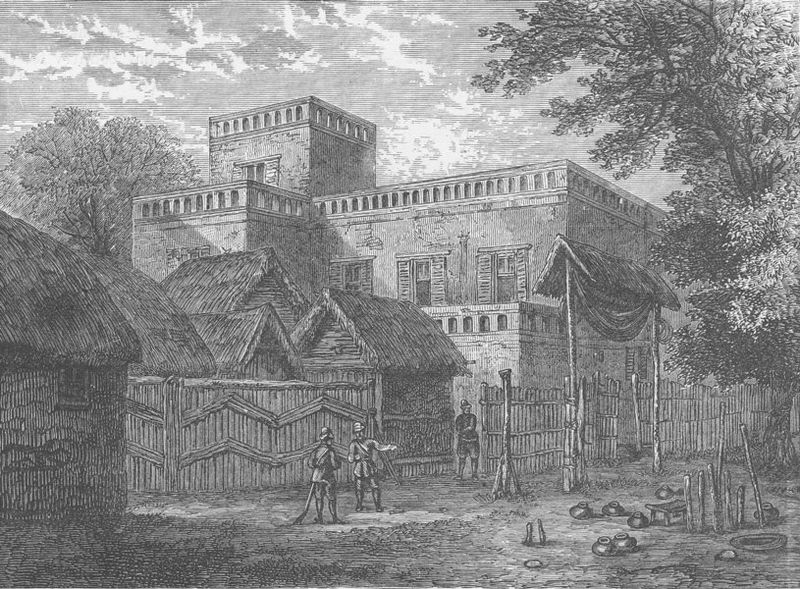
The current residence of the Asantehene is the Manhyia Palace built in 1925 by the British and presented to the Prempeh I as a present upon his return from exile. The original palace of the Asantehene in Kumasi was burned down by the British in 1874. From European accounts, the edifice was massive and ornately built. In 1819, English traveler and author, Thomas Edward Bowdich described the palace complex as ...an immense building of a variety of oblong courts and regular squares [with] entablatures exuberantly adorned with bold fan and trellis work of Egyptian character. They have a suite of rooms over them, with small windows of wooden lattice, of intricate but regular carved work, and some have frames cased with thin gold. The squares have a large apartment on each side, open in front, with two supporting pillars, which break the view and give it all the appearance of the proscenium or front of the stage of the older Italian theaters. They are lofty and regular, and the cornices of a very bold cane-work in alto-relievo. A drop-curtain of curiously plaited cane is suspended in front, and in each, we observed chairs and stools embossed with gold, and beds of silk, with scattered regalia. Winwood Reade also described his visit to the Asante Royal Palace of Kumasi in 1874:"We went to the king's palace, which consists of many courtyards, each surrounded with alcoves and verandahs, and having two gates or doors, so that each yard was a thoroughfare . . . But the part of the palace fronting the street was a stone house, Moorish in its style . . . with a flat roof and a parapet, and suites of apartments on the first floor. It was built by Fanti masons many years ago. The rooms upstairs remind me of Wardour Street. Each was a perfect Old Curiosity Shop. Books in many languages, Bohemian glass, clocks, silver plate, old furniture, Persian rugs, Kidderminster carpets, pictures and engravings, numberless chests and coffers. A sword bearing the inscription From Queen Victoria to the King of Ashantee. A copy of the Times, 17 October 1843. With these were many specimens of Moorish and Ashanti handicraft."
This institution assisted the Asantehene and served as an advisory body to the king. The council was made up of Amanhene or paramount chiefs who were leaders of the various Asante states. The council also included other provincial chiefs. By law the Asantehene never ignored the decisions of the Asanteman council. Doing so could get him de-stooled from the throne.
The Asante Empire was made up of metropolitan and provincial states. The metropolitan states were made up of Asante citizens known as amanfo. The provincial states were other kingdoms absorbed into the empire. Every metropolitan Asante state was headed by the Amanhene or paramount chief. Each of these paramount chiefs served as principal rulers of their own states, where they exerted executive, legislative and judicial powers.
The Ohene is a male representative of his mother's family, where he is chosen from. The Ohene were divisional chiefs under the Amanhene. Their major function was to advise the Amanhene. The divisional chiefs were the highest order in various Asante state divisions. The divisions were made up of various villages put together. Examples of divisional chiefs included Krontihene, Nifahene, Benkumhene, Adontenhene and Kyidomhene.
Each village in Asante had a chief called Odikro who was the owner of the village. The Odikro was responsible for the maintenance of law and order. He also served as a medium between the people of his jurisdiction, the ancestor and the gods. As the head of the village, the Odikro presided over the village council.
The queen or Ohenemaa was an important figure in Asante political systems. She was the most powerful female in the Empire, because the Ohene represents her or her family and is either her son or her sister's son. She has the power to be King, if she desires but would rather see her son or her maternal nephew(which is also considered her 2nd child in African culture). She had the prerogative of being consulted in the process of installing a chief or the king, as she played a major role in the nomination and selection. She settled disputes involving women and was involved in decision-making alongside the Council of elders and chiefs. Not only did she participate in the judicial and legislative processes, but also in the making and unmaking of war, and the distribution of land.
Successful entrepreneurs who accumulated large wealth and men as well as distinguished themselves through heroic deeds were awarded social and political recognition by being called "Abirempon" or "Obirempon" which means big men. By the eighteenth and nineteenth centuries AD, the appellation "Abirempon" had formalized and politicized to embrace those who conducted trade from which the whole state benefited. The state rewarded entrepreneurs who attained such accomplishments with Mena (elephant tail) which was the "heraldic badge" Obirempons had a fair amount of legislative power in their regions, more than the local nobles of Dahomey but less than the regional governors of the Oyo Empire. In addition to handling the region's administrative and economic matters, the obirempon also acted as the Supreme Judge of their jurisdiction, presiding over court cases.
The Kotoko was a government council in the Asante government. Politically, the kotoko council served as the counterweight to the king's council of elders and basically embodied the aristocratic party in the government. The council formed the Legislature of Asante governmental system. It was made up of the Asantehene, the Queen mother as well as the state chiefs and their ministers.
The election of Kings and the Asantehene (King of Kings or emperor ) himself followed a pattern. The senior female of the kingly lineage nominated the eligible males. This senior female then consulted the elders, male and female, of that line. The final candidate is then selected. That nomination was sent to a council of elders, who represented other lineages in the town or district.
The Elders then presented the nomination to the assembled people. If the assembled citizens disapproved of the nominee, the process was restarted. Chosen, the new Kings were enstooled by the Elders, who admonished him with expectations. The chosen Kings swore a solemn oath to the Earth Goddess and to his ancestors to fulfill his duties honorably in which he "sacrificed" himself and his life for the betterment of the state.
This elected and enstooled King enjoyed a great majestic ceremony with much spectacle and celebration. He reigned with much despotic power, including the ability to make judgments of life and death on his subjects. However, he did not enjoy absolute rule. Upon the stool, the King was sacred. He served as the holy intermediary between the people and the ancestors. His powers theoretically were more apparent than real and hinged on his attention to the advice and decisions of the Council of Elders.
Kings of the Asante Empire who violated any of the oaths taken during his or her enstoolment, were destooled by Kingmakers. For instance, if a king punished citizens arbitrarily or was exposed as corrupt, he would be destooled. Destoolment entailed kingmakers removing the sandals of the king and bumping his buttocks on the ground three times. Once destooled from office, his sanctity and thus reverence were lost, as he could not exercise any of the powers he had as king; this includes Chief administrator, Judge, and Military Commander. The now previous king was dispossessed of the Stool, swords and other regalia which symbolized his office and authority.
He also lost his position as custodian of the land. However, even if destooled from office, the king remained a member of the royal family from which he was elected. An impeachment occurred during the reign of Kusi Obodom, caused by a failed invasion of Dahomey.
The Asantehene was assisted by a civil service of men talented in trade, diplomacy, and the military, with a head called the Gyaasehene. Men from the Arabian Peninsula, Sudan, and Europe were employed in the Asante empire civil service; all of whom were appointed by the Asantehene.
The Asante invented the Fontomfrom, an Asante talking drum, and they also invented the Akan Drum. They drummed messages to distances of over 300 kilometres (200 mi), as rapidly as a telegraph. Asante dialect (Twi) and Akan, the language of the Asante people is tonal and more meaning is generated by tone.
04Legal system
Okomfo Anokye was responsible for creating the Seventy-Seven Laws of Komfo Anokye which served as the codified constitution of the Ashanti Empire.
The Asante state, in effect, was a theocracy. It invokes religious, rather than secular-legal postulates. What the modern state views as crimes, Ashanti view practically as sins. Antisocial acts disrespect the ancestors, and are only secondarily harmful to the community. If the chief or King fails to punish such acts, he invokes the anger of the ancestors and the gods, and is therefore in danger of impeachment. The penalty for some crimes (sins) is death, but this is seldom imposed; a more common penalty is banishment or imprisonment. The King typically exacts or commutes all capital cases. These commuted sentences by King and chiefs sometimes occur by ransom or bribe; they are regulated in such a way that they should not be mistaken for fines, but are considered as revenue to the state, which for the most part welcomes quarrels and litigation. Commutations tend to be far more frequent than executions.
Asante are repulsed by murder, and suicide is considered murder. They decapitate those who commit suicide, the conventional punishment for murder. The suicide thus had contempt for the court, for only the King may kill an Asante.
In a murder trial, intent must be established. If the homicide is accidental, the murderer pays compensation to the lineage of the deceased. The insane cannot be executed because of the absence of responsible intent – except for murder or cursing the King; in the case of cursing the king, drunkenness is a valid defense. Capital crimes include murder, incest within the female or male line, and intercourse with a menstruating woman, rape of a married woman, and adultery with any of the wives of a chief or the King. Assaults or insults of a chief or the court or the King also carried capital punishment.
Cursing the King, calling down powers to harm the King, is considered an unspeakable act and carries the weight of death. One who invokes another to commit such an act must pay a heavy indemnity. Practitioners of harmful (evil) forms of sorcery and witchcraft receive death but not by decapitation, for their blood must not be shed. They receive execution by strangling, burning, or drowning.
Ordinarily, families or lineages settle disputes between individuals. Nevertheless, such disputes can be brought to trial before a chief by uttering the taboo oath of a chief or the King. In the end, the King's Court is the sentencing court, for only the King can order the death penalty. Before the Council of Elders and the King's Court, the litigants orate comprehensively. Anyone present can cross-examine the defendant or the accuser, and if the proceedings do not lead to a verdict, a special witness is called to provide additional testimony. If there is only one witness, their sworn oath assures the truth is told. Moreover, that he favours or is hostile to either litigant is unthinkable. Cases with no witness, like sorcery or adultery are settled by ordeals, like drinking poison.
Ancestor Veneration establishes the Asante moral system, and it provides the principal foundation for governmental sanctions. The link between mother and child centres the entire network, which includes ancestors and fellow men as well. Its judicial system emphasizes the Asante conception of rectitude and good behaviour, which favours harmony among the people. The rules were made by Nyame (Supreme God) and the ancestors, and one must behave accordingly.
In the metropolitan areas of Asante, several police forces were responsible for maintaining law and order. In Kumasi, a uniformed police, who were distinguished by their long hair, maintained order by ensuring no one else entered and left the city without permission from the government. The ankobia or special police were used as the empire's special forces and bodyguards to the Asantehene, as sources of intelligence, and to suppress rebellion.
For most of the 19th century and into the 20th century, the Asante sovereign state remained powerful.
05Geography

The Asante Empire was one of a series of states along the coast including Dahomey, Benin, and Oyo. The Asante had mountains and large agricultural surpluses. The southern part of the Asante Empire was covered with moist semi-deciduous forest whilst the Guinea savanna covered the northern part of the state. The Guinea Savanna consists of short deciduous and fire resistant trees. Riparian forests also occur along the Afram River and streams of the savanna zone. Soils in Asante were mainly of two types; forest ochrosols in the southern part of Asante whilst the savanna ochrosols were confined to northern part of the empire.
The predominant fauna or food rich wildlife and animal species encountered in the Asante Empire were the hen, sheep, goat, duck, turkey, rabbit, guinea fowl, fish, and the porcupine which became the national emblem of the state, as well as about thirty multipurpose flora species of trees and shrubs and over thirty-five ornamental plants which beautified the environs of Asante. These tree/shrub-crop-animal (hen/fish) components were intensively integrated spatially and/or sequentially on the same land unit of individual Asante houses.
06Economy
The lands within the Asante Kingdom were also rich in river-gold, cocoa and kola nuts, and the Asante were soon trading with the Portuguese at coastal fort Sao Jorge da Mina, later Elmina, and with the Hausa states.
The Asante prepared the fields by burning before the onset of the rainy season and cultivated with an iron hoe. Fields are left fallow for a couple years, usually after two to four years of cultivation. Plants cultivated include plantains, yams, manioc, corn, sweet potatoes, millet, beans, onions, peanuts, tomatoes, and many fruits. Manioc and corn are New World transplants introduced during the Atlantic European trade. Many of these vegetable crops could be harvested twice a year and the cassava (manioc), after a two-year growth, provides a starchy root.
The Asante transformed palm wine, maize and millet into beer, a favourite drink; and made use of the oil from palm for many culinary and domestic uses.
Infrastructure throughout the empire included a network of well-kept roads from the Asante mainland to the Niger river and other trade cities. Stationed at various points of Asante roads were the Nkwansrafo or road wardens who served as the highway police; checking the movement of traders and strangers on all roads. They were also responsible for scouting and were charged with the collection of tolls from traders.
In the early 19th century larger rivers were either forded in the dry season or crossed by canoe or line-and-raft ferries. Smaller rivers were either waded, or were bridged by a tree trunk: in both cases a rope handrail was usually stretched across the river to assist the traveller. In response to the delivery of a carriage by Thomas Freeman in 1841, the Asante Empire began to build bridges across water bodies for transport that year. Asantehene Kwaku Dua ordered proper bridges to be built across streams in the metropolitan area of Kumase. Thomas Freeman described the construction as:
...some stout, forked sticks or posts are driven in the centre of the stream at convenient distances, across which are placed some strong beams, fastened to the posts with withes, from the numerous climbing plants on every hand. On these bearers are placed long stout poles which are covered with earth from fourth to six inches thick; and this completes the bridge.
English visitors to Kumasi in the 19th century, noted the division of the capital into 77 wards with 27 main streets; one of which was 100 yards wide. Many houses especially those near the king's palace were two story buildings embodied with indoor plumbing in the form of toilets that were flushed with gallons of boiling water. Bowdich revealed in his 1817 account that all streets of Kumasi were named.
Article sections from Wikipedia (CC BY-SA 4.0). Excerpted for readability.