The British Empire comprised the dominions, colonies, protectorates, mandates, and other territories ruled or administered by the United Kingdom and its predecessor states. It began with the overseas possessions and trading posts established by England in the late 16th and early 17th centuries, and colonisation attempts by Scotland during the 17th century. At its height in the 19th and early 20th centuries, it was the largest empire in history and, for a century, was the foremost global power. By 1913 the British Empire held sway over 412 million people, 23 per cent of the world population at the time, and by 1920 it covered 35.5 million km2 (13.7 million sq mi), 24 per cent of the Earth's total land area. The British Parliament was the supreme law-making authority for all the British possessions which made up the Empire. As a result, its constitutional, legal, linguistic, and cultural legacy is widespread. It was described as "the empire on which the sun never sets", as the sun was always shining on at least one of its territories.
During the Age of Discovery in the 15th and 16th centuries, Portugal and Spain pioneered European exploration of the world, and in the process established large overseas empires. Motivated by the great wealth these empires generated, England, France, and the Netherlands began to establish colonies and trade networks in the Americas and Asia. A series of wars in the 17th and 18th centuries with the Netherlands and France left Britain the dominant colonial power in North America. Britain became a major power in the Indian subcontinent after the East India Company's conquest of Mughal Bengal at the Battle of Plassey in 1757.
The American Revolution resulted in Britain losing some of its oldest and most populous colonies in North America by 1783. While retaining control of British North America (now Canada) and territories in and near the Caribbean in the British West Indies, British colonial expansion turned towards Asia, Africa, and the Pacific. After the defeat of France in the Napoleonic Wars (1803–1815), Britain emerged as the principal naval and imperial power of the 19th century and expanded its imperial holdings. It pursued trade concessions in China and Japan, and territory in Southeast Asia. The Great Game and Scramble for Africa also ensued. The period of relative peace (1815–1914) during which the British Empire became the global hegemon was later described as Pax Britannica (Latin for "British Peace"). It also colonised India by defeating the last major imperial dynasty Maratha Empire by 1818 in the Third Anglo-Maratha War. Alongside the formal control that Britain exerted over its colonies, its dominance of much of world trade, and of its oceans, meant that it effectively controlled the economies of, and readily enforced its interests in, many regions, such as Asia and Latin America. It also came to dominate the Middle East, shaping its modern borders alongside France. Increasing degrees of autonomy were recognised for its white settler colonies, some of which were formally reclassified as dominions by the 1920s. By the start of the 20th century, Germany and the United States had begun to challenge Britain's economic lead. Military, economic and colonial tensions between Britain and Germany were major causes of the First World War, during which Britain relied heavily on its empire. The conflict placed enormous strain on its military, financial, and manpower resources. Although the empire achieved its largest territorial extent immediately after the First World War, Britain was no longer the world's preeminent industrial or military power.
In the Second World War, Britain's colonies in East Asia and Southeast Asia were occupied by the Empire of Japan. Despite the final victory of Britain and its allies, the damage to British prestige and the British economy helped accelerate the decline of the empire. India, Britain's most valuable and populous possession, achieved independence in 1947 as part of a larger decolonisation movement, in which Britain granted independence to most territories of the empire. The Suez Crisis of 1956 confirmed Britain's decline as a global power, and the handover of Hong Kong to China on 1 July 1997 symbolised for many the end of the British Empire, though fourteen overseas territories that are remnants of the empire remain under British sovereignty. After independence many former British colonies, along with most of the dominions, joined the Commonwealth of Nations, a free association of independent states. Fifteen of these, including the United Kingdom, retain the same person as monarch, currently King Charles III.
Summary from Wikipedia (CC BY-SA 4.0)
01Origins (1497–1583)
The foundations of the overseas British Empire were laid when England and Scotland were separate kingdoms, and, at the time ruled by different monarchs. In 1496 King Henry VII of England, following the successes of Spain and Portugal in overseas exploration, commissioned John Cabot to lead an expedition to discover a Northwest Passage to Asia via the North Atlantic. Cabot sailed in 1497, five years after the first voyage of Christopher Columbus, and made landfall on the coast of Newfoundland. He believed he had reached Asia, and there was no attempt to found a colony. Cabot led another voyage to the Americas the following year but did not return; it is unknown what happened to his ships. There is "inferential evidence [that] suggests that Bristol mariners may already have known of that North American shore and had been harvesting its rich seas for a decade or more", but England made no formal claims.
No further attempts to establish English colonies in the Americas were made until well into the reign of Queen Elizabeth I, during the last decades of the 16th century. In the meantime, Henry VIII's 1533 Statute in Restraint of Appeals had declared "that this realm of England is an Empire". The Protestant Reformation turned England and Catholic Spain into implacable enemies. In 1562, Elizabeth I encouraged the privateers John Hawkins and Francis Drake to engage in slave-raiding attacks against Spanish and Portuguese ships off the coast of West Africa with the aim of establishing an Atlantic slave trade. This effort was rebuffed and later, as the Anglo-Spanish Wars intensified, Elizabeth I gave her blessing to further privateering raids against Spanish ports in the Americas and shipping that was returning across the Atlantic, laden with treasure from the New World. At the same time, influential writers such as Richard Hakluyt and John Dee (who was the first to use the term "British Empire") were beginning to press for the establishment of England's own empire. By this time, Spain had become the dominant power in the Americas and was exploring the Pacific Ocean, Portugal had established trading posts and forts from the coasts of Africa and Brazil to China, and France had begun to settle the Saint Lawrence River area, later to become New France.
Although England tended to trail behind Portugal, Spain, and France in establishing overseas colonies, it carried out its first modern colonisation, in sixteenth-century Ireland, with settlements, known as "plantations", of English and Welsh Protestants. England had already colonised part of the country following the Norman invasion of Ireland in 1169, but English authority had waned over the centuries. During the reign of Elizabeth I, a pattern of conquest and attempts at colonisation was "contemporaneous with and parallel to the first effective of Englishmen in North America". Several men who helped establish the Munster plantations in Ireland later played a part in the early colonisation of North America, particularly a group known as the West Country Men.
02English overseas possessions (1583–1707)

In 1578 Elizabeth I granted a patent to Humphrey Gilbert for discovery and overseas exploration. That year Gilbert sailed for the Caribbean with the intention of engaging in piracy and establishing a colony in North America, but the expedition was aborted before it had crossed the Atlantic. In 1583 he embarked on a second attempt. On this occasion, he formally claimed the harbour of the island of Newfoundland, although no settlers were left behind. Gilbert did not survive the return journey to England and was succeeded by his half-brother, Walter Raleigh, who was granted his own patent by Elizabeth in 1584. Later that year, Raleigh founded the Roanoke Colony on the coast of present-day North Carolina, but lack of supplies caused the colony to fail.
From 1585 to 1603 England fully conquered Ireland and challenged the naval dominance of Spain in the Anglo-Spanish War, with their war ending in a draw.
In 1603 James VI of Scotland ascended (as James I) to the English throne and in 1604 negotiated the Treaty of London, ending hostilities with Spain. Now at peace with its main rival, English attention shifted from preying on other nations' colonial infrastructures to the business of establishing its own overseas colonies. The British Empire began to take shape during the early 17th century, with the English settlement of North America and the smaller islands of the Caribbean, and the establishment of joint-stock companies, most notably the East India Company, to administer colonies and overseas trade. This period, until the loss of the Thirteen Colonies after the American War of Independence towards the end of the 18th century, has been referred to by some historians as the "First British Empire".
England's early efforts at colonisation in the Americas met with mixed success. An attempt to establish a colony in Guiana in 1604 lasted only two years and failed in its main objective to find gold deposits. Colonies on the Caribbean islands of St Lucia (1605) and Grenada (1609) rapidly folded. The first permanent English settlement in the Americas was founded in 1607 in Jamestown by Captain John Smith, and managed by the Virginia Company; the Crown took direct control of the venture in 1624, thereby founding the Colony of Virginia. Bermuda was settled and claimed by England as a result of the 1609 shipwreck of the Virginia Company's flagship, while attempts to settle Newfoundland were largely unsuccessful. In 1620, Plymouth was founded as a haven by Puritan religious separatists, later known as the Pilgrims. Fleeing religious persecution became a major motive for many English would-be colonists to risk the arduous trans-Atlantic voyage: Maryland was established by English Roman Catholics (1634), Rhode Island (1636) as a colony tolerant of all religions and Connecticut (1639) for Congregationalists. England's North American holdings were further expanded by the annexation of the Dutch colony of New Netherland in 1664, following the capture of New Amsterdam, which was renamed New York. Although less financially successful than colonies in the Caribbean, these territories had large areas of good agricultural land and attracted far greater numbers of English emigrants, who preferred their temperate climates.
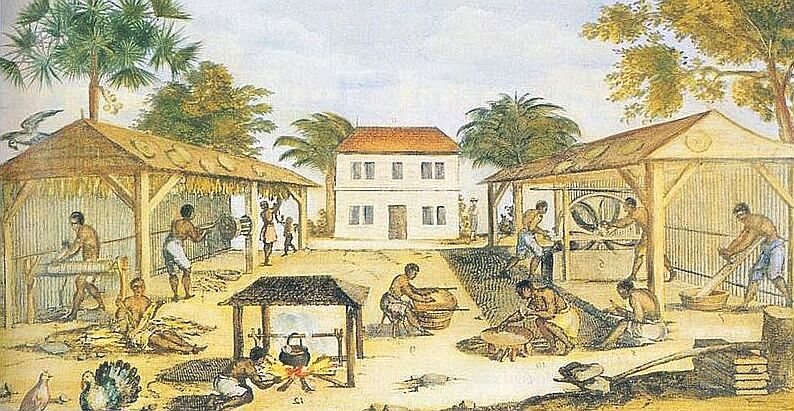
The British West Indies initially provided England's most important and lucrative colonies. Settlements were successfully established in St. Kitts (1624), Barbados (1627) and Nevis (1628), but struggled until the "Sugar Revolution" transformed the Caribbean economy in the mid-17th century. Large sugarcane plantations were first established in the 1640s on Barbados, with assistance from Dutch merchants and Sephardic Jews fleeing Portuguese Brazil. At first, sugar was grown primarily using white indentured labour, but rising costs soon led English traders to embrace the use of imported African slaves. The enormous wealth generated by slave-produced sugar made Barbados the most successful colony in the Americas, and one of the most densely populated places in the world. This boom led to the spread of sugar cultivation across the Caribbean, supported the development of non-plantation colonies in North America, and accelerated the growth of the Atlantic slave trade, particularly the triangular trade of slaves, sugar and provisions between Africa, the West Indies and Europe.
To ensure that the increasingly healthy profits of colonial trade remained in English hands, Parliament decreed in 1651 that only English ships would be able to ply their trade in English colonies. This led to hostilities with the United Dutch Provinces—a series of Anglo-Dutch Wars—which would eventually strengthen England's position in the Americas at the expense of the Dutch. In 1655, England annexed the island of Jamaica from the Spanish, and in 1666 succeeded in colonising the Bahamas.
In 1670, Charles II incorporated by royal charter the Hudson's Bay Company (HBC), granting it a monopoly on the fur trade in the area known as Rupert's Land, which would later form a large proportion of the Dominion of Canada. Forts and trading posts established by the HBC were frequently the subject of attacks by the French, who had established their own fur trading colony in adjacent New France.
Two years later, the Royal African Company was granted a monopoly on the supply of slaves to the British colonies in the Caribbean. The company would transport more slaves across the Atlantic than any other, and significantly grew England's share of the trade, from 33 per cent in 1673 to 74 per cent in 1683. The removal of this monopoly between 1688 and 1712 allowed independent British slave traders to thrive, leading to a rapid escalation in the number of slaves transported. In the Atlantic slave trade, British ships carried a third of all slaves shipped across the Atlantic—approximately 3.5 million Africans—until the abolition of the trade by Parliament in 1807 (see § Abolition of slavery). To facilitate the shipment of slaves, forts were established on the coast of West Africa, such as James Island, Accra and Bunce Island. In the British Caribbean, the percentage of the population of African descent rose from 25 per cent in 1650 to around 80 per cent in 1780, and in the Thirteen Colonies from 10 per cent to 40 per cent over the same period (the majority in the southern colonies). The transatlantic slave trade played a pervasive role in British economic life, and became a major economic mainstay for western port cities. Ships registered in Bristol, Liverpool and London were responsible for the bulk of British slave trading. For the transported, harsh and unhygienic conditions on the slaving ships and poor diets meant that the average mortality rate during the Middle Passage was one in seven.
After the abolition of slavery in the British Empire, plantation owners in the Caribbean used indentured labour from India as a replacement workforce. From the mid-19th century, more than 500,000 Indians were brought in to British Guiana, Trinidad and other colonies.
At the end of the 16th century, England and the Dutch Empire began to challenge the Portuguese Empire's monopoly of trade with Asia, forming private joint-stock companies to finance the voyages—the English, later British, East India Company and the Dutch East India Company, chartered in 1600 and 1602 respectively. The primary aim of these companies was to tap into the lucrative spice trade, an effort focused mainly on two regions: the East Indies archipelago, and an important hub in the trade network, India. There, they competed for trade supremacy with Portugal and with each other. Although England eclipsed the Netherlands as a colonial power, in the short term the Netherlands' more advanced financial system and the three Anglo-Dutch Wars of the 17th century left it with a stronger position in Asia. Hostilities ceased after the Glorious Revolution of 1688 when the Dutch William of Orange ascended the English throne, bringing peace between the Dutch Republic and England. A deal between the two nations left the spice trade of the East Indies archipelago to the Netherlands and the textiles industry of India to England, but textiles soon overtook spices in terms of profitability.
Peace between England and the Netherlands in 1688 meant that the two countries entered the Nine Years' War as allies, but the conflict—waged in Europe and overseas between France, Spain and the Anglo-Dutch alliance—left the English a stronger colonial power than the Dutch, who were forced to devote a larger proportion of their military budget to the costly land war in Europe. The death of Charles II of Spain in 1700 and his bequeathal of Spain and its colonial empire to Philip V of Spain, a grandson of the King of France, raised the prospect of the unification of France, Spain and their respective colonies, an unacceptable state of affairs for England and the other powers of Europe. In 1701, England, Portugal and the Netherlands sided with the Holy Roman Empire against Spain and France in the War of the Spanish Succession, which lasted for thirteen years.
03Colonies and territories of Scotland (1629–1707)

Colonisation attempts by the Kingdom of Scotland predates the establishment of the United Kingdom of Great Britain and the British Empire. During the 17th century, the Kingdom of Scotland made attempts to establish trading schemes in Ireland and Canada. Nova Scotia, today a province of Canada, was a short lived scheme in the Mi'kmaq people territory. Additionally, there was a high number of Scots in Ireland, particularly in the region of Ulster, who settled there as planters.
The first documented Scottish settlement in the Americas was of Nova Scotia in 1629. On 29 September 1621, the charter for the foundation of a colony was granted by James VI of Scotland to Sir William Alexander. Between 1622 and 1628, Sir William launched four attempts to send colonists to Nova Scotia; all failed for various reasons. A successful settlement of Nova Scotia was finally achieved in 1629. The colony's charter, in law, made Nova Scotia (defined as all land between Newfoundland and New England; i.e., The Maritimes) a part of mainland Scotland; this was later used to get around the English navigation acts.
As a country, Scotland engaged in two ventures in an attempt to establish colonies within English colonies during the 1680s in Carolina and East New Jersey. The attempt to establish themselves in Carolina was largely in part due to Scottish Presbyterians fleeing from the threat of religious persecution in Scotland, and were assisted in their efforts by Scottish merchants who were aiming to develop transatlantic trade which was not subjected to the English Navigation Acts. The Act restricted Scottish trade with English colonies. Scottish settlement attempts in Carolina began in 1682, and was eventually defeated by the dissolution of the Scottish settlement of Stewartstoun, which was established in 1684, by the Spanish in 1686.
In 1695 the Parliament of Scotland granted a charter to the Company of Scotland, which established a settlement in 1698 on the Isthmus of Panama. Besieged by neighbouring Spanish colonists of New Granada, and affected by malaria, the colony was abandoned two years later. The Darien scheme was a financial disaster for Scotland: a quarter of Scottish capital was lost in the enterprise. The episode had major political consequences, helping to persuade the government of the Kingdom of Scotland of the merits of turning the personal union with England into a political and economic one under the Kingdom of Great Britain established by the Acts of Union 1707.
04Expansion and colonial conflict (1707–1783)

The 18th century saw the newly united Great Britain rise to be the world's dominant colonial power, with France becoming its main rival on the imperial stage. Great Britain, Portugal, the Netherlands, and the Holy Roman Empire continued the War of the Spanish Succession, which lasted until 1714 and was concluded by the Treaty of Utrecht. Philip V of Spain renounced his and his descendants' claim to the French throne, and Spain lost its empire in Europe. The British Empire was territorially enlarged: from France, Britain gained Newfoundland and Acadia, and from Spain, Gibraltar and Menorca. Gibraltar became a critical naval base and allowed Britain to control the Atlantic entry and exit point to the Mediterranean. Spain ceded the rights to the lucrative asiento (permission to sell African slaves in Spanish America) to Britain. With the outbreak of the Anglo-Spanish War of Jenkins' Ear in 1739, Spanish privateers attacked British merchant shipping along the Triangle Trade routes. In 1746, the Spanish and British began peace talks, with the King of Spain agreeing to stop all attacks on British shipping; however, in the 1750 Treaty of Madrid, Britain lost its slave-trading rights in Latin America.
In the East Indies, British and Dutch merchants continued to compete in spices and textiles. With textiles becoming the larger trade, by 1720, in terms of sales, the British company had overtaken the Dutch. During the middle decades of the 18th century, there were several outbreaks of military conflict on the Indian subcontinent, as the English East India Company and its French counterpart, struggled alongside local rulers to fill the vacuum that had been left by the decline of the Mughal Empire. The Battle of Plassey in 1757, in which the British defeated the Nawab of Bengal and his French allies, left the British East India Company in control of Bengal and as a major military and political power in India. France was left control of its five enclaves but with military restrictions in Bengal, ending French hopes of controlling India. In the following decades the British East India Company gradually increased the size of the territories under its control, either ruling directly or via local rulers under the threat of force from the Presidency Armies, the vast majority of which was composed of Indian sepoys, led by British officers. The British and French struggles in India became but one theatre of the global Seven Years' War (1756–1763) involving France, Britain, and the other major European powers.
The signing of the Treaty of Paris of 1763 had important consequences for the future of the British Empire. In North America, France's future as a colonial power effectively ended with the recognition of British claims to Rupert's Land, and the ceding of New France to Britain (leaving a sizeable French-speaking population under British control) and Louisiana to Spain. Spain ceded the Floridas to Britain. Along with its victory over France in India, the Seven Years' War therefore left Britain as the world's most powerful maritime power.
During the 1760s and early 1770s relations between the Thirteen Colonies and Britain became increasingly strained, primarily because of resentment of the British Parliament's attempts to govern and tax American colonists without their consent. This was summarised at the time by the colonists' slogan "No taxation without representation", a perceived violation of the guaranteed Rights of Englishmen. The American Revolution began with a rejection of Parliamentary authority and moves towards self-government. In response, Britain sent troops to reimpose direct rule, leading to the outbreak of war in 1775. The following year, in 1776, the Second Continental Congress issued the Declaration of Independence proclaiming the colonies' sovereignty from the British Empire as the new United States of America. The entry of French and Spanish forces into the war tipped the military balance in the Americans' favour and after a decisive defeat at Yorktown in 1781, Britain began negotiating peace terms. American independence was acknowledged at the Peace of Paris in 1783.
The loss of such a large portion of British America, at the time Britain's most populous overseas possession, is seen by some historians as the event defining the transition between the first and second empires, in which Britain shifted its attention away from the Americas and towards Asia, the Pacific, and later Africa. Adam Smith's Wealth of Nations, published in 1776, had argued that colonies were redundant, and that free trade should replace the old mercantilist policies that had characterised the first period of colonial expansion, dating back to the protectionism of Spain and Portugal. The growth of trade between the newly independent United States and Britain after 1783 seemed to confirm Smith's view that political control was not necessary for economic success.
The war to the south influenced British policy in Canada, where between 40,000 and 100,000 defeated Loyalists had migrated from the new United States following independence. The 14,000 Loyalists who went to the Saint John and Saint Croix river valleys, then part of Nova Scotia, felt too far removed from the provincial government in Halifax, so London split off New Brunswick as a separate colony in 1784. The Constitutional Act 1791 created the provinces of Upper Canada (mainly English speaking) and Lower Canada (mainly French-speaking) to defuse tensions between the French and British communities, and implemented governmental systems similar to those employed in Britain, with the intention of asserting imperial authority and not allowing the sort of popular control of government that was perceived to have led to the American Revolution.
Tensions between Britain and the United States escalated again during the Napoleonic Wars, as Britain tried to cut off American trade with France and boarded American ships to impress men into the Royal Navy. The United States Congress declared war, the War of 1812, and invaded Canadian territory. In response, Britain invaded the US, but the pre-war boundaries were reaffirmed by the 1814 Treaty of Ghent, ensuring Canada's future would be separate from that of the United States.
05Consolidation and global dominance (1783–1815)
Since 1718 transportation and exile to the American colonies had been a penalty for various offences in Britain, with about one thousand convicts transported per year. Forced to find an alternative location after the loss of the Thirteen Colonies in 1783, the British government looked for an alternative, eventually turning to Australia. On his first of three voyages commissioned by the government, James Cook reached New Zealand in October 1769. He was the first European to circumnavigate and map the country. From the late 18th century, the country was regularly visited by explorers and other sailors, missionaries, traders and adventurers but no attempt was made to settle the country or establish possession. The coast of Australia had been discovered for Europeans by the Dutch in 1606, but there was no attempt to colonise it. In 1770, after leaving New Zealand, Cook charted the eastern coast, claimed the continent for Britain, and named it New South Wales. In 1778, Joseph Banks, Cook's botanist on the voyage, presented evidence to the government on the suitability of Botany Bay for the establishment of a penal settlement, and in 1787 the first shipment of convicts set sail, arriving in 1788. Unusually, Australia was claimed through proclamation. Indigenous Australians were considered too uncivilised to require treaties, and colonisation brought disease and violence that together with the deliberate dispossession of land and culture were devastating to these peoples. Britain continued to transport convicts to New South Wales until 1840, to Tasmania until 1853 and to Western Australia until 1868. The Australian colonies became profitable exporters of wool and gold, mainly because of the Victorian gold rush, making its capital Melbourne for a time the richest city in the world.
The British also expanded their mercantile interests in the North Pacific. Spain and Britain had become rivals in the area, culminating in the Nootka Crisis in 1789. Both sides mobilised for war, but when France refused to support Spain, it was forced to back down, leading to the Nootka Convention. The outcome was a humiliation for Spain, which practically renounced all sovereignty on the North Pacific coast. This opened the way to British expansion in the area, and a number of expeditions took place; firstly a naval expedition led by George Vancouver which explored the inlets around the Pacific North West, particularly around Vancouver Island. On land, expeditions sought to discover a river route to the Pacific for the extension of the North American fur trade. Alexander Mackenzie of the North West Company led the first, starting out in 1792, and a year later he became the first European to reach the Pacific overland north of the Rio Grande, reaching the ocean near present-day Bella Coola. This preceded the Lewis and Clark Expedition by twelve years. Shortly thereafter, Mackenzie's companion, John Finlay, founded the first permanent European settlement in British Columbia, Fort St. John. The North West Company sought further exploration and backed expeditions by David Thompson, starting in 1797, and later by Simon Fraser. These pushed into the wilderness territories of the Rocky Mountains and Interior Plateau to the Strait of Georgia on the Pacific Coast, expanding British North America westward.
The East India Company fought a series of Anglo-Mysore Wars in Southern India with the Sultanate of Mysore under Hyder Ali and then Tipu Sultan. Defeats in the First Anglo-Mysore War and stalemate in the Second were followed by victories in the Third and the Fourth. Following Tipu Sultan's death in the fourth war in the Siege of Seringapatam (1799), the kingdom became a protectorate of the company.
The East India Company fought three Anglo-Maratha Wars with the Maratha Confederacy. The First Anglo-Maratha War ended in 1782 with a restoration of the pre-war status quo. The Second and Third Anglo-Maratha wars resulted in British victories. After the surrender of Peshwa Bajirao II in 1818, the East India Company acquired control of a large majority of the Indian subcontinent.
Britain was challenged again by France under Napoleon, in a struggle that, unlike previous wars, represented a contest of ideologies between the two nations. It was not only Britain's position on the world stage that was at risk: Napoleon threatened to invade Britain itself, just as his armies had overrun many countries of continental Europe.
The Napoleonic Wars were therefore ones in which Britain invested large amounts of capital and resources to win. French ports were blockaded by the Royal Navy, which won a decisive victory over a French Imperial Navy-Spanish Navy fleet at the Battle of Trafalgar in 1805. Overseas colonies were attacked and occupied, including those of the Netherlands, which was annexed by Napoleon in 1810. France was finally defeated by a coalition of European armies in 1815. Britain was again the beneficiary of peace treaties: France ceded the Ionian Islands, Malta (which it had occupied in 1798), Mauritius, St Lucia, the Seychelles, and Tobago; Spain ceded Trinidad; the Netherlands ceded Guiana, Ceylon and the Cape Colony, while the Danish ceded Heligoland. Britain returned Guadeloupe, Martinique, French Guiana, and Réunion to France; Menorca to Spain; Danish West Indies to Denmark and Java and Suriname to the Netherlands.
With the advent of the Industrial Revolution, goods produced by slavery became less important to the British economy. Added to this was the cost of suppressing regular slave rebellions. With support from the British abolitionist movement, Parliament enacted the Slave Trade Act in 1807, which abolished the slave trade in the empire. In 1808, Sierra Leone Colony was designated an official British colony for freed slaves. Parliamentary reform in 1832 saw the influence of the West India Committee decline. The Slavery Abolition Act, passed the following year, abolished slavery in the British Empire on 1 August 1834, finally bringing the empire into line with the law in the UK (with the exception of the territories administered by the East India Company and Ceylon, where slavery was ended in 1844). Under the Act, slaves were granted full emancipation after a period of four to six years of "apprenticeship". Facing further opposition from abolitionists, the apprenticeship system was abolished in 1838. The British government compensated slave-owners.
06Britain's imperial century (1815–1914)
During Britain's "imperial century" between 1815 and 1914, around 10 million sq mi (26 million km2) of territory and roughly 400 million people were added to the British Empire. Victory over Napoleon left Britain without any serious international rival, other than Russia in Central Asia. Unchallenged at sea, Britain became the global policeman, a state of affairs later known as the Pax Britannica, and a foreign policy of "splendid isolation". Alongside the formal control it exerted over its own colonies, Britain's dominant position in world trade meant that it effectively controlled the economies of many countries, such as China, Argentina and Siam, which were seen as its "Informal Empire".
British imperial strength was underpinned by the steamship and the telegraph, new technologies invented in the second half of the 19th century, allowing it to control and defend the empire. By 1902, the British Empire was linked together by a network of telegraph cables, the All Red Line.
The East India Company drove the expansion of the British Empire in Asia. The company's army had first joined forces with the Royal Navy during the Seven Years' War, and the two continued to co-operate in arenas outside India: the eviction of the French from Egypt (1799), the capture of Java from the Netherlands (1811), the acquisition of Penang Island (1786), Singapore (February 1819) and Malacca (March 1824), and the defeat of Burma (1826).
From its base in India, the company had been engaged in an increasingly profitable opium export trade to Qing China since the 1730s. This trade, illegal since it was outlawed by China in 1729, helped reverse the trade imbalances resulting from the British imports of tea, which saw large outflows of silver from Britain to China. In 1839, the confiscation by the Chinese authorities at Canton of 20,000 chests of opium led Britain to attack China in the First Opium War, and resulted in the seizure by Britain of Hong Kong Island, at that time a minor settlement, and other treaty ports including Shanghai.
During the late 18th and early 19th centuries, the British Crown began to assume an increasingly large role in the affairs of the company. A series of acts of Parliament were passed, including the Regulating Act 1773, East India Company Act 1784 and the Charter Act 1813 which regulated the company's affairs and established the sovereignty of the Crown over the territories that it had acquired. The company's eventual end was precipitated by the Indian Rebellion in 1857, a conflict that had begun with the mutiny of sepoys, Indian troops under British officers and discipline. The rebellion took six months to suppress, with heavy loss of life on both sides. The following year the British government dissolved the company and assumed direct control over India through the Government of India Act 1858, establishing the British Raj, where an appointed governor-general administered India and Queen Victoria was crowned the Empress of India. India became the empire's most valuable possession, "the Jewel in the Crown", and was the most important source of Britain's strength.
A series of serious crop failures in the late 19th century led to widespread famines on the subcontinent in which it is estimated that over 15 million people died. The East India Company had failed to implement any coordinated policy to deal with the famines during its period of rule. Later, under direct British rule, commissions were set up after each famine to investigate the causes and implement new policies, which took until the early 1900s to have an effect.
On each of his three voyages to the Pacific between 1769 and 1777, James Cook visited New Zealand. He was followed by an assortment of Europeans and Americans which including whalers, sealers, escaped convicts from New South Wales, missionaries and adventurers. Initially, contact with the indigenous Māori people was limited to the trading of goods, although interaction increased during the early decades of the 19th century with many trading and missionary stations being set up, especially in the north. The first of several Church of England missionaries arrived in 1814 and as well as their missionary role, they soon become the only form of European authority in a land that was not subject to British jurisdiction: the closest authority being the New South Wales governor in Sydney. The sale of weapons to Māori resulted from 1818 on in the intertribal warfare of the Musket Wars, with devastating consequences for the Māori population.
The UK government finally decided to act, dispatching Captain William Hobson with instructions to take formal possession after obtaining native consent. There was no central Māori authority able to represent all New Zealand so, on 6 February 1840, Hobson and many Māori chiefs signed the Treaty of Waitangi in the Bay of Islands; most other chiefs signing in stages over the following months. William Hobson declared British sovereignty over all New Zealand on 21 May 1840, over the North Island by cession and over the South Island by discovery (the island was sparsely populated and deemed terra nullius). Hobson became Lieutenant-Governor, subject to Governor Sir George Gipps in Sydney, with British possession of New Zealand initially administered from Australia as a dependency of the New South Wales colony. From 16 June 1840 New South Wales laws applied in New Zealand. This transitional arrangement ended with the Charter for Erecting the Colony of New Zealand on 16 November 1840. The Charter stated that New Zealand would be established as a separate Crown colony on 3 May 1841 with Hobson as its governor.
During the 19th century Britain and the Russian Empire vied to fill the power vacuums that had been left by the declining Ottoman Empire, Qajar dynasty and Qing dynasty. This rivalry in Central Asia came to be known as the "Great Game". As far as Britain was concerned, defeats inflicted by Russia on Persia and Turkey demonstrated its imperial ambitions and capabilities and stoked fears in Britain of an overland invasion of India. In 1839, Britain moved to pre-empt this by invading Afghanistan, but the First Anglo-Afghan War was a disaster for Britain.
When Russia invaded the Ottoman Balkans in 1853, fears of Russian dominance in the Mediterranean and the Middle East led Britain and France to enter the war in support of the Ottoman Empire and invade the Crimean Peninsula to destroy Russian naval capabilities. The ensuing Crimean War (1854–1856), which involved new techniques of modern warfare, was the only global war fought between Britain and another imperial power during the Pax Britannica and was a resounding defeat for Russia. The situation remained unresolved in Central Asia for two more decades, with Britain annexing Baluchistan in 1876 and Russia annexing Kirghizia, Kazakhstan, and Turkmenistan. For a while, it appeared that another war would be inevitable, but the two countries reached an agreement on their respective spheres of influence in the region in 1878 and on all outstanding matters in 1907 with the signing of the Anglo-Russian Entente. The destruction of the Imperial Russian Navy by the Imperial Japanese Navy at the Battle of Tsushima during the Russo-Japanese War of 1904–1905 limited its threat to the British.
The Dutch East India Company had founded the Dutch Cape Colony on the southern tip of Africa in 1652 as a way station for its ships travelling to and from its colonies in the East Indies. Britain formally acquired the colony, and its large Afrikaner (or Boer) population in 1806, having occupied it in 1795 to prevent its falling into French hands during the Flanders Campaign. British immigration to the Cape Colony began to rise after 1820, and pushed thousands of Boers, resentful of British rule, northwards to found their own—mostly short-lived—independent republics, during the Great Trek of the late 1830s and early 1840s. In the process the Voortrekkers clashed repeatedly with the British, who had their own agenda with regard to colonial expansion in South Africa and to the various native African polities, including those of the Sotho people and the Zulu Kingdom. Eventually, the Boers established two republics that had a longer lifespan: the South African Republic or Transvaal Republic (1852–1877; 1881–1902) and the Orange Free State (1854–1902). In 1902 Britain occupied both republics, concluding a treaty with the two Boer Republics following the Second Boer War (1899–1902).
In 1869 the Suez Canal opened under Napoleon III, linking the Mediterranean Sea with the Indian Ocean. Initially the Canal was opposed by the British; but once opened, its strategic value was quickly recognised and became the "jugular vein of the Empire". In 1875, the Conservative government of Benjamin Disraeli bought the indebted Egyptian ruler Isma'il Pasha's 44 per cent shareholding in the Suez Canal for £4 million (equivalent to £400 million in 2025). Although this did not grant outright control of the strategic waterway, it did give Britain leverage. Joint Anglo-French financial control over Egypt ended in outright British occupation in 1882. Although Britain controlled the Khedivate of Egypt into the 20th century, it was officially a vassal state of the Ottoman Empire and not part of the British Empire. The French were still majority shareholders and attempted to weaken the British position, but a compromise was reached with the 1888 Convention of Constantinople, which made the Canal officially neutral territory.
With competitive French, Belgian and Portuguese activity in the lower Congo River region undermining orderly colonisation of tropical Africa, the Berlin Conference of 1884–85 was held to regulate the competition between the European powers in what was called the "Scramble for Africa" by defining "effective occupation" as the criterion for international recognition of territorial claims. The scramble continued into the 1890s, and caused Britain to reconsider its decision in 1885 to withdraw from Sudan. A joint force of British and Egyptian troops defeated the Mahdist Army in 1896 and rebuffed an attempted French invasion at Fashoda in 1898. Sudan was nominally made an Anglo-Egyptian condominium, but a British colony in reality.
British gains in Southern and East Africa prompted Cecil Rhodes, pioneer of British expansion in Southern Africa, to urge a "Cape to Cairo" railway linking the strategically important Suez Canal to the mineral-rich south of the continent. During the 1880s and 1890s, Rhodes, with his privately owned British South Africa Company, occupied and annexed territories named after him, Rhodesia.
The path to independence for the white colonies of the British Empire began with the 1839 Durham Report, which proposed unification and self-government for Upper and Lower Canada, as a solution to political unrest which had erupted in armed rebellions in 1837. This began with the passing of the Act of Union in 1840, which created the Province of Canada. Responsible government was first granted to Nova Scotia in 1848, and was soon extended to the other British North American colonies. With the passage of the British North America Act, 1867 by the British Parliament, the Province of Canada, New Brunswick and Nova Scotia were formed into Canada, a confederation enjoying full self-government with the exception of international relations. Australia and New Zealand achieved similar levels of self-government after 1900, with the Australian colonies federating in 1901. The term "dominion status" was officially introduced at the 1907 Imperial Conference. As the dominions gained greater autonomy, they would come to be recognised as distinct realms of the empire with unique customs and symbols of their own.
Article sections from Wikipedia (CC BY-SA 4.0). Excerpted for readability.