Elam () was an ancient civilization centered in the far west and southwest of Iran, stretching from the lowlands of Ilam and Khuzestan as well as a small part of modern-day southern Iraq. The modern name Elam stems from the Sumerian transliteration elam(a), along with the later Akkadian elamtu, and the Elamite haltamti. Elamite states were among the leading political forces of the Ancient Near East. In classical literature, Elam was also known as Susiana (US: UK: ; Ancient Greek: Σουσιανή Sousiānḗ), a name derived from its capital Susa.
Elam was part of the early urbanization of the Near East during the Chalcolithic period (Copper Age). The emergence of written records from around 3000 BC also parallels Sumerian history, where slightly earlier records have been found. In the Old Elamite period (Middle Bronze Age), Elam consisted of kingdoms on the Iranian plateau, centered in Anshan, and from the mid-2nd millennium BC, it was centered in Susa in the Khuzestan lowlands. The Elamites played an important role in the development of Iranian civilization. Their administrative traditions and organized government were an important foundation of the Iranian administrative system.
Summary from Wikipedia (CC BY-SA 4.0)
01Etymology
The Elamite language endonym for Elam as a country appears to have been Hatamti ( in Linear Elamite), or Haltamti (Cuneiform Elamite: 𒁹𒄬𒆷𒁶𒋾 halatamti).
Exonyms included the Sumerian names ELAM.MAki𒉏𒈠𒆠 and ELAM, the Akkadian Elamû (masculine/neuter) and Elamītu (feminine) meant "resident of Susiana, Elamite". The Sumerian term elam also referred to the highlands.
In prehistory, Elam was centered primarily in modern Khuzestān and Ilam. The name Khuzestān is derived ultimately from Old Persian: 𐎢𐎺𐎩 (hūja) meaning Susa/Elam. This became Middle Persian: 𐭧𐭥𐭰 (hūz) "Susiana", and in modern Persian: خوز (xuz), compounded with the toponymic suffix -stån "place".
02Geography

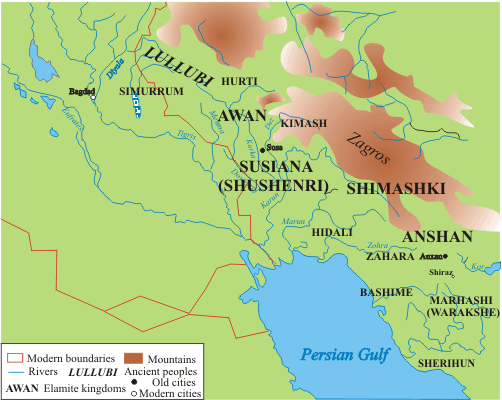
In geographical terms, Susiana basically represents the Iranian province of Khuzestan around the river Karun. In ancient times, several names were used to describe this area. The ancient geographer Ptolemy was the earliest to call the area Susiana, referring to the country around Susa.
Another ancient geographer, Strabo, viewed Elam and Susiana as two different geographic regions. He referred to Elam ("land of the Elymaei") as primarily the highland area of Khuzestan.
Disagreements over the location also exist in the Jewish historical sources says Daniel T. Potts. Some ancient sources draw a distinction between Elam as the highland area of Khuzestan, and Susiana as the lowland area. Yet in other ancient sources 'Elam' and 'Susiana' seem equivalent.
The uncertainty in this area extends also to modern scholarship. Since the discovery of ancient Anshan, and the realization of its great importance in Elamite history, the definitions were changed again. Some modern scholars argued that the center of Elam lay at Anshan and in the highlands around it, and not at Susa in lowland Khuzistan.
Potts disagrees suggesting that the term 'Elam' was primarily constructed by the Mesopotamians to describe the area in general terms, without referring specifically either to the lowlanders or the highlanders,
Elam is not an Iranian term and has no relationship to the conception which the peoples of highland Iran had of themselves. They were Anshanites, Marhashians, Shimashkians, Zabshalians, Sherihumians, Awanites, etc. That Anshan played a leading role in the political affairs of the various highland groups inhabiting southwestern Iran is clear. But to argue that Anshan is coterminous with Elam is to misunderstand the artificiality and indeed the alienness of Elam as a construct imposed from without on the peoples of the southwestern highlands of the Zagros mountain range, the coast of Fars and the alluvial plain drained by the Karun-Karkheh river system.
03History

Prehistorically the area was well settled during the Ubaid period and shared many aspects of Ubaid cultures.
Knowledge of Elamite history remains largely fragmentary, reconstruction being based on mainly Mesopotamian (Sumerian, Akkadian, Assyrian, and Babylonian) sources. The history of Elam is conventionally divided into three periods, spanning more than two millennia. The period before the first Elamite period is known as the proto-Elamite period:
Proto-Elamite period: c. 3200 – c. 2700 BC (Proto-Elamite script in Susa)
Old Elamite period: c. 2700 – c. 1500 BC (earliest documents until the Sukkalmah Dynasty)
Middle Elamite period: c. 1500 – c. 1100 BC (Anzanite dynasty until the Babylonian invasion of Susa)
Neo-Elamite period: c. 1100 – 540 BC (characterized by Assyrian and Median influence. 539 BC marks the beginning of the Achaemenid period.)
Proto-Elamite civilization grew up east of the Tigris and Euphrates alluvial plains; it was a combination of the lowlands and the immediate highland areas to the north and east. At least three proto-Elamite states merged to form Elam: Anshan, Awan, and Shimashki. References to Awan are generally older than those to Anshan, and some scholars suggest that both states encompassed the same territory, in different eras (see Hanson, Encyclopædia Iranica). To this core Shushiana was periodically annexed and broken off. In addition, some Proto-Elamite sites are found well outside this area, spread out on the Iranian plateau; such as Warakshe, Sialk (now a suburb of the modern city of Kashan) and Jiroft in Kerman Province. The state of Elam was formed from these lesser states as a response to invasion from Sumer during the Old Elamite period. Elamite strength was based on an ability to hold these various areas together under a coordinated government that permitted the maximum interchange of the natural resources unique to each region. Traditionally, this was done through a federated governmental structure.
The Proto-Elamite city of Susa was founded around 4000 BC in the watershed of the river Karun. It is considered to be the site of Proto-Elamite cultural formation. During its early history, it fluctuated between submission to Mesopotamian and Elamite power. The earliest levels (22–17 in the excavations conducted by Le Brun, 1978) exhibit pottery that has no equivalent in Mesopotamia, but for the succeeding period, the excavated material allows identification with the culture of Sumer of the Uruk period. Proto-Elamite influence from Mesopotamia in Susa becomes visible from about 3200 BC, and texts in the still undeciphered Proto-Elamite writing system continue to be present until about 2700 BC. The Proto-Elamite period ends with the establishment of the Awan dynasty. The earliest known historical figure connected with Elam is the king Enmebaragesi of Kish (c. 2650 BC?), who subdued it, according to the Sumerian king list. Elamite history can only be traced from records dating to beginning of the Akkadian Empire (2335–2154 BC) onwards.
The Proto-Elamite states in Jiroft and Zabol (not universally accepted), present a special case because of their great antiquity.
In ancient Luristan, bronze-making tradition goes back to the mid-3rd millennium BC, and has many Elamite connections. Bronze objects from several cemeteries in the region date to the Early Dynastic Period (Mesopotamia) I, and to Ur-III period c. 2900–2000 BC. These excavations include Kalleh Nisar, Bani Surmah, Chigha Sabz, Kamtarlan, Sardant, and Gulal-i Galbi.
The Old Elamite period began around 2700 BC. Historical records mention the conquest of Elam by Enmebaragesi, the Sumerian king of Kish in Mesopotamia. Three dynasties ruled during this period. Twelve kings of each of the first two dynasties, those of Awan (or Avan; c. 2400 – c. 2100 BC) and Simashki (c. 2100 – c. 1970 BC), are known from a list from Susa dating to the Old Babylonian period. Two Elamite dynasties said to have exercised brief control over parts of Sumer in very early times include Awan and Hamazi; and likewise, several of the stronger Sumerian rulers, such as Eannatum of Lagash and Lugal-anne-mundu of Adab, are recorded as temporarily dominating Elam.
The Awan dynasty (2350–2150 BC) was partly contemporary with that of the Mesopotamian emperor Sargon of Akkad, who not only defeated the Awan king Luh-ishan and subjected Susa, but attempted to make the East Semitic Akkadian the official language there. From this time, Mesopotamian sources concerning Elam become more frequent, since the Mesopotamians had developed an interest in resources (such as wood, stone, and metal) from the Iranian plateau, and military expeditions to the area became more common. With the collapse of Akkad under Sargon's great-great-grandson, Shar-kali-sharri, Elam declared independence under the last Awan king, Kutik-Inshushinak (c. 2240 – c. 2220 BC), and threw off the Akkadian language, promoting in its place the brief Linear Elamite script. Kutik-Inshushinnak conquered Susa and Anshan, and seems to have achieved some sort of political unity. Following his reign, the Awan dynasty collapsed as Elam was temporarily overrun by the Guti, another pre-Iranic people from what is now north west Iran who also spoke a language isolate.
About a century later, the Sumerian king Shulgi of the Neo-Sumerian Empire retook the city of Susa and the surrounding region. During the first part of the rule of the Simashki dynasty, Elam was under intermittent attack from the Sumerians of Mesopotamia and also Gutians from northwestern Iran, alternating with periods of peace and diplomatic approaches. The Elamite state of Simashki at this time also extended into northern Iran, and possibly even as far as the Caspian Sea. Shu-Sin of Ur gave one of his daughters in marriage to a prince of Anshan. But the power of the Sumerians was waning; Ibbi-Sin in the 21st century did not manage to penetrate far into Elam, and in 2004 BC, the Elamites, allied with the people of Susa and led by king Kindattu, the sixth king of Simashki, managed to sack Ur and lead Ibbi-Sin into captivity, ending the third dynasty of Ur. The Akkadian kings of Isin, successor state to Ur, managed to drive the Elamites out of Ur, rebuild the city, and to return the statue of Nanna that the Elamites had plundered.
The succeeding dynasty, often called the Sukkalmah dynasty (c. 1970 – c. 1770 BC) after "Great regents", the title borne by its members, also called the Epartid dynasty after the name of its founder Ebarat/ Eparti, was roughly contemporary with the Old Assyrian Empire, and Old Babylonian period in Mesopotamia, being younger by approximately sixty years than the Akkadian-speaking Old Assyrian Empire in Upper Mesopotamia, and almost seventy-five years older than the Old Babylonian Empire. This period is said by many to be confusing and difficult to reconstruct. It was apparently founded by Eparti I. During this time, Susa was under Elamite control, but Akkadian-speaking Mesopotamian states such as Larsa and Isin continually tried to retake the city. Around 1850 BC Kudur-Mabuk, apparently king of another Akkadian state to the north of Larsa, managed to install his son, Warad-Sin, on the throne of Larsa, and Warad-Sin's brother, Rim-Sin, succeeded him and conquered much of southern Mesopotamia for Larsa.
Notable Eparti dynasty rulers in Elam during this time include Shirukduh (c. 1850 BC), who entered various military coalitions to contain the power of the south Mesopotamian states. Siruk-tuh was the king of Elam when Hammurabi first ruled, he and later kings of the Elamite dynasty were referred to as "great king" and "father" by kings in Syria and Mesopotamia and were the only kings that the Mesopotamian Kings considered to be higher in status than themselves. Siwe-Palar-Khuppak, who for some time was the most powerful person in the area, respectfully addressed as "Father" by Mesopotamian kings such as Zimrilim of Mari, Shamshi-Adad I of the Kingdom of Upper Mesopotamia, and even Hammurabi of Babylon. During his reign alone, Elam interfered extensively with Mesopotamian politics, allowing messengers and envoys to travel far west to Emar and Qatna in Syria. His messenger reached Emar and sent his three servants to King Amut-piʾel II of Qatna (1772–1762 BC), and the king of Qatna also sent two messengers to Elam. The Elamite rulers had become increasingly involved in Mesopotamian politics during the Sukkalmah dynasty. In fact, Rim-Sin of Larsa himself was of Elamite descent, notwithstanding his Akkadian name. Kudur-Nahhunte, who plundered the temples of southern Mesopotamia, the north being under the control of the Old Assyrian Empire. But Elamite influence in southern Mesopotamia did not last. Around 1760 BC, Hammurabi drove out the Elamites, overthrew Rim-Sin of Larsa, and established a short lived Babylonian Empire in Mesopotamia. Little is known about the latter part of this dynasty, since sources again become sparse with the Kassite rule of Babylon (from c. 1595 BC).
Many archaeological finds suggest that maritime trade along the shores of Africa and Asia started several millennia ago. Trade between the Indus Valley Civilization and the cities of Mesopotamia and Elam can be inferred from numerous find of Indus artifacts, particularly in the excavation at Susa. Various objects made with shell species that are characteristic of the Indus coast, particularly Trubinella pyrum and Fasciolaria trapezium, have been found in the archaeological sites of Mesopotamia and Susa dating from around 2500–2000 BC. Carnelian beads from the Indus were found in Susa in the excavation of the tell of the citadel. In particular, carnelian beads with an etched design in white were probably imported from the Indus Valley, and made according to a technique of acid-etching developed by the Harappans.
Exchanges seem to have waned after 1900 BC, together with the disappearance of the Indus valley Civilization.
The Middle Elamite period began with the rise of the Anshanite dynasties around 1500 BC. Their rule was characterized by an "Elamisation" of Susa, and the kings took the title "king of Anshan and Susa". While the first of these dynasties, the Kidinuids continued to use the Akkadian language frequently in their inscriptions, the succeeding Igihalkids and Shutrukids used Elamite with increasing regularity. Likewise, Elamite language and culture grew in importance in Susiana. The Kidinuids (c. 1500 – 1400 BC) are a group of five rulers of uncertain affiliation. They are identified by their use of the older title, "king of Susa and of Anshan", and by calling themselves "servant of Kirwashir", an Elamite deity, thereby introducing the pantheon of the highlands to Susiana. The city of Susa itself is one of the oldest in the world dating back to around 4200 BC. Since its founding Susa was known as a central power location for the Elamites and for later Persian dynasties. Susa's power would peak during the Middle Elamite period, when it would be the region's capital.
Of the Igehalkids (c. 1400 – 1210 BC), ten rulers are known, though their number was possibly larger. Some of them married Kassite princesses. The Kassites were also a language isolate speaking people from the Zagros Mountains who had taken Babylonia shortly after its sacking by the Hittite Empire in 1595 BC. The Kassite king of Babylon Kurigalzu II who had been installed on the throne by Ashur-uballit I of the Middle Assyrian Empire (1366–1020 BC), temporarily occupied Elam around 1320 BC, and later (c. 1230 BC) another Kassite king, Kashtiliash IV, fought Elam unsuccessfully. Kassite-Babylonian power waned, as they became dominated by the northern Mesopotamian Middle Assyrian Empire. Kiddin-Khutran of Elam repulsed the Kassites by defeating Enlil-nadin-shumi in 1224 BC and Adad-shuma-iddina around 1222–1217 BC.
04Art
Dated to approximately the 12th century BC, gold and silver figurines of Elamite worshippers are shown carrying a sacrificial goat. These divine and royal statues were meant to assure the king of the enduring protection of the deity, well-being and a long life. Works which showed a ruler and his performance of a ritual action were intended to eternalize the effectiveness of such deeds. Found near the Temple of Inshushinak in Susa, these statuettes would have been considered charged with beneficial power.
While archaeologists cannot be certain that the location where these figures were found indicates a date before or in the time of the Elamite king Shilhak-Inshushinak, stylistic features can help ground the figures in a specific time period. The hairstyle and costume of the figures which are strewn with dots and hemmed with short fringe at the bottom, and the precious metals point to a date in the latter part of the second millennium BC rather than to the first millennium.
In general, any gold or silver statuettes which represent the king making a sacrifice not only served a religious function, but was also a display of wealth.
Elamite seals reached their peak of complexity in the 4th millennium BC when their shape became cylindrical rather than stamp-like. Seals were primarily used as a form of identification and were often made out of precious stones. Because seals for different time periods had different designs and themes, seals and seal impressions can be used to track the various phases of the Elamite Empire and can teach a lot about the empire in ways which other forms of documentation cannot.
The seal pictured shows two seated figures holding cups with a man in front of them wearing a long robe next to a table. A man is sitting on a throne, presumably the king, and is in a wrapped robe. The second figure, perhaps his queen, is draped in a wide, flounced garment and is elevated on a platform beneath an overhanging vine. A crescent is shown in the field.
This life-size votive offering of Queen Napir-Asu was commissioned around 1300 BC in Susa, Iran. It is made of copper using the lost-wax casting method and rests on a solid bronze frame that weighs 1750 kg (3760 lb). This statue is different from many other Elamite statues of women because it resembles male statues due to the wide belt on the dress and the patterns which closely resemble those on male statues.
The inscription on the side of the statue curses anyone, specifically men, who attempts to destroy the statue: "I, Napir-Asu, wife of Untash-Napirisha. He who would seize my statue, who would smash it, who would destroy its inscription, who would erase my name, may he be smitten by the curse of Napirisha, of Kiririsha, and of Inshushinka, that his name shall become extinct, that his offspring be barren, that the forces of Beltiya, the great goddess, shall sweep down on him. This is Napir-Asu's offering."
The stele of the Elamite king, Untash-Napirisha was believed to have been commissioned in the 12th century BC. It was moved from the original religious capital of Chogha Zanbil to the city of Susa by the successor king, Shutruk-Nahnante. Four registers of the stele are left. The remains depict the god Inshushinak validating the legitimacy of who is thought to be Shutruk-Nahnante. In the periphery are two priestesses, deity hybrids of fish and women holding streams of water, and two half-man half-mouflon guardians of the sacred tree. The names of the two priestesses are carved on their arms.
King Untash Napirisha dedicated the stele to the god Ishushinak. Like other forms of art in the ancient Near East, this one portrays a king ceremonially recognizing a deity. This stele is unique in that the acknowledgement between king and god is reciprocal.
05Religion

The Elamites practised polytheism. Due to scarcity of sources, past scholars assumed that Elamite religion must have been characterized by the "ill-defined character of the individual gods and goddesses. ...Most of them were not only ineffable beings whose real name was either not uttered or was unknown, but also sublime ideas, not to be exactly defined by the human race." Worship also varied between localities. However, more recent scholarship shows that Elamite deities most likely were not any less defined than those of their Sumerian, Akkadian and Hurrian neighbors.
Inscriptions of many Elamite kings indicate that a concept of a supreme triad consisting of Inshushinak (originally the civic protector god of Susa, eventually the leader of the triad and guarantor of the monarchy), Kiririsha (an earth/mother goddess in southern Elam), and Napirisha existed. In the Neo-Elamite period Humban, previously a deity of limited relevance in known sources, emerged as a divine source of royal power.
Another significant deity was Pinikir, an astral goddess of love, similar to Ishtar. Some researchers, especially in the 1960s and 1970s, saw her as a mother goddess, and possibly originally chief deity, in northern Elam, later supplanted by or identified with Kiririsha, but scholars no longer support this view.
There were also imported deities, such as Beltiya, Nergal or Nanaya; some native Elamite deities had Akkadian or Sumerian names as well (ex. Manzat, Inshushinak and his attendants), indicating a long history of interchange. Some Elamite deities were also venerated outside Elam: Pinikir was known to the Hurrians and Hittites, Simut appeared in Babylonian personal names, and an Assyrian text mentions Khumban, Napirisha and Yabru (Jabru) as protectors of the king.
06Language
Elamite is traditionally thought to be a language isolate, and completely unrelated to the neighbouring Semitic languages, Sumerian and Kassite (also isolates), Hurrian, and the later arriving Indo-European Iranian languages that came to dominate the region of Elam from the 6th century BC. It was written in a cuneiform adapted from the Semitic Akkadian script of Assyria and Babylonia, although the very earliest documents were written in the quite different "Linear Elamite" script. In 2006, two even older inscriptions in a similar script were discovered at Jiroft to the east of Elam, leading archaeologists to speculate that Linear Elamite had originally spread from further east to Susa. It seems to have developed from an even earlier writing known as "proto-Elamite", but scholars are not unanimous on whether or not this script was used to write Elamite or another language, as it has not yet been deciphered. Several stages of the language are attested; the earliest date back to the third millennium BC, the latest to the Achaemenid Empire.
The Elamite language may have survived as late as the early Islamic period (roughly contemporary with the early medieval period in Europe). Among other Islamic medieval historians, Ibn al-Nadim, for instance, wrote that "The Iranian languages are Fahlavi (Pahlavi), Dari (not to be confused with Dari Persian in modern Afghanistan), Khuzi, Persian and Suryani (Assyrian)", and Ibn Moqaffa noted that Khuzi was the unofficial language of the royalty of Persia, "Khuz" being the corrupted name for Elam.
While Elamite is viewed as a language isolate by the vast majority of linguists, a minority of scholars have proposed that the Elamite language could be related to the Dravidian languages. David McAlpin believed Elamite may be related to the living Dravidian languages. This hypothesis (which has been subject to serious criticism by linguists) is considered under the rubric of Elamo-Dravidian languages.
Article sections from Wikipedia (CC BY-SA 4.0). Excerpted for readability.