Haiti, officially the Republic of Haiti, is a country in the Caribbean on the island of Hispaniola in the Caribbean Sea, east of Cuba and Jamaica and south of The Bahamas. It occupies the western side of the island, which it shares with the Dominican Republic. Haiti is the third largest country in the Caribbean by area, and with an estimated population of 11.4 million, it is the most populous Caribbean country. The capital and largest city is Port-au-Prince.
Haiti was originally inhabited by Indigenous peoples, known as the Taíno. In 1492, Christopher Columbus established the first European settlement in the Americas, La Navidad, on its northeastern coast. The island was part of the Spanish Empire until 1697, when the western portion was ceded to France and became Saint-Domingue, dominated by sugarcane plantations worked by enslaved Africans. The 1791–1804 Haitian Revolution made Haiti the first sovereign state in the Caribbean, the second republic in the Americas, the first country in the Americas to officially abolish slavery, and the only country in history established by a slave revolt. The independent state began as an empire, later splitting into two nations before reunifying in 1820; a second empire was established under Faustin Soulouque before the return of the republic in 1859. The 19th century also saw political instability, international isolation, a crippling debt to France, and failed invasions of the Dominican Republic, including a costly war. U.S. forces occupied Haiti from 1915 to 1934, followed by the dictatorial rule of the Duvalier family (1957–1986). Following a coup d'état in 1991, a U.S.-led multinational force intervened in 1994; a second coup in 2004 was followed by a United Nations intervention. In the 2010s, a catastrophic earthquake and a large-scale cholera outbreak devastated the country.
Historically poor and politically unstable, Haiti has faced severe economic and political crises, gang activity displacing over 1.3 million, and the collapse of its government. The presidency has been vacant since the assassination of Jovenel Moïse in July 2021, while the National Assembly and the judiciary have been rendered inoperative, leaving the country in virtual anarchy with almost nonexistent state control. One of the world's least developed countries and with no elected officials remaining, Haiti has been described as a failed state.
Haiti is a founding member of the United Nations, Organization of American States, Association of Caribbean States, and the Organisation internationale de la Francophonie. In addition to CARICOM, it is a member of the International Monetary Fund, World Trade Organization, and Community of Latin American and Caribbean States.
Summary from Wikipedia (CC BY-SA 4.0)
01Etymology
Haiti (also earlier Hayti) comes from the Indigenous Taíno language and means "land of high mountains"; it was the Native name for the entire island of Hispaniola. The name was restored by Haitian revolutionary Jean-Jacques Dessalines as the official name of independent Saint-Domingue, as a tribute to the Amerindian predecessors. Another theory on the name Haiti is its origin in African tradition; in Fon language, one of the most spoken by the bossales (Haitians born in Africa), Ayiti-Tomè means: "From nowadays this land is our land."
In French, the ï in Haïti has a diacritical mark, a diaeresis (used to show that the second vowel is pronounced separately, as in the word naïve), while the H is silent. (In English, this rule for the pronunciation is often disregarded, thus the spelling Haiti is used.) There are different anglicizations for its pronunciation such as HIGH-ti, high-EE-ti and haa-EE-ti, which are still in use, but HAY-ti is the most widespread and best-established. In French, Haiti's nickname is La Perle des Antilles ("Pearl of the Antilles") because of both its natural beauty and the amount of wealth it accumulated for the Kingdom of France. In Haitian Creole, it is spelled and pronounced with a y but no H: Ayiti. In the Haitian community the country has multiple nicknames: Ayiti-Toma (as its origin in Ayiti Tomè), Ayiti-Cheri (Ayiti my Darling), Tè-Desalin (Dessalines' Land) or Lakay (Home).
02History

The island of Hispaniola, of which Haiti occupies the western three-eighths, has been inhabited since about 6,000 years ago by Indigenous peoples who are thought to have arrived from Central or northern South America. These Archaic Age people are thought to have been largely hunter-gatherers. During the 1st millennium BC, the Arawakan-speaking ancestors of the Taino people began to migrate into the Caribbean. Unlike the Archaic peoples, they practiced the intensive production of pottery and agriculture. The earliest evidence of the ancestors of the Taino people on Hispaniola is the Ostionoid culture, which dates to around 600 AD.
In Taíno society the largest unit of political organization was led by a cacique, or chief, as the Europeans understood them. At the time of European contact, Hispaniola was divided among five 'caciquedoms': the Magua in the northeast, the Marien in the northwest, the Jaragua in the southwest, the Maguana in the central regions of Cibao, and the Higüey in the southeast.
Taíno cultural artifacts include cave paintings in several locations in the country. These have become national symbols of Haiti and tourist attractions. Modern-day Léogâne, started as a French colonial town in the southwest, is beside the former capital of the caciquedom of Xaraguá.
According to the Puerto Rican historian Cayetano Coll y Toste, the German explorer Carl Friedrich Philipp von Martius was the first person to describe the Indigenous peoples of Haiti as "Taini" (Taino). The archaeologist L. Antonio Curet has written that Martius described these peoples as "Taini...perhaps by mistaking the qualifier for an ethnonym".
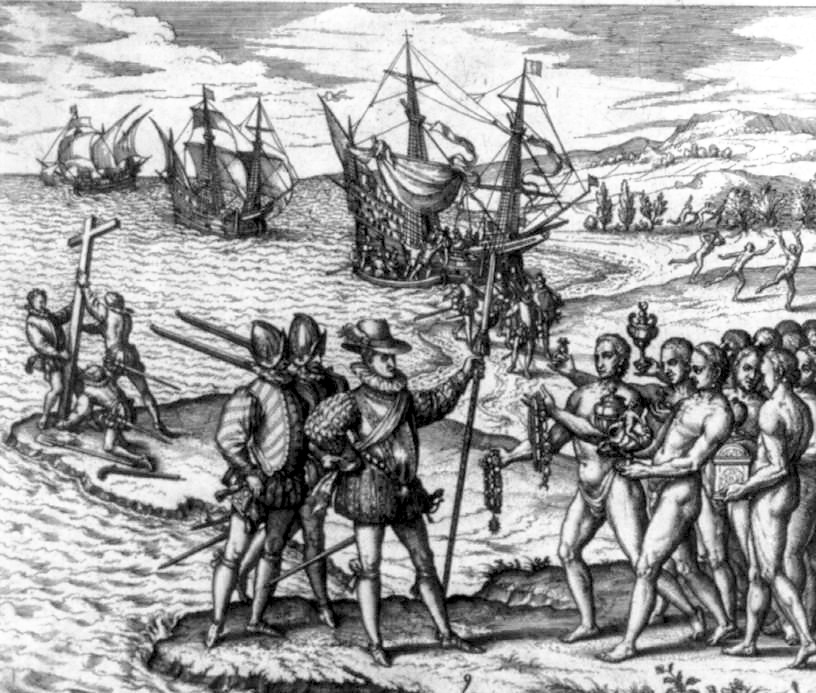
Navigator Christopher Columbus landed in Haiti on 6 December 1492, in an area that he named Môle-Saint-Nicolas, and claimed the island for the Crown of Castile. On 25 December his ship the Santa María ran aground near the present site of Cap-Haïtien. Columbus left 39 men on the island, who founded the settlement of La Navidad. Relations with the native peoples were initially good; however the settlers were later killed by the Taíno.
The sailors carried endemic Eurasian infectious diseases, causing epidemics that killed a large number of native people. The first recorded smallpox epidemic in the Americas erupted on Hispaniola in 1507. Their numbers were further reduced by the harshness of the encomienda system, in which the Spanish forced natives to work in gold mines and plantations. The Spanish passed the Laws of Burgos (1512–1513) which forbade the maltreatment of natives, endorsed their conversion to Catholicism, and gave legal framework to encomiendas. The natives were brought to these sites to work in specific plantations or industries.
As the Spanish re-focused their colonization efforts on the greater riches of mainland Central and South America, Hispaniola became reduced largely to a trading and refueling post. As a result piracy became widespread, encouraged by European powers hostile to Spain such as France (based on Île de la Tortue) and England. The Spanish largely abandoned the western third of the island, focusing their colonization effort on the eastern two-thirds. The western part of the island was thus gradually settled by French buccaneers; among them was Bertrand d'Ogeron, who succeeded in growing tobacco and recruited many French colonial families from Martinique and Guadeloupe. In 1697 France and Spain settled their hostilities on the island by way of the Treaty of Ryswick of 1697, which divided Hispaniola between them.
France received the western third and subsequently named it Saint-Domingue, the French equivalent of Santo Domingo, the Spanish colony on Hispaniola. The French set about creating sugar and coffee plantations, worked by vast numbers of those enslaved imported from Africa, and Saint-Domingue grew to become their richest colonial possession, generating 40% of France’s foreign trade and doubling the wealth generation of all of England’s colonies, combined.
The French settlers were outnumbered by enslaved persons by almost 10 to 1. According to the 1788 census, Haiti's population consisted of nearly 25,000 Europeans, 22,000 free coloreds and 700,000 Africans in slavery. In the north of the island, those enslaved were able to retain many ties to African cultures, religion and language; these ties were continually being renewed by newly imported Africans. Some West Africans in slavery held on to their traditional Vodou beliefs by secretly syncretizing it with Catholicism.
The French enacted the Code Noir ("Black Code"), prepared by Jean-Baptiste Colbert and ratified by Louis XIV, which established rules on slave treatment and permissible freedoms. Saint-Domingue has been described as one of the most brutally efficient slave colonies; at the end of the 18th century it was supplying two-thirds of Europe's tropical produce while one-third of newly imported Africans died within a few years. Many enslaved persons died from diseases such as smallpox and typhoid fever. They had low birth rates, and there is evidence that some women aborted fetuses rather than give birth to children within the bonds of slavery. The colony's environment also suffered, as forests were cleared to make way for plantations and the land was overworked so as to extract maximum profit for French plantation owners.
As in its Louisiana colony, the French colonial government allowed some rights to free people of color (gens de couleur), the mixed-race descendants of European male colonists and African enslaved females (and later, mixed-race women). Over time, many were released from slavery, and they established a separate social class. White French Creole fathers frequently sent their mixed-race sons to France for their education. Some men of color were admitted into the military. More of the free people of color lived in the south of the island, near Port-au-Prince, and many intermarried within their community. They frequently worked as artisans and tradesmen and began to own some property, including enslaved persons of their own. The free people of color petitioned the colonial government to expand their rights.
The brutality of slave life led many people in bondage to escape to mountainous regions, where they set up their own autonomous communities and became known as maroons. One maroon leader, François Mackandal, led a rebellion in the 1750s; however, he was later captured and executed by the French.
Inspired by the French Revolution of 1789 and principles of the rights of man, the French settlers and free people of color pressed for greater political freedom and more civil rights. Tensions between these two groups led to conflict, and a militia of free-coloreds was set up in 1790 by Vincent Ogé, resulting in his capture, torture and execution. Sensing an opportunity, in August 1791 the first slave armies were established in northern Haiti under the leadership of Toussaint Louverture inspired by the Vodou houngan (priest) Boukman, and backed by the Spanish in Santo Domingo – soon a full-blown slave rebellion had broken out across the entire colony.
In 1792 , the French First Republic sent three commissioners with troops to re-establish control. To build an alliance with the gens de couleur and enslaved persons, commissioners Léger-Félicité Sonthonax and Étienne Polverel abolished slavery in the colony. Six months later, the National Convention endorsed abolition and extended it to all the French colonies.
The United States oscillated between supporting or not supporting Louverture and the emerging country of Haiti, depending on who was President of the US. George Washington, who was a slave holder and isolationist, kept the United States neutral, although private US citizens at times provided aid to French planters trying to put down the revolt. John Adams, a vocal opponent of both slavery and Revolutionary France, fully supported the slave revolt by providing diplomatic recognition, financial support, munitions and warships (including the USS Constitution) beginning in 1798. This support ended in 1801 when Thomas Jefferson, another slave-holding president, took office and recalled the US Navy.
With slavery abolished, Louverture pledged allegiance to France, and he fought off the British and Spanish forces who had taken advantage of the situation and had invaded Saint-Domingue. The Spanish were later forced to cede their part of the island to France under the terms of the Peace of Basel in 1795, uniting the island under one government. However, an insurgency against French rule broke out in the east, and in the west there was fighting between Louverture's forces and the free people of color led by André Rigaud in the War of the Knives (1799–1800). The United States' support for the blacks in the war contributed to their victory over the mulattoes. More than 25,000 whites and free blacks left the island as refugees.
After Louverture created a separatist constitution and proclaimed himself governor-general for life, Napoléon Bonaparte in 1802 sent an expedition of 20,000 soldiers and as many sailors under the command of his brother-in-law Charles Leclerc to reassert French control. The French achieved some victories, but within a few months most of their army had died from yellow fever. Ultimately more than 50,000 French troops died in an attempt to retake the colony, including 18 generals. The French managed to capture Louverture, transporting him to France for trial. He was imprisoned at Fort de Joux, where he died in 1803 of exposure and possibly tuberculosis.
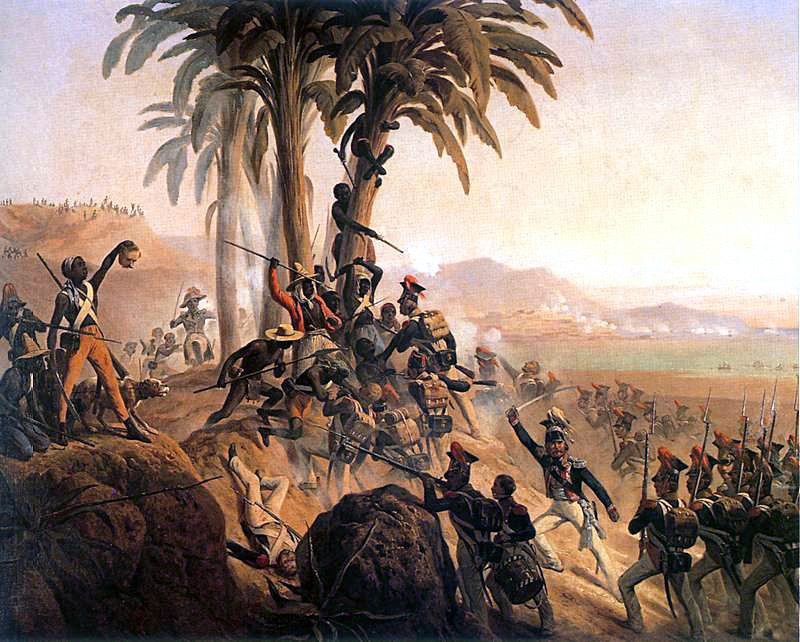
The enslaved persons, along with free gens de couleur and allies, continued their fight for independence, led by generals Jean-Jacques Dessalines, Alexandre Pétion and Henry Christophe. The rebels finally managed to decisively defeat the French troops at the Battle of Vertières on 18 November 1803, establishing the only state to successfully gain independence through a slave revolt. Under the overall command of Dessalines, the Haitian armies avoided open battle and instead conducted a successful guerrilla campaign against the Napoleonic forces, working with diseases such as yellow fever to reduce the numbers of French soldiers. Later that year France withdrew its remaining 7,000 troops from the island, and Napoleon gave up his idea of re-establishing a North American empire, selling Louisiana (New France) to the United States in the Louisiana Purchase. On 1 January 1804, the leaders of the Haitian Revolution declared their achieved independence from France.
Throughout the revolution, an estimated 20,000 French troops succumbed to yellow fever, while another 37,000 were killed in action, exceeding the total French soldiers killed in action across various 19th-century colonial campaigns in Algeria, Mexico, Indochina, Tunisia, and West Africa, which resulted in approximately 10,000 French soldiers killed in action combined. The British sustained 45,000 dead. Additionally, 200,000 Haitians died. In the process, Dessalines became arguably the most successful military commander in the struggle against Napoleonic France.
The independence of Saint-Domingue was proclaimed under the native name 'Haiti' by Dessalines on 1 January 1804 in Gonaïves, and he was proclaimed "Emperor for Life" as Emperor Jacques I by his troops. Dessalines at first offered protection to the white planters and others. However, once in power, he ordered the 1804 Haitian massacre of nearly all the remaining whites; between January and April 1804, 3,000 to 5,000 whites were killed, including those who had been friendly and sympathetic to the black population. Only three categories of white people were selected out as exceptions and spared: Polish soldiers, some of whom had deserted from the French army and fought alongside the Haitian rebels; a small group of German colonists invited to the north-west region; and a group of medical doctors and professionals.
03Geography

Haiti forms the western three-eighths of Hispaniola, the second largest island in the Greater Antilles. At 27,750 km2 (10,710 sq mi) Haiti is the third largest country in the Caribbean behind Cuba and the Dominican Republic, the latter sharing a 360-kilometer (224 mi) border with Haiti. The country has a roughly horseshoe shape and because of this it has a disproportionately long coastline, second in length (1,771 km or 1,100 mi) behind Cuba in the Greater Antilles.
Haiti is the most mountainous country in the Caribbean. Its terrain consists of mountains interspersed with small coastal plains and river valleys. Plains are only 22% of its territory. The climate is tropical, with some variation depending on altitude. The highest point is Pic la Selle, at 2,680 meters (8,793 ft).
The northern region or Marien Region consists of the Massif du Nord (Northern Massif) and the Plaine du Nord (Northern Plain). The Massif du Nord is an extension of the Cordillera Central in the Dominican Republic. It begins at Haiti's eastern border, north of the Guayamouc River, and extends to the northwest through the northern peninsula. The lowlands of the Plaine du Nord lie along the northern border with the Dominican Republic, between the Massif du Nord and the North Atlantic Ocean.
The central region or Artibonite Region consists of two plains and two sets of mountain ranges. The Plateau Central (Central Plateau) extends along both sides of the Guayamouc River, south of the Massif du Nord. It runs from the southeast to the northwest. To the southwest of the Plateau Central are the Montagnes Noires, whose most northwestern part merges with the Massif du Nord. The most important valley in terms of crops is the Plaine de l'Artibonite, which lies between the Montagnes Noires and the Chaîne des Matheux. This region contains the country's longest river, the Riviere l'Artibonite, which begins in the western region of the Dominican Republic and continues for most of its length through central Haiti, where it then empties into the Golfe de la Gonâve. Also in this valley lies Haiti's second largest lake, Lac de Péligre, formed as a result of the construction of the Péligre Dam in the mid-1950s.
The southern region or Xaragua Region consists of the Plaine du Cul-de-Sac (the southeast) and the mountainous southern peninsula (the Tiburon Peninsula). The Plaine du Cul-de-Sac is a natural depression that harbors the country's saline lakes, such as Trou Caïman and Haiti's largest lake, Étang Saumatre. The Chaîne de la Selle mountain range – an extension of the southern mountain chain of the Dominican Republic (the Sierra de Baoruco) – extends from the Massif de la Selle in the east to the Massif de la Hotte in the west.
Haiti includes several offshore islands. The island of Tortuga is located off the coast of northern Haiti. The arrondissement of La Gonâve is located on the island of the same name, in the Golfe de la Gonâve; Haiti's largest island, Gonâve is moderately populated by rural villagers. Île à Vache is located off the southwest coast; also part of Haiti are the Cayemites, located in the Gulf of Gonâve north of Pestel. Navassa Island, located 40 nautical miles (46 mi; 74 km) west of Jérémie on the southwest peninsula, is subject to an ongoing territorial dispute with the United States, who currently administer the island.
The climate is tropical with some variation depending on altitude. Port-au-Prince ranges in January from an average minimum of 23 °C (73.4 °F) to an average maximum of 31 °C (87.8 °F); in July, from 25–35 °C (77–95 °F). The rainfall pattern is varied, with rain heavier in some of the lowlands and the northern and eastern slopes of the mountains. The dry season occurs from November to January.
Port-au-Prince receives an average annual rainfall of 1,370 mm (53.9 in). There are two rainy seasons, April–June and October–November. Haiti is subject to periodic droughts and floods, made more severe by deforestation. Hurricanes are a menace, and the country is prone to flooding and earthquakes.
There are blind thrust faults associated with the Enriquillo-Plantain Garden fault system over which Haiti lies. After the earthquake of 2010, there was no evidence of surface rupture, and geologists' findings were based on seismological, geological and ground deformation data. The northern boundary of the fault is where the Caribbean plate shifts eastwards by about 20 mm (0.79 inches) per year in relation to the North American plate. The strike-slip fault system in the region has two branches in Haiti, the Septentrional-Oriente fault in the north and the Enriquillo-Plantain Garden fault in the south.
A 2007 earthquake hazard study notes that the Enriquillo-Plantain Garden fault zone could be at the end of its seismic cycle and concludes that a worst-case forecast would involve a 7.2 Mw earthquake, similar in size to the 1692 Jamaica earthquake. A study team performing a hazard assessment of the fault system recommended "high priority" historical geologic rupture studies, as the fault was fully locked and had recorded few earthquakes in the preceding 40 years. A magnitude 7.0 earthquake happened on this fault zone on 12 January 2010.
Haiti has rare elements such as gold, which can be found at the Mont Organisé gold mine. There are no currently active volcanoes; no volcanic activity has been experienced since the Miocene age.
The soil erosion released from the upper catchments and deforestation have caused periodic and severe flooding, as experienced, for example, on 17 September 2004. Earlier in May that year, floods had killed over 3,000 people on Haiti's southern border with the Dominican Republic.
Haiti's forests covered 60% of the country as recently as 50 years ago, but that has been halved to a current estimate of 30% tree cover. This estimate poses a stark difference from the erroneous figure of 2% which has been oft-cited in discourse concerning the country's environmental condition. Haiti had a 2019 Forest Landscape Integrity Index mean score of 4.01/10, ranking it 137th globally out of 172 countries. Major national parks in Haiti include the La Visite National Park and the Pic Macaya National Park.
Scientists at the Columbia University's Center for International Earth Science Information Network and the United Nations Environment Programme are working on the Haiti Regenerative Initiative, an initiative aiming to reduce poverty and natural disaster vulnerability through ecosystem restoration and sustainable resource management.
Haiti is home to four ecoregions: Hispaniolan moist forests, Hispaniolan dry forests, Hispaniolan pine forests, and Greater Antilles mangroves. Despite its small size, the mountainous terrain and resultant multiple climatic zones have resulted in a wide variety of plant life. About 5,000 species of plants have been identified in Haiti, including over 3,000 woody plants, trees, and shrubs, 600 species of fern, and 160 orchids. Notable tree species include the breadfruit tree, mango tree, acacia, mahogany, coconut palm, royal palm and West Indian cedar.
Most mammal species are not native, having been brought to the island since colonial times. However, there are various native bat species, as well as the endemic Hispaniolan hutia and Hispaniolan solenodon. Whale and dolphin species can be found off the coast. There are over 260 species of birds, 31 endemic to Hispaniola. Notable endemic species include the Hispaniolan trogon, Hispaniolan parakeet, grey-crowned tanager and the Hispaniolan amazon. There are also several raptors, as well as pelicans, ibis, hummingbirds and ducks. Reptiles are common, with species such as the rhinoceros iguana, Haitian boa, American crocodile and gecko.
04Government and politics
The government is a semi-presidential republic, a multiparty system wherein the president of Haiti is head of state and elected directly by popular elections held every five years. A president cannot serve two consecutive terms or more than two terms in total, but can be reelected for a second term after an interval. The prime minister of Haiti acts as head of government and is appointed by the president, chosen from the majority party in the National Assembly. Executive power is exercised by the president and prime minister who together constitute the government. The president is the nominal commander-in-chief of the Armed Forces of Haiti and the National Police.
Legislative power is vested in the two chambers of the National Assembly of Haiti, the Senate and the Chamber of Deputies. Deputies and senators are both directly elected; deputies for a term of four years and senators for six years. There are three senators from each department of Haiti and at least one deputy from each commune, with larger communes having up to three deputies. Elections are meant to be held for the entire chamber every four years, and for one-third of the Senate every two years. The judicial branch includes the Supreme Court of Haiti (also called the Court of Cassation) and the Courts of Appeals, with justices for the former appointed by the president from a list recommended by the Senate, and for the latter recommended by department assemblies.
The current structure of Haiti's political system was set forth in the Constitution of Haiti in 1987 and was amended in 2012. The constitution creates a division of executive, legislative, and judicial powers. Haitian politics have been contentious; since independence, Haiti has suffered 32 coups. A long history of oppression by dictators such as François Duvalier and his son Jean-Claude Duvalier has markedly affected the republic's governance and society, and since then Haiti has been transitioning to a democratic system. Jovenel Moïse, who was elected as president in 2016, was assassinated in 2021 amidst an ongoing gang conflict, worsening a political crisis. With the presidency vacant, and the National Assembly and judiciary no longer functioning, there have been no elected officials in Haiti since 2023, and the political architecture set by the constitution exists only on paper.
The Transitional Presidential Council with nine members was created when acting prime minister Ariel Henry was forced to resign on 24 April 2024. The council intended to hold a two-round election in November 2025 and January 2026, to inaugurate a new government in February 2026, but it has been undermined by corruption scandals and infighting. The Haitian government and the Kenyan-led Multinational Security Support Mission, have not been able to restore public safety in the country. The planned election was further delayed until the second half of 2026 due to violence, and the expiration of the Council's mandate on 7 February 2026 left acting prime minister Alix Didier Fils-Aimé as the sole executive until the election, with the support of several major political parties.
Haiti is a member of a wide range of international and regional organizations, such as the United Nations, CARICOM, Community of Latin American and Caribbean States, International Monetary Fund, Organisation of American States, Organisation internationale de la Francophonie, OPANAL and the World Trade Organization.
Haiti is divided into ten departments, which are the largest territorial units. The departments are further divided into 42 arrondissements, 145 communes and 571 communal sections. Departments and communes have autonomy from the central government in their administration and finances. Communal sections, communes, and departments are led by a three-member council which is elected either by universal suffrage (in communal sections) or by an assembly in communes and departments. An assembly consists of representatives from each of the previous level of territorial units.
The Armed Forces of Haiti (FAd'H) and the Haitian National Police (PNH) together officially make up the Public Force of Haiti, whose personnel take an oath to the constitution and the flag of the country. The Armed Forces consist of the land, sea, and air forces, along with technical support. They are led by an active-duty general officer who is appointed as the commander-in-chief of the Armed Forces of Haiti. The Ministry of Defense is the main oversight body of the armed forces while the police are part of the Ministry of Justice and Public Security. The constitutional duties of the FA'dH include defending the country's borders, responding to natural disasters, and providing assistance to the police. The 1987 constitution provides the basis for conscription, though it has never been used. The Armed Forces were disbanded in 1995 and security became solely the responsibility of the civilian National Police until 2017. As of 2023 the Armed Forces had a strength of 2,000 service members, who were trained in nearby countries. The military has had a small role during the gang war, which includes protecting government officials.
The National Police was established in 1995 to replace the military's former role in law enforcement, initially recruited from among former military personnel and Haitian migrants to the United States. In 1999 it had 6,000 members; in 2010, it numbered 7,000; and in 2016 it had 9,000. It is led by a director-general appointed by the president. The PNH consists of the Administrative Police for day-to-day police work, the Judicial Police for investigations, and some specialized units that include presidential security, riot control, a SWAT team, and the Haitian Coast Guard. Under-equipped and understaffed, it has been unable maintain security in the entire Haitian territory, despite some improvements to its capability by 2012. Since the start of the gang war in 2020 the PNH has seen increasingly high levels of desertion and casualties.
The legal system is based on a modified version of the Napoleonic Code. Haiti has consistently ranked among the most corrupt countries in the world on the Corruption Perceptions Index. According to a 2006 report by the Corruption Perceptions Index, there is a strong correlation between corruption and poverty in Haiti. The republic ranked first of all countries surveyed for levels of perceived domestic corruption. It is estimated that President "Baby Doc" Duvalier, his wife Michele, and their agents stole US$504 million from the treasury between 1971 and 1986. Some media outlets alleged that millions were stolen by President Aristide. The BBC described pyramid schemes in which Haitians lost hundreds of millions in 2002, as the "only real economic initiative" of the Aristide years.
After the fall of the military government in the early 1990s, the presence of a large quantity of firearms and paramilitary groups (consisting of former soldiers, gangsters, and other criminal elements) gave Haiti one of the highest crime rates in the world as of 2005. According to the 2023 United Nations Office on Drugs and Crime report, due to escalating gang violence and the near-collapse of state institutions, the security situation has deteriorated sharply. The official homicide rate for Haiti more than doubled in 2023 to approximately 40.9 per 100,000 (with 4,789 homicides reported by the UN). According to the UN, Haiti faces a worsening crisis marked by extreme violence, political instability, and a deepening humanitarian emergency. UN Special Representative Virginia Gamba condemned the use of children by armed gangs, highlighting sexual violence as a weapon of war. The removal of Prime Minister Garry Conille has further destabilized governance. Armed groups have targeted schools and hospitals, displacing thousands and leaving 300,000 children without education. The UN calls for urgent humanitarian aid, enhanced security efforts, and political unity to address the crisis, as over 2.7 million people live under gang control.
Port-au-Prince penitentiary is home to half of Haiti's prisoners. The prison has a capacity of 1,200 detainees, but as of November 2017 the penitentiary was obliged to keep 4,359 detainees, a 363% occupancy level. The inability to receive sufficient funds has caused deadly cases of malnutrition, combined with the tight living conditions, increases the risk of infectious diseases such as tuberculosis. Haitian law states that once arrested, one must go before a judge within 48 hours; however, this is very rare. Unless families are able to provide the necessary funds for inmates to appear before a judge, there is a very slim chance the inmate would have a trial, on average, within 10 years. In confined living spaces for 22–23 hours a day, inmates are not provided with latrines and are forced to defecate into plastic bags. These conditions were considered inhumane by the Inter-American Court of Human Rights in 2008. On 3 March 2024, armed gangs stormed the main prison in Port-au-Prince, and about 3,700 inmates escaped, while 12 people were killed.
05Economy
The economy of Haiti declined dramatically after the 2010 earthquake and subsequent outbreak of cholera, with the country's nominal GDP falling by 8% (from US$12.15 billion to US$11.18 billion). Since then it has grown to US$33.55 billion in nominal GDP as of 2025, and during the same time period it grew from $26.88 billion to $38.2 billion in PPP-adjusted GDP. Despite its tourism industry, Haiti is one of the poorest countries in the Americas, with corruption, political instability, poor infrastructure, lack of health care and lack of education cited as the main causes. Haiti ranked 145th of 182 countries in the 2010 United Nations Human Development Index, with 57.3% of the population being deprived in at least three of the HDI's poverty measures. As of 2021, about 30% of the population lived in extreme poverty (making less than US$2.15 a day), and 87.6% made less than US$6.85. There is a division between the formal economy, which is controlled by an upper class and is concentrated in certain areas, and an informal economy that represents 90% of employment.
Haiti became a member of the World Trade Organization in 1996. It liberalized its economy in the 1980s, removing tariff and non-tariff barriers, which had an impact on domestic businesses, especially in the agricultural sector. The existence of monopolies and oligopolies in many economic markets distorts the price setting mechanism, and is why the cost of goods and services in Haiti is the highest in the region. Following the disputed 2000 election and accusations about President Aristide's rule, U.S. aid to the Haitian government was cut off between 2001 and 2004. After Aristide's departure in 2004, aid was restored and the Brazilian army led a United Nations Stabilization Mission in Haiti peacekeeping operation. After almost four years of recession, the economy grew by 1.5% in 2005. In September 2009, Haiti met the conditions set out by the IMF and World Bank's Heavily Indebted Poor Countries program to qualify for cancellation of its external debt.
In 2015, more than 90 percent of the government's budget came from an agreement with Petrocaribe, a Venezuela-led oil alliance.
Haiti received more than US$4 billion in aid from 1990 to 2003, including US$1.5 billion from the United States. The largest donor is the US, followed by Canada and the European Union. In January 2010, following the earthquake, US President Barack Obama promised US$1.15 billion in assistance. The European Union pledged more than €400 million (US$616 million). Dominican Republic provided extensive humanitarian aid, including the funding and construction of a public university, human capital, free healthcare services in the border region, and logistical support after the 2010 earthquake.
The United Nations states that US$13.34 billion has been earmarked for post-earthquake reconstruction through 2020, though two years after the 2010 quake, less than half of that amount had actually been released. As of 2015, the US government has allocated US$4 billion, US$3 billion has already been spent, and the rest is dedicated to longer-term projects.
According to the 2015 CIA World Factbook, Haiti's main import partners are: Dominican Republic 35%, US 26.8%, Netherlands Antilles 8.7%, China 7% (est. 2013). Haiti's main export partner is the US 83.5% (est. 2013). Haiti had a trade deficit of US$3 billion in 2011, or 41% of GDP.
Haiti relies heavily on an oil alliance with Petrocaribe for much of its energy requirements. In recent years, hydroelectric, solar and wind energy have been explored as possible sustainable energy sources. As of 2017, among all the countries in the Americas, Haiti produces the least energy. Less than a quarter of the country has electric coverage. Most regions of Haiti that do have energy are powered by generators. These generators are often expensive and produce a lot of pollution. The areas that do get electricity experience power cuts on a daily basis, and some areas are limited to 12 hours of electricity a day. Electricity is provided by a small number of independent companies: Sogener, E-power, and Haytrac. There is no national electricity grid. The most common sources of energy are wood and charcoal. About 4 million metric tons of wood products are consumed yearly. Like charcoal and wood, petroleum is also an important source of energy. Since Haiti cannot produce its own fuel, all fuel is imported. Yearly, about 691,000 tons of oil is imported into the country.
In 2018, a 24-hour electricity project was announced; for this purpose 236 MW needs to be installed in Port-au-Prince alone, with an additional 75 MW needed in all other regions. Presently only 27.5% of the population has access to electricity; moreover, the national energy agency l'Électricité d'Haïti is only able to meet 62% of overall electricity demand.
Haiti suffers from a shortage of skilled labor, widespread unemployment, and underemployment. Most Haitians in the labor force have informal jobs. Three-quarters of the population lives on US$2 or less per day. Remittances from Haitians living abroad are the primary source of foreign exchange, equaling one-fifth (20%) of GDP and more than five times the earnings from exports as of 2012. In 2004, 80% or more of college graduates from Haiti were living abroad.
Occasionally, families who are unable to care for children may send them to live with a wealthier family as a restavek, or house servant. In return the family are supposed to ensure that the child is educated and provided with food and shelter; however, the system is open to abuse and has proved controversial, with some likening it to child slavery.
In rural areas, people often live in wooden huts with corrugated iron roofs. Outhouses are located in back of the huts. In Port-au-Prince, shantytowns surround the central city and go up the mountainsides. The middle and upper classes live in suburbs, or in the central part of the bigger cities in apartments, where there is urban planning. Many of the houses they live in are like miniature fortresses, located behind walls embedded with metal spikes, barbed wire, broken glass, and sometimes all three. The houses have backup generators, because the electrical grid is unreliable. Some even have rooftop reservoirs for water.
Haiti is the world's leading producer of vetiver, a root plant used to make luxury perfumes, essential oils and fragrances, providing for half the world's supply. Roughly 40–50% of Haitians work in the agricultural sector. However, according to soil surveys by the United States Department of Agriculture in the early 1980s, only 11.3 percent of the land was highly suitable for crops. Haiti relies upon imports for half its food needs and 80% of its rice.
Haiti exports crops such as mangoes, cacao, coffee, papayas, mahogany nuts, spinach, and watercress. Agricultural products constitute 6% of all exports. In addition, local agricultural products include maize, beans, cassava, sweet potato, peanuts, pistachios, bananas, millet, pigeon peas, sugarcane, rice, sorghum, and wood.
The Haitian gourde (HTG) is the national currency. The "Haitian dollar" equates to 5 gourdes (goud). The vast majority of the business sector and individuals will also accept US dollars, though at the outdoor markets gourdes may be preferred. Locals may refer to the USD as "dollar américain" (dola ameriken) or "dollar US" (pronounced oo-es).
The tourism market in Haiti is undeveloped, and the government is heavily promoting this sector. Haiti has many of the features that attract tourists to other Caribbean destinations, such as white sand beaches, mountainous scenery and a year-round warm climate. However, the country's poor image overseas, at times exaggerated, has hampered the development of this sector. In 2014, the country received 1,250,000 tourists (mostly from cruise ships), and the industry generated US$200 million in 2014.
Several hotels were opened in 2014, including an upscale Best Western Premier, a five-star Royal Oasis hotel by Occidental Hotel and Resorts in Pétion-Ville, a four-star Marriott Hotel in the Turgeau area of Port-au-Prince and other new hotel developments in Port-au-Prince, Les Cayes, Cap-Haïtien and Jacmel.
On 21 October 2012, Haitian President Michel Martelly, US Secretary of State Hillary Clinton, Bill Clinton, Richard Branson, Ben Stiller and Sean Penn inaugurated the 240-hectare (600-acre) Caracol industrial park, the largest in the Caribbean. The project cost US$300 million and included a 10-megawatt power plant, a water-treatment plant and worker housing. The plan for the park pre-dated the 2010 earthquake but was fast-tracked as part of US foreign aid strategy to help Haiti recover. The park was part of a "master plan" for Haiti's North and North-East departments, including the expansion of the Cap-Haïtien International Airport to accommodate large international flights, the construction of an international seaport in Fort-Liberté and the opening of the $50 million Roi Henri Christophe Campus of a new university in Limonade (near Cap-Haïtien) on 12 January 2012.
In 2012, USAID believed the park had the potential to create as many as 65,000 jobs once fully developed. South Korean clothing manufacturer Sae-A Trading Co. Ltd, the park's only major tenant, created 5,000 permanent jobs out of the 20,000 it had projected and promised to build 5,000 houses yet only 750 homes had been built near Caracol by 2014.
Ten years later, the park was considered to have failed to uphold its promise to deliver the transformation the Clintons had promised. The US invested tens of millions of dollars into the port project but eventually abandoned it. In order to establish the park, hundreds of families of small farmers had to be removed from the land, approximately 3,500 people overall. An audit by the United States Government Accountability Office uncovered that the port project lacked "staff with technical expertise in planning, construction, and oversight of a port" and revealed that USAID had not constructed a port anywhere since the 1970s. A USAID feasibility study in 2015 found that "a new port was not viable for a variety of technical, environmental and economic reasons", that the US was short US$72m in funds to cover the majority of the projected costs, and that private companies USAID had wanted to attract "had no interest in supporting the construction of a new port in northern Haiti".
Haiti has two main highways that run from one end of the country to the other. The northern highway, Route Nationale No. 1 (National Highway One), originates in Port-au-Prince, winding through the coastal towns of Montrouis and Gonaïves, before reaching its terminus at the northern port Cap-Haïtien. The southern highway, Route Nationale No. 2, links Port-au-Prince with Les Cayes via Léogâne and Petit-Goâve. The state of roads is generally poor, many being potholed and becoming impassable in rough weather.
Port international de Port-au-Prince has more registered shipping than any of the other dozen ports in the country. The port's facilities include cranes, large berths, and warehouses, but these facilities are not in good condition. The port is underused, possibly due to the substantially high port fees. The port of Saint-Marc is currently the preferred port of entry for consumer goods.
In the past, Haiti used rail transport; however, the rail infrastructure was poorly maintained when in use and cost of rehabilitation is beyond the means of the Haitian economy. In 2018 the Regional Development Council of the Dominican Republic proposed a "trans-Hispaniola" railway between both countries.
Toussaint Louverture International Airport, located ten kilometers (six miles) north-northeast of Port-au-Prince proper in the commune of Tabarre, is the primary hub for entry and exit into the country.
06Demographics
In 2018, Haiti's population was estimated to be about 10,788,000. In 2006, half of the population was younger than age 20. In 1950, the first formal census gave a total population of 3.1 million. Haiti averages approximately 350 people per square kilometer (910 people/mi2), with its population concentrated most heavily in urban areas, coastal plains, and valleys.
There is a large Haitian diaspora community, predominantly based in the United States, Canada, and France. Many others of Haitian descent live abroad in the Dominican Republic, Cuba, the Bahamas, the French Antilles, the Turks and Caicos, Jamaica, Puerto Rico, Venezuela, Brazil, Suriname and French Guiana. There were an estimated 881,500 people of Haitian ancestry in the United States in 2015, while in the Dominican Republic there were an estimated 800,000 in 2007. There were 300,000 in Cuba in 2013, 100,000 in Canada in 2006, 80,000 in Metropolitan France (2010), and up to 80,000 in the Bahamas (2009). Many influential early American settlers and black freemen, including Jean Baptiste Point du Sable and W. E. B. Du Bois, were of Haitian origin.
In 2018, the life expectancy at birth was 63.66 years.
Under colonial rule, Haitian mulattoes were generally privileged above the black majority, though they possessed fewer rights than the white population. Following the country's independence, they became the nation's social elite. Numerous leaders throughout Haiti's history have been mulattoes. During this time, the enslaved persons and the affranchis were given limited opportunities toward education, income, and occupations, but even after gaining independence, the social structure remains a legacy today as the disparity between the upper and lower classes have not been reformed significantly since the colonial days. Making up 5% of the nation's population, mulattoes have retained their preeminence, evident in the political, economic, social and cultural hierarchy in Haiti. As a result, the elite class today consists of a small group of influential people who are generally light in color.
The two official languages of Haiti are French and Haitian Creole. French is the principal written and administratively authorized language (as well as the main language of the press) and is spoken by 42% of Haitians. It is spoken by all educated Haitians, is the medium of instruction in most schools, and is used in the business sector. It is also used in ceremonial events such as weddings, graduations and church Masses. Haiti is one of two independent nations in the Americas (along with Canada) to designate French as an official language; the other French-speaking areas are all overseas départements, or collectivités, of France, such as French Guiana. Haitian Creole is spoken by nearly all of the Haitian population. French, the base language for Haitian Creole, is popular among the Haitian elite and upper classes. French is also popular in the business sector, and to a far lesser degree, English due to American influence. Spanish is spoken by some Haitians who live along the Haitian-Dominican border. English and Spanish may also be spoken by Haitian deportees from the United States and various Latin American countries. Overall, about 90–95% of Haitians only speak Haitian Creole and French fluently, with over half only knowing Creole.
Haitian Creole, locally called Kreyòl, has recently undergone standardization and is spoken by virtually the entire population. One of the French-based creole languages, Haitian Creole has a vocabulary overwhelmingly derived from French, but its grammar resembles that of some West African languages. It also has influences from Taino, Spanish, and Portuguese. Haitian Creole is related to the other French creoles, and in particular to the Antillean and Louisiana Creole variants.
The 2018 CIA World Factbook reported that 55% of Haitians were Catholics and 29% were Protestants (Baptist 15.4%, Pentecostal 7.9%, Seventh-day Adventist 3%, Methodist 1.5%, other 0.7%). Other sources put the Protestant population higher, suggesting that it might have formed one-third of the population in 2001. Like other countries in the neighboring Latin American region, Haiti has witnessed a general Protestant expansion, which is largely Evangelical and Pentecostal in nature. Haitian Cardinal Chibly Langlois is president of the National Bishops Conference of the Catholic Church.
Vodou, a religion with West African roots similar to those of Cuba and Brazil, is formally practiced by 2.1% of the population; however, it is estimated that 50–80% of Haitians incorporate some elements of Vodou belief or practices into their religion, particularly with Catholicism. This reflects Vodou's colonial origins, when enslaved persons were obliged to disguise their traditional loa (lwa), or spirits, as Catholic saints, as part of a process called syncretism. As such, it is difficult to estimate the number of Vodouists in Haiti, especially given the legacy of historic persecution and misrepresentation in popular media and culture, as well as modern stigmatization among segments of the growing Protestant population. Nonetheless, Vodou was officially recognized by the Haitian government in 2003. Today, Vodou is experiencing somewhat of a resurgence with younger Haitians, and some are turning to Vodou to treat mental illness.
Reflecting the ubiquity of Vodou culture and beliefs, while many Catholics and Protestants in Haiti denounce Vodou as devil worship, they do not deny the power or existence of its spirits; rather, they are regarded as "evil" and "satanic" adversaries that require intervention through Christian prayer. Protestants view Catholic veneration of saints as idol worship, and some Protestants would often destroy statues and other Catholic paraphernalia.
Minority religions in Haiti include Islam, Bahá'í Faith, Judaism, and Buddhism.
The educational system is based on the French system. Higher education, under the responsibility of the Ministry of Education, is provided by universities and other public and private institutions.
More than 80% of primary schools are privately managed by nongovernmental organizations, churches, communities, and for-profit operators, with minimal government oversight. According to the 2013 Millennium Development Goals Report, Haiti has steadily boosted net enrollment rate in primary education from 47% in 1993 to 88% in 2011, achieving equal participation of boys and girls in education. Charity organizations, including Food for the Poor and Haitian Health Foundation, are building schools for children and providing necessary school supplies.
According to UNESCO, Haiti's adult literacy rate was 61.7% in 2022.
Many reformers have advocated the creation of a free, public and universal education system for all primary school-age students in Haiti. The Inter-American Development Bank estimates that the government will need at least US$3 billion to create an adequately funded system.
Upon successful graduation of secondary school, students may continue into higher education. The higher education schools include the University of Haiti. There are also medical schools and law schools offered at both the University of Haiti and abroad. Brown University is cooperating with L'Hôpital Saint-Damien to coordinate a pediatric health care curriculum.
As of 2012, 60% of children under the age of 10 were vaccinated, compared to 93–95% in other countries. Recently there have been mass vaccination campaigns claiming to vaccinate as many as 91% of a target population against specific diseases (measles and rubella in this case). Most people have no transportation or access to Haitian hospitals.
The World Health Organization cites diarrheal diseases, HIV/AIDS, meningitis, and respiratory infections as common causes of death. Ninety percent of children suffer from waterborne diseases and intestinal parasites. HIV infection is found in 1.71% of Haiti's population (est. 2015). Per a 2017 report, incidence of tuberculosis is the highest in the region with an estimated 200 cases per 100,000 people. Approximately 30,000 Haitians fall ill with malaria each year.
Roughly 75% of households lack running water. Unsafe water, along with inadequate housing and unsanitary living conditions, contributes to the high incidence of infectious diseases. There is a chronic shortage of health care personnel and hospitals lack resources, a situation that became readily apparent after the January 2010 earthquake. The infant mortality rate in 2019 was 48.2 deaths per 1,000 live births, compared to 5.6 per 1,000 in the United States.
After the 2010 earthquake, Partners In Health founded the Hôpital Universitaire de Mirebalais, the largest solar-powered hospital in the world.
Article sections from Wikipedia (CC BY-SA 4.0). Excerpted for readability.