World History Atlas
MapTimelineBrowseToursAbout
Search history…Search
Browse/Macedonia

Place

Macedonia

Read Article

Macedonia ( MASS-ih-DOH-nee-ə; Greek: Μακεδονία, Makedonía), also called Macedon ( MASS-ih-don), was an ancient kingdom on the periphery of Archaic and Classical Greece, which later became the dominant state of Hellenistic Greece. The kingdom was founded and initially ruled by the royal Argead dynasty, which was followed by the Antipatrid and Antigonid dynasties. Home to the ancient Macedonians, the earliest kingdom was centred on the northeastern part of the Greek peninsula, and bordered by Epirus to the southwest, Illyria to the northwest, Paeonia to the north, Thrace to the east and Thessaly to the south.

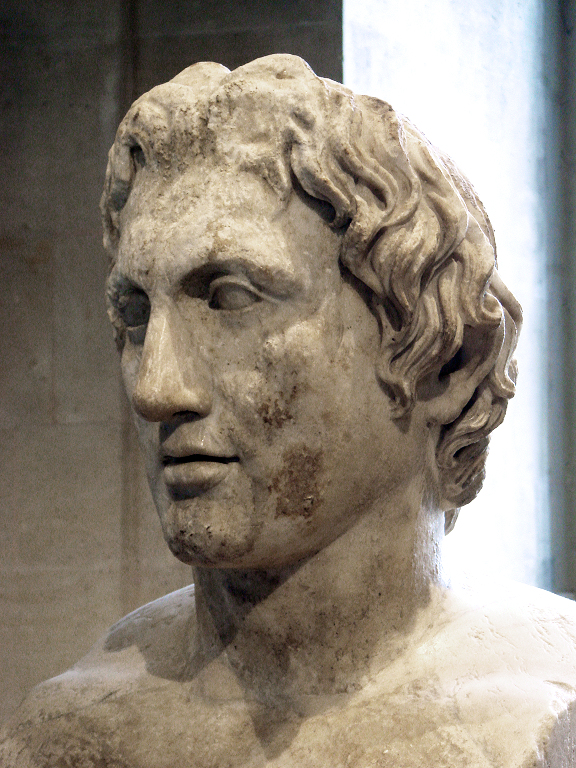
Before the 4th century BC, Macedonia was a small kingdom centered in Aegae, outside of the area dominated by the city-states of Athens, Sparta, and Thebes, and briefly subordinate to the Achaemenid Empire. During the reign of king Philip II (359–336 BC), Macedonia with its capital in Pella, subdued mainland Greece, Paeonia and the Thracian Odrysian kingdom through conquest and diplomacy. With a reformed army containing phalanxes wielding the sarissa pike, Philip II defeated the old powers of Athens and Thebes in the Battle of Chaeronea in 338 BC. Philip II's son Alexander the Great, leading a federation of Greek states founded by his father, accomplished the objective of commanding the whole of Greece when he destroyed Thebes after the city revolted. During Alexander's subsequent campaign of conquest, he overthrew the Achaemenid Empire and conquered territory that stretched as far as the Indus River. For a brief period, his Macedonian Empire was the most powerful in the world – the definitive Hellenistic state, inaugurating the transition to a new period of Ancient Greek civilization. Greek arts and literature flourished in the new conquered lands and advances in philosophy, engineering, and science spread across the empire and beyond. Of particular importance were the contributions of Aristotle, tutor to Alexander, whose writings became a keystone of Western philosophy.

After Alexander's death in 323 BC, the ensuing wars of the Diadochi, and the partitioning of Alexander's short-lived empire, Macedonia remained a Greek cultural and political centre in the Mediterranean region along with Ptolemaic Egypt, the Seleucid Empire, and the Attalid kingdom. Important cities included its capital Pella, Dion, Beroea, Pydna, and Amphipolis, while new cities were founded, such as Thessalonica by the usurper Cassander (named after his wife Thessalonike of Macedon). Macedonia's decline began with the Second Macedonian War and the rise of Rome as the leading Mediterranean power. At the end of the Third Macedonian War in 168 BC, the Macedonian monarchy was abolished and replaced by Roman client states. A short-lived revival of the monarchy during the Fourth Macedonian War in 150–148 BC ended with the establishment of the Roman province of Macedonia.

The Macedonian kings, who wielded absolute power and commanded state resources such as gold and silver, facilitated mining operations to mint currency, finance their armies and, by the reign of Philip II, a Macedonian navy. Unlike the other diadochi successor states, the imperial cult fostered by Alexander was never adopted in Macedonia, yet Macedonian rulers nevertheless assumed roles as high priests of the kingdom and leading patrons of domestic and international cults of the Hellenistic religion. The authority of Macedonian kings was theoretically limited by the institution of the army, while a few municipalities within the Macedonian commonwealth enjoyed a high degree of autonomy and even had democratic governments with popular assemblies.

Summary from Wikipedia (CC BY-SA 4.0)

History

History Main article: History of Macedonia (ancient kingdom) Early history and legend Main articles: Achaemenid Macedonia and Argead dynasty Further information: List of ancient Macedonians § Kings The entrance to one of the royal tombs at Vergina , a UNESCO World Heritage Site The Classical Greek historians Herodotus and Thucydides reported the legend that the Macedonian kings of the Argead dynasty were descendants of Temenus , king of Argos , and could therefore claim the mythical Heracles as one of their ancestors as well as a direct lineage from Zeus , chief god of the Greek pantheon . [ 1 ] Contradictory legends state that either Perdiccas I of Macedon or Caranus of Macedon were the founders of the Argead dynasty, with either five or eight kings before Amyntas   I. [ 2 ] The assertion that the Argeads descended from Temenus was accepted by the Hellanodikai authorities of the Ancient Olympic Games , permitting Alexander I of Macedon ( r.  498–454 BC ) to enter the competitions owing to his perceived Greek heritage. [ 3 ] Little is known about the kingdom before the reign of Alexander   I's father Amyntas I of Macedon ( r.  547–498 BC ) during the Archaic period . [ 4 ] The kingdom of Macedonia was initially situated along the Haliacmon and Loudias rivers in Lower Macedonia , north of Mount Olympus , east of the Vermio and Pierian mountain ranges, stretching along the coast of the Thermaic Gulf . Historian Robert Malcolm Errington suggests that one of the earliest Argead kings established Aigai (modern Vergina ) as their capital in the mid-7th century   BC. [ 5 ] Before the 4th century   BC, the kingdom covered a region corresponding roughly to the western and central parts of the region of Macedonia in modern Greece . [ 6 ] It gradually expanded into the regions of Emathia , Pieria , Bottiaea , Almopia , Mygdonia , Crestonia , and Bisaltia , which were inhabited by various peoples such as Thracians and Phrygians , and into Eordaea and the rest of Upper Macedonia , inhabited by the Greek tribes of Lyncestae , Orestae , and Elimiotae . [ note 1 ] Macedonia's non-Greek neighbours included Thracians, inhabiting territories to the northeast, Illyrians to the northwest, and Paeonians to the north, while the lands of Thessaly to the south and Epirus to the west were inhabited by Greeks with similar cultures to that of the Macedonians. [ 7 ] A silver octadrachm of Alexander I of Macedon ( r.  498–454 BC ), minted c.  465–460 BC , showing an equestrian figure wearing a chlamys (short cloak) and petasos (head cap) while holding two spears and leading a horse A year after Darius I of Persia ( r.  522–486 BC ) launched an invasion into Europe against the Scythians , Paeonians , Thracians , and several Greek city-states in coastal Thrace, the Persian general Megabazus used diplomacy to convince Amyntas   I to submit as a vassal of the Achaemenid Empire , ushering in the period of Achaemenid Macedonia . [ note 2 ] Achaemenid Persian hegemony over Macedonia was briefly interrupted by the Ionian Revolt (499–493   BC), yet the Persian general Mardonius brought it back under Achaemenid suzerainty . [ 10 ] Although Macedonia enjoyed a large degree of autonomy and was never made a satrapy (i.e. province) of the Achaemenid Empire, it was expected to provide troops for the Achaemenid army . [ 11 ] Alexander   I provided Macedonian military support to Xerxes I ( r.  486–465 BC ) during the Second Persian invasion of Greece in 480–479 BC, and Macedonian soldiers fought on the side of the Persians at the 479   BC Battle of Platea . [ 12 ] Following the Greek victory at Salamis in 480   BC, Alexander   I was employed as an Achaemenid diplomat to propose a peace treaty and alliance with Athens , an offer that was rejected. [ 13 ] Soon afterwards, the Achaemenid forces were forced to withdraw from mainland Europe , marking the end of Persian control over Macedonia. [ 14 ] Involvement in the Classical Greek world Further information: Delian League , Spartan hegemony , and Theban hegemony Macedon (orange) during the Peloponnesian War around 431   BC, with Athens and the Delian League (yellow), Sparta and Peloponnesian League (red), independent states (blue), and the Persian Achaemenid Empire (purple) Although initially a Persian vassal, Alexander   I of Macedon fostered friendly diplomatic relations with his former Greek enemies, the Athenian and Spartan -led coalition of Greek city-states. [ 15 ] His successor Perdiccas   II ( r.  454–413 BC ) led the Macedonians to war in four separate conflicts against Athens, leader of the Delian League , while incursions by the Thracian ruler Sitalces of the Odrysian kingdom threatened Macedonia's territorial integrity in the northeast. [ 16 ] The Athenian statesman Pericles promoted colonization of the Strymon River near the Kingdom of Macedonia, where the colonial city of Amphipolis was founded in 437/436   BC so that it could provide Athens with a steady supply of silver and gold as well as timber and pitch to support the Athenian navy . [ 17 ] Initially Perdiccas II did not take any action and might have even welcomed the Athenians, as the Thracians were foes to both of them. [ 18 ] This changed due to an Athenian alliance with a brother and cousin of Perdiccas   II who had rebelled against him. [ 18 ] Thus, two separate wars were fought against Athens between 433 and 431   BC. [ 18 ] The Macedonian king retaliated by promoting the rebellion of Athens' allies in Chalcidice and subsequently won over the strategic city of Potidaea . [ 19 ] After capturing the Macedonian cities Therma and Beroea , Athens besieged Potidaea but failed to overcome it; Therma was returned to Macedonia and much of Chalcidice to Athens in a peace treaty brokered by Sitalces, who provided Athens with military aid in exchange for acquiring new Thracian allies. [ 20 ] Perdiccas   II sided with Sparta in the Peloponnesian War (431–404 BC) between Athens and Sparta, and in 429 BC Athens retaliated by persuading Sitalces to invade Macedonia, but he was forced to retreat owing to a shortage of provisions in winter. [ 21 ] In 424 BC, Arrhabaeus , a local ruler of Lynkestis in Upper Macedonia, rebelled against his overlord Perdiccas, and the Spartans agreed to help in putting down the revolt. [ 22 ] At the Battle of Lyncestis the Macedonians panicked and fled before the fighting began, enraging the Spartan general Brasidas , whose soldiers looted the unattended Macedonian baggage train . [ 23 ] Perdiccas then changed sides and supported Athens, and he was able to put down Arrhabaeus's revolt. [ 24 ] A Macedonian didrachm minted during the reign of Archelaus I of Macedon ( r.  413–399 BC ) Brasidas died in 422 BC, the year Athens and Sparta struck an accord, the Peace of Nicias , that freed Macedonia from its obligations as an Athenian ally. [ 25 ] Following the 418   BC Battle of Mantinea , the victorious Spartans formed an alliance with Argos , a military pact Perdiccas   II was keen to join given the threat of Spartan allies remaining in Chalcidice. [ 26 ] When Argos suddenly switched sides as a pro-Athenian democracy , the Athenian navy was able to form a blockade against Macedonian seaports and invade Chalcidice in 417   BC. [ 27 ] Perdiccas   II sued for peace in 414   BC, forming an alliance with Athens that was continued by his son and successor Archelaus   I ( r.  413–399 BC ). [ 28 ] Athens then provided naval support to Archelaus   I in the 410   BC Macedonian siege of Pydna , in exchange for timber and naval equipment. [ 29 ] Although Archelaus I was faced with some internal revolts and had to fend off an invasion of Illyrians led by Sirras of Lynkestis, he was able to project Macedonian power into Thessaly where he sent military aid to his allies. [ 30 ] Although he retained Aigai as a ceremonial and religious centre, Archelaus   I moved the capital of the kingdom north to Pella , which was then positioned by a lake with a river connecting it to the Aegean Sea . [ 31 ] He improved Macedonia's currency by minting coins with a higher silver content as well as issuing separate copper coinage . [ 32 ] His royal court attracted the presence of well-known intellectuals such as the Athenian playwright Euripides . [ 33 ] When Archelaus   I was assassinated (perhaps following a homosexual love affair with royal pages at his court), the kingdom was plunged into chaos, in an era lasting from 399 to 393   BC that included the reign of four different monarchs: Orestes , son of Archelaus   I; Aeropus   II , uncle, regent , and murderer of Orestes; Pausanias , son of Aeropus   II; and Amyntas   II , who was married to the youngest daughter of Archelaus   I. [ 34 ] Very little is known about this turbulent period; it came to an end when Amyntas   III ( r.  393–370 BC ), son of Arrhidaeus and grandson of Amyntas   I, killed Pausanias and claimed the Macedonian throne. [ 35 ] A silver stater of Amyntas III of Macedon ( r.  393–370 BC ) Amyntas III was forced to flee his kingdom in either 393 or 383   BC (based on conflicting accounts), owing to a massive invasion by the Illyrians led by Bardylis . [ note 3 ] The pretender to the throne Argaeus ruled in his absence, yet Amyntas   III eventually returned to his kingdom with the aid of Thessalian allies. [ 36 ] Amyntas   III was also nearly overthrown by the forces of the Chalcidian city of Olynthos , but with the aid of Teleutias , brother of the Spartan king Agesilaus II , the Macedonians forced Olynthos to surrender and dissolve their Chalcidian League in 379   BC. [ 37 ] Alexander II ( r.  370–368 BC ), son of Eurydice   I and Amyntas   III, succeeded his father and immediately invaded Thessaly to wage war against the tagus (supreme Thessalian military leader) Alexander of Pherae , capturing the city of Larissa . [ 38 ] The Thessalians, desiring to remove both Alexander   II and Alexander of Pherae as their overlords , appealed to Pelopidas of Thebes for aid; he succeeded in recapturing Larissa and, in the peace agreement arranged with Macedonia, received aristocratic hostages including Alexander   II's brother and future king Philip   II ( r.  359–336 BC ). [ 39 ] When Alexander was assassinated by his brother-in-law Ptolemy of Aloros , the latter acted as an overbearing regent for Perdiccas   III ( r.  368–359 BC ), younger brother of Alexander   II, who eventually had Ptolemy executed when reaching the age of majority in 365   BC. [ 40 ] The remainder of Perdiccas III's reign was marked by political stability and financial recovery. [ 41 ] However, an Athenian invasion led by Timotheus , son of Conon , captured Methone and Pydna, and an Illyrian invasion led by Bardylis succeeded in killing Perdiccas   III and 4,000 Macedonian troops in battle. [ 42 ] Rise of Macedon Main article: Expansion of Macedonia under Philip II Further information: Argead dynasty , Amyntas IV of Macedon , and League of Corinth Map of the Kingdom of Macedon at the death of Philip   II in 336   BC (light blue), with the original territory that existed in 431   BC (red outline), and dependent states (yellow) Philip II was twenty-four years old when he acceded to the throne in 359   BC. [ 43 ] Through the use of deft diplomacy, he was able to convince the Thracians under Berisades to cease their support of Pausanias , a pretender to the throne, and the Athenians to halt their support of another pretender . [ 44 ] He achieved these by bribing the Thracians and their Paeonian allies and establishing a treaty with Athens that relinquished his claims to Amphipolis. [ 45 ] He was also able to make peace with the Illyrians who had threatened his borders . [ 46 ] Philip II spent his initial years radically transforming the Macedonian army . A reform of its organization, equipment, and training, including the introduction of the Macedonian phalanx armed with long pikes (i.e. the sarissa ), proved immediately successful when tested against his Illyrian and Paeonian enemies. [ 47 ] Confusing accounts in ancient sources have led modern scholars to debate how much Philip   II's royal predecessors may have contributed to these reforms and the extent to which his ideas were influenced by his adolescent years of captivity in Thebes as a political hostage during the Theban hegemony , especially after meeting with the general Epaminondas . [ 48 ] The Macedonians, like the other Greeks, traditionally practised monogamy , but Philip   II practised polygamy and married seven wives with perhaps only one that did not involve the loyalty of his aristocratic subjects or new allies. [ note 4 ] His first marriages were to Phila of Elimeia of the Upper Macedonian aristocracy as well as the Illyrian princess Audata to ensure a marriage alliance. [ 49 ] To establish an alliance with Larissa in Thessaly, he married the Thessalian noblewoman Philinna in 358   BC, who bore him a son who would later rule as Philip III Arrhidaeus ( r.  323–317 BC ). [ 50 ] In 357   BC, he married Olympias to secure an alliance with Arybbas , the king of Epirus and the Molossians . This marriage would bear a son who would later rule as Alexander   III (better known as Alexander the Great ) and claim descent from the legendary Achilles by way of his dynastic heritage from Epirus . [ 51 ] It is unclear whether or not the Achaemenid Persian kings influenced Philip   II's practice of polygamy, although his predecessor Amyntas   III had three sons with a possible second wife Gygaea: Archelaus, Arrhidaeus, and Menelaus . [ 52 ] Philip   II had Archelaus put to death in 359   BC, while Philip   II's other two half brothers fled to Olynthos, serving as a casus belli for the Olynthian War (349–348   BC) against the Chalcidian League. [ 53 ] While Athens was preoccupied with the Social War (357–355 BC) , Philip   II retook Amphipolis from them in 357   BC and the following year recaptured Pydna and Potidaea, the latter of which he handed over to the Chalcidian League as promised in a treaty. [ 54 ] In 356   BC, he took Crenides , refounding it as Philippi , while his general Parmenion defeated the Illyrian king Grabos II of the Grabaei . [ 55 ] During the 355–354   BC siege of Methone, Philip   II lost his right eye to an arrow wound, but managed to capture the city and treated the inhabitants cordially, unlike the Potidaeans, who had been enslaved. [ note 5 ] Philip II then involved Macedonia in the Third Sacred War (356–346   BC). It began when Phocis captured and plundered the temple of Apollo at Delphi instead of submitting unpaid fines, causing the Amphictyonic League to declare war on Phocis and a civil war among the members of the Thessalian League aligned with either Phocis or Thebes. [ 56 ] Philip   II's initial campaign against Pherae in Thessaly in 353   BC at the behest of Larissa ended in two disastrous defeats by the Phocian general Onomarchus . [ note 6 ] Philip   II in turn defeated Onomarchus in 352   BC at the Battle of Crocus Field , which led to Philip   II's election as leader ( archon ) of the Thessalian League, provided him a seat on the Amphictyonic Council, and allowed for a marriage alliance with Pherae by wedding Nicesipolis , niece of the tyrant Jason of Pherae . [ 57 ] Philip II had some early involvement with the Achaemenid Empire, especially by supporting satraps and mercenaries who rebelled against the central authority of the Achaemenid king. The satrap of Hellespontine Phrygia Artabazos II , who was in rebellion against Artaxerxes III , was able to take refuge as an exile at the Macedonian court from 352 to 342 BC. He was accompanied in exile by his family and by his mercenary general Memnon of Rhodes . [ 58 ] [ 59 ] Barsine , daughter of Artabazos, and future wife of Alexander the Great, grew up at the Macedonian court. [ 59 ] After campaigning against the Thracian ruler Cersobleptes , in 349   BC, Philip   II began his war against the Chalcidian League, which had been reestablished in 375   BC following a temporary disbandment. [ 60 ] Despite an Athenian intervention by Charidemus , [ 61 ] Olynthos was captured by Philip   II in 348   BC, and its inhabitants were sold into slavery , including some Athenian citizens . [ 62 ] The Athenians, especially in a series of speeches by Demosthenes known as the Olynthiacs , were unsuccessful in persuading their allies to counterattack and in 346   BC concluded a treaty with Macedonia known as the Peace of Philocrates . [ 63 ] The treaty stipulated that Athens would relinquish claims to Macedonian coastal territories, the Chalcidice, and Amphipolis in return for the release of the enslaved Athenians as well as guarantees that Philip   II would not attack Athenian settlements in the Thracian Chersonese . [ 64 ] Meanwhile, Phocis and Thermopylae were captured by Macedonian forces, the Delphic temple robbers were executed, and Philip   II was awarded the two Phocian seats on the Amphictyonic Council and the position of master of ceremonies over the Pythian Games . [ 65 ] Athens initially opposed his membership on the council and refused to attend the games in protest, but they eventually accepted these conditions, perhaps after some persuasion by Demosthenes in his oration On the Peace . [ 66 ] Over the next few years, Philip II reformed local governments in Thessaly, campaigned against the Illyrian ruler Pleuratus I , deposed Arybbas in Epirus in favour of his brother-in-law Alexander   I (through Philip   II's marriage to Olympias), and defeated Cersebleptes in Thrace. This allowed him to extend Macedonian control over the Hellespont in anticipation of an invasion into Achaemenid Anatolia . [ 68 ] In 342   BC, Philip   II conquered a Thracian city in what is now Bulgaria and renamed it Philippopolis (modern Plovdiv ). [ 69 ] War broke out with Athens in 340   BC while Philip   II was engaged in two ultimately unsuccessful sieges of Perinthus and Byzantion , followed by a successful campaign against the Scythians along the Danube and Macedonia's involvement in the Fourth Sacred War against Amphissa in 339   BC. [ 70 ] Thebes ejected a Macedonian garrison from Nicaea (near Thermopylae) , leading Thebes to join Athens, Megara , Corinth, Achaea , and Euboea in a final confrontation against Macedonia at the Battle of Chaeronea in 338   BC. [ 71 ] After the Macedonian victory at Chaeronea, Philip   II installed an oligarchy in Thebes, yet was lenient toward Athens, wishing to utilize their navy in a planned invasion of the Achaemenid Empire. [ 72 ] He was then chiefly responsible for the formation of the League of Corinth that included the major Greek city-states except Sparta. Despite the Kingdom of Macedonia's official exclusion from the league, in 337   BC, Philip   II was elected as the leader ( hegemon ) of its council ( synedrion ) and the commander-in-chief ( strategos autokrator ) of a forthcoming campaign to invade the Achaemenid Empire. [ 73 ] Philip's plan to punish the Persians for the suffering of the Greeks and to liberate the Greek cities of Asia Minor [ 74 ] as well as perhaps the panhellenic fear of another Persian invasion of Greece, contributed to his decision to invade the Achaemenid Empire. [ 75 ] The Persians offered aid to Perinthus and Byzantion in 341–340   BC, highlighting Macedonia's strategic need to secure Thrace and the Aegean Sea against increasing Achaemenid encroachment, as the Persian king Artaxerxes III further consolidated his control over satrapies in western Anatolia . [ 76 ] The latter region, yielding far more wealth and valuable resources than the Balkans, was also coveted by the Macedonian king for its sheer economic potential. [ 77 ] When Philip II married Cleopatra Eurydice , niece of general Attalus , talk of providing new potential heirs at the wedding feast infuriated Philip   II's son Alexander, a veteran of the Battle of Chaeronea, and his mother Olympias. [ 78 ] They fled together to Epirus before Alexander was recalled to Pella by Philip   II. [ 78 ] When Philip   II arranged a marriage between his son Arrhidaeus and Ada of Caria , daughter of Pixodarus , the Persian satrap of Caria , Alexander intervened and proposed to marry Ada instead. Philip   II then cancelled the wedding altogether and exiled Alexander's advisors Ptolemy , Nearchus , and Harpalus . [ 79 ] To reconcile with Olympias, Philip   II had their daughter Cleopatra marry Olympias' brother (and Cleopatra's uncle) Alexander   I of Epirus, but Philip   II was assassinated by his bodyguard, Pausanias of Orestis , during their wedding feast and succeeded by Alexander in 336   BC. [ 80 ] Alexander's Empire Further information: Wars of Alexander the Great and Chronology of the expedition of Alexander the Great into Asia Alexander's empire and his route Modern scholars have argued over the possible role of Alexander   III "the Great" and his mother Olympias in the assassination of Philip   II, noting the latter's choice to exclude Alexander from his planned invasion of Asia, choosing instead for him to act as regent of Greece and deputy hegemon of the League of Corinth, and the potential bearing of another male heir between Philip   II and his new wife, Cleopatra Eurydice. [ note 7 ] Alexander   III ( r.  336–323 BC ) was immediately proclaimed king by an assembly of the army and leading aristocrats, chief among them being Antipater and Parmenion. [ 81 ] By the end of his reign and military career in 323   BC, Alexander would rule over an empire consisting of mainland Greece , Asia Minor , the Levant , ancient Egypt , Mesopotamia , Persia , and much of Central and South Asia (i.e. modern Pakistan ). [ 82 ] Among his first acts was the burial of his father at Aigai. [ 83 ] The members of the League of Corinth revolted at the news of Philip   II's death, but were soon quelled by military force alongside persuasive diplomacy, electing Alexander as hegemon of the league to carry out the planned invasion of Achaemenid Persia. [ 84 ] In 335 BC, Alexander fought against the Thracian tribe of the Triballi at Haemus Mons and along the Danube , forcing their surrender on Peuce Island . [ 85 ] Shortly thereafter, the Illyrian chieftain Cleitus , son of Bardylis , threatened to attack Macedonia with the aid of Glaucias , king of the Taulantii , but Alexander took the initiative and besieged the Illyrians at Pelion (in modern Albania ). [ 86 ] When Thebes had once again revolted from the League of Corinth and was besieging the Macedonian garrison in the Cadmea , Alexander left the Illyrian front and marched to Thebes, which he placed under siege . [ 87 ] After breaching the walls, Alexander's forces killed 6,000 Thebans, took 30,000 inhabitants as prisoners of war , and burned the city to the ground as a warning that convinced all other Greek states except Sparta not to challenge Alexander again. [ 88 ] Throughout his military career, Alexander won every battle that he personally commanded. [ 89 ] His first victory against the Persians in Asia Minor at the Battle of the Granicus in 334   BC used a small cavalry contingent as a distraction to allow his infantry to cross the river followed by a cavalry charge from his companion cavalry . [ 90 ] Alexander led the cavalry charge at the Battle of Issus in 333   BC, forcing the Persian king Darius III and his army to flee. [ 90 ] Darius   III, despite having superior numbers, was again forced to flee the Battle of Gaugamela in 331   BC. [ 90 ] The Persian king was later captured and executed by his own satrap of Bactria and kinsman, Bessus , in 330   BC. The Macedonian king subsequently hunted down and executed Bessus in what is now Afghanistan , securing the region of Sogdia in the process. [ 91 ] At the 326   BC Battle of the Hydaspes (modern-day Punjab ), when the war elephants of King Porus of the Pauravas threatened Alexander's troops, he had them form open ranks to surround the elephants and dislodge their handlers by using their sarissa pikes. [ 92 ] When his Macedonian troops threatened mutiny in 324   BC at Opis , Babylonia (near modern Baghdad , Iraq ), Alexander offered Macedonian military titles and greater responsibilities to Persian officers and units instead, forcing his troops to seek forgiveness at a staged banquet of reconciliation between Persians and Macedonians. [ 93 ] The Stag Hunt Mosaic , c.   300   BC, from Pella ; the figure on the right is possibly Alexander the Great due to the date of the mosaic along with the depicted upsweep of his centrally-parted hair ( anastole ); the figure on the left wielding a double-edged axe (associated with Hephaistos ) is perhaps Hephaestion , one of Alexander's loyal companions. Alexander perhaps undercut his own rule by demonstrating signs of megalomania . [ 94 ] While utilizing effective propaganda such as the cutting of the Gordian Knot , he also attempted to portray himself as a living god and son of Zeus following his visit to the oracle at Siwah in the Libyan Desert (in modern-day Egypt) in 331   BC. [ 95 ] His attempt in 327   BC to have his men prostrate before him in Bactra in an act of proskynesis borrowed from the Persian kings was rejected as religious blasphemy by his Macedonian and Greek subjects after his court historian Callisthenes refused to perform this ritual. [ 94 ] When Alexander had Parmenion murdered at Ecbatana (near modern Hamadan , Iran ) in 330   BC, this was "symptomatic of the growing gulf between the king's interests and those of his country and people", according to Errington. [ 96 ] His murder of Cleitus the Black in 328   BC is described as "vengeful and reckless" by Dawn L. Gilley and Ian Worthington. [ 97 ] Continuing the polygamous habits of his father, Alexander encouraged his men to marry native women in Asia, leading by example when he wed Roxana , a Sogdian princess of Bactria. [ 98 ] He then married Stateira II , eldest daughter of Darius   III, and Parysatis II , youngest daughter of Artaxerxes III , at the Susa weddings in 324   BC. [ 99 ] Meanwhile, in Greece, the Spartan king Agis III attempted to lead a rebellion of the Greeks against Macedonia. [ 100 ] He was defeated in 331   BC at the Battle of Megalopolis by Antipater, who was serving as regent of Macedonia and deputy hegemon of the League of Corinth in Alexander's stead. [ note 8 ] Before Antipater embarked on his campaign in the Peloponnese , Memnon, the governor of Thrace, was dissuaded from rebellion by use of diplomacy. [ 101 ] Antipater deferred the punishment of Sparta to the League of Corinth headed by Alexander, who ultimately pardoned the Spartans on the condition that they submit fifty nobles as hostages. [ 102 ] Antipater's hegemony was somewhat unpopular in Greece due to his practice (perhaps by order of Alexander) of exiling malcontents and garrisoning cities with Macedonian troops, yet in 330   BC, Alexander declared that the tyrannies installed in Greece were to be abolished and Greek freedom was to be restored. [ 103 ] Diadochi Further information: Diadochi and Wars of the Diadochi Kingdoms of the Diadochi c.   301   BC, after the Battle of Ipsus    Kingdom of Ptolemy I Soter    Kingdom of Cassander    Kingdom of Lysimachus    Kingdom of Seleucus I Nicator     Epirus Other     Carthage     Roman Republic     Greek States A golden stater of Philip III Arrhidaeus ( r.  323–317 BC ) bearing images of Athena (left) and Nike (right) When Alexander the Great died at Babylon in 323   BC, his mother Olympias immediately accused Antipater and his faction of poisoning him, although there is no evidence to confirm this. [ 104 ] With no official heir apparent , the Macedonian military command split, with one side proclaiming Alexander's half-brother Philip   III Arrhidaeus ( r.  323–317 BC ) as king and the other siding with the infant son of Alexander and Roxana, Alexander   IV ( r.  323–309 BC ). [ 105 ] Except for the Euboeans and Boeotians, the Greeks also immediately rose up in a rebellion against Antipater known as the Lamian War (323–322   BC). [ 106 ] When Antipater was defeated at the 323   BC Battle of Thermopylae , he fled to Lamia where he was besieged by the Athenian commander Leosthenes . A Macedonian army led by Leonnatus rescued Antipater by lifting the siege. [ 107 ] Antipater defeated the rebellion, yet his death in 319   BC left a power vacuum wherein the two proclaimed kings of Macedonia became pawns in a power struggle between the diadochi , the former generals of Alexander's army. [ 108 ] A council of the army convened in Babylon immediately after Alexander's death, naming Philip   III as king and the chiliarch Perdiccas as his regent. [ 109 ] Antipater, Antigonus Monophthalmus , Craterus , and Ptolemy formed a coalition against Perdiccas in a civil war initiated by Ptolemy's seizure of the hearse of Alexander the Great . [ 110 ] Perdiccas was assassinated in 321   BC by his own officers during a failed campaign in Egypt against Ptolemy, where his march along the Nile River resulted in the drowning of 2,000 of his men. [ 111 ] Although Eumenes of Cardia managed to kill Craterus in battle, this had little to no effect on the outcome of the 321   BC Partition of Triparadisus in Syria where the victorious coalition settled the issue of a new regency and territorial rights. [ 112 ] Antipater was appointed as regent over the two kings. Before Antipater died in 319   BC, he named the staunch Argead loyalist Polyperchon as his successor, passing over his own son Cassander and ignoring the right of the king to choose a new regent (since Philip   III was considered mentally unstable), in effect bypassing the council of the army as well. [ 113 ] Forming an alliance with Ptolemy, Antigonus, and Lysimachus , Cassander had his officer Nicanor capture the Munichia fortress of Athens' port town Piraeus in defiance of Polyperchon's decree that Greek cities should be free of Macedonian garrisons, sparking the Second War of the Diadochi (319–315   BC). [ 114 ] Given a string of military failures by Polyperchon, in 317   BC, Philip   III, by way of his politically engaged wife Eurydice II of Macedon , officially replaced him as regent with Cassander. [ 115 ] Afterwards, Polyperchon desperately sought the aid of Olympias in Epirus. [ 115 ] A joint force of Epirotes, Aetolians, and Polyperchon's troops invaded Macedonia and forced the surrender of Philip   III and Eurydice's army, allowing Olympias to execute the king and force his queen to commit suicide. [ 116 ] Olympias then had Nicanor and dozens of other Macedonian nobles killed, but by the spring of 316   BC, Cassander had defeated her forces, captured her, and placed her on trial for murder before sentencing her to death. [ 117 ] Cassander married Philip II's daughter Thessalonike and briefly extended Macedonian control into Illyria as far as Epidamnos (modern Durrës , Albania). By 313   BC, it was retaken by the Illyrian king Glaucias of Taulantii . [ 118 ] By 316   BC, Antigonus had taken the territory of Eumenes and managed to eject Seleucus Nicator from his Babylonian satrapy, leading Cassander, Ptolemy, and Lysimachus to issue a joint ultimatum to Antigonus in 315   BC for him to surrender various territories in Asia. [ 119 ] Antigonus promptly allied with Polyperchon, now based in Corinth, and issued an ultimatum of his own to Cassander, charging him with murder for executing Olympias and demanding that he hand over the royal family, King Alexander   IV and the queen mother Roxana. [ 120 ] The conflict that followed lasted until the winter of 312/311   BC, when a new peace settlement recognized Cassander as general of Europe, Antigonus as "first in Asia", Ptolemy as general of Egypt, and Lysimachus as general of Thrace. [ 121 ] Cassander had Alexander   IV and Roxana put to death in the winter of 311/310   BC, and between 306 and 305   BC the diadochi were declared kings of their respective territories. [ 122 ] Hellenistic era Further information: Antipatrid dynasty , Antigonid dynasty , Hellenistic period , Pyrrhic War , Chremonidean War , Cleomenean War , and Macedonian league Preview warning: Page using Template:Multiple image with unknown parameter "1 = right" The beginning of Hellenistic Greece was defined by the struggle between the Antipatrid dynasty , led first by Cassander ( r.  305–297 BC ), son of Antipater, and the Antigonid dynasty , led by the Macedonian general Antigonus I Monophthalmus ( r.  306–301 BC ) and his son, the future king Demetrius   I ( r.  294–288 BC ). Cassander besieged Athens in 303   BC, but was forced to retreat to Macedonia when Demetrius invaded Boeotia to his rear, attempting to sever his path of retreat. [ 123 ] While Antigonus and Demetrius attempted to recreate Philip   II's Hellenic league with themselves as dual hegemons, a revived coalition of Cassander, Ptolemy I Soter ( r.  305–283 BC ) of Egypt's Ptolemaic dynasty , Seleucus I Nicator ( r.  305–281 BC ) of the Seleucid Empire , and Lysimachus ( r.  306–281 BC ), King of Thrace , defeated the Antigonids at the Battle of Ipsus in 301   BC, killing Antigonus and forcing Demetrius into flight. [ 124 ] Cassander died in 297 BC, and his sickly son Philip   IV died the same year, succeeded by Cassander's other sons Alexander V of Macedon ( r.  297–294 BC ) and Antipater II of Macedon ( r.  297–294 BC ), with their mother Thessalonike of Macedon acting as regent. [ 125 ] While Demetrius fought against the Antipatrid forces in Greece, Antipater   II killed his own mother to obtain power. [ 125 ] His desperate brother Alexander   V then requested aid from Pyrrhus of Epirus ( r.  297–272 BC ), [ 125 ] who had fought alongside Demetrius at the Battle of Ipsus, but was sent to Egypt as a hostage as part of an agreement between Demetrius and Ptolemy   I. [ 126 ] In exchange for defeating the forces of Antipater   II and forcing him to flee to the court of Lysimachus in Thrace, Pyrrhus was awarded the westernmost portions of the Macedonian kingdom. [ 127 ] Demetrius had his nephew Alexander   V assassinated and was then proclaimed king of Macedonia, but his subjects protested against his aloof, Eastern-style autocracy . [ 125 ] War broke out between Pyrrhus and Demetrius in 290   BC when Lanassa, wife of Pyrrhus , daughter of Agathocles of Syracuse , left him for Demetrius and offered him her dowry of Corcyra . [ 128 ] The war dragged on until 288   BC, when Demetrius lost the support of the Macedonians and fled the country. Macedonia was then divided between Pyrrhus and Lysimachus, the former taking western Macedonia and the latter eastern Macedonia. [ 128 ] By 286   BC, Lysimachus had expelled Pyrrhus and his forces from Macedonia. [ note 9 ] In 282   BC, a new war erupted between Seleucus   I and Lysimachus; the latter was killed in the Battle of Corupedion , allowing Seleucus   I to take control of Thrace and Macedonia. [ 129 ] In two dramatic reversals of fortune, Seleucus   I was assassinated in 281   BC by his officer Ptolemy Keraunos , son of Ptolemy   I and grandson of Antipater, who was then proclaimed king of Macedonia before being killed in battle in 279   BC by Celtic invaders in the Gallic invasion of Greece . [ 130 ] The Macedonian army proclaimed the general Sosthenes of Macedon as king, although he apparently refused the title. [ 131 ] After defeating the Gallic ruler Bolgios and driving out the raiding party of Brennus , Sosthenes died and left a chaotic situation in Macedonia. [ 132 ] The Gallic invaders ravaged Macedonia until Antigonus Gonatas , son of Demetrius, defeated them in Thrace at the 277   BC Battle of Lysimachia and was then proclaimed king Antigonus II of Macedon ( r.  277–274, 272–239 BC ). [ 133 ] In 280 BC, Pyrrhus embarked on a campaign in Magna Graecia (i.e. southern Italy ) against the Roman Republic known as the Pyrrhic War , followed by his invasion of Sicily . [ 134 ] Ptolemy Keraunos secured his position on the Macedonian throne by giving Pyrrhus five thousand soldiers and twenty war elephants for this endeavor. [ 126 ] Pyrrhus returned to Epirus in 275   BC after the ultimate failure of both campaigns, which contributed to the rise of Rome because Greek cities in southern Italy such as Tarentum now became Roman allies. [ 134 ] Pyrrhus invaded Macedonia in 274   BC, defeating the largely mercenary army of Antigonus   II at the 274   BC Battle of Aous and driving him out of Macedonia, forcing him to seek refuge with his naval fleet in the Aegean. [ 135 ] Antigonid Macedon Paintings of Hellenistic -era military arms and armor from a tomb in ancient Mieza (modern-day Lefkadia), Imathia , Central Macedonia , Greece , 2nd century   BC Pyrrhus lost much of his support among the Macedonians in 273   BC when his unruly Gallic mercenaries plundered the royal cemetery of Aigai. [ 136 ] Pyrrhus pursued Antigonus   II in the Peloponnese, yet Antigonus   II was ultimately able to recapture Macedonia. [ 137 ] Pyrrhus was killed while besieging Argos in 272   BC, allowing Antigonus   II to reclaim the rest of Greece. [ 138 ] He then restored the Argead dynastic graves at Aigai and annexed the Kingdom of Paeonia . [ 139 ] The Aetolian League hampered Antigonus   II's control over central Greece , and the formation of the Achaean League in 251   BC pushed Macedonian forces out of much of the Peloponnese and at times incorporated Athens and Sparta. [ 140 ] While the Seleucid Empire aligned with Antigonid Macedonia against Ptolemaic Egypt during the Syrian Wars , the Ptolemaic navy heavily disrupted Antigonus   II's efforts to control mainland Greece. [ 141 ] With the aid of the Ptolemaic navy, the Athenian statesman Chremonides led a revolt against Macedonian authority known as the Chremonidean War (267–261   BC). [ 142 ] By 265   BC, Athens was surrounded and besieged by Antigonus   II's forces, and a Ptolemaic fleet was defeated in the Battle of Cos . Athens finally surrendered in 261   BC. [ 143 ] After Macedonia formed an alliance with the Seleucid ruler Antiochus II , a peace settlement between Antigonus   II and Ptolemy II Philadelphus of Egypt was finally struck in 255   BC. [ 144 ] The Temple of Apollo at Corinth , built c.   540   BC, with the Acrocorinth (i.e. the acropolis of Corinth that once held a Macedonian garrison ) [ 145 ] seen in the background In 251 BC, Aratus of Sicyon led a rebellion against Antigonus   II, and in 250   BC, Ptolemy   II declared his support for the self-proclaimed King Alexander of Corinth . [ 146 ] Although Alexander died in 246   BC and Antigonus was able to score a naval victory against the Ptolemies at Andros , the Macedonians lost the Acrocorinth to the forces of Aratus in 243   BC, followed by the induction of Corinth into the Achaean League. [ 147 ] Antigonus   II made peace with the Achaean League in 240   BC, ceding the territories that he had lost in Greece. [ 148 ] Antigonus   II died in 239   BC and was succeeded by his son Demetrius II of Macedon ( r.  239–229 BC ). Seeking an alliance with Macedonia to defend against the Aetolians, the queen mother and regent of Epirus, Olympias II , offered her daughter Phthia of Macedon to Demetrius   II in marriage. Demetrius II accepted her proposal, but he damaged relations with the Seleucids by divorcing Stratonice of Macedon . [ 149 ] Although the Aetolians formed an alliance with the Achaean League as a result, Demetrius   II was able to invade Boeotia and capture it from the Aetolians by 236   BC. [ 145 ] The Achaean League managed to capture Megalopolis in 235   BC, and by the end of Demetrius   II's reign most of the Peloponnese except Argos was taken from the Macedonians. [ 150 ] Demetrius   II also lost an ally in Epirus when the monarchy was toppled in a republican revolution . [ 151 ] Demetrius   II enlisted the aid of the Illyrian king Agron to defend Acarnania against Aetolia, and in 229   BC, they managed to defeat the combined navies of the Aetolian and Achaean Leagues at the Battle of Paxos . [ 151 ] Another Illyrian ruler, Longarus of the Dardanian Kingdom , invaded Macedonia and defeated an army of Demetrius   II shortly before his death in 229   BC. [ 152 ] Although his young son Philip immediately inherited the throne, his regent Antigonus III Doson ( r.  229–221 BC ), nephew of Antigonus   II, was proclaimed king by the army, with Philip as his heir, following a string of military victories against the Illyrians in the north and the Aetolians in Thessaly. [ 153 ] A tetradrachm minted during the reign of Antigonus III Doson ( r.  229–221 BC ), possibly at Amphipolis , bearing the portrait image of Poseidon on the obverse and on the reverse a scene depicting Apollo sitting on the prow of a ship Aratus sent an embassy to Antigonus III in 226   BC seeking an unexpected alliance now that the reformist king Cleomenes III of Sparta was threatening the rest of Greece in the Cleomenean War (229–222   BC). [ 154 ] In exchange for military aid, Antigonus   III demanded the return of Corinth to Macedonian control, which Aratus finally agreed to in 225   BC. [ 155 ] In 224   BC, Antigonus   III's forces took Arcadia from Sparta. After forming a Hellenic league in the same vein as Philip   II's League of Corinth, he managed to defeat Sparta at the Battle of Sellasia in 222   BC. [ 156 ] Sparta was occupied by a foreign power for the first time in its history, restoring Macedonia's position as the leading power in Greece. [ 157 ] Antigonus died a year later, perhaps from tuberculosis , leaving behind a strong Hellenistic kingdom for his successor Philip   V. [ 158 ] Philip V of Macedon ( r.  221–179 BC ) faced immediate challenges to his authority by the Illyrian Dardani and Aetolian League. [ 159 ] Philip   V and his allies were successful against the Aetolians and their allies in the Social War (220–217 BC) , yet he made peace with the Aetolians once he heard of incursions by the Dardani in the north and the Carthaginian victory over the Romans at the Battle of Lake Trasimene in 217   BC. [ 160 ] Demetrius of Pharos is alleged to have convinced Philip   V to first secure Illyria in advance of an invasion of the Italian peninsula . [ note 10 ] In 216   BC, Philip   V sent a hundred light warships into the Adriatic Sea to attack Illyria, a move that prompted Scerdilaidas of the Ardiaean Kingdom to appeal to the Romans for aid. [ 161 ] Rome responded by sending ten heavy quinqueremes from Roman Sicily to patrol the Illyrian coasts, causing Philip   V to reverse course and order his fleet to retreat, averting open conflict for the time being. [ 162 ] Conflict with Rome Main article: Macedonian Wars Further information: Lyttian War , Cretan War (205–200 BC) , Punic Wars , and Macedonian–Carthaginian Treaty The Kingdom of Macedonia (orange) under Philip   V ( r.  221–179 BC ), with Macedonian dependent states (dark yellow), the Seleucid Empire (bright yellow), Roman protectorates (dark green), the Kingdom of Pergamon (light green), independent states (light purple), and possessions of the Ptolemaic Empire (violet purple) In 215 BC, at the height of the Second Punic War with the Carthaginian Empire , Roman authorities intercepted a ship off the Calabrian coast holding a Macedonian envoy and a Carthaginian ambassador in possession of a treaty composed by Hannibal declaring an alliance with Philip   V. [ 163 ] The treaty stipulated that Carthage had the sole right to negotiate the terms of Rome's hypothetical surrender and promised mutual aid if a resurgent Rome should seek revenge against either Macedonia or Carthage. [ 164 ] Although the Macedonians were perhaps only interested in safeguarding their newly conquered territories in Illyria, [ 165 ] the Romans were nevertheless able to thwart whatever grand ambitions Philip   V had for the Adriatic region during the First Macedonian War (214–205   BC). In 214   BC, Rome positioned a naval fleet at Oricus , which was assaulted along with Apollonia by Macedonian forces. [ 166 ] When the Macedonians captured Lissus in 212   BC, the Roman Senate responded by inciting the Aetolian League, Sparta, Elis , Messenia , and Attalus I ( r.  241–197 BC ) of Pergamon to wage war against Philip   V, keeping him occupied and away from Italy. [ 167 ] The Aetolian League concluded a peace agreement with Philip   V in 206   BC, and the Roman Republic negotiated the Treaty of Phoenice in 205   BC, ending the war and allowing the Macedonians to retain some captured settlements in Illyria. [ 168 ] Although the Romans rejected an Aetolian request in 202   BC for Rome to declare war on Macedonia once again, the Roman Senate gave serious consideration to the similar offer made by Pergamon and its ally Rhodes in 201   BC. [ 169 ] These states were concerned about Philip   V's alliance with Antiochus III the Great of the Seleucid Empire, which invaded the war-weary and financially exhausted Ptolemaic Empire in the Fifth Syrian War (202–195   BC) as Philip   V captured Ptolemaic settlements in the Aegean Sea. [ 170 ] Although Rome's envoys played a critical role in convincing Athens to join the anti-Macedonian alliance with Pergamon and Rhodes in 200   BC, the comitia centuriata (people's assembly) rejected the Roman Senate's proposal for a declaration of war on Macedonia. [ 171 ] Meanwhile, Philip   V conquered territories in the Hellespont and Bosporus as well as Ptolemaic Samos , which led Rhodes to form an alliance with Pergamon , Byzantium , Cyzicus , and Chios against Macedonia. [ 172 ] Despite Philip   V's nominal alliance with the Seleucid king, he lost the naval Battle of Chios in 201   BC and was blockaded at Bargylia by the Rhodian and Pergamene navies. [ 173 ] A tetradrachm of Philip V of Macedon ( r.  221–179 BC ), with the king's portrait on the obverse and Athena Alkidemos brandishing a thunderbolt on the reverse While Philip V was busy fighting Rome's Greek allies, Rome viewed this as an opportunity to punish this former ally of Hannibal with a war that they hoped would supply a victory and require few resources. [ note 11 ] The Roman Senate demanded that Philip   V cease hostilities against neighbouring Greek powers and defer to an international arbitration committee for settling grievances. [ 174 ] When the comitia centuriata finally voted in approval of the Roman Senate's declaration of war in 200   BC and handed their ultimatum to Philip   V, demanding that a tribunal assess the damages owed to Rhodes and Pergamon, the Macedonian king rejected it. This marked the beginning of the Second Macedonian War (200–197   BC), with Publius Sulpicius Galba Maximus spearheading military operations in Apollonia. [ 175 ] Bronze bust of Eumenes II of Pergamon , a Roman copy of a Hellenistic Greek original , from the Villa of the Papyri in Herculaneum The Macedonians successfully defended their territory for roughly two years, [ 176 ] but the Roman consul Titus Quinctius Flamininus managed to expel Philip   V from Macedonia in 198   BC, forcing his men to take refuge in Thessaly. [ 177 ] When the Achaean League switched their loyalties from Macedonia to Rome, the Macedonian king sued for peace, but the terms offered were considered too stringent, and so the war continued. [ 177 ] In June 197   BC, the Macedonians were defeated at the Battle of Cynoscephalae . [ 178 ] Rome then ratified a treaty that forced Macedonia to relinquish control of much of its Greek possessions outside of Macedonia proper, if only to act as a buffer against Illyrian and Thracian incursions into Greece. [ 179 ] Although some Greeks suspected Roman intentions of supplanting Macedonia as the new hegemonic power in Greece, Flaminius announced at the Isthmian Games of 196   BC that Rome intended to preserve Greek liberty by leaving behind no garrisons and by not exacting tribute of any kind. [ 180 ] His promise was delayed by negotiations with the Spartan king Nabis , who had meanwhile captured Argos, yet Roman forces evacuated Greece in 194   BC. [ 181 ] Encouraged by the Aetolian League and their calls to liberate Greece from the Romans, the Seleucid king Antiochus   III landed with his army at Demetrias , Thessaly, in 192   BC, and was elected strategos by the Aetolians. [ 182 ] Macedonia, the Achaean League, and other Greek city-states maintained their alliance with Rome. [ 183 ] The Romans defeated the Seleucids in the 191   BC Battle of Thermopylae as well as the Battle of Magnesia in 190   BC, forcing the Seleucids to pay a war indemnity , dismantle most of its navy, and abandon its claims to any territories north or west of the Taurus Mountains in the 188   BC Treaty of Apamea . [ 184 ] With Rome's acceptance, Philip   V was able to capture some cities in central Greece in 191–189   BC that had been allied to Antiochus   III, while Rhodes and Eumenes II ( r.  197–159 BC ) of Pergamon gained territories in Asia Minor. [ 185 ] Failing to please all sides in various territorial disputes, the Roman Senate decided in 184/183   BC to force Philip   V to abandon Aenus and Maronea , since these had been declared free cities in the Treaty of Apamea. [ note 12 ] This assuaged the fear of Eumenes   II that Macedonia could pose a threat to his lands in the Hellespont. [ 186 ] Perseus of Macedon ( r.  179–168 BC ) succeeded Philip   V and executed his brother Demetrius , who had been favoured by the Romans but was charged by Perseus with high treason . [ 187 ] Perseus then attempted to form marriage alliances with Prusias II of Bithynia and Seleucus IV Philopator of the Seleucid Empire, along with renewed relations with Rhodes that greatly unsettled Eumenes   II. [ 188 ] Although Eumenes   II attempted to undermine these diplomatic relationships, Perseus fostered an alliance with the Boeotian League , extended his authority into Illyria and Thrace , and in 174   BC, won the role of managing the Temple of Apollo at Delphi as a member of the Amphictyonic Council . [ 189 ] Eumenes II came to Rome in 172 BC and delivered a speech to the Senate denouncing the alleged crimes and transgressions of Perseus. [ 190 ] This convinced the Roman Senate to declare the Third Macedonian War (171–168   BC). [ note 13 ] Although Perseus's forces were victorious against the Romans at the Battle of Callinicus in 171   BC, the Macedonian army was defeated at the Battle of Pydna in June 168   BC. [ 191 ] Perseus fled to Samothrace but surrendered shortly afterwards, was brought to Rome for the triumph of Lucius Aemilius Paullus Macedonicus , and was placed under house arrest at Alba Fucens , where he died in 166   BC. [ 192 ] The Romans abolished the Macedonian monarchy by installing four separate allied republics in its stead, their capitals located at Amphipolis , Thessalonica , Pella , and Pelagonia . [ 193 ] The Romans imposed severe laws inhibiting many social and economic interactions between the inhabitants of these republics, including the banning of marriages between them and the (temporary) prohibition on gold and silver mining. [ 193 ] A certain Andriscus , claiming Antigonid descent, rebelled against the Romans and was pronounced king of Macedonia, defeating the army of the Roman praetor Publius Juventius Thalna during the Fourth Macedonian War (150–148   BC). [ 194 ] Despite this, Andriscus was defeated in 148   BC at the second Battle of Pydna by Quintus Caecilius Metellus Macedonicus , whose forces occupied the kingdom. [ 195 ] This was followed in 146   BC by the Roman destruction of Carthage and victory over the Achaean League at the Battle of Corinth , ushering in the era of Roman Greece and the gradual establishment of the Roman province of Macedonia . [ 196 ] ^ King 2010 , p. 376; Sprawski 2010 , p. 127; Errington 1990 , pp. 2–3. ^ King 2010 , p. 376; Errington 1990 , pp. 3, 251. ^ Badian 1982 , p. 34; Sprawski 2010 , p. 142. ^ Cite error: The named reference king 2010 376 was invoked but never defined (see the help page ). ^ Errington 1990 , p. 2. ^ Thomas 2010 , pp. 67–68, 74–78. ^ Anson 2010 , pp. 5–6. ^ "DNa – Livius" . www.livius.org . ^ Olbrycht 2010 , pp. 343–344 ^ Olbrycht 2010 , p. 344; Sprawski 2010 , pp. 135–137; Errington 1990 , pp. 9–10. ^ Olbrycht 2010 , pp. 343–344; Sprawski 2010 , p. 137; Errington 1990 , p. 10. ^ King 2010 , p. 376; Olbrycht 2010 , pp. 344–345; Sprawski 2010 , pp. 138–139. ^ Sprawski 2010 , pp. 139–140. ^ Olbrycht 2010 , p. 345; Sprawski 2010 , pp. 139–141; see also Errington 1990 , pp. 11–12 for further details. ^ Sprawski 2010 , pp. 141–143; Errington 1990 , pp. 9, 11–12. ^ Roisman 2010 , pp. 145–147. ^ Roisman 2010 , pp. 146–147; Müller 2010 , p. 171; Cawkwell 1978 , p. 72; see also Errington 1990 , pp. 13–14 for further details. ^ a b c Roisman 2010 , pp. 146–147. ^ Roisman 2010 , pp. 146–147; see also Errington 1990 , p. 18 for further details. ^ Roisman 2010 , pp. 147–148; Errington 1990 , pp. 19–20. ^ Roisman 2010 , pp. 149–150; Errington 1990 , p. 20. ^ Roisman 2010 , pp. 150–152; Errington 1990 , pp. 21–22. ^ Roisman 2010 , p. 152; Errington 1990 , p. 22. ^ Roisman 2010 , pp. 152–153; Errington 1990 , pp. 22–23. ^ Roisman 2010 , p. 153; Errington 1990 , pp. 22–23. ^ Roisman 2010 , pp. 153–154; see also Errington 1990 , p. 23 for further details. ^ Roisman 2010 , p. 154; see also Errington 1990 , p. 23 for further details. ^ Roisman 2010 , p. 154; Errington 1990 , pp. 23–24. ^ Roisman 2010 , pp. 154–155; Errington 1990 , p. 24. ^ Roisman 2010 , pp. 155–156. ^ Roisman 2010 , p. 156; Errington 1990 , p. 26. ^ Roisman 2010 , pp. 156–157. ^ Roisman 2010 , pp. 156–157; Errington 1990 , p. 26. ^ Roisman 2010 , pp. 157–158; Errington 1990 , pp. 28–29. ^ Roisman 2010 , p. 158; Errington 1990 , pp. 28–29. ^ Roisman 2010 , p. 159; see also Errington 1990 , p. 30 for further details. ^ Roisman 2010 , pp. 159–160; Errington 1990 , pp. 32–33. ^ Roisman 2010 , p. 161; Errington 1990 , pp. 34–35. ^ Roisman 2010 , pp. 161–162; Errington 1990 , pp. 35–36. ^ Roisman 2010 , pp. 162–163; Errington 1990 , p. 36. ^ Roisman 2010 , pp. 162–163. ^ Roisman 2010 , pp. 163–164; Errington 1990 , p. 37. ^ Müller 2010 , pp. 166–167; Buckley 1996 , pp. 467–472. ^ Müller 2010 , pp. 167–168; Buckley 1996 , pp. 467–472. ^ Müller 2010 , pp. 167–168; Buckley 1996 , pp. 467–472; Errington 1990 , p. 38. ^ Müller 2010 , p. 167. ^ Müller 2010 , p. 168. ^ Müller 2010 , pp. 168–169. ^ Müller 2010 , p. 169. ^ Müller 2010 , p. 170; Buckler 1989 , p. 62. ^ Müller 2010 , pp. 170–171; Gilley & Worthington 2010 , p. 187. ^ Müller 2010 , pp. 167, 169; Roisman 2010 , p. 161. ^ Müller 2010 , pp. 169, 173–174; Cawkwell 1978 , p. 84; Errington 1990 , pp. 38–39. ^ Müller 2010 , p. 171; Buckley 1996 , pp. 470–472; Cawkwell 1978 , pp. 74–75. ^ Müller 2010 , p. 172; Hornblower 2002 , p. 272; Cawkwell 1978 , p. 42; Buckley 1996 , pp. 470–472. ^ Müller 2010 , pp. 171–172; Buckler 1989 , pp. 8, 20–22, 26–29. ^ Müller 2010 , p. 173; Cawkwell 1978 , pp. 62, 66–68; Buckler 1989 , pp. 74–75, 78–80; Worthington 2008 , pp. 61–63. ^ Howe, Timothy; Brice, Lee L. (2015). Brill's Companion to Insurgency and Terrorism in the Ancient Mediterranean . BRILL. p. 170. ISBN   978-90-04-28473-9 . ^ a b Carney, Elizabeth Donnelly (2000). Women and Monarchy in Macedonia . University of Oklahoma Press. p. 101. ISBN   978-0-8061-3212-9 . ^ Müller 2010 , p. 173; Cawkwell 1978 , p. 44; Schwahn 1931 , col. 1193–1194. ^ Cawkwell 1978 , p. 86. ^ Müller 2010 , pp. 173–174; Cawkwell 1978 , pp. 85–86; Buckley 1996 , pp. 474–475. ^ Müller 2010 , pp. 173–174; Worthington 2008 , pp. 75–78; Cawkwell 1978 , pp. 96–98. ^ Müller 2010 , p. 174; Cawkwell 1978 , pp. 98–101. ^ Müller 2010 , pp. 174–175; Cawkwell 1978 , pp. 95, 104, 107–108; Hornblower 2002 , pp. 275–277; Buckley 1996 , pp. 478–479. ^ Müller 2010 , p. 175. ^ Errington 1990 , p. 227. ^ Müller 2010 , pp. 175–176; Cawkwell 1978 , pp. 114–117; Hornblower 2002 , p. 277; Buckley 1996 , p. 482; Errington 1990 , p. 44. ^ Mollov & Georgiev 2015 , p. 76. ^ Müller 2010 , p. 176; Cawkwell 1978 , pp. 136–142; Errington 1990 , pp. 82–83. ^ Müller 2010 , pp. 176–177; Cawkwell 1978 , pp. 143–148. ^ Müller 2010 , p. 177; Cawkwell 1978 , pp. 167–168. ^ Müller 2010 , pp. 177–179; Cawkwell 1978 , pp. 167–171; see also Hammond & Walbank 2001 , p. 16 for further details. ^ Davis Hanson, Victor (2010). Makers of Ancient Strategy: From the Persian Wars to the Fall of Rome . Princeton University Press. p.  119 . ISBN   978-0-691-13790-2 . Afterwards he [Alexander] revived his father's League of Corinth, and with it his plan for a pan-Hellenic invasion of Asia to punish the Persians for the suffering of the Greeks, especially the Athenians, in the Greco-Persian Wars and to liberate the Greek cities of Asia Minor. ^ Olbrycht 2010 , pp. 348, 351 ^ Olbrycht 2010 , pp. 347–349 ^ Olbrycht 2010 , p. 351 ^ a b Müller 2010 , pp. 179–180; Cawkwell 1978 , p. 170. ^ Müller 2010 , pp. 180–181; see also Hammond & Walbank 2001 , p. 14 for further details. ^ Müller 2010 , pp. 181–182; Errington 1990 , p. 44; Gilley & Worthington 2010 , p. 186; see Hammond & Walbank 2001 , pp. 3–5 for details of the arrests and judicial trials of other suspects in the conspiracy to assassinate Philip II of Macedon . ^ Gilley & Worthington 2010 , p. 190; Müller 2010 , p. 183; Renault 2001 , pp. 61–62; Fox 1980 , p. 72; see also Hammond & Walbank 2001 , pp. 3–5 for further details. ^ Gilley & Worthington 2010 , p. 186. ^ Gilley & Worthington 2010 , p. 190. ^ Gilley & Worthington 2010 , pp. 190–191; see also Hammond & Walbank 2001 , pp. 15–16 for further details. ^ Gilley & Worthington 2010 , p. 191; Hammond & Walbank 2001 , pp. 34–38. ^ Gilley & Worthington 2010 , p. 191; Hammond & Walbank 2001 , pp. 40–47. ^ Gilley & Worthington 2010 , p. 191; see also Errington 1990 , p. 91 and Hammond & Walbank 2001 , p. 47 for further details. ^ Gilley & Worthington 2010 , pp. 191–192; see also Errington 1990 , pp. 91–92 for further details. ^ Gilley & Worthington 2010 , pp. 192–193. ^ a b c Gilley & Worthington 2010 , p. 193. ^ Gilley & Worthington 2010 , pp. 193–194; Holt 2012 , pp. 27–41. ^ Gilley & Worthington 2010 , pp. 193–194. ^ Gilley & Worthington 2010 , p. 194; Errington 1990 , p. 113. ^ a b Gilley & Worthington 2010 , p. 195. ^ Gilley & Worthington 2010 , pp. 194–195. ^ Errington 1990 , pp. 105–106. ^ Gilley & Worthington 2010 , p. 198. ^ Holt 1989 , pp. 67–68. ^ Gilley & Worthington 2010 , p. 196. ^ Gilley & Worthington 2010 , p. 199; Errington 1990 , p. 93. ^ Gilley & Worthington 2010 , pp. 200–201; Errington 1990 , p. 58. ^ Gilley & Worthington 2010 , p. 201. ^ Gilley & Worthington 2010 , pp. 201–203. ^ Gilley & Worthington 2010 , p. 204; see also Errington 1990 , p. 44 for further details. ^ Gilley & Worthington 2010 , p. 204; see also Errington 1990 , pp. 115–117 for further details. ^ Gilley & Worthington 2010 , p. 204; Adams 2010 , p. 209; Errington 1990 , pp. 69–70, 119. ^ Gilley & Worthington 2010 , pp. 204–205; Adams 2010 , pp. 209–210; Errington 1990 , pp. 69, 119. ^ Gilley & Worthington 2010 , p. 205; see also Errington 1990 , p. 118 for further details. ^ Adams 2010 , pp. 208–209; Errington 1990 , p. 117. ^ Adams 2010 , pp. 210–211; Errington 1990 , pp. 119–120. ^ Adams 2010 , p. 211; Errington 1990 , pp. 120–121. ^ Adams 2010 , pp. 211–212; Errington 1990 , pp. 121–122. ^ Adams 2010 , pp. 207 n. #1, 212; Errington 1990 , pp. 122–123. ^ Adams 2010 , pp. 212–213; Errington 1990 , pp. 124–126. ^ a b Adams 2010 , p. 213; Errington 1990 , pp. 126–127. ^ Adams 2010 , pp. 213–214; Errington 1990 , pp. 127–128. ^ Adams 2010 , p. 214; Errington 1990 , pp. 128–129. ^ Adams 2010 , pp. 214–215. ^ Cite error: The named reference Adams 2010 215 was invoked but never defined (see the help page ). ^ Adams 2010 , pp. 215–216. ^ Adams 2010 , p. 216. ^ Adams 2010 , pp. 216–217; Errington 1990 , p. 129. ^ Adams 2010 , p. 217; Errington 1990 , p. 145. ^ Adams 2010 , p. 217; Errington 1990 , pp. 145–147; Bringmann 2007 , p. 61. ^ a b c d Adams 2010 , p. 218. ^ a b Bringmann 2007 , p. 61. ^ Adams 2010 , p. 218; Errington 1990 , p. 153. ^ a b Adams 2010 , pp. 218–219; Bringmann 2007 , p. 61. ^ Adams 2010 , p. 219; Bringmann 2007 , p. 61; Errington 1990 , pp. 156–157. ^ Adams 2010 , p. 219; Bringmann 2007 , pp. 61–63; Errington 1990 , pp. 159–160. ^ Errington 1990 , p. 160. ^ Errington 1990 , pp. 160–161. ^ Adams 2010 , p. 219; Bringmann 2007 , p. 63; Errington 1990 , pp. 162–163. ^ a b Adams 2010 , pp. 219–220; Bringmann 2007 , p. 63. ^ Adams 2010 , pp. 219–220; Bringmann 2007 , p. 63; Errington 1990 , p. 164. ^ Adams 2010 , p. 220; Errington 1990 , pp. 164–165. ^ Adams 2010 , p. 220. ^ Adams 2010 , p. 220; Bringmann 2007 , p. 63; Errington 1990 , p. 167. ^ Adams 2010 , p. 220; Errington 1990 , pp. 165–166. ^ Adams 2010 , p. 221; see also Errington 1990 , pp. 167–168 about the resurgence of Sparta under Areus I . ^ Adams 2010 , p. 221; Errington 1990 , p. 168. ^ Adams 2010 , p. 221; Errington 1990 , pp. 168–169. ^ Adams 2010 , p. 221; Errington 1990 , pp. 169–171. ^ Adams 2010 , p. 221. ^ a b Adams 2010 , p. 222. ^ Adams 2010 , pp. 221–222; Errington 1990 , p. 172. ^ Adams 2010 , p. 222; Errington 1990 , pp. 172–173. ^ Adams 2010 , p. 222; Errington 1990 , p. 173. ^ Adams 2010 , p. 222; Errington 1990 , p. 174. ^ Adams 2010 , p. 223; Errington 1990 , pp. 173–174. ^ a b Adams 2010 , p. 223; Errington 1990 , p. 174. ^ Adams 2010 , p. 223; Errington 1990 , pp. 174–175. ^ Adams 2010 , p. 223; Errington 1990 , pp. 175–176. ^ Adams 2010 , pp. 223–224; Eckstein 2013 , p. 314; see also Errington 1990 , pp. 179–180 for further details. ^ Adams 2010 , pp. 223–224; Eckstein 2013 , p. 314; Errington 1990 , pp. 180–181. ^ Adams 2010 , p. 224; Eckstein 2013 , p. 314; Errington 1990 , pp. 181–183. ^ Adams 2010 , p. 224; see also Errington 1990 , p. 182 about the Macedonian military's occupation of Sparta following the Battle of Sellasia . ^ Adams 2010 , p. 224; Errington 1990 , pp. 183–184. ^ Eckstein 2010 , p. 229; Errington 1990 , pp. 184–185. ^ Eckstein 2010 , p. 229; Errington 1990 , pp. 185–186, 189. ^ Eckstein 2010 , p. 230; Errington 1990 , pp. 189–190. ^ Eckstein 2010 , pp. 230–231; Errington 1990 , pp. 190–191. ^ Bringmann 2007 , p. 79; Eckstein 2010 , p. 231; Errington 1990 , p. 192; also mentioned by Gruen 1986 , p. 19. ^ Bringmann 2007 , p. 80; see also Eckstein 2010 , p. 231 and Errington 1990 , pp. 191–193 for further details. ^ Errington 1990 , pp. 191–193, 210. ^ Bringmann 2007 , p. 82; Errington 1990 , p. 193. ^ Bringmann 2007 , p. 82; Eckstein 2010 , pp. 232–233; Errington 1990 , pp. 193–194; Gruen 1986 , pp. 17–18, 20. ^ Bringmann 2007 , p. 83; Eckstein 2010 , pp. 233–234; Errington 1990 , pp. 195–196; Gruen 1986 , p. 21; see also Gruen 1986 , pp. 18–19 for details on the Aetolian League 's treaty with Philip V of Macedon and Rome's rejection of the second attempt by the Aetolians to seek Roman aid, viewing the Aetolians as having violated the earlier treaty. ^ Bringmann 2007 , p. 85; see also Errington 1990 , pp. 196–197 for further details. ^ Eckstein 2010 , pp. 234–235; Errington 1990 , pp. 196–198; see also Bringmann 2007 , p. 86 for further details. ^ Bringmann 2007 , pp. 85–86; Eckstein 2010 , pp. 235–236; Errington 1990 , pp. 199–201; Gruen 1986 , p. 22. ^ Bringmann 2007 , p. 86; see also Eckstein 2010 , p. 235 for further details. ^ Bringmann 2007 , p. 86; Errington 1990 , pp. 197–198. ^ Bringmann 2007 , p. 87. ^ Bringmann 2007 , pp. 87–88; Errington 1990 , pp. 199–200; see also Eckstein 2010 , pp. 235–236 for further details. ^ Eckstein 2010 , p. 236. ^ a b Bringmann 2007 , p. 88. ^ Bringmann 2007 , p. 88; Eckstein 2010 , p. 236; Errington 1990 , p. 203. ^ Bringmann 2007 , p. 88; Eckstein 2010 , pp. 236–237; Errington 1990 , p. 204. ^ Bringmann 2007 , pp. 88–89; Eckstein 2010 , p. 237. ^ Bringmann 2007 , pp. 89–90; see also Eckstein 2010 , p. 237 and Gruen 1986 , pp. 20–21, 24 for further details. ^ Bringmann 2007 , pp. 90–91; Eckstein 2010 , pp. 237–238. ^ Bringmann 2007 , p. 91; Eckstein 2010 , p. 238. ^ Bringmann 2007 , pp. 91–92; Eckstein 2010 , p. 238; see also Gruen 1986 , pp. 30, 33 for further details. ^ Bringmann 2007 , p. 92; Eckstein 2010 , p. 238. ^ Bringmann 2007 , p. 97; see also Errington 1990 , pp. 207–208 for further details. ^ Bringmann 2007 , p. 97; Eckstein 2010 , pp. 240–241; see also Errington 1990 , pp. 211–213 for a discussion about Perseus's actions during the early part of his reign. ^ Bringmann 2007 , pp. 97–98; Eckstein 2010 , p. 240. ^ Bringmann 2007 , p. 98; Eckstein 2010 , p. 240; Errington 1990 , pp. 212–213. ^ Bringmann 2007 , pp. 98–99; Eckstein 2010 , pp. 241–242. ^ Bringmann 2007 , p. 99; Eckstein 2010 , pp. 243–244; Errington 1990 , pp. 215–216; Hatzopoulos 1996 , p. 43. ^ Bringmann 2007 , p. 99; Eckstein 2010 , p. 245; Errington 1990 , pp. 204–205, 216; see also Hatzopoulos 1996 , p. 43 for further details. ^ a b Bringmann 2007 , pp. 99–100; Eckstein 2010 , p. 245; Errington 1990 , pp. 216–217; see also Hatzopoulos 1996 , pp. 43–46 for further details. ^ Bringmann 2007 , p. 104; Eckstein 2010 , pp. 246–247. ^ Bringmann 2007 , pp. 104–105; Eckstein 2010 , p. 247; Errington 1990 , pp. 216–217. ^ Bringmann 2007 , pp. 104–105; Eckstein 2010 , pp. 247–248; Errington 1990 , pp. 203–205, 216–217. Cite error: There are <ref group=note> tags on this page, but the references will not show without a {{reflist|group=note}} template (see the help page ). Read more on Wikipedia →

Society and culture

Society and culture Main article: Ancient Macedonians Further information: Culture of ancient Greece Language and dialects Main articles: Ancient Macedonian language , Pella curse tablet , Attic Greek , and Koine Greek Further information: History of Greek , Ancient Greek dialects , Northwest Greek , and Proto-Greek Following its adoption as the court language of Philip II of Macedon 's regime, authors of ancient Macedonia wrote their works in Koine Greek , the lingua franca of late Classical and Hellenistic Greece . [ note 1 ] Rare textual evidence indicates that the native Macedonian language was either a dialect of Greek similar to Thessalian Greek and Northwest Greek , [ note 2 ] or a language closely related to Greek . [ note 3 ] The Pella curse tablet has been forwarded as an argument that Ancient Macedonian was a variety of Northwest Greek. [ 1 ] [ 2 ] The vast majority of surviving inscriptions from ancient Macedonia were written in Attic Greek and its successor Koine Greek. [ 3 ] Attic (and later Koine) Greek was the preferred language of the Ancient Macedonian army , although it is known that Alexander the Great once shouted an emergency order in Macedonian to his royal guards during the drinking party where he killed Cleitus the Black . [ 4 ] Macedonian became extinct in either the Hellenistic or the Roman period, and entirely replaced by Koine Greek. [ 5 ] [ note 4 ] Religious beliefs and funerary practices Main articles: Ancient Greek religion , Greek mythology , and Hellenistic religion Further information: Ancient Greek temple , Greek hero cult , Greco-Roman mysteries , Oracle of Delphi , Lion of Amphipolis , Lion of Chaeronea , and Pella curse tablet A mosaic of the Kasta Tomb in Amphipolis depicting the abduction of Persephone by Pluto , 4th   century   BC The Lion of Amphipolis in Amphipolis , northern Greece , a 4th-century   BC marble tomb sculpture [ 6 ] erected in honor of Laomedon of Mytilene , a general who served under Alexander the Great By the 5th century BC, the Macedonians and the southern Greeks worshiped more or less the same deities of the Greek pantheon . [ 7 ] In Macedonia, political and religious offices were often intertwined. For instance, the head of state for the city of Amphipolis also served as the priest of Asklepios , Greek god of medicine; a similar arrangement existed at Cassandreia , where a cult priest honoring the city's founder Cassander was the nominal head of the city. [ 8 ] The main sanctuary of Zeus was maintained at Dion , while another at Veria was dedicated to Herakles and was patronized by Demetrius II Aetolicus ( r.  239–229 BC ). [ 9 ] Meanwhile, foreign cults from Egypt were fostered by the royal court, such as the temple of Sarapis at Thessaloniki. [ 10 ] The Macedonians also had relations with "international" cults; for example, Macedonian kings Philip III of Macedon and Alexander IV of Macedon made votive offerings to the internationally esteemed Samothrace temple complex of the Cabeiri mystery cult . [ 10 ] In the three royal tombs at Vergina , professional painters decorated the walls with a mythological scene of Hades abducting Persephone and royal hunting scenes, while lavish grave goods including weapons, armor , drinking vessels, and personal items were housed with the dead, whose bones were burned before burial in golden coffins . [ 11 ] Some grave goods and decorations were common in other Macedonian tombs, yet some items found at Vergina were distinctly tied to royalty, including a diadem , luxurious goods, and arms and armor. [ 12 ] Scholars have debated about the identity of the tomb occupants since the discovery of their remains in 1977–1978, [ 13 ] and recent research and forensic examination have concluded that at least one of the persons buried was Philip   II. [ note 5 ] Located near Tomb   1 are the above-ground ruins of a heroon , a shrine for cult worship of the dead. [ 14 ] In 2014, the ancient Macedonian Kasta Tomb was discovered outside of Amphipolis and is the largest ancient tomb found in Greece (as of 2017). [ 15 ] Economics and social class Main article: Economy of ancient Greece Further information: Slavery in ancient Greece , Prostitution in ancient Greece , and Pederasty in ancient Greece Young Macedonian men were typically expected to engage in hunting and martial combat as a by-product of their transhumance lifestyle of herding livestock such as goats and sheep, while horse breeding and raising cattle were other common pursuits. [ 16 ] Some Macedonians engaged in farming, often with irrigation , land reclamation , and horticulture activities supported by the Macedonian state. [ note 6 ] The Macedonian economy and state finances were mainly supported by logging and by mining valuable minerals such as copper, iron, gold, and silver. [ 17 ] The conversion of these raw materials into finished products and the sale of those products encouraged the growth of urban centres and a gradual shift away from the traditional rustic Macedonian lifestyle during the course of the 5th   century   BC. [ 18 ] The Macedonian king was an autocratic figure at the head of both government and society, with arguably unlimited authority to handle affairs of state and public policy, but he was also the leader of a very personal regime with close relationships or connections to his hetairoi , the core of the Macedonian aristocracy . [ 19 ] These aristocrats were second only to the king in terms of power and privilege, filling the ranks of his administration and serving as commanding officers in the military. [ 20 ] It was in the more bureaucratic regimes of the Hellenistic kingdoms that succeeded Alexander the Great's empire where greater social mobility for members of society seeking to join the aristocracy could be found, especially in Ptolemaic Egypt. [ 21 ] Although governed by a king and martial aristocracy, Macedonia seems to have lacked the widespread use of slaves seen in contemporaneous Greek states. [ 22 ] Visual arts Main article: Ancient Greek art Further information: Hellenistic art , Music in ancient Greece , Pottery of ancient Greece , and Ancient Greek sculpture By the reign of Archelaus   I in the 5th century BC, the ancient Macedonian elite was importing customs and artistic traditions from other regions of Greece while retaining more archaic, perhaps Homeric , funerary rites connected with the symposium that were typified by items such as the decorative metal kraters that held the ashes of deceased Macedonian nobility in their tombs. [ 23 ] Among these is the large bronze Derveni Krater from a 4th-century   BC tomb of Thessaloniki, decorated with scenes of the Greek god Dionysus and his entourage and belonging to an aristocrat who had had a military career. [ 24 ] Macedonian metalwork usually followed Athenian styles of vase shapes from the 6th   century   BC onward, with drinking vessels, jewellery, containers, crowns, diadems , and coins among the many metal objects found in Macedonian tombs. [ 25 ] Alexander (left), wearing a kausia and fighting an Asiatic lion with his friend Craterus (detail); late 4th-century   BC mosaic , [ 26 ] Pella Museum. Surviving Macedonian painted artwork includes frescoes and murals , but also decoration on sculpted artwork such as statues and reliefs . For instance, trace colours still exist on the bas-reliefs of the late 4th-century BC Alexander Sarcophagus . [ 27 ] Macedonian paintings have allowed historians to investigate the clothing fashions as well as military gear worn by the ancient Macedonians . [ 28 ] Aside from metalwork and painting, mosaics are another significant form of surviving Macedonian artwork. [ 25 ] The Stag Hunt Mosaic of Pella, with its three-dimensional qualities and illusionist style, show clear influence from painted artwork and wider Hellenistic art trends, although the rustic theme of hunting was tailored to Macedonian tastes. [ 29 ] The similar Lion Hunt Mosaic of Pella illustrates either a scene of Alexander the Great with his companion Craterus , or simply a conventional illustration of the royal diversion of hunting. [ 29 ] Mosaics with mythological themes include scenes of Dionysus riding a panther and Helen of Troy being abducted by Theseus , the latter of which employs illusionist qualities and realistic shading similar to Macedonian paintings. [ 29 ] Common themes of Macedonian paintings and mosaics include warfare, hunting, and aggressive masculine sexuality (i.e. abduction of women for rape or marriage); these subjects are at times combined within a single work and perhaps indicate a metaphorical connection. [ note 7 ] Theatre, music and performing arts Further information: Theatre of ancient Greece and Music of ancient Greece Philip II was assassinated in 336 BC at the theatre of Aigai , amid games and spectacles celebrating the marriage of his daughter Cleopatra . [ 30 ] Alexander the Great was allegedly a great admirer of both theatre and music. [ 31 ] He was especially fond of the plays by Classical Athenian tragedians Aeschylus , Sophocles , and Euripides , whose works formed part of a proper Greek education for his new eastern subjects alongside studies in the Greek language, including the epics of Homer . [ 32 ] While he and his army were stationed at Tyre (in modern-day Lebanon), Alexander had his generals act as judges not only for athletic contests but also for stage performances of Greek tragedies. [ 33 ] The contemporaneous famous actors Thessalus and Athenodorus performed at the event. [ note 8 ] Music was also appreciated in Macedonia. In addition to the agora , the gymnasium , the theatre , and religious sanctuaries and temples dedicated to Greek gods and goddesses, one of the main markers of a true Greek city in the empire of Alexander the Great was the presence of an odeon for musical performances . [ 34 ] This was the case not only for Alexandria in Egypt , but also for cities as distant as Ai-Khanoum in what is now modern-day Afghanistan . [ 34 ] Literature, education, philosophy, and patronage Further information: Literature in ancient Greece , Education in ancient Greece , Philosophy in ancient Greece , Hellenistic philosophy , Ancient Greek medicine , and Ancient Macedonian calendar Portrait bust of Aristotle , an Imperial Roman (1st or 2nd century   AD) copy of a lost bronze sculpture made by Lysippos Perdiccas II of Macedon was able to host well-known Classical Greek intellectual visitors at his royal court, such as the lyric poet Melanippides and the renowned medical doctor Hippocrates , and Pindar 's enkomion written for Alexander I of Macedon may have been composed at his court. [ 35 ] Archelaus   I received many more Greek scholars, artists, and celebrities at his court than his predecessors. [ 36 ] His honored guests included the painter Zeuxis , the architect Callimachus , the poets Choerilus of Samos , Timotheus of Miletus , and Agathon , as well as the famous Athenian playwright Euripides . [ note 9 ] The philosopher Aristotle , who studied at the Platonic Academy of Athens and established the Aristotelian school of thought , moved to Macedonia, and is said to have tutored the young Alexander the Great, as well as serving as an esteemed diplomat for Philip   II. [ 37 ] Among Alexander's retinue of artists, writers, and philosophers was Pyrrho of Elis , founder of Pyrrhonism , the school of philosophical skepticism . [ 32 ] During the Antigonid period, Antigonos Gonatas fostered cordial relationships with Menedemos of Eretria , founder of the Eretrian school of philosophy, and Zenon , the founder of Stoicism . [ 31 ] In terms of early Greek historiography and later Roman historiography , Felix Jacoby identified thirteen possible ancient historians who wrote about Macedonia in his Fragmente der griechischen Historiker . [ 38 ] Aside from accounts in Herodotus and Thucydides, the works compiled by Jacoby are only fragmentary, whereas other works are completely lost, such as the history of an Illyrian war fought by Perdiccas III written by Antipater. [ 39 ] The Macedonian historians Marsyas of Pella and Marsyas of Philippi wrote histories of Macedonia, the Ptolemaic king Ptolemy I Soter authored a history about Alexander, and Hieronymus of Cardia wrote a history about Alexander's royal successors. [ note 10 ] Following the Indian campaign of Alexander the Great , the Macedonian military officer Nearchus wrote a work of his voyage from the mouth of the Indus river to the Persian Gulf . [ 40 ] The Macedonian historian Craterus published a compilation of decrees made by the popular assembly of the Athenian democracy , ostensibly while attending the school of Aristotle. [ 40 ] Philip V of Macedon had manuscripts of the history of Philip   II written by Theopompus gathered by his court scholars and disseminated with further copies. [ 31 ] Sports and leisure Further information: History of sport § Ancient Greece , Gymnasium (ancient Greece) , Ancient Olympic Games , and Music in ancient Greece A fresco showing Hades and Persephone riding in a chariot , from the tomb of Queen Eurydice I of Macedon at Vergina , Greece, 4th   century   BC When Alexander I of Macedon petitioned to compete in the foot race of the ancient Olympic Games, the event organizers at first denied his request, explaining that only Greeks were allowed to compete. However, Alexander   I produced proof of an Argead royal genealogy showing ancient Argive Temenid lineage, a move that ultimately convinced the Olympic Hellanodikai authorities of his Greek descent and ability to compete. [ 41 ] By the end of the 5th   century   BC, the Macedonian king Archelaus   I was crowned with the olive wreath at both Olympia and Delphi (in the Pythian Games ) for winning chariot racing contests. [ 42 ] Philip   II allegedly heard of the Olympic victory of his horse (in either an individual horse race or chariot race) on the same day his son Alexander the Great was born, on either 19 or 20   July 356   BC. [ 43 ] Non-royal Macedonians also competed in and won various Olympic contests by the 4th century BC. [ 44 ] In addition to literary contests, Alexander the Great staged competitions for music and athletics across his empire. [ 32 ] Dining and cuisine Further information: Ancient Greek cuisine and Wine in ancient Greece A banquet scene from a Macedonian tomb of Agios Athanasios, Thessaloniki , 4th   century   BC; shown are six men reclining on couches , with food arranged on nearby tables, a male servant in attendance, and female musicians providing entertainment. [ 45 ] Ancient Macedonia produced only a few fine foods or beverages that were highly appreciated elsewhere in the Greek world, including eels from the Strymonian Gulf and special wine produced in Chalcidice . [ 46 ] The earliest known use of flat bread as a plate for meat was made in Macedonia during the 3rd   century   BC, which perhaps influenced the later trencher bread of medieval Europe . [ 46 ] Cattle and goats were consumed, although there was no notice of Macedonian mountain cheeses in literature until the Middle Ages . [ 46 ] The comedic playwright Menander wrote that Macedonian dining habits penetrated Athenian high society; for instance, the introduction of meats into the dessert course of a meal. [ 47 ] The Macedonians also most likely introduced mattye to Athenian cuisine, a dish usually made of chicken or other spiced, salted, and sauced meats served during the wine course . [ 48 ] This particular dish was derided and connected with licentiousness and drunkenness in a play by the Athenian comic poet Alexis about the declining morals of Athenians in the age of Demetrius I of Macedon . [ 49 ] The symposium in the Macedonian and wider Greek realm was a banquet for the nobility and privileged class, an occasion for feasting, drinking, entertainment, and sometimes philosophical discussion . [ 50 ] The hetairoi , leading members of the Macedonian aristocracy , were expected to attend such feasts with their king. [ 20 ] They were also expected to accompany him on royal hunts for the acquisition of game meat as well as for sport. [ 20 ] Ethnic identity Main article: Ancient Macedonians § Identity See also: Macedonia (terminology) , Makedon (mythology) , Ethnography , and Cultural anthropology Ancient authors and modern scholars alike disagree about the precise ethnic identity of the ancient Macedonians. The predominant viewpoint supports that the Macedonians were "truly Greeks" who had just retained a more archaic lifestyle than those living in southern parts of Greece. [ 52 ] Ernst Badian notes however that nearly all surviving references to antagonisms and differences between Greeks and Macedonians exist in the written speeches of Arrian , who lived at the time of the Roman Empire , when any notion of an ethnic disparity between Macedonians and other Greeks was incomprehensible. [ 53 ] Hatzopoulos argues that there was no real ethnic difference between Macedonians and the other Greeks, only a political distinction contrived after the creation of the League of Corinth in 337   BC (which was led by Macedonia through the league's elected hegemon Philip   II, when he was not a member of the league itself); [ note 11 ] N. G. L. Hammond asserts that ancient views differentiating Macedonia's ethnic identity from the rest of the Greek-speaking world should be seen as an expression of conflict between two different political systems: the democratic system of the city-states (e.g. Athens) versus the monarchy (Macedonia). [ 54 ] Other academics who concur that the difference between the Macedonians and Greeks was a political rather than a true ethnic discrepancy include Michael B. Sakellariou, [ 55 ] Malcolm Errington, [ note 12 ] and Craige B. Champion. [ note 13 ] Anson argues that some Hellenic authors expressed complex or even ever-changing and ambiguous ideas about the exact ethnic identity of the Macedonians, who were considered by some as barbarians and others as semi-Greek or fully Greek. [ note 14 ] Roger D. Woodard asserts that in addition to persisting uncertainty in modern times about the proper classification of the Macedonian language and its relation to Greek, ancient authors also presented conflicting ideas about the Macedonians. [ note 15 ] Simon Hornblower argues on the Greek identity of the Macedonians, taking into consideration their origin, language, cults and customs related to ancient Greek traditions. [ 56 ] Any preconceived ethnic differences between Greeks and Macedonians faded by 148   BC soon after the Roman conquest of Macedonia and then the rest of Greece with the defeat of the Achaean League by the Roman Republic at the Battle of Corinth (146 BC) . [ 57 ] Cite error: There are <ref group=note> tags on this page, but the references will not show without a {{reflist|group=note}} template (see the help page ). ^ Lamont 2023 , p. 121; Brixhe 2018 , pp. 1862–1867; Masson 2014 , p. 483; Méndez-Dosuna 2012 , pp. 141, 145; Engels 2010 , p. 95; Meier-Brügger 2003 , p. 28; Hornblower 2002 , p. 90; Masson & Dubois 2000 , p. 292 ^ Masson 2014 , pp. 905–906: "we must now think of a link with North-West Greek (Locrian, Aetolian, Phocidian, Epirote). This view is supported by the recent discovery at *Pella of a curse tablet (4th century BC) which may well be the first 'Macedonian' text attested" ^ Anson 2010 , p. 17, n. 57, n. 58; Woodard 2010 , pp. 9–10; Hatzopoulos 2011a , pp. 43–45; Engels 2010 , pp. 94–95. ^ Engels 2010 , p. 95. ^ Engels 2010 , p. 94. ^ Sansone 2017 , p. 223. ^ Anson 2010 , pp. 17–18; see also Christesen & Murray 2010 , pp. 428–445 for ways in which Macedonian religious beliefs diverged from mainstream Greek polytheism, although the latter was hardly "monolithic" throughout the Classical Greek and Hellenistic world and Macedonians were "linguistically and culturally Greek" according to Christesen and Murray. Christesen & Murray 2010 , pp. 428–429. ^ Errington 1990 , pp. 225–226. ^ Errington 1990 , p. 226; Christesen & Murray 2010 , pp. 430–431 ^ a b Errington 1990 , p. 226. ^ Borza 1992 , pp. 257–260; Christesen & Murray 2010 , pp. 432–433; see also Hammond & Walbank 2001 , pp. 5–7 for further details. ^ Borza 1992 , pp. 259–260; see also Hammond & Walbank 2001 , pp. 5–6 for further details. ^ Borza 1992 , pp. 257, 260–261. ^ Borza 1992 , p. 257. ^ Sansone 2017 , pp. 224–225. ^ Hatzopoulos 2011a , pp. 47–48; Errington 1990 , p. 7. ^ Hatzopoulos 2011a , p. 48; Errington 1990 , pp. 7–8, 222–223. ^ Hatzopoulos 2011a , p. 48. ^ Anson 2010 , pp. 9–10. ^ a b c Anson 2010 , p. 10. ^ Anson 2010 , pp. 10–11. ^ Hammond & Walbank 2001 , pp. 12–13. ^ Hardiman 2010 , p. 515. ^ Hardiman 2010 , pp. 515–517. ^ a b Hardiman 2010 , p. 517. ^ Palagia 2000 , pp. 182, 185–186. ^ Head 2016 , pp. 12–13; Piening 2013 , p. 1182. ^ Head 2016 , p. 13; Aldrete, Bartell & Aldrete 2013 , p. 49. ^ a b c Hardiman 2010 , p. 518. ^ Müller 2010 , p. 182. ^ a b c Errington 1990 , p. 224. ^ a b c Worthington 2014 , p. 186. ^ Worthington 2014 , p. 185. ^ a b Worthington 2014 , pp. 183, 186. ^ Hatzopoulos 2011b , p. 58; Roisman 2010 , p. 154; Errington 1990 , pp. 223–224. ^ Hatzopoulos 2011b , pp. 58–59; see also Errington 1990 , p. 224 for further details. ^ Chroust 2016 , p. 137. ^ Rhodes 2010 , p. 23. ^ Rhodes 2010 , pp. 23–25; see also Errington 1990 , p. 224 for further details. ^ a b Errington 1990 , p. 225. ^ Badian 1982 , p. 34, Anson 2010 , p. 16; Sansone 2017 , pp. 222–223. ^ Hatzopoulos 2011b , p. 59. ^ Nawotka 2010 , p. 2. ^ Anson 2010 , p. 19 ^ Cohen 2010 , p. 28. ^ a b c Dalby 1997 , p. 157. ^ Dalby 1997 , pp. 155–156. ^ Dalby 1997 , p. 156. ^ Dalby 1997 , pp. 156–157. ^ Anson 2010 , p. 10; Cohen 2010 , p. 28. ^ Engels 2010 , p. 87; Olbrycht 2010 , pp. 343–344. ^ Engels 2010 , p. 84. ^ Badian 1982 , p. 51, n. 72; Johannes Engels comes to a similar conclusion. See: Engels 2010 , p. 82. ^ Hammond, N.G.L. (1997). The Genius of Alexander the Great . The University of North Carolina Press. p.  11 . ISBN   978-0-8078-2350-7 . The other part of the Greek-speaking world extended from Pelagonia in the north to Macedonia in the south. It was occupied by several tribal states, which were constantly at war against Illyrians, Paeonians and Thracians. Each state had its own monarchy. Special prestige attached to the Lyncestae whose royal family, the Bacchiadae claimed descent from Heracles, and to the Macedonians, whose royal family had a similar ancestry. [...] In the opinion of the city-states these tribal states were backward and unworthy of the Greek name, although they spoke dialects of the Greek language. According to Aristotle, monarchy was the mark of people too stupid to govern themselves. ^ Sakellariou 1983 , p. 52. ^ Simon Hornblower (2016). "2: Greek Identity in the Archaic and Classical Periods". In Zacharia, Katerina (ed.). Hellenisms: Culture, Identity, and Ethnicity from Antiquity to Modernity . Routledge. p. 58. ISBN   978-0-7546-6525-0 . The question "Were the Macedonians Greeks?" perhaps needs to be chopped up further. The Macedonian kings emerge as Greeks by criterion one, namely shared blood, and personal names indicate that Macedonians generally moved north from Greece. The kings, the elite, and the generality of the Macedonians were Greeks by criteria two and three, that is, religion and language. Macedonian customs (criterion four) were in certain respects unlike those of a normal apart, perhaps, from the institutions which I have characterized as feudal. The crude one-word answer to the question has to be "yes." ^ Hatzopoulos 2011b , p. 74. Read more on Wikipedia →

Legacy

Legacy Further information: Hellenic studies , Hellenistic religion , Hellenistic Judaism , and Hellenism (neoclassicism) The reigns of Philip II and Alexander the Great witnessed the demise of Classical Greece and the birth of Hellenistic civilization, following the spread of Greek culture to the Near East during and after Alexander's conquests. [ 1 ] Macedonians then migrated to Egypt and parts of Asia, but the intensive colonization of foreign lands sapped the available manpower in Macedonia proper, weakening the kingdom in its fight with other Hellenistic powers and contributing to its downfall and conquest by the Romans. [ 2 ] However, the diffusion of Greek culture and language cemented by Alexander's conquests in West Asia and North Africa served as a "precondition" for the later Roman expansion into these territories and entire basis for the Byzantine Empire , according to Errington. [ 3 ] The Alexander Mosaic , a Roman mosaic from Pompeii , Italy, c.  100 BC The ethnic Macedonian rulers of the Ptolemaic and Seleucid successor states accepted men from all over the Greek world as their hetairoi companions and did not foster a national identity like the Antigonids. [ 4 ] Modern scholarship has focused on how these Hellenistic successor kingdoms were influenced more by their Macedonian origins than Eastern or southern Greek traditions. [ 5 ] While Spartan society remained mostly insular and Athens continued placing strict limitations on acquiring citizenship , the cosmopolitan Hellenistic cities of Asia and northeastern Africa bore a greater resemblance to Macedonian cities and contained a mixture of subjects including natives, Greek and Macedonian colonists, and Greek-speaking Hellenized Easterners, many of whom were the product of intermarriage between Greeks and native populations. [ 6 ] The deification of Macedonian monarchs perhaps began with the death of Philip   II, but it was his son Alexander the Great who unambiguously claimed to be a living god . [ note 1 ] Following his visit to the oracle of Didyma in 334   BC that suggested his divinity, Alexander traveled to the Oracle of Zeus Ammon —the Greek equivalent of the Egyptian Amun-Ra —at the Siwa Oasis of the Libyan Desert in 332   BC to confirm his divine status . [ note 2 ] Although the Ptolemaic and Seleucid empires maintained ancestral cults and deified their rulers, kings were not worshiped in the Kingdom of Macedonia. [ 7 ] While Zeus Ammon was known to the Greeks prior to Alexander's reign, particularly at the Greek colony of Cyrene, Libya , Alexander was the first Macedonian monarch to patronize Egyptian , Persian , and Babylonian priesthoods and deities , strengthening the fusion of Near Eastern and Greek religious beliefs. [ 8 ] After his reign, the cult of Isis gradually spread throughout the Hellenistic and Roman world , while beliefs in the Egyptian god Sarapis were thoroughly Hellenized by the Ptolemaic rulers of Egypt before the spread of his cult to Macedonia and the Aegean region. [ 9 ] The German historian Johann Gustav Droysen argued that the conquests of Alexander the Great and creation of the Hellenistic world allowed for the growth and establishment of Christianity in the Roman era . [ 10 ] ^ Anson 2010 , pp. 3–4. ^ Anson 2010 , pp. 4–5. ^ Errington 1990 , p. 249. ^ Asirvatham 2010 , p. 104. ^ Anson 2010 , p. 9. ^ Anson 2010 , pp. 11–12. ^ Errington 1990 , pp. 219–220. ^ Christesen & Murray 2010 , pp. 435–436. ^ Christesen & Murray 2010 , p. 436. ^ Anson 2010 , p. 3. Cite error: There are <ref group=note> tags on this page, but the references will not show without a {{reflist|group=note}} template (see the help page ). Read more on Wikipedia →

Article sections from Wikipedia (CC BY-SA 4.0). Excerpted for readability.

Explore on the map

View map at 323 BCERead on Wikipedia →

Structured data: Wikidata Q83958 (CC0)

World History Atlas

Explore how the world’s empires and nations rose, shifted, and fell — year by year. Powered by open historical data.

Explore

  • Map
  • Timeline
  • Browse by era / region
  • Guided tours
  • Search

Data & Attribution

  • Border data: aourednik/historical-basemaps (CC BY-SA 4.0)
  • Supplementary: OpenHistoricalMap (ODbL)
  • Text: Wikipedia (CC BY-SA 4.0). Data: Wikidata (CC0).
  • Full methodology & attribution →
No AI-generated history. Contested topics present perspectives, not verdicts.Report an error / contribute