Nazi Germany, officially the German Reich and later the Greater German Reich, was the German state between 1933 and 1945, when Adolf Hitler and the Nazi Party controlled the country, transforming it into a totalitarian dictatorship. The Third Reich, meaning "Third Realm" or "Third Empire", was the Nazi claim that Nazi Germany was the successor to the Holy Roman Empire (800–1806) and the German Empire (1871–1918); the Nazis called it the Thousand-Year Reich, but it ended just 12 years later in May 1945, when the Allies defeated Germany and entered Berlin, ending World War II in Europe.
After Hitler was appointed Chancellor of Germany in 1933, the Nazi Party began to eliminate political opposition and consolidate power. A 1934 referendum confirmed Hitler as sole Führer (leader). Power was centralised in Hitler's person, and his word became the highest law. The government was not a coordinated, cooperating body, but rather a collection of factions struggling to amass power. To address the Great Depression, the Nazis used heavy military spending, extensive public works projects, including the Autobahnen (motorways), and a massive secret rearmament programme, forming the Wehrmacht (armed forces), all financed by deficit spending. The return to economic stability and end of mass unemployment boosted the regime's popularity. Hitler made increasingly aggressive territorial demands, seizing Austria in the Anschluss of 1938 and the Sudetenland region of Czechoslovakia. Germany signed a non-aggression pact with the Soviet Union and invaded Poland in 1939, launching World War II in Europe. In alliance with Fascist Italy and other Axis powers, Germany conquered most of Europe by 1940, but failed to subdue Britain.
Racism, Nazi eugenics, anti-Slavism, and especially antisemitism were central ideological features of the regime. The Nazis considered Germanic peoples to be the "master race", the purest branch of the Aryan race. Jews, Slavs, Romani people, homosexuals, liberals, socialists, communists, other political opponents, Jehovah's Witnesses, Freemasons, those who refused to work and other "undesirables" were imprisoned, deported or murdered. Christian churches and citizens that opposed Hitler's rule were oppressed and opposition leaders were imprisoned. Education focused on racial biology, population policy and fitness for military service. Career and educational opportunities for women were curtailed. The Nazi Propaganda Ministry disseminated films and antisemitic canards, and organised mass rallies, fostering a pervasive cult of personality around Hitler to influence public opinion. The government controlled artistic expression, promoting specific art forms and banning or discouraging others. Genocide, mass murder and large-scale forced labour became hallmarks of the regime; the implementation of its racial policies culminated in the Holocaust.
After invading the Soviet Union in 1941, Nazi Germany implemented the Generalplan Ost and Hunger Plan, as part of its war of extermination in Eastern Europe. The Soviet resurgence and entry of the United States into the war meant Germany lost the initiative in 1943, and by late 1944, had been pushed back to the 1939 border. Large-scale aerial bombing of Germany escalated, and the Axis powers were driven back in Eastern and Southern Europe. Germany was conquered by the Soviet Union from the east and the other allies from the west, and capitulated in 1945. Hitler's refusal to admit defeat led to massive destruction of German infrastructure and additional war-related deaths in the closing months of the war. The Allies subsequently initiated a policy of denazification and put many of the surviving Nazi leadership on trial for war crimes at the Nuremberg trials.
Summary from Wikipedia (CC BY-SA 4.0)
01Name
Common English terms for the German state in the Nazi era are "Nazi Germany" and the "Third Reich", which Hitler and the Nazis also referred to as the "Thousand-Year Reich" (Tausendjähriges Reich). The latter, a translation of the Nazi propaganda term Drittes Reich, was first used in Das Dritte Reich, a 1923 book by Arthur Moeller van den Bruck. The book counted the Holy Roman Empire as the first Reich and the German Empire as the second.
02Background
Severe setbacks to the German economy began after World War I ended, partly because of reparations payments required under the 1919 Treaty of Versailles. The government printed money to make the payments and to repay the country's war debt, but the resulting hyperinflation led to inflated prices, economic chaos, and food riots. When the government defaulted on their reparations payments in January 1923, French troops occupied German industrial areas along the Ruhr and widespread civil unrest followed.
The National Socialist German Workers' Party, commonly known as the Nazi Party, was founded in 1920. The Nazi party platform included destruction of the Weimar Republic, rejection of the Treaty of Versailles, radical antisemitism, and anti-Bolshevism. They promised a strong central government, increased Lebensraum ("living space") for Germanic peoples, formation of a national community based on race, and racial cleansing via the active suppression of Jews, who would be stripped of their citizenship and civil rights. The Nazis proposed national and cultural renewal based upon the Völkisch movement. The party, especially its paramilitary organisation Sturmabteilung (SA; Storm Detachment), or Brownshirts, used physical violence to advance their political position, disrupting the meetings of rival organisations and attacking their members as well as Jewish people on the streets. Such far-right armed groups were common in Bavaria, and were tolerated by the sympathetic far-right state government of Gustav Ritter von Kahr.
When the stock market in the United States crashed in 1929, the effect in Germany was dire. Millions were thrown out of work and several major banks collapsed. Hitler and the Nazis prepared to take advantage of the emergency to gain support for their party. They promised to strengthen the economy and provide jobs. Many voters decided the Nazi Party was capable of restoring order, quelling civil unrest, and improving Germany's international reputation. After the federal election of 1932, the party was the largest in the Reichstag, holding 230 seats with 37.4 per cent of the popular vote.
03History

Although the Nazis won the greatest share of the popular vote in the two Reichstag general elections of 1932, they did not have a majority. Hitler refused to participate in a coalition government unless he was its leader. Under pressure from politicians, industrialists, and the business community, President Paul von Hindenburg reluctantly appointed Hitler Chancellor of Germany on 30 January 1933. This event is known as the Machtergreifung ("seizure of power").
On the night of 27 February 1933, the Reichstag building was set afire. A Dutch communist named Marinus van der Lubbe was found guilty of starting the blaze. Hitler proclaimed that the arson marked the start of a communist uprising. The Reichstag Fire Decree, imposed on 28 February 1933, rescinded most civil liberties, including rights of assembly and freedom of the press. The decree also allowed the police to detain people indefinitely without charges. The legislation was accompanied by a propaganda campaign that led to public support for the measure. Violent suppression of communists by the SA was undertaken nationwide and 4,000 members of the Communist Party of Germany were arrested.
On 23 March 1933, the Enabling Act, an amendment to the Weimar Constitution, passed in the Reichstag by a vote of 444 to 94. This amendment allowed Hitler and his cabinet to pass laws—even laws that violated the constitution—without the consent of the president or the Reichstag. As the bill required a two-thirds majority to pass, the Nazis used intimidation tactics as well as the provisions of the Reichstag Fire Decree to keep several Social Democratic deputies from attending, and the Communists had already been banned. The Enabling Act would subsequently serve as the legal foundation for the dictatorship the Nazis established.
On 10 May the government seized the assets of the Social Democrats, and they were banned on 22 June. On 21 June the SA raided the offices of the German National People's Party – their former coalition partners – which then disbanded on 29 June. The remaining major political parties followed suit. On 14 July 1933 Germany became a one-party state with the passage of the Law Against the Formation of Parties, decreeing the Nazi Party to be the sole legal party in Germany. The founding of new parties was also made illegal, and all remaining political parties which had not already been dissolved were banned. Further elections in November 1933, 1936 and 1938 were Nazi-controlled, with only members of the Party and a small number of independents elected.
All civilian organisations had their leadership replaced with Nazi sympathisers or party members, and either merged with the Nazi Party or faced dissolution. The Nazi government declared a "Day of National Labour" for May Day 1933, and invited many trade union delegates to Berlin for celebrations. The day after, SA stormtroopers demolished union offices around the country; all trade unions were forced to dissolve and their leaders were arrested. The Law for the Restoration of the Professional Civil Service, passed in April, removed from their jobs all teachers, professors, judges, magistrates, and government officials who were Jewish or whose commitment to the party was suspect. This meant the only non-political institutions not under control of the Nazis were the churches.
The Nazi regime abolished the symbols of the Weimar Republic, including the black, red, and gold tricolour flag—and adopted reworked symbolism. The previous imperial black, white, and red tricolour was restored as one of Germany's two official flags; the second was the swastika flag of the Nazi Party, which became the sole national flag in September 1935. The party anthem "Horst-Wessel-Lied" ("Horst Wessel Song") became a second national anthem.
Germany was still in a dire economic situation, as six million people were unemployed and the balance of trade deficit was daunting. Using deficit spending, public works projects were undertaken beginning in 1934, creating 1.7 million new jobs by the end of that year alone. Average wages began to rise.
The SA leadership continued to apply pressure for greater political and military power. In response, Hitler used the Schutzstaffel (SS) and the Gestapo—the secret police—to purge the entire SA leadership. Hitler targeted SA Stabschef (Chief of Staff) Ernst Röhm and other SA leaders who—along with a number of Hitler's political adversaries (such as Gregor Strasser and the former chancellor Kurt von Schleicher)—were arrested and shot. Up to 200 people were killed from 30 June to 2 July 1934 in an event that became known as the Night of the Long Knives.
On 2 August 1934, Hindenburg died. The previous day, the cabinet had enacted the "Law Concerning the Head of State of the German Reich", which stated that upon Hindenburg's death the office of Reich President would be abolished and its powers merged with those of Reich Chancellor. Hitler thus became head of state as well as head of government and was formally named Führer und Reichskanzler ("Leader and Chancellor"), although eventually Reichskanzler was dropped. Germany was now a totalitarian state with Hitler at its head. As head of state, Hitler became Supreme Commander of the armed forces. The new law provided an altered loyalty oath for servicemen so that they affirmed loyalty to Hitler personally rather than the office of supreme commander or the state. On 19 August the merger of the presidency with the chancellorship was approved by 90 per cent of the electorate in a plebiscite.
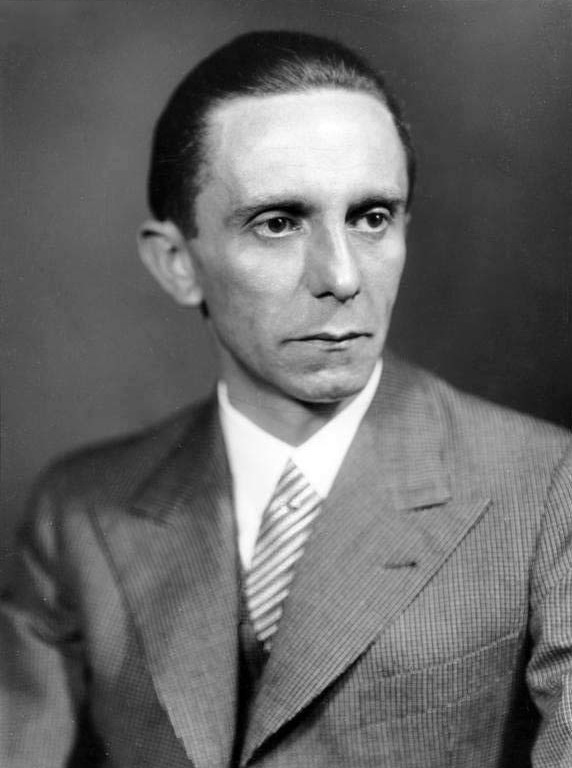
Most Germans were relieved that the conflicts and street fighting of the Weimar era had ended. They were deluged with propaganda orchestrated by the Minister of Public Enlightenment and Propaganda, Joseph Goebbels, who promised peace and plenty for all in a united, Marxist-free country without the constraints of the Treaty of Versailles. The Nazi Party obtained and legitimised power through its initial revolutionary activities, then through manipulation of legal mechanisms, the use of police powers, and by taking control of the state and federal institutions. The first major Nazi concentration camp, initially for political prisoners, was opened at Dachau in 1933. Hundreds of camps of varying size and function were created by the end of the war.
Beginning in April 1933, scores of measures defining the status of Jews and their rights were instituted. These measures culminated in the establishment of the Nuremberg Laws of 1935, which stripped them of their basic rights. The Nazis would take from the Jews their wealth, their right to intermarry with non-Jews, and their right to occupy many fields of labour (such as law, medicine, or education). Eventually the Nazis declared the Jews as undesirable to remain among German citizens and society.
As early as February 1933, Hitler announced that rearmament must begin, albeit clandestinely at first, as to do so was in violation of the Versailles Treaty. On 17 May 1933 Hitler gave a speech before the Reichstag outlining his desire for world peace and accepted an offer from American President Franklin D. Roosevelt for military disarmament, provided the other nations of Europe did the same. When the other European powers failed to accept this offer, Hitler pulled Germany out of the World Disarmament Conference and the League of Nations in October, claiming its disarmament clauses were unfair if they applied only to Germany. In a referendum held in November, 95 per cent of voters supported Germany's withdrawal.
In 1934 Hitler told his military leaders that rearmament needed to be complete by 1942, as by then the German people would require more living space and resources, so Germany would have to start a war of conquest to obtain more territory. The Saarland, which had been placed under League of Nations supervision for 15 years at the end of World War I, voted in January 1935 to become part of Germany. In March 1935, Hitler announced the creation of an air force, and that the Reichswehr would be increased to 550,000 men. Britain agreed to Germany building a naval fleet with the signing of the Anglo-German Naval Agreement on 18 June 1935.
When the Italian invasion of Ethiopia led to only mild protests by the British and French governments, on 7 March 1936 Hitler used the Franco-Soviet Treaty of Mutual Assistance as a pretext to order the army to march 3,000 troops into the demilitarised zone in the Rhineland in violation of the Versailles Treaty. As the territory was part of Germany, the British and French governments did not feel that attempting to enforce the treaty was worth the risk of war. In the one-party election held on 29 March, the Nazis received 98.9 per cent support. In 1936 Hitler signed an Anti-Comintern Pact with the Empire of Japan and a non-aggression agreement with the dictator of Fascist Italy, Benito Mussolini, who was soon referring to a "Rome-Berlin Axis".
Hitler sent military supplies and assistance to the Nationalist forces of General Francisco Franco in the Spanish Civil War, which began in July 1936. The German Condor Legion included a range of aircraft and their crews, as well as a tank contingent. The aircraft of the Legion destroyed the city of Guernica in 1937. The Nationalists were victorious in 1939 and became an informal ally of Nazi Germany.
In February 1938, Hitler emphasised to Austrian Chancellor Kurt Schuschnigg the need for Germany to secure its frontiers. Schuschnigg scheduled a plebiscite regarding Austrian independence for 13 March, but Hitler sent an ultimatum to Schuschnigg on 11 March demanding that he hand over all power to the Austrian Nazi Party or face an invasion. German troops entered Austria the next day, to be greeted with enthusiasm by the populace.
The Republic of Czechoslovakia was home to a substantial minority of Germans, who lived mostly in the Sudetenland. Under pressure from separatist groups within the Sudeten German Party, the Czechoslovak government offered economic concessions to the region. Hitler decided not just to incorporate the Sudetenland into the Reich, but to destroy the country of Czechoslovakia entirely. The Nazis undertook a propaganda campaign to try to generate support for an invasion. Top German military leaders opposed the plan, as Germany was not yet ready for war.
The crisis led to war preparations by Britain, Czechoslovakia, and France (Czechoslovakia's ally). Attempting to avoid war, British Prime Minister Neville Chamberlain arranged a series of meetings, the result of which was the Munich Agreement, signed on 29 September 1938. The Czechoslovak government was forced to accept the Sudetenland's annexation into Germany. Chamberlain was greeted with cheers when he landed in London, saying the agreement brought "peace for our time".
Austrian and Czech foreign exchange reserves were seized by the Nazis, as were stockpiles of raw materials such as metals and completed goods such as weaponry and aircraft, which were shipped to Germany. The Reichswerke Hermann Göring industrial conglomerate took control of steel and coal production facilities in both countries.
In January 1934, Germany signed a non-aggression pact with Poland. In March 1939 Hitler demanded the return of the Free City of Danzig and the Polish Corridor, a strip of land that separated East Prussia from the rest of Germany. The British announced they would come to the aid of Poland if it was attacked. Hitler, believing the British would not take action, ordered an invasion plan should be readied for September 1939. On 23 May, Hitler described to his generals his overall plan of not only seizing the Polish Corridor but greatly expanding German territory eastward at the expense of Poland. He expected this time they would be met by force.
The Germans reaffirmed their alliance with Italy and signed non-aggression pacts with Denmark, Estonia, and Latvia whilst trade links were formalised with Romania, Norway, and Sweden.
04Geography

As a result of their defeat in World War I and the resulting Treaty of Versailles, Germany lost Alsace-Lorraine, Eupen-Malmedy, Northern Schleswig, and Memel. The Saarland became a protectorate of France under the condition that its residents would later decide by referendum which country to join, and Poland became a separate nation and was given access to the sea by the creation of the Polish Corridor, which separated Prussia from the rest of Germany, while Danzig was made a free city.
Germany regained control of the Saarland through a referendum held in 1935 and annexed Austria in the Anschluss of 1938. The Munich Agreement of 1938 gave Germany control of the Sudetenland, and they seized most of Czechoslovakia's remaining territory six months later. Under threat of invasion by sea, Lithuania surrendered the Memel district in March 1939.
Between 1939 and 1941, German forces invaded Poland, Denmark, Norway, France, Luxembourg, the Netherlands, Belgium, Yugoslavia, Greece, and the Soviet Union. Germany annexed parts of northern Yugoslavia in April 1941, while Mussolini ceded Trieste, South Tyrol, and Istria to Germany in 1943.
After the armistice between Italy and the Allies in September 1943, Germany invaded Italy, and Benito Mussolini established the Italian Social Republic as a fascist puppet state. Further north, Germany established the Operational Zone of the Alpine Foothills and the Operational Zone of the Adriatic Littoral. These operational zones were not considered Reich territory, but they were de facto incorporated and Germanized.
Some of the conquered territories were incorporated into Germany as part of Hitler's long-term goal of creating a Greater Germanic Reich. Several areas, such as Alsace-Lorraine, were placed under the authority of an adjacent Gau (regional district). The Reichskommissariate (Reich Commissariats), quasi-colonial regimes, were established in some occupied countries. Areas placed under German administration included the Protectorate of Bohemia and Moravia, Reichskommissariat Ostland (encompassing the Baltic states and Belarus), and Reichskommissariat Ukraine. Conquered areas of Belgium and France were placed under control of the Military Administration in Belgium and Northern France. Belgian Eupen-Malmedy, which had been part of Germany until 1919, was annexed. Part of Poland was incorporated into the Reich, and the General Government was established in occupied central Poland. The governments of Denmark, Norway (Reichskommissariat Norwegen), and the Netherlands (Reichskommissariat Niederlande) were placed under civilian administrations staffed largely by natives. Hitler intended to eventually incorporate many of these areas into the Reich. Germany occupied the Italian protectorate of Albania and the Italian governorate of Montenegro in 1943 and installed a puppet government in occupied Serbia in 1941.
05Politics

The Nazis were a far-right fascist political party that arose during the social and financial upheavals that occurred following the end of World War I. The Party remained small and marginalised, receiving 2.6% of the federal vote in 1928, prior to the onset of the Great Depression in 1929. By 1930 the Party won 18.3% of the federal vote, making it the Reichstag's second largest political party. While in prison after the failed Beer Hall Putsch of 1923, Hitler wrote Mein Kampf, which laid out his plan for transforming German society into one based on race. Nazi ideology brought together elements of antisemitism, racial hygiene, and eugenics, and combined them with pan-Germanism and territorial expansionism with the goal of obtaining more Lebensraum for the Germanic people.
The regime attempted to obtain this new territory by attacking Poland and the Soviet Union, intending to mass-murder or deport the Jews and Slavs living there, who it viewed as being inferior to the Aryan master race and part of a Jewish-Bolshevik conspiracy. The Nazi regime believed that only Germany could defeat the forces of Bolshevism and save humanity from world domination by International Jewry. Other people deemed life unworthy of life by the Nazis included the mentally and physically disabled, Romani people, homosexuals, Jehovah's Witnesses, and social misfits. Additionally, Freemasons were heavily monitored and persecuted.
Influenced by the Völkisch movement, the regime was against cultural modernism and supported the development of an extensive military at the expense of intellectualism. Creativity and art were stifled, except where they could serve as propaganda media. The party used symbols such as the Blood Flag and rituals such as the Nazi Party rallies to foster unity and bolster the regime's popularity.
Hitler ruled Germany autocratically by asserting the Führerprinzip ("leader principle"), which called for absolute obedience by all subordinates. He viewed the government structure as a pyramid, with himself—the infallible leader—at the apex. Party rank was not determined by elections, and positions were filled through appointment by those of higher rank. The party used propaganda to develop a cult of personality around Hitler. Historians such as Kershaw emphasise the psychological impact of Hitler's skill as an orator.
While top officials reported to Hitler and followed his policies, they had considerable autonomy. He expected officials to "work towards the Führer" – to take the initiative in promoting policies and actions in line with party goals and Hitler's wishes, without his involvement in day-to-day decision-making. The government was a disorganised collection of factions led by the party elite, who struggled to amass power and gain the Führer's favour. Hitler's leadership style was to give contradictory orders to his subordinates and to place them in positions where their duties and responsibilities overlapped. In this way he fostered distrust, competition, and infighting among his subordinates to consolidate and maximise his own power.
Successive Reichsstatthalter decrees between 1933 and 1935 abolished the existing Länder (constituent states) of Germany and replaced them with new administrative divisions, the Gaue, governed by Nazi leaders (Gauleiters). The change was never fully implemented, as the Länder were still used as administrative divisions for some government departments such as education. This led to a bureaucratic tangle of overlapping jurisdictions and responsibilities typical of the administrative style of the Nazi regime. The Weimar Republic's federalism was abolished in favour of a highly centralised unitary state.
Jewish civil servants lost their jobs in 1933, except for those who had seen military service in World War I. Members of the Party or party supporters were appointed in their place. As part of the process of Gleichschaltung, the Reich Local Government Law of 1935 abolished local elections, and mayors were appointed by the Ministry of the Interior.
In August 1934, civil servants and members of the military were required to swear an oath of unconditional obedience to Hitler. These laws became the basis of the Führerprinzip, the concept that Hitler's word overrode all existing laws. Any acts that were sanctioned by Hitler—even murder—thus became legal. All legislation proposed by cabinet ministers had to be approved by the office of Deputy Führer Rudolf Hess, who could also veto top civil service appointments.
Most of the judicial system and legal codes of the Weimar Republic remained in place to deal with non-political crimes. The courts issued and carried out far more death sentences than before the Nazis took power. People who were convicted of three or more offences—even petty ones—could be deemed habitual offenders and jailed indefinitely. People such as prostitutes and pickpockets were judged to be inherently criminal and a threat to the community. Thousands were arrested and confined indefinitely without trial.
A new type of court, the Volksgerichtshof ("People's Court"), was established in 1934 to deal with political cases. This court handed out over 5,000 death sentences until its dissolution in 1945. The death penalty could be issued for offences such as being a communist, printing seditious leaflets, or even making jokes about Hitler or other officials. The Gestapo was in charge of investigative policing to enforce Nazi ideology as they located and confined political offenders, Jews, and others deemed undesirable. Political offenders who were released from prison were often immediately re-arrested by the Gestapo and confined in a concentration camp.
The Nazis used propaganda to promulgate the concept of Rassenschande ("race defilement") to justify the need for racial laws. In September 1935, the Nuremberg Laws were enacted. These laws initially prohibited sexual relations and marriages between Aryans and Jews and were later extended to include "Gypsies, Negroes or their bastard offspring". The law also forbade the employment of German women under the age of 45 as domestic servants in Jewish households. The Reich Citizenship Law stated that only those of "German or related blood" could be citizens. Thus Jews and other non-Aryans were stripped of their German citizenship. The law also permitted the Nazis to deny citizenship to anyone who was not supportive enough of the regime. A supplementary decree issued in November defined as Jewish anyone with three Jewish grandparents, or two grandparents if the Jewish faith was followed.
06Military and paramilitary
The unified armed forces of Germany from 1935 to 1945 were called the Wehrmacht (defence force). This included the Heer (army), Kriegsmarine (navy), and the Luftwaffe (air force). From 2 August 1934, members of the armed forces were required to pledge an oath of unconditional obedience to Hitler personally. In contrast to the previous oath, which required allegiance to the constitution of the country and its lawful establishments, this new oath required members of the military to obey Hitler even if they were being ordered to do something illegal. Hitler decreed that the army would have to tolerate and even offer logistical support to the Einsatzgruppen—the mobile death squads responsible for millions of murders in Eastern Europe—when it was tactically possible to do so. Wehrmacht troops also participated directly in the Holocaust by shooting civilians or committing genocide under the guise of anti-partisan operations. The party line was that the Jews were the instigators of the partisan struggle and therefore needed to be eliminated. On 8 July 1941 Heydrich announced that all Jews in the eastern conquered territories were to be regarded as partisans and gave the order for all male Jews between the ages of 15 and 45 to be shot. By August, this was extended to include the entire Jewish population.
In spite of efforts to prepare the country militarily, the economy could not sustain a lengthy war of attrition. A strategy was developed based on the tactic of Blitzkrieg ("lightning war"), which involved using quick coordinated assaults that avoided enemy strong points. Attacks began with artillery bombardment, followed by bombing and strafing runs. Next the tanks would attack and finally the infantry would move in to secure the captured area. Victories continued through mid-1940, but the failure to defeat Britain was the first major turning point in the war. The decision to attack the Soviet Union and the decisive defeat at Stalingrad led to the retreat of the German armies and the eventual loss of the war. The total number of soldiers who served in the Wehrmacht from 1935 to 1945 was around 18.2 million, of whom 5.3 million died.
The Sturmabteilung (SA; Storm Detachment), or Brownshirts, founded in 1921, was the first paramilitary wing of the Nazi Party; their initial assignment was to protect Nazi leaders at rallies and assemblies. They also took part in street battles against the forces of rival political parties and violent actions against Jews and others. Under Ernst Röhm's leadership the SA grew by 1934 to over half a million members—4.5 million including reserves—at a time when the regular army was still limited to 100,000 men by the Versailles Treaty.
Röhm hoped to assume command of the army and absorb it into the ranks of the SA. Hindenburg and Defence Minister Werner von Blomberg threatened to impose martial law if the activities of the SA were not curtailed. Therefore, less than a year and a half after seizing power, Hitler ordered the deaths of the SA leadership, including Rohm. After the purge of 1934, the SA was no longer a major force.
Initially a small bodyguard unit under the auspices of the SA, the Schutzstaffel (SS; Protection Squadron) grew to become one of the largest and most powerful groups in Nazi Germany. Led by Reichsführer-SS Heinrich Himmler from 1929, the SS had over a quarter million members by 1938. Himmler initially envisioned the SS as being an elite group of guards, Hitler's last line of defence. The Waffen-SS, the military branch of the SS, evolved into a second army. It was dependent on the regular army for heavy weaponry and equipment, and most units were under tactical control of the High Command of the Armed Forces (OKW). By the end of 1942, the stringent selection and racial requirements that had initially been in place were no longer followed. With recruitment and conscription based only on expansion, by 1943 the Waffen-SS could not longer claim to be an elite fighting force.
SS formations committed many war crimes against civilians and allied servicemen. From 1935 onward, the SS spearheaded the persecution of Jews, who were rounded up into ghettos and concentration camps. With the outbreak of World War II, the SS Einsatzgruppen units followed the army into Poland and the Soviet Union, where from 1941 to 1945 they murdered more than two million people, including 1.3 million Jews. A third of the Einsatzgruppen members were recruited from Waffen-SS personnel. The SS-Totenkopfverbände (death's head units) ran the concentration camps and extermination camps, where millions more were murdered. Up to 60,000 Waffen-SS men served in the camps.
In 1931 Himmler organised an SS intelligence service which became known as the Sicherheitsdienst (SD; Security Service) under his deputy, Heydrich. This organisation was tasked with locating and arresting communists and other political opponents. Himmler established the beginnings of a parallel economy under the auspices of the SS Economy and Administration Head Office. This holding company owned housing corporations, factories, and publishing houses.
Article sections from Wikipedia (CC BY-SA 4.0). Excerpted for readability.