The Ottoman Empire, also known historically as Turkey or the Turkish Empire, was a state that spanned much of Southeastern Europe, West Asia, and North Africa from the 14th century to the early 20th century, centred in modern-day Turkey. It also controlled parts of southeastern Central Europe between the early 16th and early 18th centuries.
The empire emerged from a beylik, or principality, founded in northwestern Anatolia in c. 1299 by the Turkoman tribal leader Osman I. His successors conquered much of Anatolia and expanded into the Balkans by the mid-14th century, transforming their petty kingdom into a transcontinental empire. The Ottomans ended the Byzantine Empire with the conquest of Constantinople in 1453 by Mehmed II. Further conquests by Selim I led the Sultans to adopt the title of caliph. With its capital at Constantinople and control over a significant portion of the Mediterranean Basin, the Ottoman Empire was at the centre of interactions between the Middle East and Europe for six centuries. Ruling over diverse peoples, the empire granted varying levels of autonomy to its many confessional communities, or millets, to manage their own affairs per Islamic law. During the reign of Suleiman the Magnificent in the 16th century, the Ottoman Empire became a global power.
Modern academic consensus posits that the empire began to decline after defeat in the Second Siege of Vienna in 1683, but continued to maintain a flexible and strong economy, society and military into much of the 18th century. The Ottoman Empire fell behind technologically from the rest of Europe by the late 18th century as imperial authority fragmented. Further defeats from Austria and Russia culminated in the loss of territory, and with rising nationalism after the French Revolution, a number of new states emerged in the Balkans. Following Mahmud II's reign and the Tanzimat reforms over the course of the 19th century, the Ottoman state became more powerful and organised internally as a new Ottoman identity took hold. In the 1876 revolution, the Ottoman Empire attempted constitutional monarchy, before reverting to an absolute monarchy under Abdul Hamid II, following the Great Eastern Crisis.
Over the course of the late 19th century, Ottoman intellectuals known as Young Turks sought to liberalise and rationalise society and politics along Western lines, culminating in the Young Turk Revolution of 1908 led by the Committee of Union and Progress (CUP), which reestablished a constitutional monarchy. However, following the disastrous Balkan Wars, the CUP became increasingly radicalised and embraced Turkish nationalism, leading to a coup d'état in 1913 that established a dictatorship.
In the 19th and in the start of 20th centuries, persecution of Muslims during the Ottoman contraction and in the Russian Empire resulted in large-scale loss of life and mass migration into modern-day Turkey from the Balkans, Caucasus, and Crimea. The CUP joined World War I on the side of the Central Powers. It struggled with internal dissent, especially the Arab Revolt, and engaged in genocide against Armenians, Assyrians, and Greeks. In the aftermath of World War I, the victorious Allied Powers occupied and partitioned the Ottoman Empire, which lost its southern territories to the United Kingdom and France. The successful Turkish War of Independence, led by Mustafa Kemal Atatürk against the occupying Allies, led to the end of the Ottoman sultanate in 1922.
Summary from Wikipedia (CC BY-SA 4.0)
01Etymology

The word Ottoman is an historical anglicisation of the name of Osman I, the founder of the Empire and of the ruling House of Osman (also known as the Ottoman dynasty). Osman's name in turn was the Turkish form of the Arabic name ʿUthmān (عثمان). In Ottoman Turkish, the empire was referred to as Devlet-i ʿAlīye-yi ʿOsmānīye (دولت عليه عثمانیه), lit. 'Sublime Ottoman State', or simply Devlet-i ʿOsmānīye (دولت عثمانيه), lit. 'Ottoman State'.
The Turkish word for Ottoman (Osmanlı) originally referred to the tribal followers of Osman in the 14th century. The word subsequently came to be used to refer to the empire's military-administrative elite. In contrast, the term Turk (Türk) was used to refer to the Anatolian peasant and tribal population and was seen as a disparaging term when applied to urban, educated individuals. In the early modern period, an educated, urban-dwelling Turkish speaker who was not a member of the military-administrative class typically referred to himself neither as an Osmanlı nor as a Türk, but rather as a Rūmī (رومى), or "Roman", meaning an inhabitant of the territory of the former Byzantine Empire in the Balkans and Anatolia. The term Rūmī was also used to refer to Turkish speakers by the other Muslim peoples of the empire and beyond.
In Western Europe, the names Ottoman Empire, Turkish Empire and Turkey were often used interchangeably, with Turkey being increasingly favoured both in formal and informal situations. This dichotomy was officially ended in 1920–1923, when the newly established Ankara-based Turkish government chose Turkey as the sole official name.
02History

As the Rum Sultanate declined in the 13th century, Anatolia was a patchwork of independent Turkish principalities known as the Anatolian Beyliks. One of these, in the Bithynia region on the Byzantine frontier, was led by Osman I (d. 1323/4), a figure of obscure origin from whom the name Ottoman is derived. Osman's early followers were Turkish tribal groups and Byzantine renegades, not all of them Muslim. Osman extended his principality by conquering Byzantine towns along the Sakarya River, and a Byzantine defeat at the Battle of Bapheus in 1302 contributed to his rise. It is not well understood how the early Ottomans came to dominate their neighbours, due to a lack of sources. The Ghaza thesis popular during the 20th century credited their success to rallying religious warriors, but the idea is no longer generally accepted, and no other hypothesis has attracted broad support.
In the century after Osman I, Ottoman rule began to extend over Anatolia and the Balkans. The Byzantine–Ottoman wars, waged in Anatolia in the late 13th century before entering Europe in the mid-14th century, were followed by the Bulgarian–Ottoman wars and the Serbian–Ottoman wars in the mid-14th century. Osman's son, Orhan, captured the northwestern Anatolian city of Bursa in 1326 and made it the new capital, supplanting Byzantine control in the region. The important port of Thessaloniki was captured from the Venetians in 1387 and sacked. The Ottoman victory in Kosovo in 1389 effectively marked the end of Serbian power in the region, paving the way for Ottoman expansion into Europe. The Battle of Nicopolis for the Bulgarian Tsardom of Vidin in 1396, regarded as the last large-scale crusade of the Middle Ages, also failed to stop the Ottomans.
As the Turks expanded into the Balkans, the conquest of Constantinople became a crucial objective. The Ottomans already controlled nearly all former Byzantine lands surrounding the city, but Constantinople's defenses and strategic position on the Bosporus Strait made it difficult to conquer. In 1402, the Byzantines were temporarily relieved when the Turco-Mongol leader Timur, founder of the Timurid Empire, invaded Ottoman Anatolia from the east. In the Battle of Ankara in 1402, Timur defeated Ottoman forces and took Sultan Bayezid I as prisoner, throwing the empire into disorder. The ensuing civil war lasted from 1402 to 1413 as Bayezid's sons fought over succession. It ended when Mehmed I emerged as the sultan.
The Balkan territories lost by the Ottomans after 1402, including Thessaloniki, Macedonia, and Kosovo, were recovered by Murad II between the 1430s and 1450s. On 10 November 1444, Murad repelled the Crusade of Varna by defeating the Hungarian, Polish, and Wallachian armies under Władysław III of Poland and John Hunyadi at the Battle of Varna, although Albanians under Skanderbeg continued to resist. Four years later, John Hunyadi prepared another army of Hungarian and Wallachian forces to attack the Turks, but was again defeated at the Second Battle of Kosovo in 1448.
In modern historiography, there is a direct connection between the rapid Ottoman advances and the Black Death from the mid-14th century onwards. Byzantine territories were exhausted demographically and militarily due to the plague, and this facilitated Ottoman expansion. In addition, slave hunting was a main economic motivation for the Ottomans. Some 21st-century authors re-periodise conquest of the Balkans into the akıncı phase, which spanned 8 to 13 decades, characterised by continuous slave hunting and destruction, followed by administrative integration into the Empire.
The son of Murad II, Mehmed the Conqueror, reorganised both state and military, and on 29 May 1453 conquered Constantinople, ending the Byzantine Empire. Mehmed allowed the Eastern Orthodox Church to maintain its autonomy and land in exchange for accepting Ottoman authority. Due to tension between the states of western Europe and the later Byzantine Empire, most of the Orthodox population accepted Ottoman rule, as preferable to Venetian rule. Albanian resistance was a major obstacle to Ottoman expansion on the Italian peninsula.
In the 15th and 16th centuries, the Ottoman Empire entered a period of expansion. The Empire prospered under the rule of a line of committed and effective Sultans. It flourished economically due to its control of the major overland trade routes between Europe and Asia.
Sultan Selim I (1512–1520) dramatically expanded the eastern and southern frontiers by defeating Shah Ismail of Safavid Iran, in the Battle of Chaldiran. Selim I established Ottoman rule in Egypt by defeating and annexing the Mamluk Sultanate of Egypt and created a naval presence on the Red Sea. After this Ottoman expansion, competition began between the Portuguese Empire and the Ottomans to become the dominant power in the region.
Suleiman the Magnificent (1520–1566) captured Belgrade in 1521, conquered the southern and central parts of the Kingdom of Hungary as part of the Ottoman–Hungarian Wars, and, after his historic victory in the Battle of Mohács in 1526, he established Ottoman rule in the territory of present-day Hungary and other Central European territories. He then laid siege to Vienna in 1529, but failed to take the city. In 1532, he made another attack on Vienna, but was repulsed in the siege of Güns. Transylvania, Wallachia and, intermittently, Moldavia, became tributary principalities of the Empire. In the east, the Ottoman Turks took Baghdad from the Persians in 1535, establishing Ottoman rule in Iraq and gaining naval access to the Persian Gulf. After the end of the Ottoman–Safavid War (1532–1555), the Caucasus became partitioned for the first time between the Safavids and the Ottomans, a status quo that persisted until the Russian conquest of the Caucasus in the 19th century. By this partitioning as signed in the Peace of Amasya, Western Armenia, western Kurdistan, and Western Georgia fell into Ottoman hands, while southern Dagestan, Eastern Armenia, Eastern Georgia, and Azerbaijan remained Persian.
In 1539, a 60,000-strong Ottoman army besieged the Spanish garrison of Castelnuovo on the Adriatic coast; the successful siege cost the Ottomans 8,000 casualties, but Venice agreed to terms in 1540, surrendering most of its empire in the Aegean and the Morea. France and the Ottoman Empire, united by mutual opposition to Habsburg rule, became allies. The French conquests of Nice (1543) and Corsica (1553) occurred as a joint venture between French king Francis I and Suleiman, and were commanded by the Ottoman admirals Hayreddin Barbarossa and Dragut. France supported the Ottomans with an artillery unit during the 1543 Ottoman conquest of Esztergom in northern Hungary. After further advances by the Turks, the Habsburg ruler Ferdinand officially recognised Ottoman ascendancy in Hungary in 1547. Suleiman died of natural causes during the siege of Szigetvár in 1566. Following his death, the Ottomans were said to be declining, although this has been rejected by many scholars. By the end of Suleiman's reign, the Empire spanned approximately 877,888 mi2 (2,273,720 km2), extending over three continents.
The Empire became a dominant naval force, controlling much of the Mediterranean Sea. The Empire was now a major part of European politics. The Ottomans became involved in multi-continental religious wars when Spain and Portugal were united under the Iberian Union. The Ottomans were holders of the Caliph title, meaning they were the leaders of Muslims worldwide. The Iberians were leaders of the Christian crusaders, and so the two fought in a worldwide conflict. There were zones of operations in the Mediterranean and Indian Ocean, where Iberians circumnavigated Africa to reach India and, on their way, wage war upon the Ottomans and their local Muslim allies. Likewise, the Iberians passed through newly-Christianised Latin America and had sent expeditions that traversed the Pacific to Christianise the formerly Muslim Philippines and use it as a base to attack the Muslims in the Far East. In this case, the Ottomans sent armies to aid its easternmost vassal and territory, the Sultanate of Aceh in Southeast Asia.
The Spanish–Ottoman wars took place primarily in the Mediterranean. Barbary corsairs from the North African cities of Algiers, Tunis, and Tripoli, which were nominally part of the Ottoman Empire, captured thousands of merchant ships and raided coastal towns in Europe, enslaving the people they captured.
During the 1600s, the world conflict between the Ottoman Caliphate and Iberian Union was a stalemate since both were at similar population, technology and economic levels. Nevertheless, the success of the Ottoman political and military establishment was compared to the Roman Empire, despite the difference in size, by the likes of contemporary Italian scholar Francesco Sansovino and French political philosopher Jean Bodin.
In the second half of the 16th century, the Ottoman Empire came under increasing strain from inflation and the rapidly rising costs of warfare that were impacting both Europe and the Middle East. These pressures led to a series of crises around the year 1600, placing great strain upon the Ottoman system of government. The empire underwent a series of transformations of its political and military institutions in response to these challenges, enabling it to successfully adapt to the new conditions of the 17th century and remain powerful, both militarily and economically. Historians of the mid-20th century once characterised this period as one of stagnation and decline, but this view is now rejected by the majority of academics.
The discovery of new maritime trade routes by Western European states allowed them to avoid the Ottoman trade monopoly. The Portuguese discovery of the Cape of Good Hope in 1488 initiated a series of Ottoman-Portuguese naval wars in the Indian Ocean throughout the 16th century. Despite the growing European presence in the Indian Ocean, Ottoman trade with the east continued to flourish. Cairo, in particular, benefitted from the rise of Yemeni coffee as a popular consumer commodity. As coffeehouses appeared in cities and towns across the empire, Cairo developed into a major centre for its trade, contributing to its continued prosperity throughout the seventeenth and much of the 18th century.
Under Ivan IV (1533–1584), the Tsardom of Russia expanded into the Volga and Caspian regions at the expense of the Tatar khanates. In 1571, the Crimean khan Devlet I Giray, commanded by the Ottomans, invaded Russia and burned Moscow. The next year, the invasion was repeated but repelled at the Battle of Molodi. The Ottoman Empire and its vassal, the Crimean Khanate, continued to invade Eastern Europe in a series of slave raids, and remained a significant power in Eastern Europe until the end of the 17th century. The Crimean cavalry became indispensable for the Ottomans' campaigns against Russia, Poland, Hungary, and Persia.
The Ottomans decided to conquer Venetian Cyprus and on 22 July 1570, Nicosia was besieged; 50,000 Christians died, and 180,000 were enslaved. On 15 September 1570, the Ottoman cavalry appeared before the last Venetian stronghold in Cyprus, Famagusta. The Venetian defenders held out for 11 months against a force that at its peak numbered 200,000 men with 145 cannons; 163,000 cannonballs struck the walls of Famagusta before it fell to the Ottomans in August 1571. The Siege of Famagusta claimed 50,000 Ottoman casualties. Meanwhile, the Holy League consisting of mostly Spanish and Venetian fleets won a victory over the Ottoman fleet at the Battle of Lepanto (1571), off southwestern Greece; Catholic forces killed over 30,000 Turks and destroyed 200 of their ships.
03Historiographical debate on the Ottoman state

Several historians, such as British historian Edward Gibbon and the Greek historian Dimitri Kitsikis, have argued that after the fall of Constantinople, the Ottoman state took over the machinery of the Byzantine (Roman) state and that the Ottoman Empire was in essence a continuation of the Byzantine Empire under a Turkish Muslim guise. The American historian Speros Vryonis writes that the Ottoman state centred on "a Byzantine-Balkan base with a veneer of the Turkish language and the Islamic religion". Kitsikis and the American historian Heath Lowry posit that the early Ottoman state was a predatory confederacy open to both Byzantine Christians and Turkish Muslims whose primary goal was attaining booty and slaves, rather than spreading Islam, and that Islam only later became the empire's primary characteristic. Other historians have followed the lead of the Austrian historian Paul Wittek, who emphasises the early Ottoman state's Islamic character, seeing it as a "jihad state" dedicated to expanding the Muslim world. Many historians led in 1937 by the Turkish historian Mehmet Fuat Köprülü championed the Ghaza thesis, according to which the early Ottoman state was a continuation of the way of life of the nomadic Turkic tribes who had come from East Asia to Anatolia via Central Asia and the Middle East on a much larger scale. They argued that the most important cultural influences on the Ottoman state came from Persia.
The British historian Norman Stone suggests many continuities between the Byzantine and Ottoman empires, such as that the zeugarion tax of Byzantium became the Ottoman Resm-i çift tax, that the pronoia land-holding system that linked the amount of land one owned with one's ability to raise cavalry became the Ottoman timar system, and that the Ottoman land measurement the dönüm was the same as the Byzantine stremma. Stone also argues that although Sunni Islam was the state religion, the Ottoman state supported and controlled the Eastern Orthodox Church, which in return for accepting that control became the Ottoman Empire's largest land-holder. Despite the similarities, Stone argues that a crucial difference is that the land grants under the timar system were not hereditary at first. Even after they became inheritable, land ownership in the Ottoman Empire remained highly insecure, and the sultan revoked land grants whenever he wished. Stone argued this insecurity in land tenure strongly discouraged Timariots from seeking long-term development of their land, and instead led them to adopt a strategy of short-term exploitation, which had deleterious effects on the Ottoman economy.
04Government
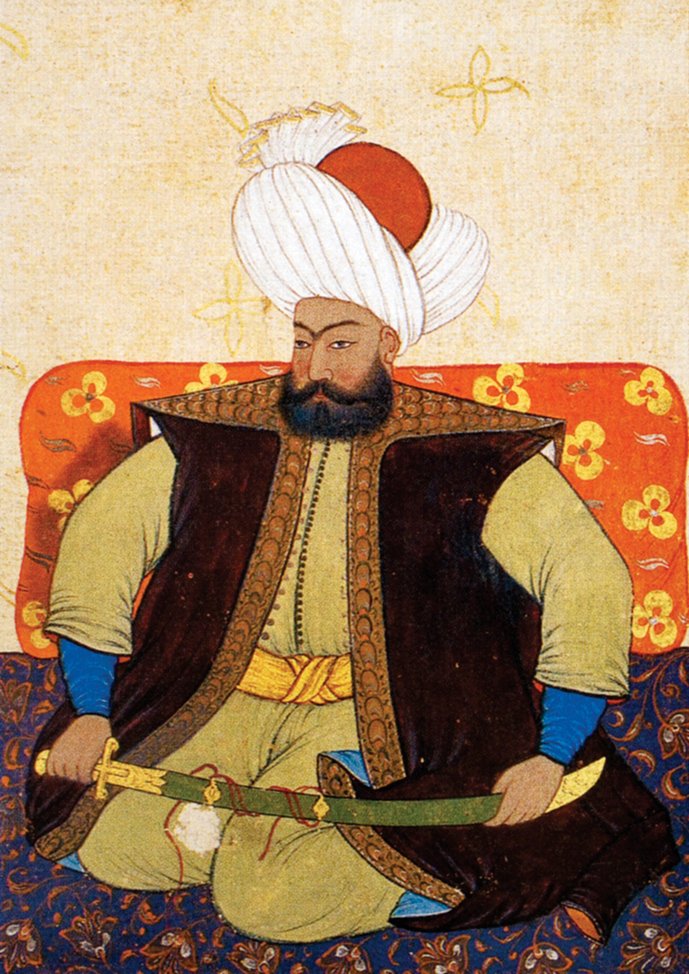
Before the reforms of the 19th and 20th centuries, the state organisation of the Ottoman Empire was a system with two main dimensions, the military administration, and the civil administration. The Sultan was in the highest position in the system. The civil system was based on local administrative units based on the region's characteristics. The state had control over the clergy. Certain pre-Islamic Turkish traditions that had survived the adoption of administrative and legal practices from Islamic Iran remained important in Ottoman administrative circles. According to Ottoman understanding, the state's primary responsibility was to defend and extend the land of the Muslims and to ensure security and harmony within its borders in the overarching context of orthodox Islamic practice and dynastic sovereignty.
The Ottoman Empire, or as a dynastic institution, the House of Osman, was unprecedented and unequalled in the Islamic world for its size and duration. In Europe, only the House of Habsburg had a similarly unbroken line of sovereigns (kings/emperors) from the same family who ruled for so long, and during the same period, between the late 13th and early 20th centuries. The Ottoman dynasty was Turkish in origin. On eleven occasions, the sultan was deposed (replaced by another sultan of the Ottoman dynasty, who were either the former sultan's brother, son or nephew) because he was perceived by his enemies as a threat to the state. There were only two attempts in Ottoman history to unseat the ruling Ottoman dynasty, both failures, which suggests a political system that for an extended period was able to manage its revolutions without unnecessary instability. As such, the last Ottoman sultan Mehmed VI (r. 1918–1922) was a direct patrilineal (male-line) descendant of the first Ottoman sultan Osman I (d. 1323/4), which was unparalleled in both Europe (e.g., the male line of the House of Habsburg became extinct in 1740) and in the Islamic world. The primary purpose of the Imperial Harem was to ensure the birth of male heirs to the Ottoman throne and secure the continuation of the direct patrilineal (male-line) power of the Ottoman sultans in the future generations.
The highest position in Islam, caliph, was claimed by the sultans starting with Selim I, which was established as the Ottoman Caliphate. The Ottoman sultan, pâdişâh or "lord of kings", served as the Empire's sole regent and was considered to be the embodiment of its government, though he did not always exercise complete control. The Imperial Harem was one of the most important powers of the Ottoman court. It was ruled by the valide sultan. On occasion, the valide sultan became involved in state politics. For a time, the women of the Harem effectively controlled the state in what was termed the "Sultanate of Women". New sultans were always chosen from the sons of the previous sultan. The strong educational system of the palace school was geared towards eliminating the unfit potential heirs and establishing support among the ruling elite for a successor. The palace schools, which also educated the future administrators of the state, were not a single track. First, the Madrasa (Medrese) was designated for the Muslims, and educated scholars and state officials according to Islamic tradition. The financial burden of the Medrese was supported by vakifs, allowing children of poor families to move to higher social levels and income. The second track was a free boarding school for the Christians, the Enderûn, which recruited 3,000 students annually from Christian boys between eight and twenty years old from one in forty families among the communities settled in Rumelia or the Balkans, a process known as Devshirme (Devşirme). The Devshirme falls within modern definitions of genocide.
Though the sultan was the supreme monarch, the sultan's political and executive authority was delegated. The politics of the state had a number of advisors and ministers gathered around a council known as Divan. The Divan, in the years when the Ottoman state was still a Beylik, was composed of the elders of the tribe. Its composition was later modified to include military officers and local elites (such as religious and political advisors). Later still, beginning in 1320, a Grand Vizier was appointed to assume certain of the sultan's responsibilities. The Grand Vizier had considerable independence from the sultan with almost unlimited powers of appointment, dismissal, and supervision. Beginning with the late 16th century, sultans withdrew from politics and the Grand Vizier became the de facto head of state.
Throughout Ottoman history, there were many instances in which local governors acted independently, and even in opposition to the ruler. After the Young Turk Revolution of 1908, the Ottoman state became a constitutional monarchy. The sultan no longer had executive powers. A parliament was formed, with representatives chosen from the provinces. The representatives formed the Imperial Government of the Ottoman Empire.
This eclectic administration was apparent even in the diplomatic correspondence of the Empire, which was initially undertaken in the Greek language to the west.
The Tughra were calligraphic monograms, or signatures, of the Ottoman Sultans, of which there were 35. Carved on the Sultan's seal, they bore the names of the Sultan and his father. The statement and prayer, "ever victorious", was also present in most. The earliest belonged to Orhan Gazi. The ornately stylised Tughra spawned a branch of Ottoman-Turkish calligraphy.
The Ottoman legal system accepted the religious law over its subjects. At the same time the Qanun (or Kanun), dynastic law, co-existed with religious law or Sharia. The Ottoman Empire was always organised around a system of local jurisprudence. Legal administration in the Ottoman Empire was part of a larger scheme of balancing central and local authority. Ottoman power revolved crucially around the administration of the rights to land, which gave a space for the local authority to develop the needs of the local millet. The jurisdictional complexity of the Ottoman Empire was aimed to permit the integration of culturally and religiously different groups. The Ottoman system had three court systems: one for Muslims, one for non-Muslims, involving appointed Jews and Christians ruling over their respective religious communities, and the "trade court". The entire system was regulated from above by means of the administrative Qanun, i.e., laws, a system based upon the Turkic Yassa and Töre, which were developed in the pre-Islamic era.
These court categories were not, however, wholly exclusive; for instance, the Islamic courts, which were the Empire's primary courts, could also be used to settle a trade conflict or disputes between litigants of differing religions, and Jews and Christians often went to them to obtain a more forceful ruling on an issue. The Ottoman state tended not to interfere with non-Muslim religious law systems, despite legally having a voice to do so through local governors. The Islamic Sharia law system had been developed from a combination of the Qur'an; the Hadīth, or words of Muhammad; ijmā', or consensus of the members of the Muslim community; qiyas, a system of analogical reasoning from earlier precedents; and local customs. Both systems were taught at the Empire's law schools, which were in Istanbul and Bursa.
The Ottoman Islamic legal system was set up differently from traditional European courts. Presiding over Islamic courts was a Qadi, or judge. Since the closing of the ijtihad, or 'Gate of Interpretation', Qadis throughout the Ottoman Empire focused less on legal precedent, and more with local customs and traditions in the areas that they administered. However, the Ottoman court system lacked an appellate structure, leading to jurisdictional case strategies where plaintiffs could take their disputes from one court system to another until they achieved a ruling that was in their favour.
In the late 19th century, the Ottoman legal system saw substantial reform. This process of legal modernisation began with the Edict of Gülhane of 1839. These reforms included the "fair and public trial[s] of all accused regardless of religion", the creation of a system of "separate competences, religious and civil", and the validation of testimony on non-Muslims. Specific land codes (1858), civil codes (1869–1876), and a code of civil procedure also were enacted.
These reforms were based heavily on French models, as indicated by the adoption of a three-tiered court system. Referred to as Nizamiye, this system was extended to the local magistrate level with the final promulgation of the Mecelle, a civil code that regulated marriage, divorce, alimony, will, and other matters of personal status. In an attempt to clarify the division of judicial competences, an administrative council laid down that religious matters were to be handled by religious courts, and statute matters were to be handled by the Nizamiye courts.
The first military unit of the Ottoman State was an army that was organised by Osman I from the tribesmen inhabiting the hills of western Anatolia in the late 13th century. The military system became an intricate organisation with the advance of the Empire. The Ottoman military was a complex system of recruiting and fief-holding. The main corps of the Ottoman Army included Janissary, Sipahi, Akıncı and Mehterân. The Ottoman army was once among the most advanced fighting forces in the world, being one of the first to use muskets and cannons. The Ottoman Turks began using falconets, which were short but wide cannons, during the Siege of Constantinople. The Ottoman cavalry depended on high speed and mobility rather than heavy armour, using bows and short swords on fast Turkoman and Arabian horses (progenitors of the Thoroughbred racing horse), and often applied tactics similar to those of the Mongol Empire, such as pretending to retreat while surrounding the enemy forces inside a crescent-shaped formation and then making the real attack. The Ottoman army continued to be an effective fighting force throughout the seventeenth and early eighteenth centuries, falling behind the empire's European rivals only during a long period of peace from 1740 to 1768.
The modernisation of the Ottoman Empire in the 19th century started with the military. In 1826 Sultan Mahmud II abolished the Janissary corps and established the modern Ottoman army. He named them as the Nizam-ı Cedid (New Order). The Ottoman army was also the first institution to hire foreign experts and send its officers for training in western European countries. Consequently, the Young Turks movement began when these relatively young and newly trained men returned with their education.
The Ottoman Navy vastly contributed to the expansion of the Empire's territories on the European continent. It initiated the conquest of North Africa, with the addition of Algeria and Egypt to the Ottoman Empire in 1517. Starting with the loss of Greece in 1821 and Algeria in 1830, Ottoman naval power and control over the Empire's distant overseas territories began to decline. Sultan Abdülaziz (reigned 1861–1876) attempted to reestablish a strong Ottoman navy, building the largest fleet after those of Britain and France. The shipyard at Barrow, England, built its first submarine in 1886 for the Ottoman Empire.
However, the collapsing Ottoman economy could not sustain the fleet's strength for long. Sultan Abdülhamid II distrusted the admirals who sided with the reformist Midhat Pasha and claimed that the large and expensive fleet was of no use against the Russians during the Russo-Turkish War. He locked most of the fleet inside the Golden Horn, where the ships decayed for the next 30 years. Following the Young Turk Revolution in 1908, the Committee of Union and Progress sought to develop a strong Ottoman naval force.
05Administrative divisions
The Ottoman Empire was first subdivided into provinces, in the sense of fixed territorial units with governors appointed by the sultan, in the late 14th century.
The eyalet (also pashalik or beylerbeylik) was the territory of office of a beylerbey ("lord of lords" or governor), and was further subdivided into Sanjaks.
The vilayets were introduced with the promulgation of the "Vilayet Law" (Teskil-i Vilayet Nizamnamesi) in 1864, as part of the Tanzimat reforms. Unlike the previous eyalet system, the 1864 law established a hierarchy of administrative units: the vilayet, liva/sanjak/mutasarrifate, kaza and village council, to which the 1871 Vilayet Law added the nahiye.
06Economy
The Ottoman government deliberately pursued a policy for the development of Bursa, Edirne, and Istanbul, successive Ottoman capitals, into major commercial and industrial centres, considering that merchants and artisans were indispensable in creating a new metropolis. To this end, Mehmed and his successor Bayezid, also encouraged and welcomed migration of the Jews from different parts of Europe, who were settled in Istanbul and other port cities like Salonica. In many places in Europe, Jews were suffering persecution at the hands of their Christian counterparts, such as in Spain, after the conclusion of the Reconquista. The tolerance displayed by the Turks was welcomed by the immigrants.
The Ottoman economic mind was closely related to the basic concepts of state and society in the Middle East in which the ultimate goal of a state was consolidation and extension of the ruler's power, and the way to reach it was to get rich resources of revenues by making the productive classes prosperous. The ultimate aim was to increase the state revenues without damaging the prosperity of subjects to prevent the emergence of social disorder and to keep the traditional organisation of the society intact. The Ottoman economy greatly expanded during the early modern period, with particularly high growth rates during the first half of the 18th century. The empire's annual income quadrupled between 1523 and 1748, adjusted for inflation.
The organisation of the treasury and chancery were developed under the Ottoman Empire more than any other Islamic government and, until the 17th century, they were the leading organisation among all their contemporaries. This organisation developed a scribal bureaucracy (known as "men of the pen") as a distinct group, partly highly trained ulama, which developed into a professional body. The effectiveness of this professional financial body stands behind the success of many great Ottoman statesmen.
Modern Ottoman studies indicate that the change in relations between the Ottoman Turks and central Europe was caused by the opening of the new sea routes. It is possible to see the decline in the significance of the land routes to the East as Western Europe opened the ocean routes that bypassed the Middle East and the Mediterranean as parallel to the decline of the Ottoman Empire itself. The Anglo-Ottoman Treaty, also known as the Treaty of Balta Liman that opened the Ottoman markets directly to English and French competitors, can be seen as one of the staging posts along with this development.
By developing commercial centres and routes, encouraging people to extend the area of cultivated land in the country and international trade through its dominions, the state performed basic economic functions in the Empire. But in all this, the financial and political interests of the state were dominant. Within the social and political system they were living in, Ottoman administrators could not see the desirability of the dynamics and principles of the capitalist and mercantile economies developing in Western Europe.
Economic historian Paul Bairoch argues that free trade contributed to deindustrialisation in the Ottoman Empire. In contrast to the protectionism of China, Japan, and Spain, the Ottoman Empire had a liberal trade policy, open to foreign imports. This has origins in capitulations of the Ottoman Empire, dating back to the first commercial treaties signed with France in 1536 and taken further with capitulations in 1673 and 1740, which lowered duties to 3% for imports and exports. The liberal Ottoman policies were praised by British economists, such as John Ramsay McCulloch in his Dictionary of Commerce (1834), but later criticised by British politicians such as Prime Minister Benjamin Disraeli, who cited the Ottoman Empire as "an instance of the injury done by unrestrained competition" in the 1846 Corn Laws debate.
Article sections from Wikipedia (CC BY-SA 4.0). Excerpted for readability.