Poland, officially the Republic of Poland, is a country in Central Europe. It extends from the Baltic Sea in the north to the Sudetes and Carpathian Mountains in the south, and borders Lithuania and Russia to the northeast; Belarus and Ukraine to the east; Slovakia and the Czech Republic to the south; and Germany to the west. The territory has a varied landscape, diverse ecosystems, and a temperate climate. Poland is composed of sixteen voivodeships and is the fifth most populous member state of the European Union (EU), with over 38 million people, and the fifth largest EU country by land area, covering 312,696 km2 (120,733 sq mi). The capital and largest city is Warsaw; other major cities include Kraków, Wrocław, Łódź, Poznań, and Gdańsk.
Prehistoric human activity on Polish soil dates to the Lower Paleolithic, with continuous settlement since the end of the Last Glacial Period. Culturally diverse throughout late antiquity, in the early medieval period the region became inhabited by the West Slavic tribal Polans, who gave Poland its name. The process of establishing statehood coincided with the conversion of a pagan ruler of the Polans to Christianity in 966 under the auspices of the Catholic Church. The Kingdom of Poland emerged in 1025, and in 1569 cemented its long-standing association with Lithuania, thus forming the Polish–Lithuanian Commonwealth. At the time, the Commonwealth was one of the great powers of Europe, with an elective monarchy and a uniquely liberal political system, which adopted Europe's first modern constitution in 1791.
With the passing of the prosperous Polish Golden Age, the country was partitioned by neighbouring states at the end of the 18th century. At the end of World War I in 1918, Poland regained its independence with the founding of the Second Polish Republic, which emerged victorious in various conflicts of the interbellum period. In September 1939, the invasion of Poland by Germany and the invasion by the Soviet Union marked the beginning of World War II, which resulted in the Holocaust and millions of Polish casualties as well as extensive border and demographic changes. Forced into the Eastern Bloc in the global Cold War, the Polish People's Republic was a signatory of the Warsaw Pact. Through the 1980 emergence and contributions of the Solidarity movement, which initiated the fall of the Iron Curtain, the communist government was dissolved and Poland as the first of the communist countries re-established itself as a liberal democracy in 1989, and held free elections.
Poland is a parliamentary republic with its bicameral legislature comprising the Sejm and the Senate. Considered a middle power and a regional power, it is a developed country with a developed market and high-income economy. In terms of nominal GDP, it is the 21st largest economy in the world and the sixth in the European Union, and fifth largest by PPP-adjusted GDP in the EU. Poland has free university education and universal health care. It has 18 UNESCO World Heritage Sites, over 100 Historic Monuments and 23 national parks. Poland is a founding member of the United Nations, and a member of the Council of Europe, World Trade Organization, OECD, NATO, and EU (including the Schengen Area).
Summary from Wikipedia (CC BY-SA 4.0)
01Etymology
The native Polish name for Poland is Polska. It is believed that the name derives from the Polans, a West Slavic tribe who inhabited the Warta River basin of present-day Greater Poland region (6th–8th century CE). The tribe's name stems from the Proto-Slavic noun pole, meaning field, which itself originates from the Proto-Indo-European word *pleh₂- indicating flatland. The etymology alludes to the topography of the region and the flat landscape of Greater Poland. During the Middle Ages, the Latin form Polonia was widely used throughout Europe.
The country's alternative archaic name is Lechia and its root syllable remains in official use in several languages, notably Hungarian, Lithuanian, and Persian. The exonym possibly derives from either Lech, a legendary ruler of the Lechites, or from the Lendians, a West Slavic tribe that dwelt on the south-easternmost edge of Lesser Poland. The origin of the tribe's name lies in the Old Polish word lęda (plain). Initially, both names Lechia and Polonia were used interchangeably when referring to Poland by chroniclers during the Middle Ages.
02History

The first Stone Age archaic humans and Homo erectus species settled what was to become Poland approximately 500,000 years ago, though the ensuing hostile climate prevented early humans from founding more permanent encampments. The arrival of Homo sapiens and anatomically modern humans coincided with the climatic discontinuity at the end of the Last Glacial Period (Northern Polish glaciation 10,000 BC), when Poland became habitable. Neolithic excavations indicated broad-ranging development in that era; the earliest evidence of European cheesemaking (5500 BC) was discovered in Polish Kuyavia, and the Bronocice pot is incised with the earliest known depiction of what may be a wheeled vehicle (3400 BC).
The period spanning the Bronze Age and the Early Iron Age (1300 BC–500 BC) was marked by an increase in population density, establishment of palisaded settlements (gords) and the expansion of Lusatian culture. A significant archaeological find from the protohistory of Poland is a fortified settlement at Biskupin, attributed to the Lusatian culture of the Late Bronze Age (mid-8th century BC).
Throughout antiquity (400 BC–500 AD), many distinct ancient populations inhabited the territory of present-day Poland, notably Celtic, Scythian, Germanic, Sarmatian, Baltic and Slavic tribes. Furthermore, archaeological findings confirmed the presence of Roman Legions sent to protect the amber trade. The Polish tribes emerged following the second wave of the Migration Period around the 6th century AD; they were Slavic and may have included assimilated remnants of peoples that earlier dwelled in the area. Beginning in the early 10th century, the Polans would come to dominate other Lechitic tribes in the region, initially forming a tribal federation and later a centralised monarchical state.
Poland began to form into a recognisable unitary and territorial entity around the middle of the 10th century under the Piast dynasty. In 966, the ruler of the Polans, Mieszko I, accepted Western Christianity under the auspices of the Roman Catholic Church which was tantamount to the adoption of Christianity by Poland. In 968, a missionary bishopric was established in Poznań. An incipit titled Dagome iudex first defined Poland's geographical boundaries with its capital in Gniezno and affirmed that its monarchy was under the protection of the Apostolic See. The country's early origins were described by Gallus Anonymus in Gesta principum Polonorum, the oldest Polish chronicle. An important national event of the period was the martyrdom of Saint Adalbert, who was killed by Prussian pagans in 997 and whose remains were reputedly bought back for their weight in gold by Mieszko's successor, Bolesław I the Brave.
In 1000, at the Congress of Gniezno, Bolesław I the Brave obtained the right of investiture from Otto III, Holy Roman Emperor, who assented to the creation archdioceses in Gniezno and three new dioceses on Polish lands in Kraków, Kołobrzeg, and Wrocław. Also, Otto bestowed upon Bolesław royal regalia and a replica of the Holy Lance, which were later used at his coronation as the first King of Poland c. 1025, when Bolesław received permission for his coronation from Pope John XIX. Bolesław also expanded the realm considerably by seizing parts of German Lusatia, Czech Moravia, Upper Hungary, and southwestern regions of the Kievan Rus'.
The transition from paganism in Poland was not instantaneous and resulted in the pagan reaction of the 1030s. In 1031, Mieszko II Lambert lost the title of king and fled amidst the violence. The unrest led to the transfer of the capital to Kraków in 1038 by Casimir I the Restorer. In 1076, Bolesław II re-instituted the office of king, but was banished in 1079 for murdering his opponent, Bishop Stanislaus. In 1138, the country fragmented into five principalities when Bolesław III Wrymouth divided his lands among his sons. These were Lesser Poland, Greater Poland, Silesia, Masovia, and Sandomierz, with intermittent hold over Pomerania. In 1226, Konrad I of Masovia invited the Teutonic Knights to aid in combating the Baltic Prussians; a decision that later led to centuries of warfare with the Knights.
In the first half of the 13th century, Henry I the Bearded and Henry II the Pious aimed to unite the fragmented dukedoms, but the Mongol invasion and the death of Henry II in battle hindered the unification. As a result of the devastation which followed, depopulation and the demand for craft labour spurred a migration of German and Flemish settlers into Poland, which was encouraged by the Polish dukes. In 1264, the Statute of Kalisz introduced unprecedented autonomy for the Polish Jews, who came to Poland fleeing persecution elsewhere in Europe.
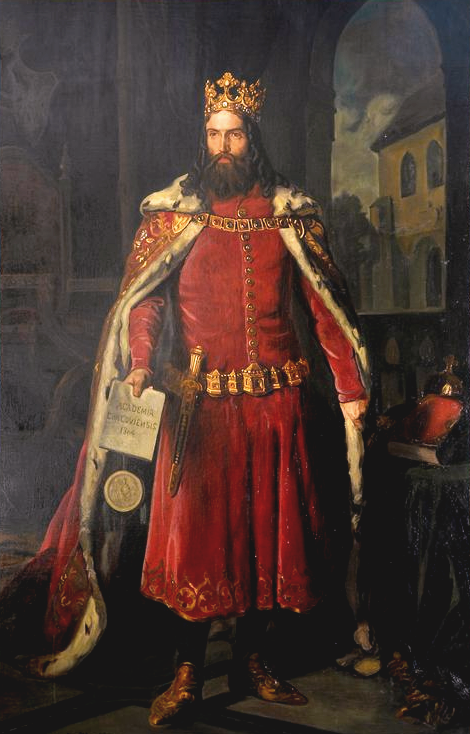
In 1320, Władysław I the Short became the first king of a reunified Poland since Przemysł II in 1296, and the first to be crowned at Wawel Cathedral in Kraków. Beginning in 1333, the reign of Casimir III the Great was marked by developments in castle infrastructure, army, judiciary and diplomacy. Under his authority, Poland transformed into a major European power; he instituted Polish rule over Ruthenia in 1340 and imposed quarantine that prevented the spread of Black Death. In 1364, Casimir inaugurated the University of Kraków, one of the oldest institutions of higher learning in Europe. Upon his death in 1370, the Piast dynasty came to an end. He was succeeded by his closest male relative, Louis of Anjou, who ruled Poland, Hungary, and Croatia in a personal union. Louis' younger daughter Jadwiga became Poland's first female monarch in 1384.
In 1386, Jadwiga of Poland entered a marriage of convenience with Władysław II Jagiełło, the Grand Duke of Lithuania, thus forming the Jagiellonian dynasty and the Polish–Lithuanian union which spanned the late Middle Ages and early Modern Era. The partnership between Poles and Lithuanians brought the vast multi-ethnic Lithuanian territories into Poland's sphere of influence and proved beneficial for its inhabitants, who coexisted in one of the largest European political entities of the time.
In the Baltic Sea region, the struggle of Poland and Lithuania with the Teutonic Knights continued and culminated at the Battle of Grunwald in 1410, where a combined Polish–Lithuanian army inflicted a decisive victory against them. In 1466, after the Thirteen Years' War, king Casimir IV Jagiellon gave royal consent to the Peace of Thorn, which created the future Duchy of Prussia under Polish suzerainty and forced the Prussian rulers to pay tributes. The Jagiellonian dynasty also established dynastic control over the kingdoms of Bohemia (1471 onwards) and Hungary. In the south, Poland confronted the Ottoman Empire (at the Varna Crusade) and the Crimean Tatars, and in the east helped Lithuania to combat Russia.
Poland was developing as a feudal state, with a predominantly agricultural economy and an increasingly powerful landed nobility that confined the population to private manorial farmstead known as folwarks. In 1493, John I Albert sanctioned the creation of a bicameral parliament (the Sejm) composed of a lower house, the chamber of deputies, and an upper house, the chamber of senators. The Nihil novi act adopted by the Polish General Sejm in 1505, transferred most of the legislative power from the monarch to the parliament, an event which marked the beginning of the period known as Golden Liberty, when the state was ruled by the seemingly free and equal Polish nobles.
The 16th century saw Protestant Reformation movements making deep inroads into Polish Christianity, which resulted in the establishment of policies promoting religious tolerance, unique in Europe at that time. This tolerance allowed the country to avoid the religious turmoil and wars of religion that beset Europe. In Poland, Nontrinitarian Christianity became the doctrine of the so-called Polish Brethren, who separated from their Calvinist denomination and became the co-founders of global Unitarianism.
The European Renaissance evoked under Sigismund I the Old and Sigismund II Augustus a sense of urgency in the need to promote a cultural awakening. During the Polish Golden Age, the nation's economy and culture flourished. The Italian-born Bona Sforza, daughter of the Duke of Milan and queen consort to Sigismund I, made considerable contributions to architecture, cuisine, language and court customs at Wawel Castle.
The Union of Lublin of 1569 established the Polish–Lithuanian Commonwealth, a unified federal state with an elective monarchy that was largely governed by the nobility. The latter coincided with a period of prosperity. The Polish-dominated union thereafter became a leading power and a major cultural entity, exercising political control over parts of Central, Eastern, Southeastern and Northern Europe. The Polish–Lithuanian Commonwealth occupied approximately 1 million km2 (390,000 sq mi) at its peak and was the largest state in Europe. Simultaneously, Poland imposed Polonisation policies in newly acquired territories which were met with resistance from ethnic and religious minorities.
In 1573, Henry de Valois of France, the first elected king, approbated the Henrician Articles which obliged future monarchs to respect the rights of nobles. When he left Poland to become King of France, his successor, Stephen Báthory, led a successful campaign in the Livonian War, granting Poland more lands across the eastern shores of the Baltic Sea. State affairs were then headed by Jan Zamoyski, the Crown Chancellor. Stephen's successor, Sigismund III, defeated a rival Habsburg electoral candidate, Archduke Maximilian III, in the War of the Polish Succession (1587–1588). In 1592, Sigismund succeeded his father John Vasa, in Sweden. The Polish-Swedish union endured until 1599, when he was deposed by the Swedes.
In 1609, Sigismund invaded Russia which was engulfed in a civil war, and a year later the Polish winged hussar units under Stanisław Żółkiewski occupied Moscow for two years after defeating the Russians at Klushino. Sigismund also countered the Ottoman Empire in the southeast; at Khotyn in 1621 Jan Karol Chodkiewicz achieved a decisive victory against the Turks, which ushered the downfall of Sultan Osman II. Sigismund's long reign in Poland coincided with the Silver Age. The liberal Władysław IV effectively defended Poland's territorial possessions but after his death the vast Commonwealth began declining from internal disorder and constant warfare.
In 1648, the Polish hegemony over Ukraine sparked the Khmelnytsky Uprising, followed by the decimating Swedish Deluge during the Second Northern War, and Prussia's independence in 1657. In 1683, John III Sobieski re-established military prowess when he halted the advance of an Ottoman Army into Europe at the Battle of Vienna. The Saxon era, under Augustus II and Augustus III, saw neighbouring powers grow in strength at the expense of Poland. Both Saxon kings faced opposition from Stanisław Leszczyński during the Great Northern War (1700) and the War of the Polish Succession (1733).
The royal election of 1764 resulted in the elevation of Stanisław II Augustus Poniatowski to the monarchy. His candidacy was extensively funded by his sponsor and former lover, Empress Catherine II of Russia. The new king maneuvered between his desire to implement necessary modernising reforms, and the necessity to remain at peace with surrounding states. His ideals led to the formation of the 1768 Bar Confederation, a rebellion directed against the Poniatowski and all external influence, which ineptly aimed to preserve Poland's sovereignty and privileges held by the nobility. The failed attempts at government restructuring as well as the domestic turmoil provoked its neighbours to invade.
In 1772, the First Partition of the Commonwealth by Prussia, Russia, and Austria took place, an act which the Partition Sejm, under considerable duress, eventually ratified as a fait accompli.
03Geography

Poland covers an administrative area of 312,722 km2 (120,743 sq mi), and is the ninth-largest country in Europe. Approximately 311,895 km2 (120,423 sq mi) of the country's territory consists of land, 2,041 km2 (788 sq mi) is internal waters and 8,783 km2 (3,391 sq mi) is territorial sea. Topographically, the landscape of Poland is characterised by diverse landforms, water bodies and ecosystems. The central and northern region bordering the Baltic Sea lie within the flat Central European Plain, but its south is hilly and mountainous. The average elevation above the sea level is estimated at 173 metres.
The country has a coastline spanning 770 km (480 mi); extending from the shores of the Baltic Sea, along the Bay of Pomerania in the west to the Gulf of Gdańsk in the east. The beach coastline is abundant in sand dune fields or coastal ridges and is indented by spits and lagoons, notably the Hel Peninsula and the Vistula Lagoon, which is shared with Russia. The largest Polish island on the Baltic Sea is Wolin, located within Wolin National Park. Poland also shares the Szczecin Lagoon and the Usedom island with Germany.
The mountainous belt in the extreme south of Poland is divided into two major mountain ranges; the Sudetes in the west and the Carpathians in the east. The highest part of the Carpathian massif are the Tatra Mountains, extending along Poland's southern border. Poland's highest point is the northwestern summit of Rysy at 2,500 metres (8,202 ft) in elevation, located in the Tatras. The highest summit of the Sudetes massif is Mount Śnieżka at 1,603.3 metres (5,260 ft), shared with the Czech Republic. The lowest point in Poland situated at Marzęcino on the Vistula Fens, which is 2.2 metres (7.2 ft) below sea level.
In Poland, Trójmorski Wierch is one of the six tripoints of the European watershed.
Poland's longest rivers are the Vistula, the Oder, the Warta, and the Bug. The country also possesses one of the highest densities of lakes in the world, numbering around ten thousand and mostly concentrated in the north-eastern region of Masuria, within the Masurian Lake District. The largest lakes, covering more than 100 square kilometres (39 sq mi), are Śniardwy and Mamry, and the deepest is Lake Hańcza at 108.5 metres (356 ft) in depth.
The climate of Poland is temperate transitional, and varies from oceanic in the north-west to continental in the south-east. The mountainous southern fringes are situated within an alpine climate. Poland is characterised by warm summers, with a mean temperature of around 20 °C (68.0 °F) in July, and moderately cold winters averaging −1.2 °C (29.8 °F) in January. In summer, maximum temperatures can reach 40 °C (104.0 °F), while in winter in the Tatra Mountains and Bieszczady Mountains they can even drop below −30 °C (−22.0 °F).
The warmest and sunniest part of Poland is Lower Silesia in the southwest and the coldest region is the northeast corner, around Suwałki and Olecko where the climate is affected by cold fronts from Scandinavia and Siberia. Precipitation is more frequent during the summer months, with highest rainfall recorded from June to September.
There is a considerable fluctuation in day-to-day weather and the arrival of a particular season can differ each year. Climate change and other factors have further contributed to interannual thermal anomalies and increased temperatures; the average annual air temperature between 2011 and 2020 was 9.33 °C (48.8 °F), around 1.11 °C higher than in the 2001–2010 period. Winters are also becoming increasingly drier, with less snowfall.
Phytogeographically, Poland belongs to the Central European province of the Circumboreal Region within the Boreal Kingdom. The country has four Palearctic ecoregions – Central, Northern, Western European temperate broadleaf and mixed forest, and the Carpathian montane conifer. Forests occupy 31% of Poland's land area, the largest of which is the Lower Silesian Wilderness. The most common deciduous trees found across the country are oak, maple, and beech; the most common conifers are pine, spruce, and fir. An estimated 69% of all forests are coniferous.
The flora and fauna in Poland is that of Continental Europe, with the wisent, white stork and white-tailed eagle designated as national animals, and the red common poppy being the unofficial floral emblem. Among the most protected species is the European bison, Europe's heaviest land animal, as well as the Eurasian beaver, the brown bear, the northern lynx, the Eurasian wolf and the Tatra chamois. The region was also home to the extinct aurochs, the last individual dying in Poland in 1627. Game animals such as red deer, roe deer, and wild boar are found in most woodlands. Poland is also a significant breeding ground for migratory birds and hosts around one quarter of the global population of white storks.
Around 315,100 hectares (1,217 sq mi), equivalent to 1% of Poland's territory, is protected within 23 Polish national parks, two of which – Białowieża and Bieszczady – are UNESCO World Heritage Sites. There are 123 areas designated as landscape parks, along with numerous nature reserves and other protected areas under the Natura 2000 network.
04Government and politics

Poland is a unitary parliamentary republic and a representative democracy, with a president as the head of state. The executive power is exercised further by the Council of Ministers and the prime minister who acts as the head of government. The council's individual members are selected by the prime minister, approved by parliament and sworn in by the president. The head of state is elected by popular vote for a five-year term. The current president is Karol Nawrocki and the prime minister is Donald Tusk.
Poland's legislative assembly is a bicameral parliament consisting of a 460-member lower house (Sejm) and a 100-member upper house (Senate). The Sejm is elected under proportional representation according to the d'Hondt method for vote–seat conversion. The Senate is elected under the first-past-the-post electoral system, with one senator being returned from each of the one hundred constituencies. The Senate has the right to amend or reject a statute passed by the Sejm, but the Sejm may override the Senate's decision with a majority vote.
With the exception of ethnic minority parties, only candidates of political parties receiving at least 5% of the total national vote can enter the Sejm. Both the lower and upper houses of parliament in Poland are elected for a four-year term and each member of the Polish parliament is guaranteed parliamentary immunity. Under current legislation, a person must be 21 years of age or over to assume the position of deputy, 30 or over to become senator and 35 to run in a presidential election.
Members of the Sejm and Senate jointly form the National Assembly of the Republic of Poland. The National Assembly, headed by the marshal of the Sejm, or marshal of the Senate in their absence, is formed on three occasions – when a new president takes the oath of office; when an indictment against the president is brought to the State Tribunal; and for a declaration of the president's permanent incapacity to exercise his duties due to the state of his health.
According to International IDEA's Global State of Democracy (GSoD) Indices and Democracy Tracker, Poland performs in the mid-range on overall democratic measures, with particular weaknesses in civic engagement and judicial independence.
Poland is divided into 16 provinces or states known as voivodeships. As of 2022, the voivodeships are subdivided into 380 counties (powiats), which are further fragmented into 2,477 municipalities (gminas). Major cities normally have the status of both gmina and powiat. The provinces are largely founded on the borders of historic regions, or named for individual cities. Administrative authority at the voivodeship level is shared between a government-appointed governor (voivode), an elected regional assembly (sejmik) and a voivodeship marshal, an executive elected by the assembly.
The Constitution of Poland is the enacted supreme law, and Polish judicature is based on the principle of civil rights, governed by the code of civil law. The current democratic constitution was adopted by the National Assembly of Poland on 2 April 1997; it guarantees a multi-party state with freedoms of religion, speech and gatherings, prohibits the practices of forced medical experimentation, torture or corporal punishment, and acknowledges the inviolability of the home, the right to form trade unions, and the right to strike.
The judiciary in Poland is composed of the Supreme Court as the country's highest judicial organ, the Supreme Administrative Court for the judicial control of public administration, Common Courts (District, Regional, Appellate) and the Military Court. The Constitutional and State Tribunals are separate judicial bodies, which rule the constitutional liability of people holding the highest offices of state and supervise the compliance of statutory law, thus protecting the Constitution. Judges are nominated by the National Council of the Judiciary and are appointed for life by the president. With the approval of the Senate, the Sejm appoints an ombudsman for a five-year term to guard the observance of social justice.
Poland has a low homicide rate at 0.7 murders per 100,000 people, as of 2018. Rape, assault and violent crime remain at a very low level. The country has imposed strict regulations on abortion, which is permitted only in cases of rape, incest or when the woman's life is in danger; congenital disorder is not covered by the law, prompting some women to seek abortion abroad.
Historically, the most significant Polish legal act is the Constitution of 3 May 1791. Instituted to redress long-standing political defects of the federative Polish–Lithuanian Commonwealth and its Golden Liberty, it was the first modern constitution in Europe and influenced many later democratic movements across the globe. In 1918, the Second Polish Republic became one of the first countries to introduce universal women's suffrage.
Poland is a middle power and a regional power in Europe. It has a total of 53 representatives in the European Parliament as of 2024. Warsaw serves as the headquarters for Frontex, the European Union's agency for external border security as well as ODIHR, one of the principal institutions of the OSCE. Apart from the European Union, Poland has been a member of NATO, the United Nations, the World Trade Organization and regional alliances such as the Visegrád Group, the Weimar Triangle and the Polish-led Three Seas Initiative.
In recent years, Poland significantly strengthened its relations with the United States, becoming one of its closest allies and strategic partners in Europe. Historically, Poland maintained strong cultural and political ties with Hungary and France.
The Polish Armed Forces are composed of five branches – the Land Forces, the Navy, the Air Force, the Special Forces and the Territorial Defence Force. The military is subordinate to the Ministry of National Defence of the Republic of Poland. However, its commander-in-chief in peacetime is the president, who nominates officers, the Minister for National Defence and the chief of staff. Polish military tradition is generally commemorated by the Armed Forces Day, celebrated annually on 15 August. In July 2024, the Polish Armed Forces had a combined strength of 216,100 active soldiers, making it the largest standing army in the European Union and the third largest in NATO.
Poland ranks 14th in the world in terms of military expenditures; the country allocated 4.12% of its total GDP on military spending, equivalent to approximately US$35 billion in 2024. From 2022, Poland initiated a programme of mass modernisation of its armed forces, in close cooperation with American, South Korean and local Polish defence manufacturers concentrated in the Polish Armaments Group. Also, the Polish military is set to increase its size to 250,000 enlisted and officers, and 50,000 Territorial Defence Force. According to SIPRI, the country exported €487 million worth of arms and armaments to foreign countries in 2020.
Compulsory military service for men was discontinued in 2008. Polish military doctrine reflects the same defensive nature as that of its NATO partners and the country actively hosts NATO's military exercises. The Polish Special Forces, consisting of six units (Grom, Formoza, Agat, Nil, Commandos Military Unit, Airborne Special Operations Unit), have the authority to command full-scale as well as joint NATO operations, with special forces from all NATO member states. Since 1953, the country has been a large contributor to various United Nations peacekeeping missions, and currently maintains military presence in the Middle East, Africa, the Baltic states and southeastern Europe. Moreover, there are approximately 10,000 troops from the United States Armed Forces stationed across Poland. From 2024, Poland also provides mandatory firearms training for pupils in primary and secondary schools.
Law enforcement in Poland is performed by several agencies which are subordinate to the Ministry of Interior and Administration – the State Police (Policja), assigned to investigate crimes or transgression; the Municipal City Guard, which maintains public order; and several specialised agencies, such as the Polish Border Guard. Municipal guards are primarily headed by provincial, regional or city councils; individual guards are not permitted to carry firearms unless instructed by the superior commanding officer. Security service personnel conduct regular patrols in both large urban areas or smaller suburban localities.
Emergency services in Poland consist of the emergency medical services, search and rescue units of the Polish Armed Forces and State Fire Service. Emergency medical services in Poland are operated by local and regional governments, but are a part of the centralised national agency – the National Medical Emergency Service (Państwowe Ratownictwo Medyczne). Thanks to its location, Poland is a country essentially free from the threat of natural disasters such as earthquakes, volcanic eruptions, tornadoes and tropical cyclones. However, floods have occurred in low-lying areas from time to time during periods of extreme rainfall, for example during the 2010 Central European floods.
The Internal Security Agency (ABW, or ISA in English) is the chief counterintelligence instrument safeguarding Poland's internal security, along with Agencja Wywiadu (AW) which identifies threats and collects secret information abroad. The Central Investigation Bureau of Police (CBŚP) and the Central Anticorruption Bureau (CBA) are responsible for countering organised crime and corruption in state and private institutions.
05Economy
Poland has a social market economy and is a regional economic power in East-Central Europe. As of 2025, the country's gross domestic product (GDP) is the sixth largest in the European Union by nominal standards, the fifth largest by purchasing power parity, and ranks 20th globally. It is one of the fastest growing within the Union and reached a developed market status in 2018. The unemployment rate published by Eurostat in 2023 amounted to 2.8%, which was the second-lowest in the EU. As of 2023, around 62% of the employed population works in the service sector, 29% in manufacturing, and 8% in the agricultural sector, thus manifesting a highly diversified economy. Although Poland is a member of the European single market, the country has not adopted the Euro as legal tender and maintains its own currency – the Polish złoty (zł, PLN).
Poland is a regional European leader in terms of foreign direct investment and possesses around 40 percent of the 500 biggest companies in the region by revenues whilst maintaining a high globalisation rate and relatively high economic competitiveness. The country's largest firms compose the WIG20 and WIG30 stock market indexes, which are traded on the Warsaw Stock Exchange. The Central Statistical Office estimated that in 2014 there were 1,437 Polish corporations with interests in 3,194 foreign entities. Poland also has the largest banking sector in East-Central Europe, with 32.3 branches per 100,000 adults. The monetary policy is determined by the National Bank of Poland (NBP), which controls the issuing of the national currency. It was the only European economy to have avoided the recession of 2008. Since 2019, workers under the age of 26 are exempt from paying the income tax.
The country is the 19th largest exporter of goods and services in the world. Exports of goods and services are valued at approximately 58% of GDP, as of 2023. Poland's largest trade partners are Germany, the United Kingdom, the Czech Republic, France, Italy, the Netherlands, and the United States. Among its lead exports are motor cars, buses, and vehicle-related accessories, machinery, electronics, electric batteries, home appliances, furniture, cosmetics, military equipment, and tobacco as well as materials such as silver, copper, steel, coal, zinc, tar, and coke. In 2023, the country produced 1300 tonnes of silver and was the 5th largest silver producer globally. As of May 2026, Poland holds the world's 11th largest gold reserve, estimated at 582 tonnes.
In 2020, the total value of the tourism industry in Poland was 104.3 billion PLN, then equivalent to 4.5% of the Polish GDP. Tourism contributes considerably to the overall economy and makes up a relatively large proportion of the country's service market. Nearly 200,000 people were employed in the accommodation and catering (hospitality) sector in 2020. In 2021, Poland ranked 12th most visited country in the world by international arrivals.
Tourist attractions in Poland range from the mountains in the south to the beaches on the Baltic Sea in the north. Many trail of rich architectural and cultural heritage. Among the most recognisable landmarks are Old Towns in Kraków, Warsaw, Wrocław (dwarf statues), Gdańsk, Poznań, Lublin, Toruń and Zamość as well as museums, zoological gardens, theme parks and the Wieliczka Salt Mine, with its labyrinthine tunnels, underground lake and chapels carved by miners out of rock salt beneath the ground. There are over 100 castles in the country, largely within the Lower Silesian Voivodeship (including the Piast Castles Trail), and also on the Trail of the Eagles' Nests; the largest castle in the world by land area is situated in Malbork. The German Auschwitz concentration camp in Oświęcim, and the Skull Chapel in Kudowa-Zdrój constitute dark tourism. Regarding nature based travel, notable sites include the Masurian Lake District and Białowieża Forest in the east; on the south Karkonosze, the Table Mountains, the Pieniny and the Tatra Mountains, where Rysy and the Eagle's Path trail are located. The Bieszczady Mountains lie in the extreme south-east.
Transport in Poland is provided by means of rail, road, marine shipping and air travel. The country is part of EU's Schengen Area and is an important transport hub due to its strategic geographical position in Central Europe. Some of the longest European routes, including the E30 and E40, run through Poland. The country has a good network of highways consisting of express roads and motorways. As of August 2023, Poland has the world's 21st-largest road network, maintaining over 5,000 km (3,100 mi) of highways in use. In larger cities, public transport is heavily utilised; Poland is one of Europe's largest bus and tram manufacturers, and hosts one of the biggest tram and light rail transit systems.
In 2022, the nation had 19,393 kilometres (12,050 mi) of railway track, the third longest in the European Union after Germany and France. Polish State Railways (PKP) is the dominant railway operator, with certain major voivodeships or urban areas possessing their own commuter and regional rail. Poland has a number of international airports, the largest of which is Warsaw Chopin Airport. It is the primary global hub for LOT Polish Airlines, the country's flag carrier.
Seaports exist all along Poland's Baltic coast, with most freight operations using Świnoujście, Police, Szczecin, Kołobrzeg, Gdynia, Gdańsk and Elbląg as their base. The Port of Gdańsk is the only port in the Baltic Sea adapted to receive oceanic vessels. Polferries and Unity Line are the largest Polish ferry operators, with the latter providing roll-on/roll-off and train ferry services to Scandinavia.
The electricity generation sector in Poland is largely fossil-fuel–based. Coal production in Poland is a major source of employment and the largest source of the nation's greenhouse gas emissions. Many power plants nationwide use Poland's position as a major European exporter of coal to their advantage by continuing to use coal as the primary raw material in the production of their energy. The three largest Polish coal mining firms (Węglokoks, Kompania Węglowa and JSW) extract around 100 million tonnes of coal annually. After coal, Polish energy supply relies significantly on natural gas and oil.
The new Energy Policy of Poland until 2040 (EPP2040) would reduce the share of coal and lignite in electricity generation by 25% from 2017 to 2030. The plan involves deploying new nuclear plants, increasing energy efficiency, and decarbonising the Polish transport system in order to reduce greenhouse gas emissions and prioritise long-term energy security. In March 2026, PEJ submitted an application for a permit to build a nuclear power plant.
Over the course of history, the Polish people have made considerable contributions in the fields of science, technology and mathematics. Perhaps the most renowned Pole to support this theory was Nicolaus Copernicus, who triggered the Copernican Revolution by placing the Sun rather than the Earth at the centre of the universe. He also derived a quantity theory of money, which made him a pioneer of economics. Copernicus' achievements and discoveries are considered the basis of Polish culture and cultural identity. Poland was ranked 39th in the Global Innovation Index in 2025.
Poland's tertiary education institutions; traditional universities, as well as technical, medical, and economic institutions, employ around tens of thousands of researchers and staff members. There are hundreds of research and development institutes. However, in the 19th and 20th centuries many Polish scientists worked abroad; one of the most important of these exiles was Maria Skłodowska-Curie, a physicist and chemist who lived much of her life in France. In 1925, she established Poland's Radium Institute.
In the first half of the 20th century, Poland was a flourishing centre of mathematics. Outstanding Polish mathematicians formed the Lwów School of Mathematics (with Stefan Banach, Stanisław Mazur, Hugo Steinhaus, Stanisław Ulam) and Warsaw School of Mathematics (with Alfred Tarski, Kazimierz Kuratowski, Wacław Sierpiński and Antoni Zygmund). Numerous mathematicians, scientists, chemists or economists emigrated due to historic vicissitudes, among them Benoit Mandelbrot, Leonid Hurwicz, Alfred Tarski, Joseph Rotblat and Nobel Prize laureates Roald Hoffmann, Georges Charpak and Tadeusz Reichstein.
06Demographics
Poland has a population of approximately 38.2 million as of 2021, and is the ninth-most populous country in Europe, as well as the fifth-most populous member state of the European Union. It has a population density of 122 inhabitants per square kilometre (320 inhabitants/mi2). The total fertility rate was estimated at 1.2 children born to a woman in 2023, which is among the world's lowest. Furthermore, Poland's population is aging significantly, and the country has a median age of 42.2.
Around 60% of the country's population lives in urban areas or major cities and 40% in rural zones. In 2020, 50.2% of Poles resided in detached dwellings and 44.3% in apartments. The most populous administrative province or state is the Masovian Voivodeship and the most populous city is the capital, Warsaw, at 1.8 million inhabitants with a further 2–3 million people living in its metropolitan area. The metropolitan area of Katowice is the largest urban conurbation with a population between 2.7 million and 5.3 million residents. Population density is higher in the south of Poland and mostly concentrated in Upper Silesia, between the cities of Wrocław and Kraków.
In the 2011 Polish census, 37,310,341 people reported Polish identity, 846,719 Silesian, 232,547 Kashubian and 147,814 German. Other identities were reported by 163,363 people (0.41%) and 521,470 people (1.35%) did not specify any nationality. Official population statistics do not include migrant workers who do not possess a permanent residency permit or Karta Polaka. More than 1.7 million Ukrainian citizens worked legally in Poland in 2017. The number of migrants is rising steadily; the country approved 504,172 work permits for foreigners in 2021 alone.
According to the 2021 census, ethnic Poles comprise 98.84% of the population, including people who declared Polish heritage alone (96.28%) or both Polish and another ethnicity (2.56%) as responders were allowed to select up to two ethnicities. People who declared only non-Polish ethnicities made up 1.13% of the population and people who did not report their ethnicity numbered 0.03%. The province with the highest percentage of ethnic Poles was the Holy Cross Voivodeship (99.70%), and the region with the lowest share of ethnic Poles was the Silesian Voivodeship (95.49%).
Polish is the official and predominant spoken language in Poland, and is one of the official languages of the European Union. It is also a second language in parts of neighbouring Lithuania, where it is taught in Polish-minority schools. Contemporary Poland is a linguistically homogeneous nation, with 97% of respondents declaring Polish as their mother tongue. There are currently 15 minority languages in Poland, including one recognised regional language, Kashubian, which is spoken by approximately 100,000 people on a daily basis in the northern regions of Kashubia and Pomerania. Poland also recognises secondary administrative languages or auxiliary languages in bilingual municipalities, where bilingual signs and placenames are commonplace. According to the Centre for Public Opinion Research, around 32% of Polish citizens declared knowledge of the English language in 2015.
According to the 2021 census, 71.3% of all Polish citizens adhere to the Catholic Church, with 6.9% identifying as having no religion and 20.6% refusing to answer.
Poland is one of the most religious countries in Europe, where Catholicism remains a part of national identity and Polish-born Pope John Paul II is widely revered. In 2015, 61.6% of respondents outlined that religion is of high or very high importance. However, church attendance has greatly decreased in recent years; only 28% of Catholics attended mass weekly in 2021, down from around half in 2000. According to The Wall Street Journal, "Of [the] more than 100 countries studied by the Pew Research Center in 2018, Poland was secularising the fastest, as measured by the disparity between the religiosity of young people and their elders."
Freedom of religion in Poland is guaranteed by the Constitution, and Poland's concordat with the Holy See enables the teaching of religion in public schools. Historically, the Polish state maintained a high degree of religious tolerance and provided asylum for refugees fleeing religious persecution in other parts of Europe. Poland hosted Europe's largest Jewish diaspora, and the country was a centre of Ashkenazi Jewish culture and traditional learning until the Holocaust.
Contemporary religious minorities include Eastern Orthodox Church, Protestants, including Lutherans of the Evangelical-Augsburg Church, Pentecostals in the Pentecostal Church in Poland, Adventists in the Seventh-day Adventist Church. Other smaller Christian denominations include Eastern Catholics, Mariavites, Evangelicalism denominations. Other religions include Jehovah's Witnesses, Jews, Muslims (Tatars), and neopagans, some of whom are members of the Native Polish Church.
Medical service providers and hospitals in Poland are subordinate to the Ministry of Health; it provides administrative oversight and scrutiny of general medical practice and is obliged to maintain a high standard of hygiene and patient care. Poland has a universal healthcare system based on an all-inclusive insurance system; state subsidised healthcare is available to all citizens covered by the general health insurance programme of the National Health Fund (NFZ). Private medical complexes exist nationwide; over 50% of the population uses both public and private sectors.
According to the Human Development Report from 2020, the average life expectancy at birth is 79 years (around 75 years for an infant male and 83 years for an infant female); the country has a low infant mortality rate (4 per 1,000 births). In 2019, Poland was the 15th-largest importer of medications and pharmaceutical products. In the same year, the principal cause of death was ischemic heart disease; diseases of the circulatory system accounted for 45% of all deaths. Moreover, the increasing rate of childhood obesity in Poland is one of the fastest in Europe. Health professionals warn that if these rapid upward trajectories continue, the current generation of children could be the first in modern history to have a shorter life expectancy than their parents due to obesity-related complications like type 2 diabetes and hypertension.
The Jagiellonian University founded in 1364 by Casimir III in Kraków was the first institution of higher learning established in Poland, and is one of the oldest universities still in continuous operation. Poland's Commission of National Education (Komisja Edukacji Narodowej), established in 1773, was the world's first state ministry of education. In 2018, the Programme for International Student Assessment, coordinated by the Organisation for Economic Co-operation and Development, placed Poland's educational output as one of the highest in the OECD, ranking 5th by student attainment and 6th by student performance in 2022.
The framework for primary, secondary and higher tertiary education are established by the Ministry of Education and Science. One year of kindergarten is compulsory for six-year-olds. Primary education traditionally begins at the age of seven, although children aged six can attend at the request of their parents or guardians. Elementary school spans eight grades and secondary schooling is dependent on student preference – a four-year high school (liceum), a five-year technical school (technikum) or various vocational studies (szkoła branżowa) can be pursued by individual pupils. A liceum or technikum is concluded with a maturity exit exam (matura), which must be passed in order to apply for a university or other institutions of higher learning.
In Poland, there are over 500 university-level institutions, with numerous faculties. The University of Warsaw and Warsaw Polytechnic, the University of Wrocław, Adam Mickiewicz University in Poznań and the University of Technology in Gdańsk are among the most prominent. There are three conventional academic degrees in Poland – licencjat or inżynier (first cycle), magister (second cycle) and doktor (third cycle qualification).
Article sections from Wikipedia (CC BY-SA 4.0). Excerpted for readability.