Prehistoric Egypt and Predynastic Egypt was the period of time starting at the first human occupation of the region and ending at the First Dynasty of Egypt around 3100 BC.
At the end of prehistory, "Predynastic Egypt" is traditionally defined as the period from the final part of the Neolithic period beginning c. 6210 BC to the end of the Naqada III period c. 3000 BC. The dates of the Predynastic period were first defined before widespread archaeological excavation of Egypt took place, and recent finds indicating a gradual Predynastic development have led to controversy over when exactly the Predynastic period ended. Thus, various terms such as "Protodynastic period", "Zero Dynasty" or "Dynasty 0" are used to name the part of the period which might be characterized as Predynastic by some and Early Dynastic by others.
The Predynastic period is generally divided into cultural eras, each named after the place where a certain type of Egyptian settlement was first discovered. However, the same gradual development that characterizes the Protodynastic period is present throughout the entire Predynastic period, and individual "cultures" must not be interpreted as separate entities but as largely subjective divisions used to facilitate study of the entire period.
The vast majority of Predynastic archaeological finds have been in Upper Egypt, because the silt of the Nile River was more heavily deposited at the Delta region, completely burying most Delta sites long before modern times.
Summary from Wikipedia (CC BY-SA 4.0)
01Paleolithic

It is theorized that Egypt has been inhabited by humans (including archaic humans) for over a million (and probably over 2 million) years, though the evidence for early occupation of Egypt is sparse and fragmentary. The oldest archaeological finds in Egypt, stone tools belonging to the Oldowan industry, are poorly dated. These tools are succeeded by those belonging to the Acheulean industry. The youngest Achulean sites in Egypt date to around 400,000–300,000 years ago.
During the Late Pleistocene, when Egypt was occupied by modern humans, several archaeological industries are recognised including the Silsilian, Fakhurian, Afian, Kubbaniyan, Idfuan-Shuwikhatian, and the Isnan industries.
Some of the oldest known structures were discovered in Egypt by archaeologist Waldemar Chmielewski along the southern border near Wadi Halfa, Sudan, at the Arkin 8 site. Chmielewski dated the structures to 100,000 BC. The remains of the structures are oval depressions about 30 cm deep and 2 × 1 meters across. Many are lined with flat sandstone slabs which served as tent rings supporting a dome-like shelter of skins or brush. This type of dwelling provided a place to live, but if necessary, could be taken down easily and transported. They were mobile structures—easily disassembled, moved, and reassembled—providing hunter-gatherers with semi-permanent habitation.
Aterian tool-making reached Egypt c. 42,000 BP.
The Khormusan industry in Egypt began between 42,000 and 32,000 BP. Khormusans developed tools not only from stone but also from animal bones and hematite. They also developed small arrow heads resembling those of Native Americans, but no bows have been found. The end of the Khormusan industry came around 16,000 B.C. with the appearance of other cultures in the region, including the Gemaian.
The Late Paleolithic in Egypt started around 32,000 BP. The Nazlet Khater skeleton was found in 1980 and given an age of 33,000 years in 1982, based on nine samples ranging between 35,100 and 30,360 years old. This specimen is the only complete modern human skeleton so far found from the earliest Late Stone Age in Africa.
The Fakhurian late Paleolithic industry in Upper Egypt, showed that a homogenous population existed in the Nile-Valley during the late Pleistocene. Studies of the skeletal material showed they were in the range of variation found in the Wadi Halfa, Jebel Sahaba and fragments from the Kom Ombo populations.
The site of Wadi Kubbaniya in Upper Egypt was inhabited during the Late Paleolithic. Archaeological excavations at the site have found the remains of a number of crops, including barley and wheat. It is believed that the site was seasonally occupied, with the population responding to the annual inundation of the Nile River. The inhabitants of this settlement primarily lived around the dune field that dominates much of the landscape. A variety of plant remains, lithic tools, hearths, and grinding stones have all been uncovered during excavations at the site.
02Mesolithic (c. 20000 to 6000 BC)

The Halfan and Kubbaniyan, two closely related industries, flourished along the Upper Nile Valley. Halfan sites are found in the far north of Sudan, whereas Kubbaniyan sites are found in Upper Egypt. For the Halfan, only four radiocarbon dates have been produced. Schild and Wendorf (2014) discard the earliest and latest as erratic and conclude that the Halfan existed c. 22.5-22.0 ka cal BP (22,500-22,000 calibrated years before present). People survived on a diet of large herd animals and the Khormusan tradition of fishing. Greater concentrations of artifacts indicate that they were not bound to seasonal wandering, but settled for longer periods. The Halfan culture was derived in turn from the Khormusan, which depended on specialized hunting, fishing, and collecting techniques for survival. The primary material remains of this culture are stone tools, flakes, and a multitude of rock paintings.
The Sebilian culture began around 13,000 BC and vanished around 10,000 BC. In Egypt, analyses of pollen found at archaeological sites indicate that the people of the Sebilian culture (also known as the Esna culture) were gathering grains, though domesticated seeds were not found. It has been hypothesized that the sedentary lifestyle practiced by these grain gatherers led to increased warfare, which was detrimental to sedentary life and brought this period to an end.
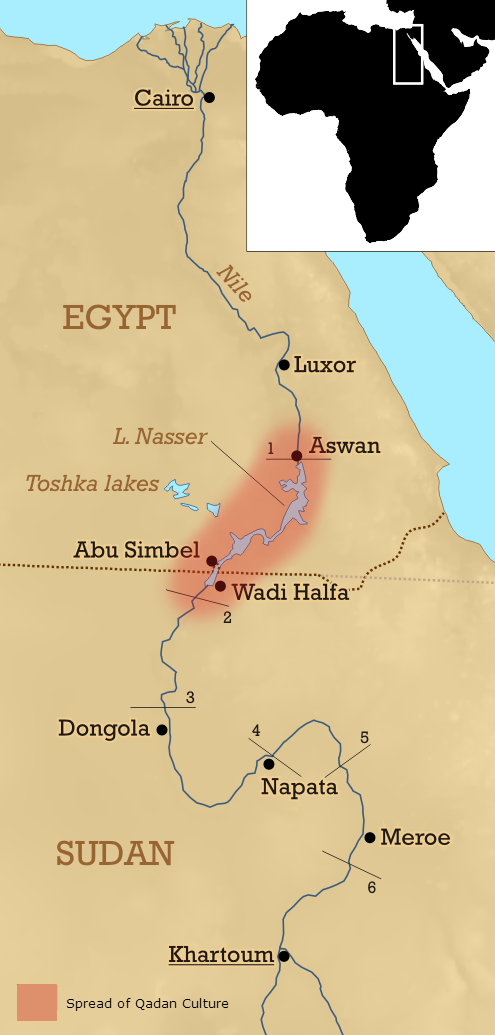
The Qadan culture (13,000–9,000 BC) was a Mesolithic industry that, archaeological evidence suggests, originated in Upper Egypt (present-day south Egypt) approximately 15,000 years ago. The Qadan subsistence mode is estimated to have persisted for approximately 4,000 years. It was characterized by hunting, as well as a unique approach to food gathering that incorporated the preparation and consumption of wild grasses and grains. Systematic efforts were made by the Qadan people to water, care for, and harvest local plant life, but grains were not planted in ordered rows.
Around twenty archaeological sites in Upper Nubia give evidence for the existence of the Qadan culture's grain-grinding culture. Its makers also practiced wild grain harvesting along the Nile during the beginning of the Sahaba Daru Nile phase, when desiccation in the Sahara caused residents of the Libyan oases to retreat into the Nile valley. Among the Qadan culture sites is the Jebel Sahaba cemetery, which has been dated to the Mesolithic.
Qadan peoples were the first to develop sickles and they also developed grinding stones independently to aid in the collecting and processing of these plant foods prior to consumption. However, there are no indications of the use of these tools after 10,000 BC, when hunter-gatherers replaced them.
03Pre-Dynastic Egypt (c. 6000-3000 BC)
The term "Pre-Dynastic" often cover the subsequent Neolithic as well as the Chalcolithic periods, starting circa 6000-5500 BC.
Early evidence for Neolithic cultures in the Nile Valley are generally located in the north of Egypt, exhibiting well-developed stages of Neolithic subsistence, including the cultivation of crops and sedentism, as well as pottery production from the late 6th Millennium BC onwards.
The natural scientist Frederick Falkenburger in 1947, based on a sample set of around 1,800 prehistoric Egyptian crania, noted great heterogeneity amongst his samples. Falkenburger categorized them based on the nasal index, overall head and face form, taking into account width, eye socket structure, amongst other given indicators. He divided and characterized the skulls into four types: Cro-Magnon type, "Negroid" type, Mediterranean type, and mixed types resulting from the mixture of the aforementioned groups. Similarly, the craniometrics of early Egyptians were according to the physician and anthropologist Eugene Strouhal in 1971, designated as either Cro-Magnon of North Africa, Mediterranean, "Negroid" of East Africa, and intermediate/mixed.
According to professor Fekhri A. Hassan, the peopling of the Egyptian Nile Valley from archaeological and biological data, was the result of a complex interaction between coastal northern Africans, "neolithic" Saharans, Nilotic hunters, and riverine proto-Nubians with some influence and migration from the Levant (Hassan, 1988).
Egypt was one of the first areas to adopt the Neolithic package emerging from West Asia as early as the 6th millennium BCE. In particular, goats and sheep, which are not indigenous to Africa, were introduced from the Neolithic Levant around 6000 BCE, probably through the Sinai Peninsula, followed by a rapid spread. Population genetics in the Nile Valley observed a marked change around this period, as shown by odontometric and dental tissue changes. Cultural exchange and trade between the two regions, including Egypt-Mesopotamia relations, then continued through the 4th millennium BCE, as shown by the transfer of Mesopotamian Late Uruk period features to the Nile Valley of the later Predynastic Period. Migration flows from Mesopotamia accompanied such cultural exchanges, possibly through the sea routes of the Mediterranean and the Red Sea or through yet un-sampled intermediaries in the Levant, which could explain the relative sparsity of genetic influence from known Chalcolithic/Bronze Age Levantine populations.
Faiyum B culture, also called Qarunian due to being of the Lake Qarun or Qaroun area is an Epipalaeolithic (also called Mesolithic) culture and predates Faiyum A culture. No pottery has been found, with blade types being both plain and microlithic blades. A set of gouges and arrow-heads suggests it may have had contact with the Sahara (c. 6500 to - 5190 BC).
Maciej Henneberg (1989) documented a remote 8,000 year old female skull from the Qarunian. It showed closest affinity to Wadi Halfa, modern African groups and Aboriginal Australians, being quite different from Epipalaeolithic materials of Northern Africa usually labelled as Mechta-Afalou (Paleo-Berber) or the later Proto-Mediterranean types (Capsian). The skull still had an intermediate position, being gracile, but possessing large teeth and a heavy set jaw. Similar results would later be found by a short report from SOY Keita in 2021, showing affinities with the Qarunian skull and the Teita series.
Dating to about 5600-4400 BC of the Faiyum Neolithic,
continued expansion of the desert forced the early ancestors of the Egyptians to settle around the Nile more permanently, adopting increasingly sedentary lifestyles. The Faiyum A industry is the earliest farming culture in the Nile Valley.
Archaeological deposits that have been found are characterized by concave base projectile points and pottery. Around 6210 BC, Neolithic settlements appear all over Egypt. Some studies based on morphological, genetic, and archaeological data have attributed these settlements to migrants from the Fertile Crescent in the Near East returning during the Egyptian and North African Neolithic, bringing agriculture to the region.
Studies in anthropology and post-cranial data has linked the earliest farming populations at Faiyum, Merimde, and El-Badari, to Near Eastern populations. The archaeological data also suggests that Near Eastern domesticates were incorporated into a pre-existing foraging strategy and only slowly developed into a full-blown lifestyle. Finally, the names for the Near Eastern domesticates imported into Egypt were not Sumerian or Proto-Semitic loan words.
However, some scholars have disputed this view and cited linguistic, physical anthropological, archaeological and genetic data which does not support the hypothesis of a mass migration from the Levant during the prehistoric period. According to historian William Stiebling and archaeologist Susan N. Helft, this view posits that the ancient Egyptians are the same original population group as Nubians and other Saharan populations, with some genetic input from Arabian, Levantine, North African, and Indo-European groups who have known to have settled in Egypt during its long history. On the other hand, Stiebling and Helft acknowledge that the genetic studies of North African populations generally suggest a big influx of Near Eastern populations during the Neolithic Period or earlier. They also added that there have only been a few studies on ancient Egyptian DNA to clarify these issues.
Egyptologist Ian Shaw (2003) wrote that "anthropological studies suggest that the predynastic population included a mixture of racial types (Negroid, Mediterranean and European)", but it is the skeletal material at the beginning of the pharaonic period that has proven to be most controversial. He said according to some scholars there may have been a much slower period of demographic change, than previously hypothesized rapid conquests of people coming into Egypt from the East. It probably involved the gradual infiltration of a different physical type from Syria-Palestine, via the eastern Delta.
Weaving is evidenced for the first time during the Faiyum A Period. People of this period, unlike later Egyptians, buried their dead very close to, and sometimes inside, their settlements.
Although archaeological sites reveal very little about this time, an examination of the many Egyptian words for "city" provides a hypothetical list of causes of Egyptian sedentarism. In Upper Egypt, terminology indicates trade, protection of livestock, high ground for flood refuge, and sacred sites for deities.
From about 5000 to 4200 BC the Merimde culture, so far only known from Merimde Beni Salama, a large settlement site at the edge of the Western Delta, flourished in Lower Egypt. The culture has strong connections to the Faiyum A culture as well as the Levant. People lived in small huts, produced a simple undecorated pottery and had stone tools. Cattle, sheep, goats and pigs were held. Wheat, sorghum and barley were planted. The Merimde people buried their dead within the settlement and produced clay figurines. The first life-sized Egyptian head made of clay comes from Merimde.
The community at Merimde Beni Salama was primarily sedentary. Archaeological stratification shows that the site had been continuously inhabited for several centuries, with people during that time conducting trade with regions outside of the Nile Valley. The settlement itself was home to several large communal storage pits, and the inhabitants resided in sturdy structures that were constructed with mud slabs. Not much is known about the details surrounding Merimde society, but the site provides little evidence to suggest a pronounced level of socioeconomic differentiation between individuals. Additionally, the culture’s stone tools appear to show a degree of standardization and organization, with the majority of lithics found at the site being classified as bifacially carved core tools.
The El Omari culture is known from a small settlement near modern Cairo. People seem to have lived in huts, but only postholes and pits survive. The pottery is undecorated. Stone tools include small flakes, axes and sickles. Metal was not yet known. Their sites were occupied from 4000 BC to the Archaic Period (3,100 BC).
The Maadi culture (also called Buto Maadi culture) is the most important Lower Egyptian prehistoric culture dated about 4000–3500 BC, and contemporary with Naqada I and II phases in Upper Egypt. The culture is best known from the site Maadi near Cairo, as well as the site of Buto, but is also attested in many other places in the Delta to the Faiyum region. This culture was marked by development in architecture and technology. It also followed its predecessor cultures when it comes to undecorated ceramics.
Copper was known, and some copper adzes have been found. The pottery is hand-made; it is simple and undecorated. Presence of black-topped red pots indicate contact with the Naqada sites in the south. Many imported vessels from Palestine have also been found. Black basalt stone vessels were also used.
The culture primarily relied on the cultivation of crops such as wheat and barley, as well as herding animals such as cattle, sheep, and pigs. People lived in small huts, partly dug into the ground. The dead were buried in cemeteries, but with few burial goods. The Maadi culture was replaced by the Naqada III culture; whether this happened by conquest or infiltration is still an open question.
The developments in Lower Egypt in the times previous to the unification of the country have been the subject of considerable disputes over the years. The recent excavations at Tell el-Farkha, Sais, and Tell el-Iswid have clarified this picture to some extent. As a result, the Chalcolithic Lower Egyptian culture is now emerging as an important subject of study.
The Tasian culture appeared around 4500 BC in Upper Egypt. This culture group is named for the burials found at Der Tasa, on the east bank of the Nile between Asyut and Akhmim. It is believed that the Tasian culture primary resided in the desert, and often interacted with other nearby cultures in the Nile Valley, such as the Badarian. The Tasian culture group is notable for producing the earliest blacktop-ware, a type of red and brown pottery that is colored black on the top portion and interior. This pottery is vital to the dating of Predynastic Egypt. Because all dates for the Predynastic period are tenuous at best, WMF Petrie developed a system called sequence dating by which the relative date, if not the absolute date, of any given Predynastic site can be ascertained by examining its pottery.
As the Predynastic period progressed, the handles on pottery evolved from functional to ornamental. The degree to which any given archaeological site has functional or ornamental pottery can also be used to determine the relative date of the site. Since there is little difference between Tasian ceramics and Badarian pottery, the Tasian Culture overlaps the Badarian range significantly. From the Tasian period onward, it appears that Upper Egypt was influenced strongly by the culture of Lower Egypt. Archaeological evidence has suggested that "the Tasian and Badarian Nile Valley sites were a peripheral network of earlier African cultures of around which Badarian, Saharan, Nubian, and Nilotic peoples regularly circulated." Bruce Williams, Egyptologist, has argued that the Tasian culture was significantly related to the Sudanese-Saharan traditions from the Neolithic era which extended from regions north of Khartoum to locations near Dongola in Sudan.
The Badarian culture, from about 4400 to 4000 BC, is named for the Badari site near Der Tasa. It followed the Tasian culture, but was so similar that many consider them one continuous period.
04Lower Nubia

Lower Nubia is located within the borders of modern-day Egypt but is south of the border of Ancient Egypt, which was located at the first cataract of the Nile.
Nabta Playa was once a large internally drained basin in the Nubian Desert, located approximately 800 kilometers south of modern-day Cairo or about 100 kilometers west of Abu Simbel in southern Egypt, 22.51° north, 30.73° east. Today the region is characterized by numerous archaeological sites. The Nabta Playa archaeological site, one of the earliest of the Egyptian Neolithic Period, is dated to circa 7500 BC. Also, excavations from Nabta Playa, located about 100 km west of Abu Simbel for example, suggest that the Neolithic inhabitants of the region included migrants from both Sub-Saharan Africa and the Mediterranean area. According to Christopher Ehret, the material cultural indicators correspond with the conclusion that the inhabitants of the wider Nabta Playa region were a Nilo-Saharan-speaking population.
Egyptian historian H. A. A. Ibrahim examined the megalithic complex of Nabta Playa, Upper Egypt to understand the cultural and population influences of the Holocene on pre-dynastic Egypt. She cited an anthropological study confirming the appearance of a Sub-Saharan high status child in a ceremonial center and concluded that the megalithic structures had close resemblance to comparable structures in the Sahelian and Sub-Saharan regions of Africa.
05Timeline
Late Paleolithic, from 40th millennium BC
Aterian tool-making
Semi-permanent dwellings in Wadi Halfa
Tools made from animal bones, hematite, and other stones
Neolithic, from 11th millennium BC
c. 10,500 BC: Wild grain harvesting along the Nile, grain-grinding culture creates world's earliest stone sickle blades roughly at end of Pleistocene
c. 8000 BC: Migration of peoples to the Nile, developing a more centralized society and settled agricultural economy
c. 7500 BC: Importing animals from Asia to Sahara
c. 7000 BC: Agriculture—animal and cereal—in East Sahara
c. 7000 BC: in Nabta Playa deep year-round water wells dug, and large organized settlements designed in planned arrangements
c. 6000 BC: Rudimentary ships (rowed, single-sailed) depicted in Egyptian rock art
c. 5500 BC: Stone-roofed subterranean chambers and other subterranean complexes in Nabta Playa containing buried sacrificed cattle
c. 5000 BC: Alleged archaeoastronomical stone megalith in Nabta Playa.
c. 5000 BC: Badarian: furniture, tableware, models of rectangular houses, pots, dishes, cups, bowls, vases, figurines, combs
c. 5000 BC: Cosmetics
c. 4500 BC: Donkey domestication
c. 4400 BC: finely-woven linen fragment
From 4th millennium BC, inventing has become prevalent
4th millennium BC: Gerzean tomb-building, including underground rooms and burial of furniture and amulets
c. 4000 BC: early Naqadan trade
c. 4000 BC: Conifer wood imported from West Asia
c. 4000 BC: Faience, some of the world's earliest-known glazed ceramic beads
c. 3900 BC: An aridification event in the Sahara leads to human migration to the Nile Valley
c. 3500 BC: Lapis lazuli imported from Badakshan and / or Mesopotamia
c. 3500 BC: Senet, world's oldest (confirmed) board game
c. 3400 BC: (Meteoric) iron works, mortar (masonry)
c. 3300 BC: Double reed instruments and lyres (see Music of Egypt)
c. 3100 BC: Pharaoh Narmer, or Menes, or possibly Hor-Aha unified Upper and Lower Egypt
Article sections from Wikipedia (CC BY-SA 4.0). Excerpted for readability.