East Asia by year
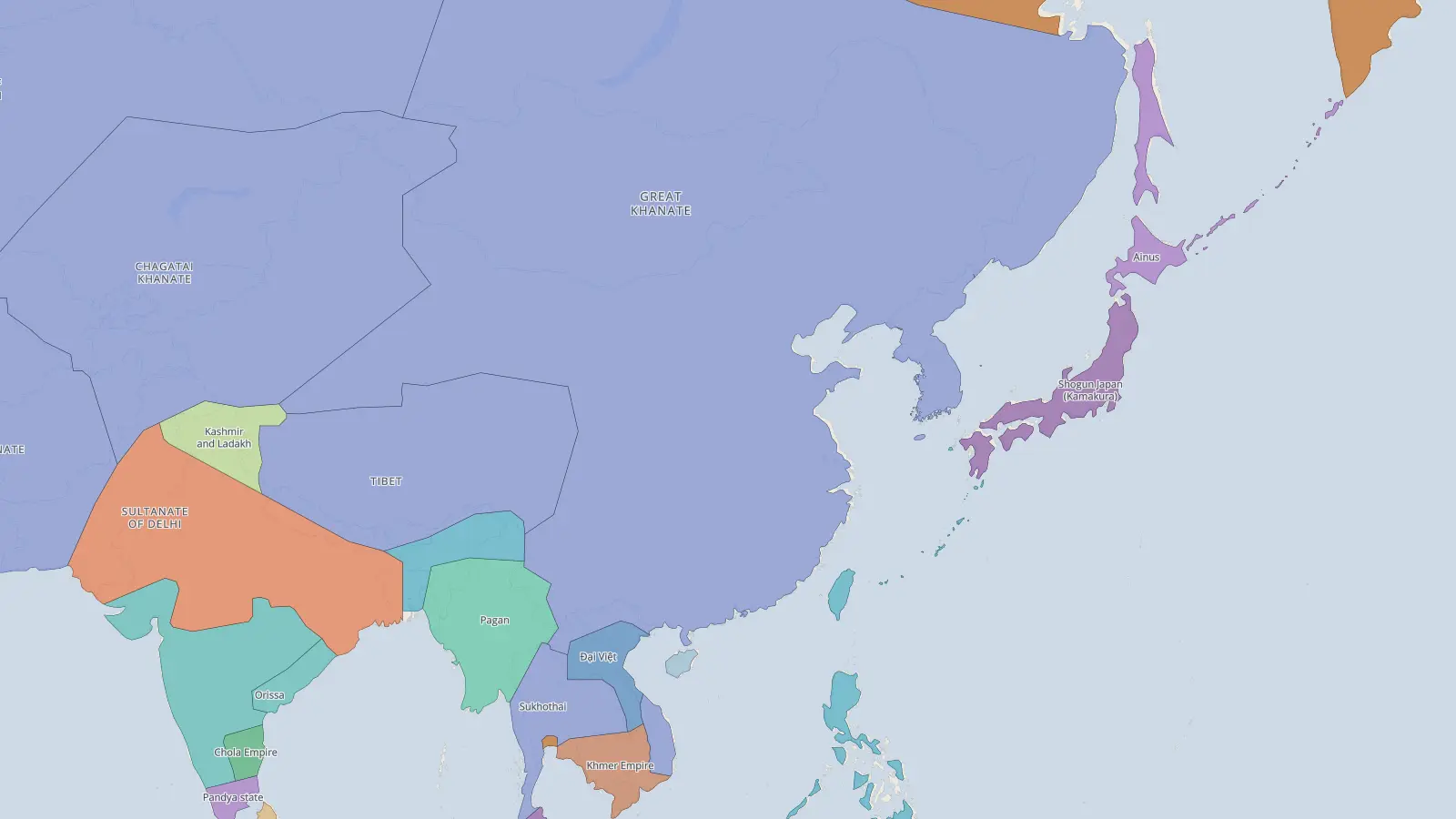
East Asia in 1279
Kublai Khan’s Yuan dynasty has conquered the last of the Song, uniting all of China under Mongol rule, and Kamakura Japan has driven off one Mongol invasion.
10 named states on the map
largest: Mongol Empire
Explore 1279 full screen
Click any border for its story, and drag the timeline to watch the map change in the years before and after 1279.
The largest states in 1279
top 6- 1Mongol Empire11,745,601 km²
- 2Pagan730,656 km²
- 3Shogun Japan (Kamakura)280,122 km²
- 4Sukhothai231,478 km²
- 5Đại Việt214,951 km²
- 6Champa9,222 km²
Measured on the sphere from the borders drawn on this year’s map, including colonies and dependencies shown as part of a state. Areas are measured inside a frame around East Asia, which also takes in mainland Southeast Asia.
Watch these years move
Questions
- What did East Asia look like in 1279?
- Kublai Khan’s Yuan dynasty has conquered the last of the Song, uniting all of China under Mongol rule, and Kamakura Japan has driven off one Mongol invasion.
- What was the largest empire in 1279?
- On this map, the largest state is Mongol Empire, covering about 11.7 million km², followed by Pagan, Shogun Japan (Kamakura), Sukhothai.
- How many countries were there in East Asia in 1279?
- The 1279 map of East Asia shows 10 named states. The count depends on how finely a map divides the world, so maps from different sources give different numbers, and borders in early periods are approximate.
Every year on one page →The whole world in 1279 →Europe in 1279 →The Middle East in 1279 →South Asia in 1279 →Africa in 1279 →
Borders from historical-basemaps by André Ourednik, with our own corrections. Borders in early periods are approximate.