East Asia by year
East Asia in 1994
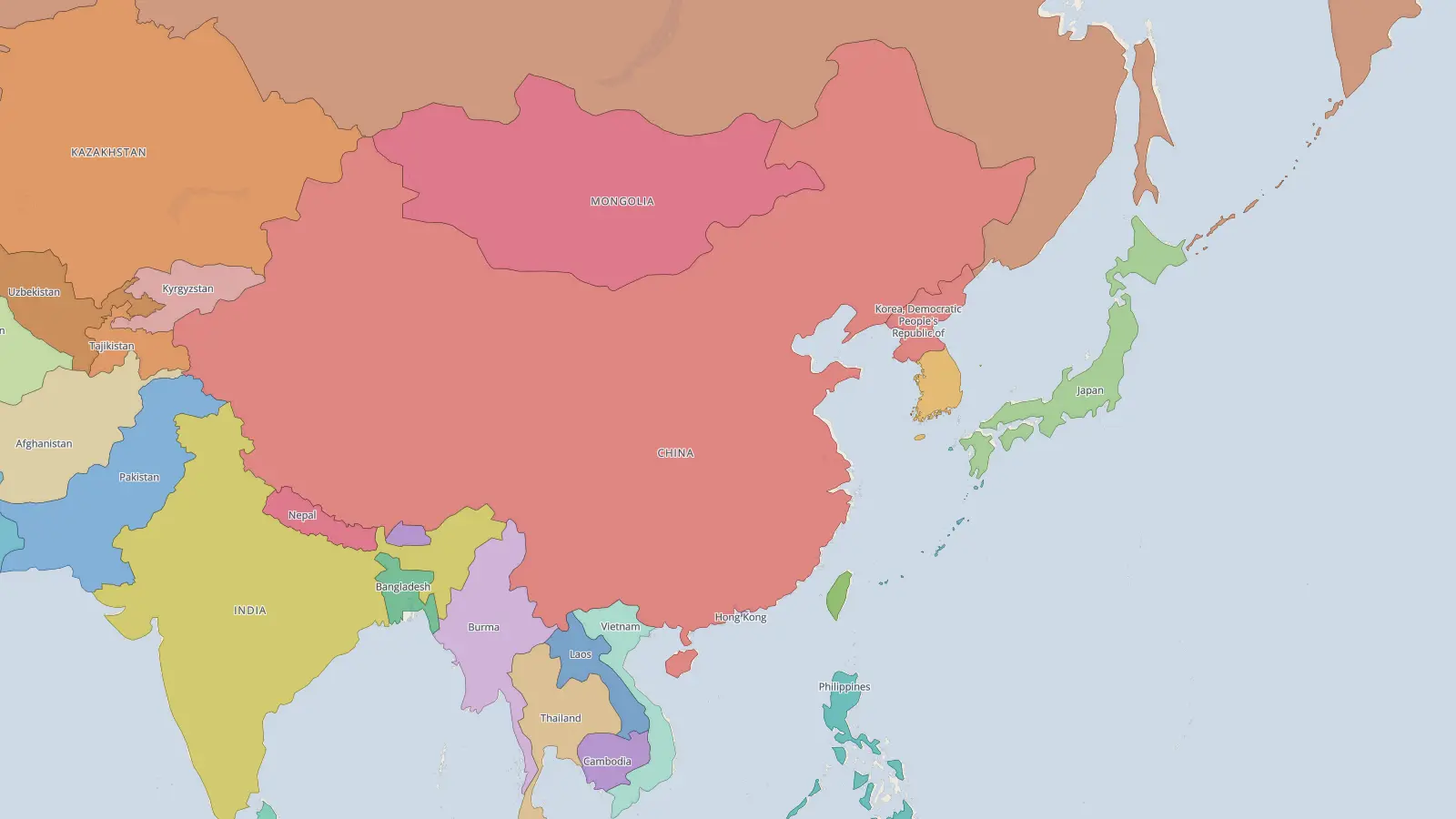
The Soviet Union has broken up, leaving Russia and a democratic Mongolia, while China’s economy is growing fast and Korea is still divided.
18 named states on the map
largest: China
Explore 1994 full screen
Click any border for its story, and drag the timeline to watch the map change in the years before and after 1994.
The largest states in 1994
top 10- 1China8,032,428 km²
- 2Russia1,880,192 km²
- 3Mongolia1,572,878 km²
- 4Burma609,753 km²
- 5India436,051 km²
- 6Japan358,442 km²
- 7Thailand224,356 km²
- 8Laos190,248 km²
- 9Vietnam172,045 km²
- 10Bangladesh132,618 km²
Measured on the sphere from the borders drawn on this year’s map, including colonies and dependencies shown as part of a state. Areas are measured inside a frame around East Asia, which also takes in mainland Southeast Asia.
Watch these years move
Questions
- What did East Asia look like in 1994?
- The Soviet Union has broken up, leaving Russia and a democratic Mongolia, while China’s economy is growing fast and Korea is still divided.
- What was the largest empire in 1994?
- On this map, the largest state is China, covering about 8 million km², followed by Russia, Mongolia, Burma.
- How many countries were there in East Asia in 1994?
- The 1994 map of East Asia shows 18 named states. The count depends on how finely a map divides the world, so maps from different sources give different numbers, and borders in early periods are approximate.
Every year on one page →The whole world in 1994 →Europe in 1994 →The Middle East in 1994 →South Asia in 1994 →Africa in 1994 →
Borders from historical-basemaps by André Ourednik, with our own corrections. Borders in early periods are approximate.