World map by year
The world in 1930
Between the wars: the Soviet Union, a smaller Germany, an independent Poland and Baltic states, and European empires still ruling much of Africa and Asia.
137 named states on the map
largest: Soviet Union
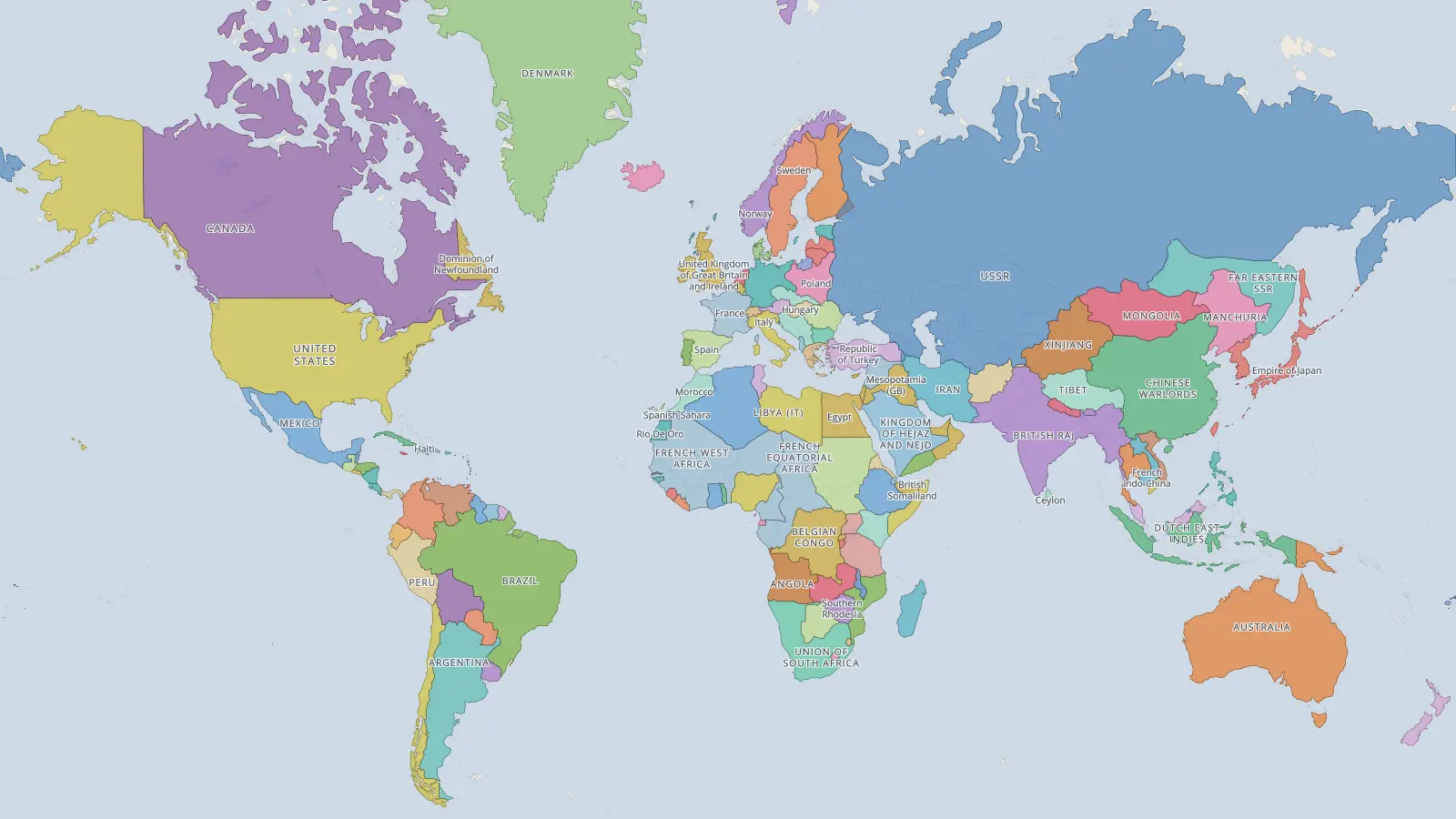
Explore 1930 full screen
Click any border for its story, and drag the timeline to watch the map change in the years before and after 1930.
The largest states in 1930
top 10- 1Soviet Union19,909,023 km²
- 2United States9,253,781 km²
- 3Canada9,123,386 km²
- 4France8,469,993 km²
- 5Brazil8,420,194 km²
- 6United Kingdom7,663,139 km²
- 7Australia7,661,521 km²
- 8Republic of China5,452,867 km²
- 9Argentina2,768,856 km²
- 10Sudan2,507,460 km²
Measured on the sphere from the borders drawn on this year’s map, including colonies and dependencies shown as part of a state.
Watch these years move
Questions
- What did the world look like in 1930?
- Between the wars: the Soviet Union, a smaller Germany, an independent Poland and Baltic states, and European empires still ruling much of Africa and Asia.
- What was the largest empire in 1930?
- On this map, the largest state is Soviet Union, covering about 19.9 million km², followed by United States, Canada, France.
- How many countries were there in the world in 1930?
- The 1930 map of the world shows 137 named states. The count depends on how finely a map divides the world, so maps from different sources give different numbers, and borders in early periods are approximate.
Every year on one page →Europe in 1930 →The Middle East in 1930 →East Asia in 1930 →South Asia in 1930 →Africa in 1930 →
Borders from historical-basemaps by André Ourednik, with our own corrections. Borders in early periods are approximate.