World map by year
The world in 1600
The age of the gunpowder empires: the Ottomans, the Safavids and the Mughals, with Ming China and a growing Russia.
635 named states on the map
largest: Tsardom of Muscovy
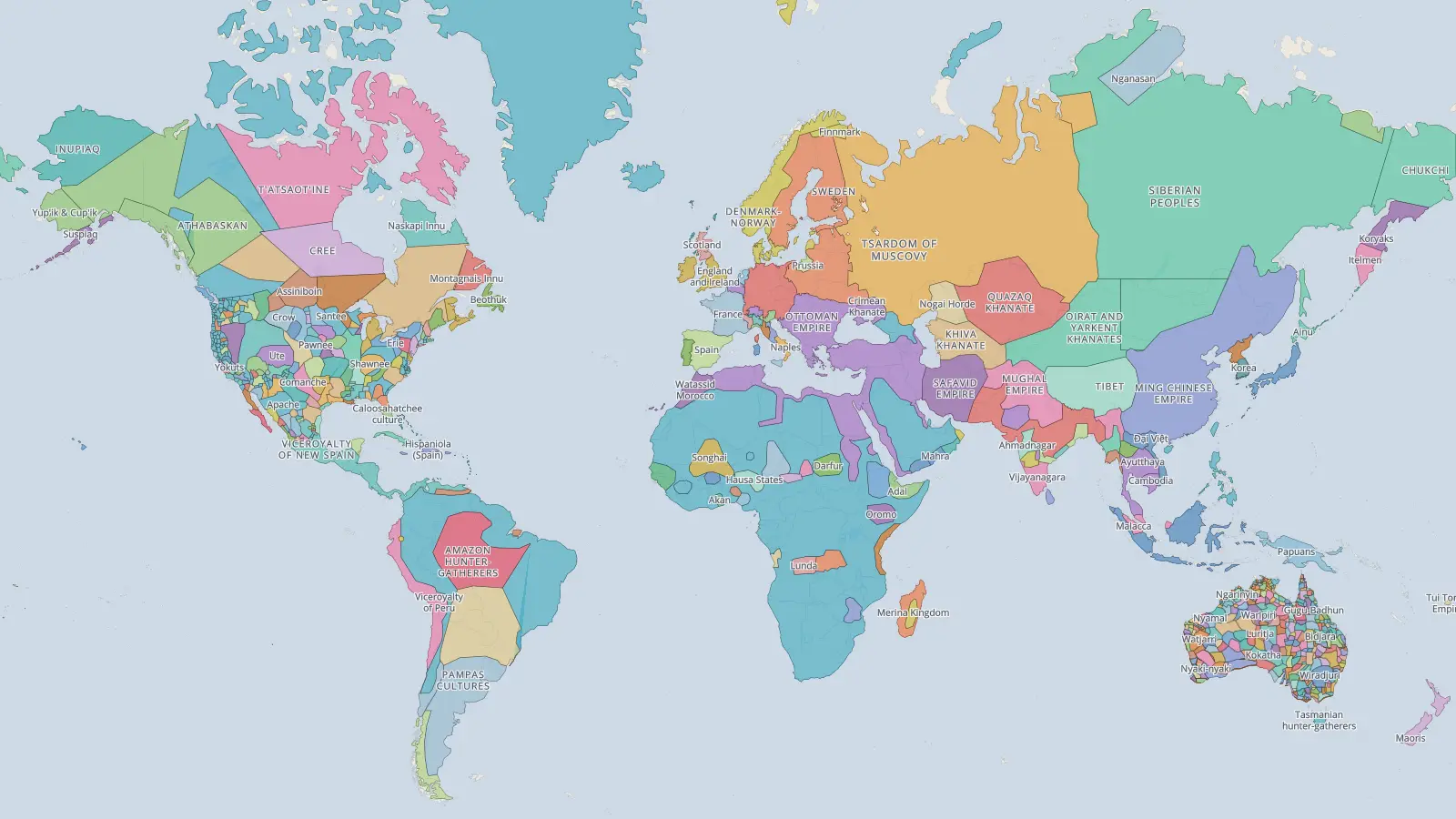
Explore 1600 full screen
Click any border for its story, and drag the timeline to watch the map change in the years before and after 1600.
The largest states in 1600
top 10- 1Tsardom of Muscovy6,868,234 km²
- 2Ming Chinese Empire5,971,798 km²
- 3Ottoman Empire5,450,869 km²
- 4Tibet2,050,237 km²
- 5Quazaq Khanate1,972,647 km²
- 6Safavid Empire1,611,234 km²
- 7Mughal Empire1,495,633 km²
- 8Viceroyalty of New Spain1,400,792 km²
- 9Malaysian Islamic states1,369,849 km²
- 10Inca Empire1,171,951 km²
Measured on the sphere from the borders drawn on this year’s map, including colonies and dependencies shown as part of a state.
Watch these years move
Questions
- What did the world look like in 1600?
- The age of the gunpowder empires: the Ottomans, the Safavids and the Mughals, with Ming China and a growing Russia.
- What was the largest empire in 1600?
- On this map, the largest state is Tsardom of Muscovy, covering about 6.9 million km², followed by Ming Chinese Empire, Ottoman Empire, Tibet.
- How many countries were there in the world in 1600?
- The 1600 map of the world shows 635 named states. The count depends on how finely a map divides the world, so maps from different sources give different numbers, and borders in early periods are approximate.
Every year on one page →Europe in 1600 →The Middle East in 1600 →East Asia in 1600 →South Asia in 1600 →Africa in 1600 →
Borders from historical-basemaps by André Ourednik, with our own corrections. Borders in early periods are approximate.