Age II · 3000 BCE – 500 BCE
Ancient
The ancient world
The ancient age, from about 3000 to 500 BCE, is the time of the first civilisations: societies with cities, writing, kings, organised religion and armies. It opens with the earliest written records in Mesopotamia and Egypt and closes as a new kind of world took shape, dominated by large multi-ethnic empires and by the thinkers whose ideas still shape religion and philosophy. Over these twenty-five centuries, states multiplied from a handful of river valleys to much of Eurasia and north-east Africa, and independently arose in the Americas.
The Bronze Age civilisations
The first civilisations grew where great rivers made irrigation farming productive. In Mesopotamia the city-states of Sumer were followed by the empire of Sargon of Akkad in the 2300s BCE and later by Babylon, whose king Hammurabi set out his laws on a stone stele in the eighteenth century BCE. In ancient Egypt, kings of the Old Kingdom built the pyramids of Giza around 2600 to 2500 BCE, and after periods of division the New Kingdom, from about 1550 BCE, became an empire reaching into Nubia and the Levant. In the north-west of the Indian subcontinent the Indus Valley Civilisation built planned brick cities between about 2600 and 1900 BCE, trading by sea with Mesopotamia. In China, the Shang dynasty ruled the Yellow River plain from about 1600 BCE and left the earliest Chinese writing, inscribed on bones used in divination.
Bronze, an alloy of copper and tin, gave the age its name. Because tin was rare, its supply depended on long trade routes, and those routes carried luxury goods and ideas between distant societies. By about 2000 BCE light chariots with spoked wheels had appeared on the steppe, and over the following centuries they became the elite weapon of states from Egypt to China. The Late Bronze Age, roughly 1550 to 1200 BCE, was a time of international diplomacy: the kings of Egypt, Babylon, Mitanni, the Hittites and Assyria wrote to one another as brothers, exchanged gifts and married into each other's families, while the Minoans and then the Mycenaean Greeks traded across the Aegean.
Collapse and the Iron Age
Around 1200 BCE this system broke down. Within a few decades the Hittite Empire disappeared, the Mycenaean palaces were destroyed, and cities along the Levantine coast were burned. Historians still debate the causes, which probably combined drought, earthquakes, internal revolt, the disruption of trade and the movements of groups the Egyptians called the Sea Peoples. The Late Bronze Age collapse was followed by the spread of iron working, which used far more abundant ore than bronze and in time put metal tools and weapons within reach of ordinary farmers and soldiers.
Out of the recovery came new peoples and new tools of culture. The Phoenician cities of the Levant developed a compact alphabet, which the Greeks adapted in the eighth century BCE, and Phoenician traders founded colonies across the Mediterranean, including Carthage. Israel and Judah emerged in the southern Levant, and the Hebrew scriptures that took shape there would become the foundation of Judaism. In Greece, city-states revived. From the ninth century BCE Assyria used iron weapons, professional armies and mass deportations to build the largest empire yet seen, and after its fall in 612 BCE the Neo-Babylonians briefly took its place. In China, the Zhou dynasty, which overthrew the Shang in 1046 BCE, presided over a slow fragmentation into competing states. In Mesoamerica, the Olmecs built the first major ceremonial centres from about 1200 BCE, and in the Andes the Chavín culture spread a shared religious art.
Why the age ends around 500 BCE
Two developments mark the close of the ancient age. The first is political. Between about 550 and 539 BCE Cyrus the Great conquered Media, Lydia and Babylon, creating the Achaemenid Empire, which soon ran from Egypt and the Aegean to the Indus and was governed through provinces, roads and a common administrative system. It set the pattern for the great territorial empires of the next millennium. The second is intellectual. Within a century or two either side of 500 BCE, Confucius taught in China, the Buddha and Mahavira in India, and the first Greek philosophers in Ionia, while Hebrew prophets and Zoroastrian tradition reshaped religious thought in western Asia. Coinage, invented in Lydia in the seventh century BCE, was spreading. The world that followed would be one of empires, universal religions and philosophical schools, the subject of the classical age.
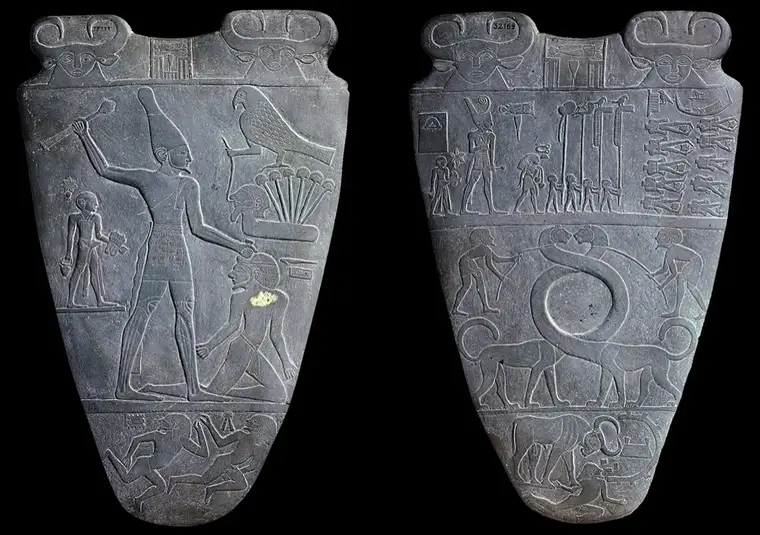
The age of the first cities, writing, and states — from Mesopotamia and Egypt to the Indus Valley and early China. Empires, law codes, and long-distance trade appeared as people began to record their world.
Maps of this age
5 mapsEmpires & states of the ancient age
6 placesOther ages