Age V · 1400 CE – 1800 CE
Early Modern
The early modern world
The early modern age, from about 1400 to 1800, is when the world's regions became permanently connected. Ocean voyages linked the Americas to Afro-Eurasia for good, silver mined in Peru and Mexico ended up in Chinese treasuries, and crops, animals, diseases and people crossed the seas on a scale never seen before. It was also an age of powerful land empires that used firearms and cannon to build large, centralised states, and of new ideas in religion and science that began in Europe and later spread worldwide.
Gunpowder empires and great dynasties
The largest states of the age were Asian. The Ottomans, after the fall of Constantinople in 1453, ruled south-eastern Europe, the Arab Middle East and North Africa, and under Suleiman the Magnificent in the sixteenth century were the most formidable military power in Europe. Safavid Iran, founded in 1501, made Shia Islam its state faith, and the Mughal Empire, founded in 1526, came to rule almost all of the Indian subcontinent and some of the richest economies on earth. Historians sometimes group these three as the gunpowder empires, because artillery and trained musketeers helped their rulers overcome rivals.
China under the Ming dynasty sent Zheng He's great fleets into the Indian Ocean between 1405 and 1433, then turned inward and rebuilt the Great Wall in the form seen today. The Manchu Qing, who took Beijing in 1644, governed the most populous state in the world and expanded it into Inner Asia. Japan, after a century of civil war, was united by 1600 and ruled by the Tokugawa shoguns, and Russia grew from the principality of Moscow into a vast empire, crossing Siberia to reach the Pacific in 1639. In Africa, Songhai dominated the Niger until 1591, and later the kingdoms of Asante, Oyo and Dahomey rose in West Africa.
Oceans, silver and slavery
The Age of Discovery began with Portuguese voyages down the African coast. Vasco da Gama reached India in 1498, six years after Columbus crossed the Atlantic, and Magellan's expedition sailed around the world between 1519 and 1522. Spain conquered the Aztec and Inca empires within two decades, aided by epidemics that devastated Indigenous populations, and Spain and Portugal divided much of the Americas between them. The Dutch, English and French followed in the seventeenth century, often through chartered trading companies such as the Dutch East India Company.
The resulting Columbian exchange carried maize, potatoes and cassava to Africa, Europe and Asia, where they helped populations grow, and brought wheat, horses, cattle and sugar cane to the Americas. Silver from Potosí, in present-day Bolivia, flowed across the Atlantic and, by the Manila galleons, across the Pacific to China. The plantations that grew sugar, tobacco and later cotton relied on the Atlantic slave trade, which forcibly carried millions of Africans to the Americas, more of them in the eighteenth century than in any other.
Print, reform and science
Johannes Gutenberg's printing press, working by around 1450, made books cheaper and faster to produce in Europe and helped the ideas of the Renaissance spread. Martin Luther's challenge to the papacy in 1517 launched the Protestant Reformation and more than a century of religious war. Astronomers and natural philosophers from Copernicus to Galileo and Newton developed the experimental and mathematical methods of the Scientific Revolution, and in the eighteenth century the Enlightenment applied reason to politics, religion and society.
Elsewhere, religion also shaped politics: Sikhism was founded in Punjab by Guru Nanak around 1500, Islam continued to spread in Southeast Asia and West Africa, and Catholic missionaries followed Spanish and Portuguese ships to the Americas and Asia. By 1800 the world's population had reached roughly one billion. The age ends with the American and French revolutions, which challenged the authority of kings, and with the first steam-powered factories in Britain, which began the industrial transformation of the next age.
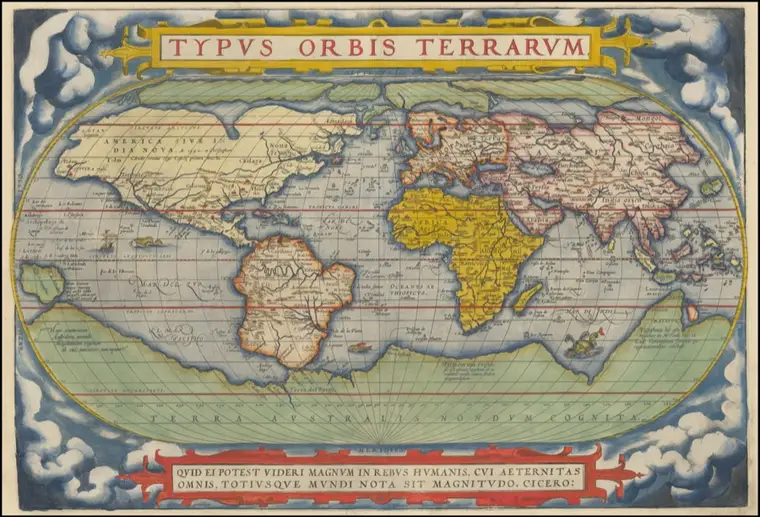
Oceans became highways. Europeans reached the Americas, gunpowder empires spanned Asia, and goods, people, and diseases crossed continents for the first time — reshaping the world, often through conquest and slavery.
Maps of this age
9 mapsEmpires & states of the early modern age
20 places- Roman Empire27 BCE–1453
- Byzantine Empire285–1453
- Holy Roman Empire962–1806
- Golden Horde1243–1502
- Timurid Empire1370–1507
- Ming dynasty1368–1644
- Mali Empire1235–1670
- Songhai Empire1464–1591
- Khmer Empire802–1431
- Majapahit1293–1527
- Delhi Sultanate1206–1526
- Aztec Empire1325–1521
- Inca Empire1438–1572
- Republic of Venice697–1797
- Papal States754–1870
- Kingdom of France987–1791
- Kingdom of England927–1707
- Kingdom of Scotland843–1707
- Poland
- Polish-Lithuanian Commonwealth1569–1795
Related theme