Age I · Infinity BCE – 3000 BCE
Prehistoric
The prehistoric world
Prehistory is the long span of the human past before writing, and it makes up by far the greater part of it. Anatomically modern humans appeared in Africa about 300,000 years ago, and for nearly all the time since, people lived without cities, kings or written records. Everything known about this age comes from archaeology, genetics and the study of climate, so its dates are broad and its peoples are known by the names of their tools, pottery or sites rather than by what they called themselves. The age ends, by convention, around 3000 BCE, when writing and the first states appeared in Mesopotamia and Egypt.
Hunters and gatherers across the world
For most of prehistory, every human society lived by hunting, fishing and gathering wild plants, moving with the seasons in small bands linked by kinship and exchange. Homo sapiens shared the world with other human species, including Neanderthals in western Eurasia and Denisovans in Asia, and interbred with both before they disappeared, roughly 40,000 years ago in the case of the Neanderthals. From about 70,000 to 50,000 years ago modern humans spread out of Africa into Asia, reaching Australia by at least 50,000 years ago and Europe by about 45,000 years ago. They crossed into the Americas from north-east Asia late in the last Ice Age, and were in southern Chile by roughly 14,500 years ago.
These people were not simple. They made fitted clothing, sewing needles, boats and spear-throwers, traded shells and stone over hundreds of kilometres, and buried their dead with care. The painted caves of Chauvet and Lascaux in France and even older figurative art on the Indonesian island of Sulawesi show a symbolic life as rich as any later age. The Aboriginal Australians carried such traditions forward without a break into recorded history.
The farming revolution
The last Ice Age ended about 11,700 years ago, and the warmer, more stable climate that followed made farming possible. In the Fertile Crescent of south-west Asia, people began cultivating wheat, barley and lentils and herding sheep, goats and cattle between about 9500 and 8000 BCE. Before farming was fully established there, foragers raised the great carved stone enclosures of Göbekli Tepe in south-eastern Turkey, around 9500 BCE. Agriculture was invented independently in several other places: rice and millet in China, taro and bananas in New Guinea, maize, beans and squash in Mexico, potatoes and quinoa in the Andes, and sorghum and other crops in the Sahel and Ethiopia.
The Neolithic Revolution, as this shift is called, transformed human life more than any change before the industrial age. Farming fed far more people per square kilometre than foraging, so populations grew and settled in permanent villages such as Jericho and Çatalhöyük, the second of which housed several thousand people at its height after 7000 BCE. Farmers also spread, carrying crops and languages with them: from Anatolia into Europe, and later, in Africa, with the expansion of Bantu-speaking peoples. Settled life brought new burdens too, including heavier work, new diseases caught from livestock, and the accumulation of property that could be defended, inherited and fought over.
Metal, the wheel and the first cities
Copper was being smelted in the Balkans and Iran by about 5000 BCE, and in the fourth millennium BCE metalworkers began alloying copper with arsenic, with tin bronze following. The wheel and the plough drawn by oxen appeared around 3500 BCE, and the horse was being tamed on the Eurasian steppe. In southern Mesopotamia, irrigation agriculture supported the first true cities, above all Uruk, which may have held tens of thousands of people by 3100 BCE. To manage temple stores and trade, its officials developed record-keeping that grew into cuneiform writing, the beginning of history in the narrow sense.
At the same time, Egypt was moving towards unification under a single king, a process completed around 3100 BCE. The age therefore ends not everywhere at once but region by region: for much of the world, including most of Africa, the Americas, Australia and northern Eurasia, life without states or writing continued for thousands of years after 3000 BCE, and in some places into modern times. The cities of Sumer and the kings of early dynastic Egypt mark the first places where prehistory gave way to history.
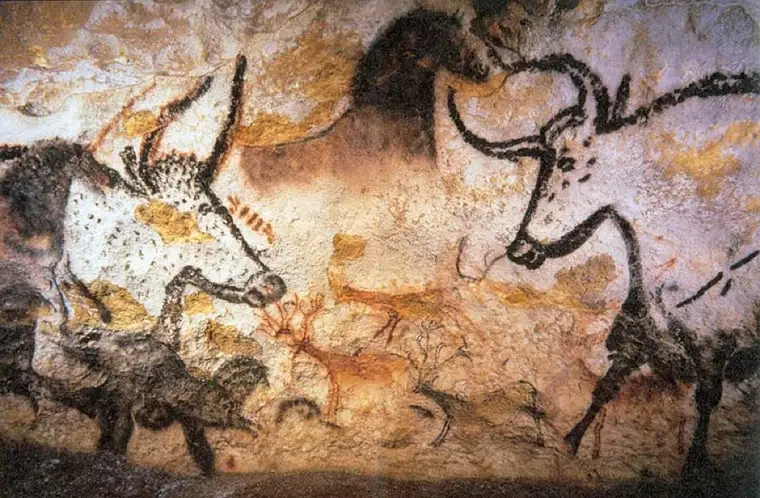
The long age before writing, when humans spread across the globe, took up farming, and raised the first villages and monuments. It is known only through archaeology — tools, bones, and art rather than names and dates.